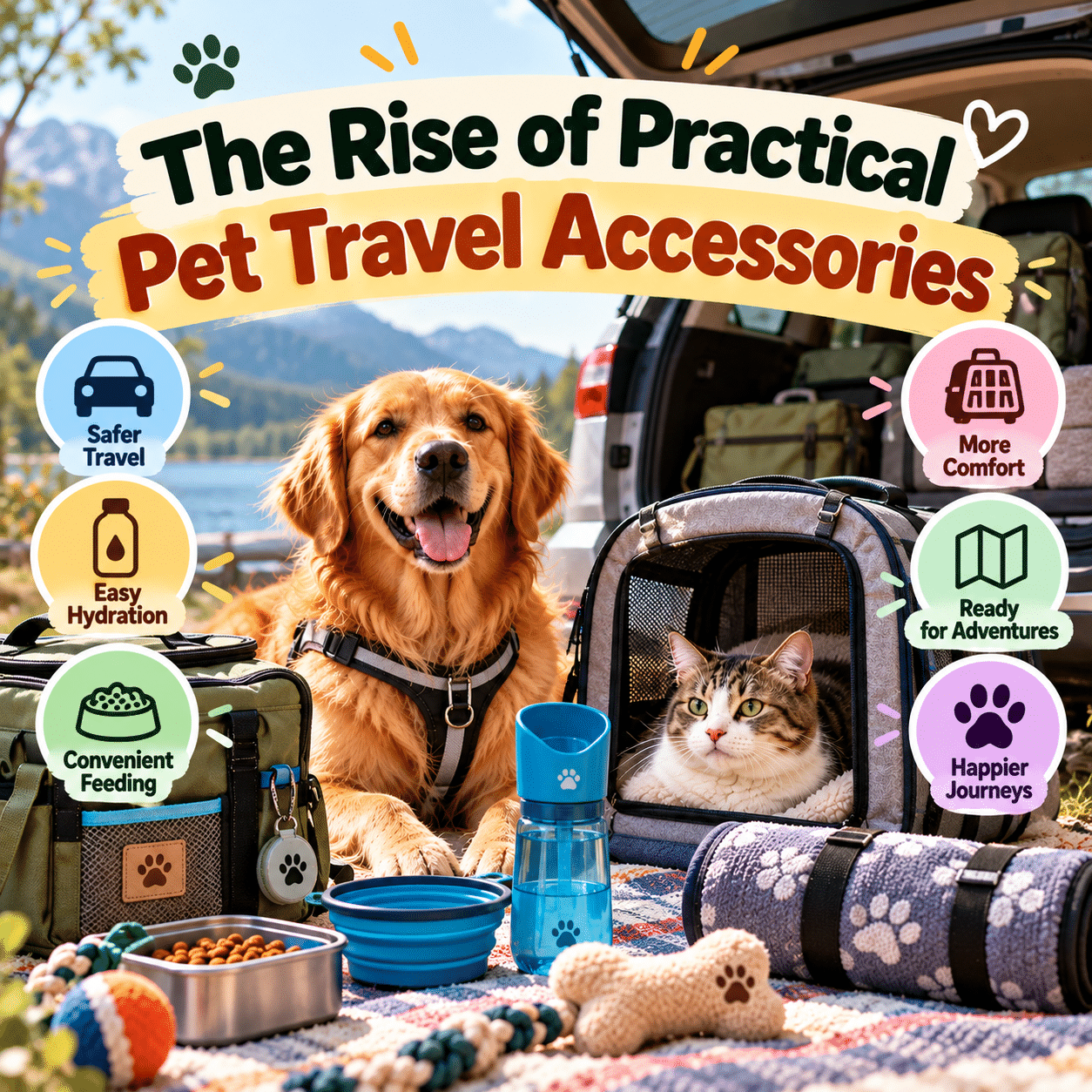
Traveling with pets has become an important consideration for many modern households. Whether the journey involves a short drive to a nearby park, a weekend visit with family, a camping trip, or a longer vacation, bringing a companion animal along requires thoughtful preparation.
Unlike ordinary personal travel, traveling with pets means planning for the needs of another living being. Animals require appropriate food, drinking water, safe transportation, opportunities to rest, suitable hygiene arrangements, and protection from unfamiliar environmental conditions.
These responsibilities have encouraged the development of a growing range of practical pet travel accessories.
Portable water bottles, collapsible bowls, secure carriers, travel harnesses, foldable mats, compact food containers, waste-management kits, and organized travel bags are designed to make journeys more manageable for both pets and their owners.
Many of these products focus on solving familiar problems: how to provide drinking water during a walk, how to keep supplies organized in a vehicle, how to create a comfortable resting area away from home, or how to transport an animal safely.
The most meaningful improvements often involve simple features rather than complicated technology. Lightweight construction, easy-clean materials, compact storage, secure closures, and thoughtful organization can make everyday travel more convenient.
However, convenience should never take priority over animal welfare.
A collapsible carrier must still provide adequate space and ventilation. A portable water container must be hygienic and easy to use. A travel restraint must be suitable for the animal and appropriate for the transportation method.
Understanding these considerations can help households choose accessories that genuinely improve the travel experience.
This guide explores why practical pet travel accessories are becoming more popular, how different products support travel routines, and what pet owners should consider when preparing for safe, comfortable journeys with companion animals.
1. Why Pet Travel Accessories Are Becoming More Important
Pet travel accessories are evolving alongside changes in household routines, transportation habits, and expectations for companion animal care.
For many people, pets participate in a wider range of everyday activities than they once did.
Pets Are Included in More Household Activities
Some households regularly bring dogs on walks, outdoor excursions, and visits to friends or relatives.
Other owners travel with cats or smaller companion animals when necessary or when the animals are comfortable with transportation.
These activities create practical needs that ordinary household supplies may not fully address.
For example, a ceramic feeding bowl may work perfectly at home but be inconvenient to carry during a hike.
A large pet bed may provide excellent comfort in a bedroom but take up too much space in a vehicle.
Portable alternatives are designed to address these differences.
Travel Requires Additional Planning
Even a short journey can involve unfamiliar surroundings, changing temperatures, unexpected delays, and different access to food or water.
Travel accessories help owners prepare for these situations.
A compact kit containing water, waste bags, identification information, and basic supplies can make routine outings easier to manage.
Convenience Matters During Repeated Activities
Many pet-related journeys are not vacations.
They include veterinary appointments, grooming visits, training sessions, and everyday transportation.
Products that are easy to pack, clean, and store may be especially useful when these activities occur regularly.
Animal Comfort Is Receiving Greater Attention
Travel can be exciting for some pets and stressful for others.
Modern accessories increasingly aim to support safe containment, familiar resting surfaces, and more predictable routines.
However, no accessory can guarantee that an animal will enjoy traveling.
Individual temperament and health remain important considerations.
2. What Makes a Pet Travel Accessory Practical?
A practical travel accessory should solve a genuine problem without creating unnecessary complexity.
The best designs often share several characteristics.
Portability
Travel equipment should be reasonably easy to carry, store, and transport.
Compact dimensions and lightweight materials may be helpful, particularly for walking or public transportation.
However, portability must not compromise strength or safety.
Durability
Travel accessories may be exposed to dirt, moisture, repeated packing, and outdoor conditions.
Materials should withstand their intended use.
Easy Cleaning
Food containers, water bowls, bedding, and carriers can become dirty during travel.
Products that can be cleaned thoroughly are often more convenient.
Secure Construction
Closures, straps, buckles, and handles should be reliable.
A carrier that folds easily but has weak fasteners may be unsuitable for transporting an animal.
Appropriate Sizing
Travel accessories must match the pet’s size and physical requirements.
A product that is too small may restrict movement or cause discomfort.
Versatility
Some accessories can be useful across different situations.
A washable travel mat may serve as a resting surface in a vehicle, hotel room, or family member’s home.
However, versatility is only beneficial when the product performs each intended function safely.
3. Portable Water Bottles Are Simplifying Hydration on the Go
Access to drinking water is one of the most important considerations during pet travel.
Portable water bottles are designed to make water easier to carry and offer during outings.
Integrated Drinking Trays
Some pet water bottles include an attached drinking tray or shallow reservoir.
The owner dispenses water into the tray so the animal can drink.
This may reduce the need to carry a separate bowl.
Leak-Resistant Designs
Travel bottles often include seals or locking mechanisms intended to prevent leaks.
However, leak resistance varies.
Owners should test containers before placing them near electronics, documents, or other belongings.
Capacity Considerations
The appropriate amount of water depends on the animal, activity level, weather, journey duration, and access to refilling locations.
A small bottle may be sufficient for a brief outing but inadequate for a long outdoor excursion.
Cleaning Requirements
Water bottles and integrated trays should be cleaned regularly.
Narrow openings and complicated valves may be difficult to maintain.
A simple design that can be thoroughly washed may be preferable.
Hydration Safety
Animals should be offered suitable opportunities to drink.
Owners should not rely on a pet to communicate dehydration clearly.
During hot weather or strenuous activity, hydration planning becomes particularly important.
Portable water accessories do not replace shade, rest, and appropriate temperature management.
4. Collapsible Bowls Are Becoming Travel Essentials
Collapsible bowls are among the simplest and most versatile pet travel accessories.
They are designed to fold, flatten, or compress when not in use.
Space-Saving Construction
Many collapsible bowls are made from flexible materials that allow them to be stored in bags or attached to outdoor equipment.
This can be useful when carrying space is limited.
Food and Water Use
Depending on the design, collapsible bowls may be suitable for food, water, or both.
Owners should confirm that the material is intended for food contact.
Stability Matters
A bowl that collapses too easily may spill.
Wide bases and stable construction can improve usability.
Material Considerations
Flexible silicone and fabric-based designs are common.
However, different materials have different cleaning and durability requirements.
Some fabric bowls may absorb moisture or require more drying time.
When a Traditional Bowl Is Better
For longer stays, a rigid bowl may be easier to clean and more stable.
Collapsible bowls are useful travel tools, but they do not need to replace permanent feeding equipment.
5. Pet Carriers Are Evolving for Different Travel Needs
Carriers are among the most important accessories for transporting many companion animals.
Their primary purpose is safe containment.
Modern designs often add features intended to improve portability, ventilation, and comfort.
Soft-Sided Carriers
Soft-sided carriers may be lightweight and easier to store.
Some include mesh ventilation panels and removable pads.
They can be useful in appropriate situations, but their suitability depends on the animal and transportation method.
Hard-Sided Carriers
Hard-sided carriers generally provide more rigid structure.
They may be useful for animals that require secure containment or for certain transportation situations.
The carrier must have reliable closures and adequate ventilation.
Backpack Carriers
Some carriers are designed to be worn as backpacks.
They may be convenient for short trips with suitable animals.
However, owners must consider ventilation, stability, internal space, and the animal’s comfort.
A backpack carrier should not force an animal into an unsuitable position.
Wheeled Carriers
Wheeled designs can reduce the need to carry a heavy load.
However, vibration, noise, and uneven surfaces may affect the animal’s experience.
Foldable Carriers
Foldable carriers can simplify storage.
They must still maintain appropriate structural stability when assembled.
Choosing the Correct Size
A carrier should generally allow the animal to adopt appropriate comfortable positions, including standing, turning, and lying down, subject to the specific transport requirements.
Owners should follow the relevant manufacturer’s sizing guidance and applicable transportation rules.
6. Comparing Common Pet Carrier Types
| Carrier Type | Main Advantage | Common Use | Important Consideration |
|---|---|---|---|
| Hard-sided carrier | Rigid structure | Veterinary visits and selected travel situations | Secure closures and ventilation |
| Soft-sided carrier | Lightweight construction | Short journeys and compatible transport settings | Structural support and size |
| Backpack carrier | Hands-free carrying | Suitable short outings | Stability, posture, and airflow |
| Wheeled carrier | Reduced carrying effort | Suitable paved environments | Vibration and maneuverability |
| Foldable carrier | Compact storage | Temporary use and travel | Secure assembly and durability |
| Vehicle crate | Dedicated containment | Road transportation | Appropriate restraint and positioning |
No single carrier is ideal for every animal or journey.
The safest option depends on the pet, vehicle or transportation system, and applicable requirements.
7. Vehicle Safety Accessories Are Receiving Greater Attention
Road travel introduces risks that are different from those encountered at home.
Sudden braking, sharp turns, collisions, and unexpected movements can endanger unrestrained animals.
Vehicle Restraints
Some travel harnesses are designed to connect to vehicle restraint systems.
However, products vary significantly in design and testing.
A harness marketed as a car safety product is not necessarily independently crash-tested.
Owners should seek credible evidence of testing and follow installation instructions.
Secured Carriers and Crates
Appropriately designed and secured carriers may help contain pets during transportation.
The carrier must be positioned and restrained according to relevant safety guidance.
A loose carrier can become dangerous during sudden vehicle movement.
Vehicle Barriers
Barriers may help prevent animals from entering certain areas of a vehicle.
However, a barrier does not automatically provide crash protection.
Seat Covers
Protective seat covers can reduce dirt and hair accumulation.
They are primarily cleanliness accessories.
They should not be confused with crash-tested restraints.
Avoiding Dangerous Travel Practices
Pets should not travel loose in the driver’s area.
Allowing an animal to ride with its head outside a moving vehicle can expose it to debris and injury.
Animals should never be left unattended in parked vehicles where temperatures may become dangerous.
8. Travel Harnesses and Leashes Are Becoming More Specialized
Walking equipment is essential for many journeys.
Travel-focused designs often emphasize adjustability, portability, and visibility.
Adjustable Harnesses
A suitable harness should fit securely without restricting normal movement.
Poorly fitted equipment may cause rubbing or allow escape.
Reflective Features
Reflective stitching or attachments may improve visibility during low-light conditions.
However, reflective materials do not replace attentive handling.
Hands-Free Leashes
Some leashes attach around the owner’s waist.
They may be useful for certain activities.
However, they can create risks if the animal pulls suddenly or if the owner cannot respond quickly.
Compact Leashes
Lightweight leashes may be convenient to pack.
Strength and suitability remain more important than compact size.
Backup Equipment
For longer trips, carrying a spare leash or identification accessory may be useful.
Equipment can become damaged or misplaced.
9. Portable Pet Beds and Travel Mats Improve Resting Comfort
Travel often involves unfamiliar floors, furniture, and resting areas.
Portable bedding can provide a familiar surface.
Foldable Travel Mats
Travel mats are designed to fold or roll for storage.
They may be useful in vehicles, accommodations, or outdoor rest areas.
Washable Materials
Travel bedding can become dirty quickly.
Machine-washable covers or easy-clean surfaces may simplify maintenance.
Familiar Scents
A familiar blanket or mat may help some animals recognize a resting location.
However, familiar bedding does not guarantee that a pet will feel relaxed in every environment.
Temperature Considerations
A thick mat may be comfortable in a cool room but unsuitable in hot weather.
Outdoor surfaces can also become dangerously hot or cold.
Safe Placement
Travel bedding should be placed away from hazards and should not obstruct exits or walking paths.
10. Pet Travel Bags Are Improving Organization
One of the most practical developments in pet travel is the use of dedicated storage systems.
A pet travel bag can keep essential supplies together.
Separate Compartments
Some bags include compartments for food, water containers, waste bags, grooming supplies, and documents.
This can reduce searching and unpacking.
Food Storage
Food should be stored in suitable containers that protect it from moisture, contamination, and pests.
Perishable food requires appropriate temperature control.
Easy Access
Frequently used items should be easy to reach.
For example, waste bags and drinking water may need to be accessed several times during a journey.
Avoiding Overpacking
A large organizer is not automatically better.
The most useful bag is one that carries necessary items without excessive bulk.
Creating a Standard Travel Kit
Keeping a basic kit prepared can simplify repeated outings.
Owners can replenish supplies after each trip.
11. Portable Food Containers Support Consistent Feeding
Travel can disrupt familiar meal routines.
Portable food containers help owners carry appropriate portions.
Pre-Portioned Meals
Preparing meals in advance can simplify feeding during travel.
This may be especially useful when pets require consistent portions.
Airtight Storage
Suitable containers can help protect dry food from moisture and contamination.
However, the term airtight does not guarantee that food will remain safe indefinitely.
Food Safety
Perishable food requires proper refrigeration and handling.
Owners should follow product storage instructions.
Maintaining Familiar Diets
Sudden dietary changes can cause digestive upset in some animals.
When practical, bringing familiar food may help maintain routine.
Animals with medical diets require particular planning.
Cleaning Containers
Food containers should be washed and dried appropriately.
Residue can accumulate in lids, seals, and corners.
12. Waste-Management Accessories Make Outings Easier
Hygiene is an important part of responsible pet travel.
Waste-management products help owners maintain cleanliness in shared environments.
Waste Bag Dispensers
Compact dispensers can attach to leashes or bags.
They make cleanup supplies easier to access.
Portable Litter Boxes
Travel litter boxes may be useful for cats during suitable journeys or temporary stays.
They should provide adequate space and familiar litter arrangements where practical.
Absorbent Pads
Absorbent pads may be useful in selected situations.
However, they should not replace appropriate toileting opportunities.
Cleaning Wipes
Pet-safe wipes may help remove surface dirt.
Owners should verify that the product is appropriate for the animal and intended body area.
Responsible Disposal
Waste should be disposed of according to local rules.
Products marketed as biodegradable or compostable may require specific conditions to break down.
Environmental claims should not be assumed to justify improper disposal.
13. Outdoor Pet Accessories Are Supporting Active Lifestyles
Outdoor activities create additional equipment needs.
Portable Shade
Shade structures may provide relief from direct sunlight.
However, shade alone may not prevent overheating in hot or humid conditions.
Cooling Accessories
Some cooling mats, vests, or bandanas are marketed for outdoor use.
Their effectiveness varies.
They should not replace water, rest, ventilation, and appropriate temperature management.
Outdoor Resting Mats
Durable mats can provide a cleaner resting surface.
They should be suitable for the terrain and weather.
Visibility Accessories
Reflective or illuminated accessories may improve visibility in low-light conditions.
Paw Protection
Protective boots may be useful in selected environments.
However, fit, traction, temperature, and the animal’s tolerance must be considered.
Boots should not be assumed necessary for every outing.
14. Pet Travel Accessories for Different Transportation Methods
Different journeys require different equipment.
Car Travel
Important considerations include appropriate restraints, ventilation, temperature control, and scheduled breaks.
Public Transportation
Rules vary by operator and location.
Some systems require carriers, while others have additional restrictions.
Owners should verify requirements before traveling.
Air Travel
Airlines may have specific rules concerning carrier dimensions, animal eligibility, documentation, and transportation arrangements.
Requirements can change.
Owners should consult the airline and relevant authorities before booking.
Train Travel
Train operators may impose restrictions on animal size, carriers, or permitted areas.
Walking and Hiking
Portable water, suitable walking equipment, waste supplies, and environmental awareness are important.
The animal’s fitness and comfort should guide activity intensity.
15. Travel Accessories for Cats
Cats may have different travel needs from dogs.
Many cats prefer familiar environments and may find transportation stressful.
Secure Carriers
A sturdy, well-ventilated carrier is essential for safe transport.
Familiar Bedding
A familiar towel or mat may make the carrier more recognizable.
Portable Litter Arrangements
Longer journeys or temporary accommodation may require suitable litter facilities.
Gradual Carrier Training
Allowing a cat to explore the carrier at home can help build familiarity.
Short, positive experiences may be useful before longer trips.
Avoiding Forced Exploration
A cat should not be forced into unfamiliar environments simply because travel accessories are available.
Individual tolerance matters.
16. Travel Accessories for Dogs
Dogs vary considerably in their enjoyment of travel.
Some eagerly accompany their owners on outings.
Others experience motion sickness, fear, or discomfort.
Walking Equipment
A properly fitted harness and secure leash are important.
Drinking Water
Portable hydration equipment is useful during walks and outdoor activities.
Resting Mats
A familiar mat may provide a designated place to settle.
Vehicle Restraints
Appropriate containment or restraint is important for road safety.
Motion Sickness and Anxiety
Persistent travel-related distress should be discussed with a veterinarian.
Accessories alone may not address the underlying problem.
17. Travel Accessories for Small Companion Animals
Rabbits, guinea pigs, birds, and other small pets have species-specific transportation needs.
Appropriate Carriers
Carriers must provide suitable ventilation, containment, and protection.
Temperature Sensitivity
Some small animals are particularly sensitive to temperature changes.
Travel conditions should be planned carefully.
Familiar Materials
Appropriate familiar bedding or enclosure materials may help maintain continuity.
Species-Specific Food and Water
Feeding requirements vary.
Owners should prepare supplies based on the animal’s normal diet and veterinary guidance.
Minimizing Unnecessary Travel
Not every companion animal benefits from recreational travel.
For some species and individuals, remaining in a familiar environment with appropriate care may be preferable.
18. How to Choose Pet Travel Accessories
A thoughtful selection process helps avoid unnecessary purchases.
Step 1: Identify the Journey Type
Consider whether the accessory is intended for:
- Daily walks.
- Veterinary visits.
- Weekend trips.
- Road travel.
- Outdoor recreation.
- Longer vacations.
Different activities require different equipment.
Step 2: Consider the Animal
Evaluate species, size, age, mobility, temperament, and health.
Step 3: Prioritize Safety
Check materials, closures, straps, ventilation, and structural stability.
Step 4: Evaluate Portability
Consider packed dimensions, weight, and ease of carrying.
Step 5: Check Cleaning Requirements
Travel products should be practical to maintain.
Step 6: Consider Durability
Repeated use can expose accessories to wear.
Step 7: Review Compatibility
Confirm that the product works with the intended vehicle, carrier, or transportation system.
Step 8: Test Before Travel
Introduce equipment at home when possible.
A long journey should not be the first time an animal encounters essential travel accessories.
19. Comparing Essential and Optional Travel Accessories
| Accessory | Main Purpose | Priority | Key Consideration |
|---|---|---|---|
| Secure carrier or restraint | Safe transportation | Essential when applicable | Correct fit and secure installation |
| Water container | Hydration | Essential | Sufficient capacity |
| Food supplies | Nutrition | Essential when needed | Safe storage |
| Leash or harness | Controlled movement | Essential when applicable | Secure fit |
| Waste supplies | Hygiene | Essential | Responsible disposal |
| Identification | Recovery and contact information | Essential | Accurate details |
| Travel mat | Resting comfort | Useful | Portability and cleaning |
| Travel organizer | Supply management | Useful | Easy access |
| Cooling accessory | Supplemental temperature comfort | Situational | Environmental safety |
| Electronic tracker | Location assistance | Optional | Coverage and battery limitations |
| Portable play accessories | Enrichment | Optional | Safety and suitability |
Priorities depend on the species, journey, and applicable requirements.
20. Common Mistakes When Buying Pet Travel Accessories
Choosing Products Based Only on Compact Size
A small carrier may be convenient but uncomfortable or unsafe.
Ignoring Ventilation
Enclosed accessories must provide appropriate airflow.
Assuming All Travel Harnesses Offer Crash Protection
Testing standards and product performance vary.
Overpacking
Too many accessories can create unnecessary weight and clutter.
Forgetting Cleaning Requirements
Travel products can accumulate dirt and moisture.
Introducing Equipment During the Journey
Unfamiliar accessories may increase stress.
Relying on Products to Solve Travel Anxiety
Some animals require gradual training or veterinary support.
Ignoring Weather Conditions
Cooling accessories and portable shade do not eliminate heat-related risks.
21. Building a Practical Pet Travel Kit
A well-organized travel kit can simplify preparation.
Daily Outing Kit
For a routine walk or short excursion, useful items may include:
- Secure walking equipment.
- Drinking water.
- A suitable portable bowl.
- Waste-cleanup supplies.
- Identification information.
- Any necessary medication or care items.
Weekend Travel Kit
For a longer stay, additional supplies may include:
- Sufficient familiar food.
- Food storage containers.
- A suitable carrier or vehicle restraint.
- Bedding.
- Grooming supplies.
- Cleaning materials.
- Relevant veterinary records.
- Any required medications.
- Species-appropriate toileting supplies.
Longer Journey Kit
Extended travel may require additional planning for:
- Food availability.
- Veterinary access.
- Transportation requirements.
- Emergency contacts.
- Climate conditions.
- Accommodation policies.
- Rest and exercise opportunities.
A checklist can help ensure that essential supplies are not forgotten.
22. A Pet Travel Preparation Checklist
| Preparation Area | Questions to Ask |
|---|---|
| Transportation | Is the pet safely contained or restrained? |
| Identification | Are contact details current? |
| Hydration | Is enough drinking water available? |
| Food | Are appropriate meals packed and stored safely? |
| Comfort | Is there a suitable resting surface? |
| Hygiene | Are waste and cleaning supplies available? |
| Temperature | Are conditions safe for the animal? |
| Health | Are medications and relevant records prepared? |
| Regulations | Have transport and destination requirements been checked? |
| Equipment | Have carriers, straps, and closures been inspected? |
| Familiarity | Has the pet been introduced to essential equipment? |
| Emergency planning | Is there a plan if the journey is delayed? |
Preparation should reflect the actual journey rather than follow a rigid universal list.
23. Sustainability and Durability in Pet Travel Accessories
Travel accessories are also being influenced by interest in long-lasting and reusable products.
Reusable Containers
Reusable water bottles and food containers can reduce dependence on disposable packaging.
Durable Materials
Well-constructed equipment may remain useful through repeated journeys.
Repairable Components
Replaceable straps, pads, and closures may extend product life.
Multipurpose Accessories
A mat that works at home and during travel may reduce the need for separate products.
Responsible Purchasing
The most environmentally thoughtful choice is not necessarily the product with the strongest sustainability claim.
Durability, actual usage, maintenance, and disposal all matter.
24. The Future of Practical Pet Travel Accessories
Pet travel products will likely continue evolving as manufacturers respond to changing household needs.
Lighter and Stronger Materials
Improved materials may help reduce weight without sacrificing durability.
Better Storage Systems
Modular organizers and compact designs may make packing easier.
Improved Safety Features
Travel restraints and carriers may benefit from clearer testing information and more reliable construction.
Greater Attention to Accessibility
Products may increasingly accommodate senior animals and pets with mobility limitations.
More Thoughtful Temperature Management
Breathable materials and improved ventilation may support comfort in suitable conditions.
Better Integration With Everyday Life
Accessories that work across home, vehicle, and travel settings may become more appealing.
Simpler Designs
The most useful future innovations may involve fewer complicated features and more reliable everyday functionality.
25. Frequently Asked Questions
1. What are the most important pet travel accessories?
Essential accessories depend on the animal and journey, but commonly include appropriate transportation equipment, drinking water, food when needed, identification, and hygiene supplies.
Comfort accessories and organizers can provide additional convenience.
2. Are collapsible pet bowls safe?
Collapsible bowls can be suitable when made from appropriate materials and used according to manufacturer instructions.
They should be stable, clean, and free of damage.
3. How do I choose the right pet carrier?
Consider the animal’s size, comfort, ventilation needs, and the transportation method.
The carrier should provide secure containment and appropriate space.
Always check applicable travel requirements.
4. Do pets need special accessories for car travel?
Pets should be transported using suitable containment or restraint arrangements.
Products vary in performance, so credible safety testing and correct installation are important.
Seat covers alone do not provide crash protection.
5. Are pet travel backpacks comfortable?
Some animals may tolerate suitable backpack carriers, but comfort depends on fit, ventilation, stability, journey duration, and individual temperament.
Backpacks are not appropriate for every pet.
6. How can I make travel less stressful for my pet?
Gradual familiarization, predictable routines, suitable equipment, comfortable temperatures, and appropriate breaks may help.
Persistent distress or motion sickness should be discussed with a veterinarian.
7. Do I need expensive pet travel accessories?
No.
Reliable, appropriately sized, easy-to-clean equipment is more important than premium branding or unnecessary features.
Simple products can provide excellent practical value.
Conclusion: Practical Accessories Make Pet Travel More Manageable
The growing variety of pet travel accessories reflects a broader effort to make journeys safer, more organized, and more comfortable for companion animals.
Portable water bottles, collapsible bowls, secure carriers, travel mats, and dedicated organizers address practical challenges that arise when pets leave familiar environments.
These products can reduce packing difficulties, simplify feeding and hydration, improve cleanliness, and help owners prepare for unexpected situations.
However, their value depends on thoughtful selection.
A compact product must still be safe. A comfortable carrier must provide adequate ventilation. A convenient restraint must be appropriate for its intended purpose.
Most importantly, accessories should support an animal’s needs rather than encourage travel that is unsuitable for its health or temperament.
For modern households, the best travel setup is not necessarily the largest or most expensive collection of equipment.
It is a carefully selected group of reliable products that makes responsible care easier wherever the journey leads.
Great pet travel accessories do more than save space in a bag. They help create safer, calmer, and more comfortable experiences for the animals who share our adventures.