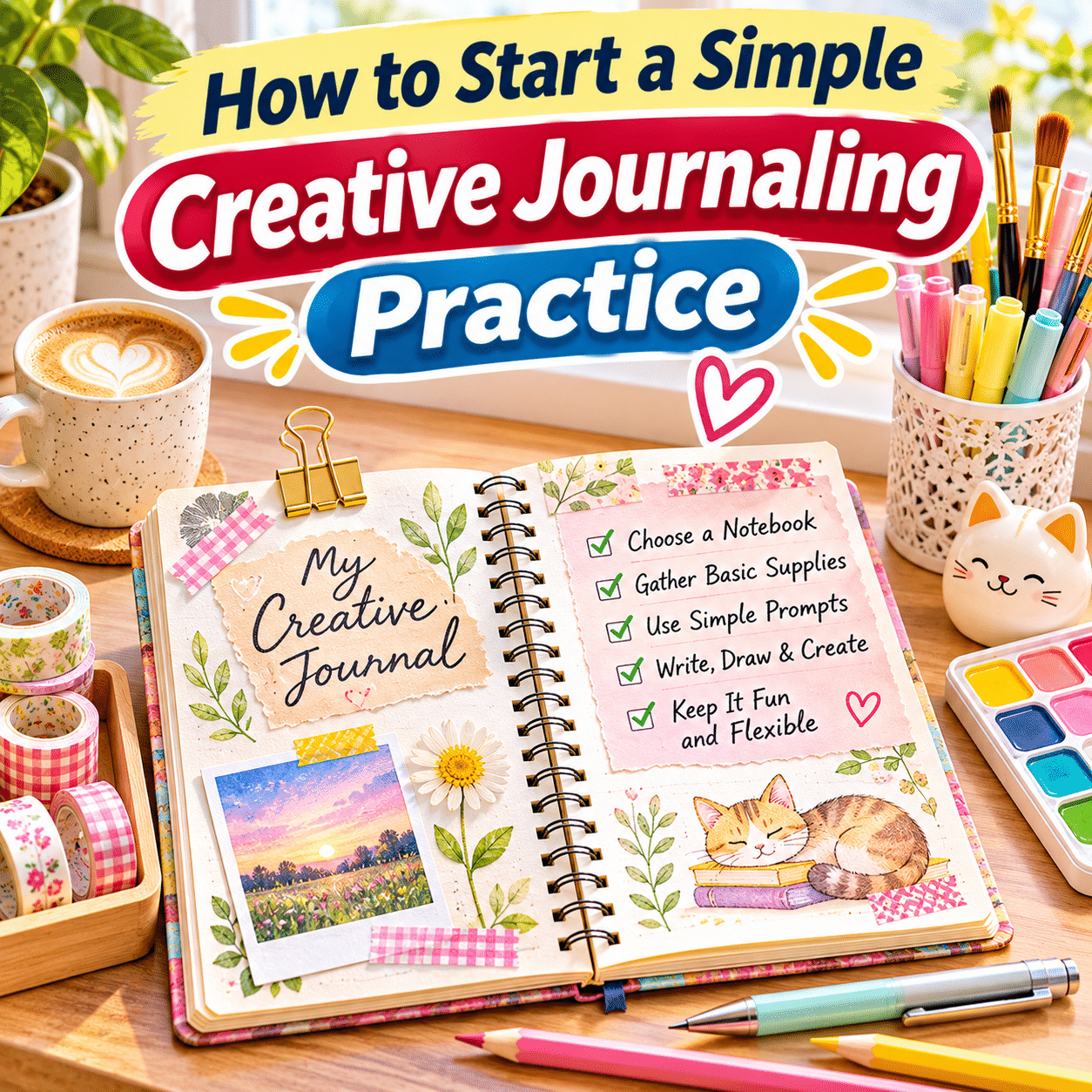
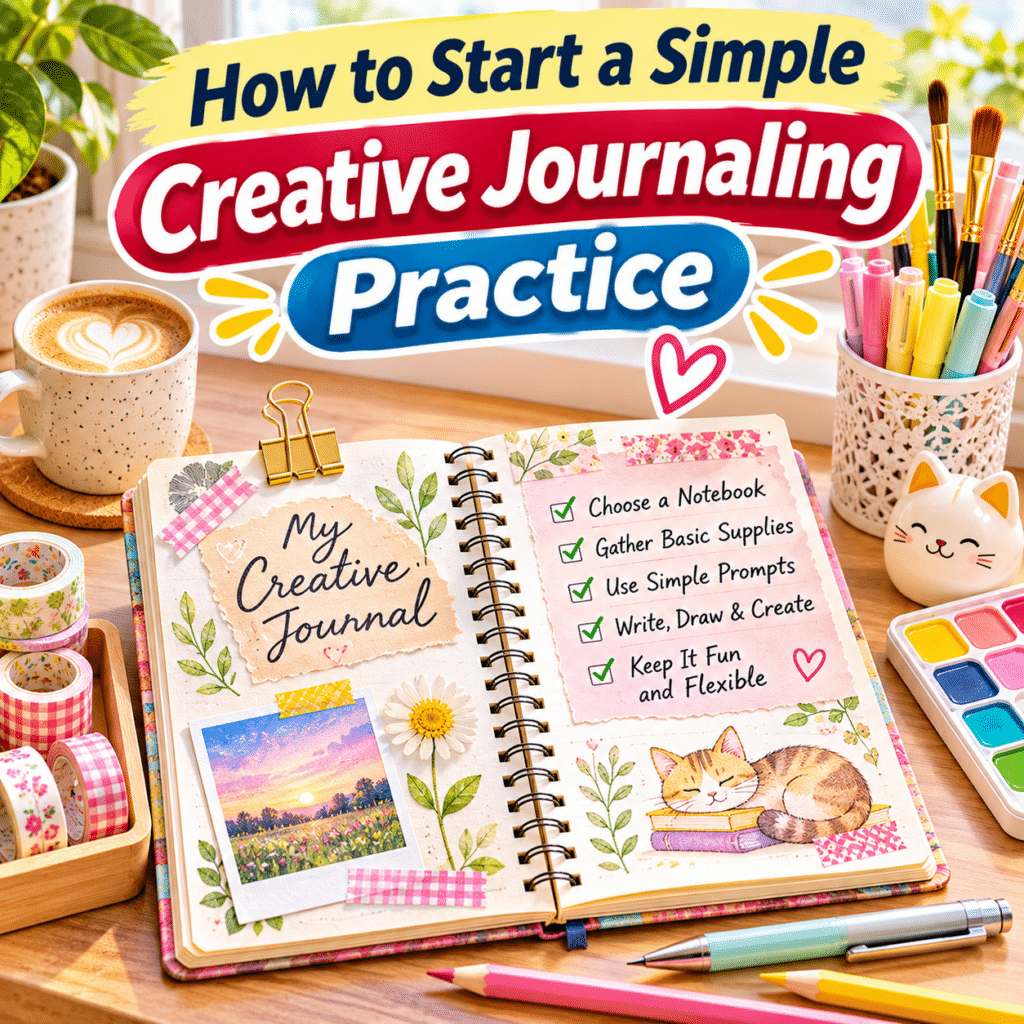
Creative journaling is a personal and flexible way to explore ideas, express thoughts, record experiences, and make room for creativity in everyday life. Unlike traditional journaling, which often focuses primarily on writing, creative journaling can combine words, drawings, colors, photographs, decorative elements, and other visual materials.
A creative journal might contain a short reflection about your day, a sketch of something you noticed, a collection of favorite colors, or a page filled with ideas for future projects.
There are no strict rules about what each page must include.
For beginners, however, the freedom of creative journaling can sometimes feel overwhelming. A blank notebook may seem intimidating, especially when beautiful journal pages shared online create the impression that every entry needs to be carefully designed.
Fortunately, a meaningful creative journaling practice does not require artistic expertise, expensive stationery, or elaborate layouts.
A simple notebook, a comfortable pen, and a willingness to experiment are enough to begin.
The most valuable part of creative journaling is the process of noticing, exploring, and expressing ideas rather than producing perfectly decorated pages.
Whether you want to document everyday memories, develop creative habits, organize inspiration, or enjoy a quiet screen-free activity, journaling can become a rewarding part of your routine.
This comprehensive guide explains how to start a simple creative journaling practice, choose beginner-friendly materials, explore different journaling styles, overcome the fear of blank pages, develop practical routines, organize ideas, and maintain an enjoyable creative habit over time.
1. What Is Creative Journaling?
Creative journaling is a flexible form of personal expression that combines traditional writing with visual or artistic elements.
Instead of limiting entries to paragraphs of text, you can use different materials and formats to communicate ideas.
A creative journal may include:
- Handwritten reflections.
- Simple sketches.
- Color combinations.
- Decorative lettering.
- Photographs.
- Collages.
- Short poems.
- Lists.
- Inspirational words.
- Personal observations.
- Travel memories.
- Creative project ideas.
Some people enjoy detailed illustrated pages, while others prefer a few handwritten sentences accompanied by small drawings.
Both approaches are valid.
Creative Journaling vs. Traditional Journaling
Traditional journaling often emphasizes written reflections, experiences, and personal thoughts.
Creative journaling expands these possibilities by incorporating visual expression.
For example, a traditional journal entry might describe a relaxing afternoon in a garden.
A creative journal entry could include the same description alongside a sketch of a flower, a pressed leaf that is safe and appropriate to preserve, or a small color palette inspired by the surroundings.
The difference is not about artistic quality.
It is about having more ways to express and document an experience.
Creative Journaling vs. Scrapbooking
Scrapbooking typically focuses on arranging photographs, memorabilia, and decorative materials into themed pages or albums.
Creative journaling may use similar techniques, but it often places greater emphasis on personal reflection, exploration, and ongoing creative practice.
The two activities can overlap.
2. Why Start a Creative Journaling Practice?
Creative journaling can serve several purposes depending on your interests.
It may be a relaxing hobby, a creative outlet, a memory-keeping system, or a place to develop new ideas.
Make Time for Personal Expression
Everyday responsibilities can leave little room for creative exploration.
Journaling provides a flexible opportunity to write, draw, or experiment without needing to produce something for other people.
Capture Everyday Moments
Small experiences can become meaningful memories.
A journal can preserve details such as:
- A memorable conversation.
- A favorite meal.
- A pleasant walk.
- An interesting place.
- A new idea.
- A moment of appreciation.
Explore Creative Interests
Journaling allows you to experiment with drawing, lettering, collage, and color without committing to a large project.
Organize Inspiration
A journal can become a collection of ideas for future activities.
You might record home decoration ideas, creative projects, books to explore, or places you would like to visit.
Enjoy a Screen-Free Activity
Using a physical notebook can provide an alternative to spending leisure time on digital devices.
Develop a Personal Creative Routine
A small, repeatable journaling practice can make creative expression easier to include in daily or weekly life.
The benefits vary between individuals. Journaling is not a substitute for professional mental health care when such care is needed.
3. Choose a Journaling Style That Fits Your Interests
There is no single correct way to keep a creative journal.
Exploring different approaches can help you discover what feels enjoyable and manageable.
Written Creative Journaling
This style combines short written entries with occasional visual details.
Examples include:
- Daily observations.
- Personal reflections.
- Favorite quotes.
- Short stories.
- Lists of ideas.
It is a good starting point for people who enjoy writing.
Illustrated Journaling
Illustrated journals use sketches and drawings to capture experiences.
You might draw:
- A cup of coffee.
- A houseplant.
- A favorite object.
- A view from a window.
- Something interesting you noticed outdoors.
Simple drawings are sufficient.
Collage Journaling
Collage journaling combines paper, images, textures, and decorative materials.
You can use suitable items such as:
- Magazine cutouts.
- Decorative paper.
- Printed photographs.
- Stickers.
- Washi tape.
- Ticket stubs.
- Paper scraps.
Art Journaling
Art journaling emphasizes visual experimentation.
Pages may include painting, mixed media, lettering, and abstract designs.
Memory Journaling
A memory journal documents meaningful experiences through writing, photographs, and memorabilia.
Idea Journaling
An idea journal focuses on inspiration, creative plans, sketches, and observations that may become future projects.
Mixed-Style Journaling
Many beginners enjoy combining several approaches.
A single notebook can contain written reflections, drawings, collages, and creative planning pages.
4. Gather a Simple Creative Journaling Starter Kit
One of the easiest ways to begin is to keep your supplies minimal.
You can always add materials later.
Basic Supplies
| Item | Purpose | Beginner Consideration |
|---|---|---|
| Notebook | Holds journal entries | Choose a size you enjoy using |
| Pen | Writing and simple drawings | Comfortable grip and reliable ink |
| Pencil | Sketching and planning | Useful for erasable marks |
| Eraser | Correcting pencil marks | Choose one suitable for your paper |
| Colored pencils | Adding color | Easy to control and store |
| Highlighters | Emphasizing text | Test for bleeding |
| Washi tape | Simple decoration | Optional |
| Glue stick | Attaching paper elements | Use an appropriate adhesive |
| Scissors | Cutting collage materials | Store safely |
| Small pouch | Organizing supplies | Useful for portability |
You do not need to purchase everything in the table.
A notebook and pen are enough for your first entry.
Start With Materials You Already Own
Look through your existing stationery before buying new supplies.
You may already have suitable pens, pencils, notebooks, and decorative paper.
Avoid Overbuying
A large collection of materials can create unnecessary clutter and make the activity feel complicated.
Add new tools when you discover a specific need.
5. Choose the Right Notebook for Creative Journaling
The notebook is the foundation of a physical journaling practice.
The best option depends on your preferred materials and how you plan to use it.
Lined Notebooks
Lined pages are useful for writing-focused entries.
They provide structure for reflections, lists, and short stories.
Blank Notebooks
Blank pages offer flexibility for drawing, collage, and mixed layouts.
They are suitable for people who prefer visual freedom.
Dot-Grid Notebooks
Dot-grid pages provide subtle guidance for writing, drawing, and organizing layouts.
They can be useful for beginners who want structure without prominent lines.
Sketchbooks
Sketchbooks are designed for drawing and may accommodate certain dry art materials.
Paper quality varies.
Mixed-Media Journals
Mixed-media paper may support combinations of drawing, ink, and some painting techniques.
Check the paper specifications before using wet materials.
Consider Notebook Size
A small notebook is easy to carry.
A medium-sized notebook offers a balance between portability and writing space.
A larger journal provides more room for artwork and collage.
Consider Paper Thickness
Thin paper may allow ink to bleed through or wrinkle when wet media are applied.
Test unfamiliar materials on a spare page.
Choose Something Comfortable to Use
An inexpensive notebook that you enjoy opening is often more useful than an elaborate journal that feels too precious to write in.
6. Create a Comfortable Journaling Space
You do not need a dedicated craft room to start journaling.
A small, comfortable area is sufficient.
Choose a Convenient Location
Possible places include:
- A writing desk.
- A dining table.
- A bedroom corner.
- A reading nook.
- A home office.
- A quiet balcony with suitable conditions.
Provide Good Lighting
Natural daylight can be pleasant for writing and drawing.
A desk lamp is useful during evening sessions.
Avoid excessive glare and strong shadows.
Keep Supplies Nearby
Store your notebook and basic tools in a small tray, drawer, or pouch.
Protect the Work Surface
Use a suitable mat when working with paint, glue, or cutting tools.
Minimize Distractions
Choose a location where you can concentrate comfortably.
A quiet environment may be helpful, but it does not need to be perfectly silent.
Keep the Setup Simple
The goal is to make journaling easy to begin, not to create an elaborate workspace that requires extensive preparation.
7. Start With a Five-Minute Creative Journaling Session
A short session is often the easiest way to overcome the pressure of beginning.
Step 1: Open to a Blank Page
Choose any page.
You do not need to start with a decorative cover or elaborate introduction.
Step 2: Write the Date
Adding the date can help you look back on entries later.
This is optional.
Step 3: Choose One Simple Topic
Examples include:
- Something you enjoyed today.
- An object on your desk.
- A favorite color.
- A place you would like to visit.
- A small moment worth remembering.
Step 4: Write a Few Sentences
Begin with two or three sentences.
Do not worry about perfect grammar or elegant wording.
Step 5: Add One Creative Element
Try:
- A small sketch.
- A colored underline.
- A decorative border.
- A sticker.
- A simple shape.
- A tiny collage element.
Step 6: Stop When You Feel Finished
Your first entry does not need to fill the entire page.
A short, completed entry is a useful beginning.
8. Overcome the Fear of a Blank Journal Page
Many beginners hesitate because they want the first page to look attractive.
This can make journaling feel more difficult than necessary.
Remember That Your Journal Is Personal
Unless you choose to share it, your journal does not need to meet anyone else’s expectations.
Begin With Simple Marks
Draw a line, write a word, or add a small shape.
Making the first mark can help reduce hesitation.
Use a Familiar Prompt
A prompt provides direction when you are unsure what to create.
Allow Imperfect Pages
Crossed-out words, uneven drawings, and unfinished ideas are normal parts of a creative process.
Avoid Comparing Your Journal With Online Examples
Many published journal pages are carefully selected, edited, or created by experienced artists.
Your journal can be useful and meaningful without resembling them.
Leave Some Pages Unfinished
You do not need to complete every page in one session.
Return later if you want to continue.
9. Explore Beginner-Friendly Creative Journaling Techniques
Creative journaling becomes more interesting when you experiment with simple techniques.
Handwritten Reflections
Write a few sentences about an experience, idea, or observation.
Simple Doodling
Draw small shapes, patterns, flowers, stars, leaves, or everyday objects.
Color Blocking
Use a few colored areas to organize the page visually.
Decorative Lettering
Experiment with writing a heading in a different size or style.
Paper Collage
Attach small pieces of decorative paper or suitable printed images.
Washi Tape Borders
Use tape to frame a section or divide the page.
Mini Photo Journaling
Add a small printed photograph with a caption.
Lists and Collections
Create lists of favorite books, enjoyable activities, creative ideas, or memorable moments.
Simple Watercolor Accents
If your paper supports wet media, add a small watercolor wash or illustration.
Mixed-Media Experiments
Combine writing, drawing, and collage when you feel comfortable with the materials.
10. Use Creative Journaling Prompts to Build Confidence
Prompts make it easier to begin without spending too much time deciding what to create.
Everyday Life Prompts
- Describe a small moment that made today enjoyable.
- Draw something you can see from your window.
- Write about your favorite part of your home.
- Create a page inspired by your morning routine.
- Record a meal you particularly enjoyed.
- Illustrate an object you use every day.
- Write about a place where you feel comfortable.
- Make a list of simple activities you enjoy.
- Capture three interesting things you noticed today.
- Create a page inspired by the weather.
Creative Exploration Prompts
- Design a page using only two colors.
- Draw five everyday objects.
- Create a collage from leftover paper.
- Experiment with three lettering styles.
- Make a page using circles and lines.
- Create a color palette inspired by nature.
- Draw a simple pattern and repeat it.
- Combine one photograph with a handwritten memory.
- Illustrate your ideal creative afternoon.
- Design a page without using any words.
Personal Inspiration Prompts
- List five things you would like to learn.
- Write about a creative hobby that interests you.
- Describe a meaningful memory.
- Create a page inspired by a favorite book.
- Record an idea for a future project.
- Illustrate a place you would like to explore.
- Make a list of things that inspire you.
- Write a short note to your future self.
- Create a page about a favorite season.
- Document something new you discovered.
You can revisit the same prompt more than once.
Your response may change over time.
11. Create a Simple Creative Journaling Routine
A sustainable practice should fit naturally into your lifestyle.
Choose a Convenient Time
Some people enjoy journaling in the morning.
Others prefer the evening or a quiet weekend afternoon.
There is no universally best time.
Start With a Manageable Frequency
You might begin with:
- Five minutes a few times per week.
- One short entry every weekend.
- A creative session whenever you have free time.
Choose a rhythm that feels realistic.
Keep Your Journal Accessible
Store it somewhere you can easily retrieve it.
Use a Simple Starting Ritual
For example:
- Clear a small space.
- Open your notebook.
- Choose one prompt.
- Write or draw.
- Put supplies away.
Avoid Turning Journaling Into an Obligation
Missing a day or week does not mean you have failed.
Resume whenever you feel ready.
12. Combine Writing and Visual Elements Naturally
Creative journaling does not require elaborate illustrations.
Small visual details can complement written entries.
Start With Words
Write a short paragraph or list.
Then add a drawing or decorative element related to the topic.
Start With an Image
Draw or paste an image first.
Add a caption explaining why it matters to you.
Use Color to Highlight Ideas
Choose a limited palette to emphasize headings or important words.
Create Simple Page Sections
Divide the page into areas for:
- Notes.
- Sketches.
- Memories.
- Ideas.
- Reflections.
Leave White Space
Not every area needs to be filled.
Empty space can make a page feel balanced and easier to read.
13. Try Different Creative Journaling Page Layouts
A layout provides structure without restricting creativity.
The Simple Daily Entry
Include:
- Date.
- Short reflection.
- Small illustration.
The Two-Column Layout
Use one column for writing and another for sketches or decorative elements.
The Memory Page
Combine a photograph, caption, and a few meaningful details.
The Color Inspiration Page
Create a palette inspired by a place, object, or experience.
The Creative Idea Page
Use the page to collect:
- Project ideas.
- Sketches.
- Material lists.
- Notes.
- Possible variations.
The Collage Page
Arrange paper pieces, images, and short captions around a theme.
The Weekly Reflection Page
Record several memorable moments from the week.
The Open Sketch Page
Use the entire page for drawing without requiring written content.
14. Use Creative Journaling to Capture Everyday Memories
Everyday experiences can become meaningful journal material.
Document Small Events
You do not need a special occasion to create an entry.
A pleasant afternoon, a new recipe, or a conversation can be worth recording.
Include Sensory Details
Consider describing:
- Colors.
- Sounds.
- Textures.
- Weather.
- Scents.
- Atmosphere.
These details can make memories more vivid.
Add Simple Illustrations
A small drawing can capture something that is difficult to describe in words.
Include Photographs
Printed photographs can help document places, objects, and experiences.
Keep Memorabilia Organized
Tickets, labels, postcards, and other paper items may be included when appropriate.
Avoid adding bulky or potentially damaging objects that could harm the journal.
15. Create an Inspiration Journal for Creative Ideas
A creative journal can also serve as a place to collect ideas for future projects.
Record Ideas Immediately
When inspiration appears, write down a few words or make a quick sketch.
Collect Visual References
Use suitable printed images, drawings, or color samples.
Respect copyright and privacy when collecting or sharing other people’s materials.
Explore Variations
Draw several versions of the same idea.
Add Material Notes
Record tools or supplies that may be useful for a future project.
Revisit Earlier Entries
An idea that seemed unimportant at first may become useful later.
Avoid Requiring Every Idea to Become a Project
A journal can be a place for exploration without the expectation of completing every concept.
16. Explore Creative Journaling With Color
Color is an accessible way to make journal pages visually interesting.
Begin With a Limited Palette
Choose two or three colors for a page.
This can simplify decisions and create a consistent appearance.
Use Color to Organize Information
Different colors may represent:
- Headings.
- Notes.
- Ideas.
- Memories.
- Decorative elements.
Experiment With Color Combinations
Try:
- Warm colors.
- Cool colors.
- Neutral tones.
- Pastel combinations.
- Nature-inspired palettes.
Create a Color Collection Page
Fill a page with small color samples and notes.
Test Materials First
Some markers and paints may bleed through notebook paper.
Test them on a spare page before using them extensively.
17. Add Simple Drawing and Doodling to Your Journal
You do not need advanced drawing skills to enjoy illustrated journaling.
Start With Basic Shapes
Practice circles, squares, triangles, and simple lines.
Draw Everyday Objects
Try sketching:
- A mug.
- A book.
- A leaf.
- A lamp.
- A flower.
- A chair.
- A favorite snack.
Use Simple Outlines
A recognizable outline can be enough.
Repeat Small Patterns
Create decorative borders using dots, lines, waves, or geometric shapes.
Experiment Without Erasing Everything
Allow imperfect marks to remain when you feel comfortable.
They can become part of the page’s character.
Focus on Observation
Drawing everyday objects can encourage you to notice details you might otherwise overlook.
18. Try Collage Journaling With Everyday Materials
Collage is a beginner-friendly technique that does not require drawing skills.
Gather Suitable Materials
Examples include:
- Decorative paper.
- Magazine images.
- Printed photographs.
- Paper scraps.
- Stickers.
- Washi tape.
- Suitable packaging illustrations.
Choose a Theme
Possible themes include:
- A favorite season.
- A cozy home.
- Travel inspiration.
- Nature.
- Personal interests.
- A color combination.
Arrange Before Gluing
Place the pieces on the page before attaching them.
Experiment with different arrangements.
Use Appropriate Adhesives
Choose adhesives compatible with your paper and materials.
Follow safety and drying instructions.
Avoid Excessive Bulk
Too many thick layers may make the journal difficult to close.
Use lightweight materials when possible.
19. Keep Your Creative Journaling Supplies Organized
A small organization system makes journaling easier to maintain.
Create a Basic Journaling Pouch
Include your most frequently used pens, pencils, and small accessories.
Store Decorative Materials Separately
Use a small box or drawer for stickers, tape, and paper pieces.
Keep Paper Scraps in a Folder
Save useful pieces without allowing them to accumulate excessively.
Protect Your Journal
Store it in a clean, dry location away from spills and excessive sunlight.
Clean Tools After Use
Follow manufacturer instructions for brushes, pens, and other materials.
Avoid Carrying Too Many Supplies
A portable kit should be light enough to use comfortably.
20. Make Creative Journaling Work in a Busy Schedule
Creative journaling does not have to be time-consuming.
Use Short Entries
A few sentences or a small sketch can be meaningful.
Try One-Page Sessions
Limit each session to a single page or part of a page.
Keep a Running Ideas List
When you do not have time for a full entry, write down a prompt for later.
Journal During Quiet Moments
You might use a few minutes before bed, during a weekend break, or after completing household tasks.
Combine Journaling With Existing Interests
For example:
- Sketch a plant after gardening.
- Record a recipe you enjoyed preparing.
- Create a page about a book.
- Document a creative project.
- Illustrate a travel memory.
Allow Flexibility
Some weeks may include several entries.
Other weeks may include none.
A flexible routine is often easier to maintain than a demanding schedule.
21. Protect Your Privacy and Personal Boundaries
Creative journals may contain private thoughts, memories, photographs, or other personal information.
Decide What You Want to Record
You do not need to document every experience.
Choose subjects that feel comfortable and meaningful.
Store Private Journals Securely
If your journal contains sensitive information, keep it in an appropriate location.
Be Thoughtful About Sharing Pages
Before posting journal pages online, check for visible personal details such as addresses, contact information, or private photographs.
Respect Other People’s Privacy
Avoid sharing personal information or images of others without appropriate permission.
Allow Yourself to Skip Difficult Topics
Creative journaling should remain a flexible activity.
You can choose lighthearted subjects, practical ideas, or visual experiments instead of personal reflections.
22. Common Creative Journaling Mistakes to Avoid
Mistake 1: Waiting for the Perfect Notebook
An ordinary notebook is enough to begin.
Mistake 2: Buying Too Many Supplies
A large collection can make the activity unnecessarily complicated.
Start with essentials.
Mistake 3: Trying to Make Every Page Beautiful
Creative journaling is about exploration, not perfect presentation.
Mistake 4: Comparing Your Work With Others
Online examples may not reflect the ordinary process behind creative work.
Focus on your own interests.
Mistake 5: Setting an Unrealistic Schedule
A demanding routine may become difficult to maintain.
Choose a manageable frequency.
Mistake 6: Using Too Many Techniques at Once
Begin with writing and one simple visual element.
Add techniques gradually.
Mistake 7: Avoiding Mistakes Completely
Crossed-out words and imperfect drawings are normal.
Mistake 8: Keeping Too Many Unfinished Pages
You do not need to finish every page.
Return to unfinished entries when they interest you.
Mistake 9: Turning Journaling Into a Performance
Your journal does not need to be designed for an audience.
Mistake 10: Forgetting to Enjoy the Process
Experimentation and personal satisfaction matter more than producing elaborate pages.
23. Troubleshooting Common Creative Journaling Challenges
| Challenge | Possible Reason | Practical Solution |
|---|---|---|
| You do not know what to write | Too many possible topics | Choose one simple prompt |
| Blank pages feel intimidating | Pressure to create something attractive | Begin with a date, word, or small sketch |
| You lose interest quickly | The style does not match your preferences | Experiment with another journaling format |
| Entries take too much time | Layouts are overly complicated | Use shorter entries |
| Pages look cluttered | Too many decorative elements | Use fewer colors and leave white space |
| Ink bleeds through paper | Materials are unsuitable for the notebook | Test pens or choose appropriate paper |
| You forget to journal | Supplies are difficult to access | Keep a small kit nearby |
| You compare your pages with others | Unrealistic visual expectations | Focus on personal expression |
| Supplies become disorganized | No designated storage | Use a pouch or small organizer |
| You miss several sessions | Routine is too rigid | Resume without trying to catch up |
24. A Simple Seven-Day Creative Journaling Starter Plan
This optional plan introduces several techniques without requiring elaborate materials.
Each activity can be completed in a short session.
Day 1: Introduce Your Journal
Write a few sentences about why you want to begin creative journaling.
Add a simple border or small drawing.
Day 2: Capture an Everyday Moment
Describe something you noticed or enjoyed.
Add a small illustration.
Day 3: Experiment With Color
Choose three colors and create a page using simple shapes, lines, or lettering.
Day 4: Make a Mini Collage
Arrange a few pieces of decorative paper or suitable printed images.
Add a short caption.
Day 5: Create an Inspiration List
Write five ideas, activities, or places that interest you.
Decorate the page with small symbols.
Day 6: Sketch an Everyday Object
Choose something nearby and draw it.
Add a few notes about its appearance or meaning.
Day 7: Reflect on the Experience
Look back at the previous entries.
Write about which techniques you enjoyed most.
You can complete these activities on consecutive days or spread them across several weeks.
The purpose is exploration, not meeting a deadline.
25. Frequently Asked Questions
1. What is creative journaling?
Creative journaling combines writing with visual elements such as drawing, color, collage, photographs, and decorative materials.
2. How do I start creative journaling as a beginner?
Choose a notebook and pen, select a simple topic, write a few sentences, and add one creative element.
3. Do I need artistic skills to keep a creative journal?
No. Simple drawings, lists, colors, and collages can be meaningful without advanced artistic ability.
4. What supplies do I need for creative journaling?
A notebook and pen are sufficient. Optional materials include colored pencils, markers, stickers, glue, and decorative paper.
5. What type of notebook is best for creative journaling?
The best notebook depends on your preferred techniques. Blank, lined, dot-grid, and mixed-media notebooks can all work.
6. Can I use a regular notebook for art journaling?
Yes, for suitable materials. Thin paper may not support heavy paint or wet media.
7. How often should I write in a creative journal?
Choose a frequency that fits your lifestyle. Daily, weekly, and occasional journaling can all be worthwhile.
8. How long should a journaling session last?
A few minutes may be enough. Longer sessions are optional.
9. What should I write on the first page?
You might introduce yourself, explain your interest in journaling, record a favorite memory, or begin with a simple creative prompt.
10. What if I do not know what to journal about?
Use prompts based on everyday observations, favorite objects, memories, colors, or creative ideas.
11. Can creative journaling include photographs?
Yes. Photographs can be combined with captions, drawings, and decorative elements.
12. Is creative journaling the same as scrapbooking?
They can overlap, but creative journaling often emphasizes ongoing personal expression, while scrapbooking commonly focuses on arranging photographs and memorabilia.
13. Can I combine writing and drawing in one journal?
Absolutely. Combining techniques is one of the defining features of creative journaling.
14. How do I make journal pages look organized?
Use simple headings, limited color palettes, clear sections, and enough white space.
15. What should I do if I make a mistake?
You can leave the mistake, cross it out, cover it creatively, or begin another page. Perfect results are not necessary.
16. Can I keep a creative journal digitally?
Yes. Digital notebooks and drawing applications can support writing, images, and visual layouts.
17. How do I stay motivated to journal?
Choose enjoyable topics, keep supplies accessible, and maintain a flexible routine.
18. Can creative journaling help me organize ideas?
Yes. A journal can be used to collect project concepts, sketches, notes, and inspiration.
19. Should I share my creative journal online?
Sharing is optional. Consider privacy and personal boundaries before posting pages publicly.
20. How can I make creative journaling a long-term habit?
Start small, choose a realistic routine, experiment with different styles, and focus on enjoying the process rather than maintaining perfect consistency.
26. Complete Creative Journaling Starter Checklist
Use this checklist to begin and maintain a simple creative journaling practice.
Getting Started
- Choose a notebook.
- Select a comfortable pen.
- Gather a few optional creative materials.
- Find a suitable journaling location.
- Prepare basic lighting.
- Keep supplies organized.
- Choose a simple first prompt.
First Journal Entry
- Open to a blank page.
- Add the date if desired.
- Write a few sentences or words.
- Add a small creative element.
- Avoid worrying about perfection.
- Stop when the entry feels complete.
Creative Techniques
- Try simple doodling.
- Experiment with color.
- Create a short written reflection.
- Make a small collage.
- Practice decorative lettering.
- Capture an everyday memory.
- Create an inspiration list.
- Explore a layout that interests you.
Building a Routine
- Choose a manageable journaling frequency.
- Keep your notebook accessible.
- Save a few prompts for future sessions.
- Allow flexibility when life becomes busy.
- Avoid comparing your pages with others.
- Revisit previous entries occasionally.
Organization and Care
- Store pens and pencils properly.
- Keep decorative materials organized.
- Protect the notebook from moisture.
- Use suitable adhesives and art materials.
- Clean tools after use when necessary.
- Store private entries securely.
- Replenish supplies only when needed.
Long-Term Enjoyment
- Experiment with different journaling styles.
- Keep meaningful memories.
- Record creative ideas.
- Adjust the routine as your interests change.
- Allow imperfect pages.
- Focus on personal enjoyment and expression.
Final Thoughts
Starting a simple creative journaling practice is an accessible way to bring more creativity, reflection, and personal expression into everyday life.
You do not need artistic training, expensive stationery, or a carefully designed journal to begin.
A notebook, a pen, and a few minutes of curiosity are enough.
Creative journaling offers the freedom to combine words, images, colors, and memories in ways that reflect your interests and experiences.
Some pages may contain detailed illustrations, while others may include only a short paragraph, a small sketch, or a collection of meaningful words.
Every approach can have value.
The most important step is allowing yourself to begin without expecting perfect results.
Choose materials you enjoy, experiment with simple techniques, and develop a routine that fits comfortably into your lifestyle.
As you continue, your journal may gradually become a personal collection of everyday observations, creative experiments, memorable experiences, and ideas worth revisiting.
It can also evolve as your interests change.
You may begin with written reflections and later discover a love for collage, illustration, lettering, or visual storytelling.
There is no need to decide everything in advance.
A creative journal is a space for exploration rather than a project that must meet a particular standard.
By keeping the process simple, flexible, and enjoyable, you can build a creative journaling practice that feels natural and rewarding—one page, one idea, and one small moment at a time.