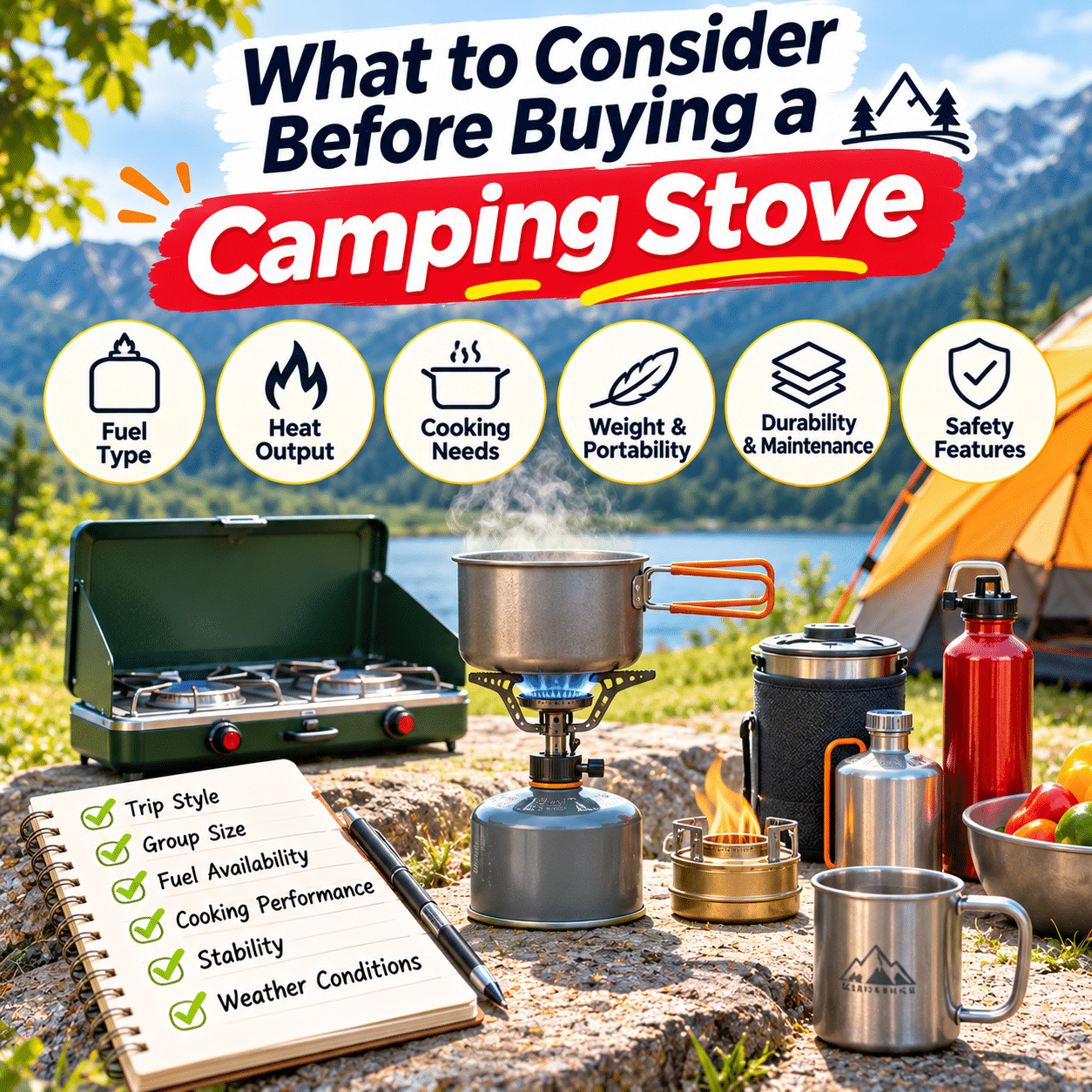
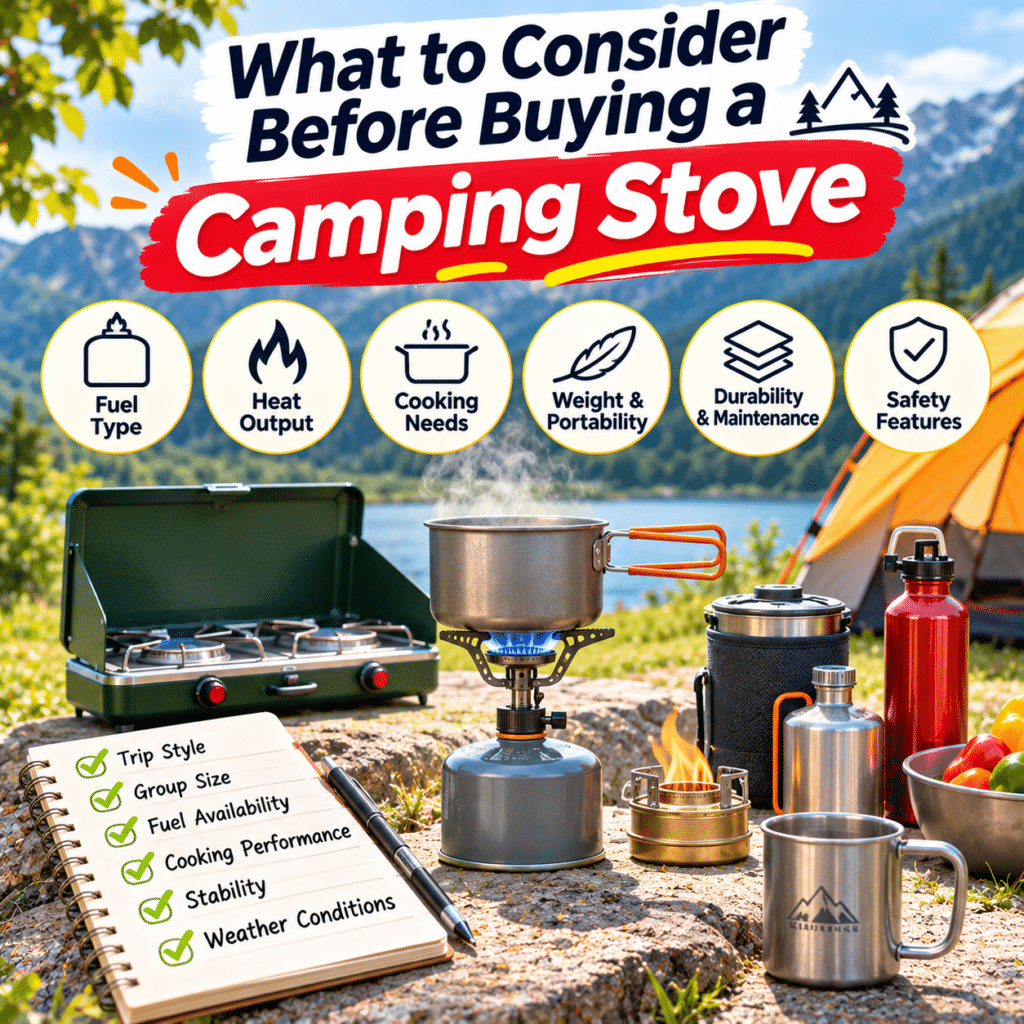
A dependable camping stove can make outdoor cooking easier, more convenient, and more enjoyable. Whether you are preparing a simple breakfast at a campsite, boiling water during a backpacking trip, or cooking meals for a family gathering outdoors, the right stove helps you prepare food efficiently while adapting to the conditions of your journey.
However, camping stoves vary considerably in size, fuel type, cooking performance, portability, stability, and maintenance requirements. A compact backpacking stove may be ideal for a solo hiker, while a two-burner tabletop stove may be more practical for a family camping trip. Some stoves perform better in cold or windy conditions, while others prioritize convenience, precise flame control, or lightweight construction.
Choosing a camping stove is not simply about selecting the model with the highest advertised heat output. Fuel availability, cookware compatibility, cooking style, safety features, environmental conditions, and long-term operating costs can all influence whether a stove is suitable for your needs.
This comprehensive buying guide explains what to consider before buying a camping stove, how different stove technologies work, which features matter most, and how to make a practical decision for camping, backpacking, road trips, and other outdoor adventures.
1. Start by Understanding Your Outdoor Cooking Needs
Before comparing camping stoves, consider how you expect to cook outdoors.
Your cooking habits should guide the type of stove you choose.
Questions to Ask Before Buying
- Will you mainly camp near your vehicle or travel on foot?
- Do you usually cook for one person, a couple, or a larger group?
- Are your trips short weekend getaways or extended outdoor adventures?
- Do you primarily boil water or prepare complete meals?
- Will you cook in windy, rainy, or cold conditions?
- How much weight and storage space can you allocate to cooking equipment?
- Will replacement fuel be readily available?
- Do you prefer simple operation or more flexible cooking control?
- What cookware do you already own?
- How frequently will you use the stove?
A lightweight stove designed for boiling water may be unsuitable for preparing several dishes simultaneously.
Likewise, a large tabletop stove may provide excellent cooking convenience but be impractical for backpacking.
The best stove is one that supports your actual outdoor cooking routine.
2. Understand the Main Types of Camping Stoves
Camping stoves can be categorized by fuel system, burner configuration, and intended use.
| Stove Type | Main Advantages | Potential Limitations | Common Uses |
|---|---|---|---|
| Canister gas stove | Compact, convenient, relatively simple | Fuel performance varies with temperature | Backpacking and short trips |
| Liquid-fuel stove | Can support demanding conditions | More maintenance and preparation | Remote and extended expeditions |
| Tabletop propane stove | Stable, spacious cooking surface | Bulky and relatively heavy | Car camping and family trips |
| Integrated stove system | Efficient water boiling in matched systems | Limited cookware flexibility | Backpacking and simple meals |
| Alcohol stove | Simple and often lightweight | Lower heat output and wind sensitivity | Minimalist outdoor cooking |
| Wood-burning stove | Uses suitable combustible biomass | Smoke, fire restrictions, fuel variability | Permitted outdoor settings |
| Solid-fuel stove | Compact and mechanically simple | Limited heat control and fuel-specific issues | Emergency or minimalist use |
| Electric portable cooktop | No combustion at the cooking surface | Requires sufficient electrical power | Powered campsites and vehicle setups |
These categories overlap. For example, a canister stove may be a compact burner or part of an integrated cooking system.
No single design performs equally well in every outdoor environment.
3. Choose Between Backpacking and Car Camping Stoves
One of the most important distinctions is whether the stove will be carried over long distances or transported mainly by vehicle.
Backpacking Stoves
Backpacking stoves prioritize:
- Low weight
- Compact dimensions
- Efficient packing
- Simple setup
- Limited fuel consumption
- Compatibility with small cookware
Many backpacking stoves use one burner.
They are particularly suitable for boiling water, preparing dehydrated meals, and cooking simple dishes.
Car Camping Stoves
Car camping stoves prioritize:
- Stable cooking surfaces
- Larger cookware support
- Multiple burners
- Convenient controls
- Comfortable meal preparation
- Practical use for groups
Weight is usually less critical because equipment is transported by vehicle.
Comparison
| Feature | Backpacking Stove | Car Camping Stove |
|---|---|---|
| Portability | High priority | Moderate priority |
| Typical burner count | One | One or more |
| Cookware support | Often compact | Often larger |
| Cooking flexibility | Depends on design | Often greater |
| Storage footprint | Usually small | Usually larger |
| Best suited for | Hiking and mobile travel | Established campsites |
Choose the category that reflects how you actually transport and use your cooking equipment.
4. Understand Common Camping Stove Fuels
Fuel type affects performance, availability, weight, maintenance, and operating convenience.
Common Fuel Categories
- Isobutane and propane gas blends
- Propane
- Butane
- White gas and other approved liquid fuels
- Alcohol-based fuels
- Solid fuel tablets
- Wood and other approved biomass
Not every stove can use every fuel.
Always use only the fuel types and containers explicitly approved by the stove manufacturer.
Incorrect fuel or incompatible connections can create serious fire, leakage, and equipment hazards.
5. Understand Canister Gas Stoves
Canister stoves commonly use pressurized gas mixtures stored in compatible fuel containers.
They are popular for backpacking because they can be compact and convenient.
Advantages
- Relatively simple operation
- Compact construction
- Quick setup
- Convenient flame adjustment on many models
- Minimal routine maintenance compared with some liquid-fuel systems
Potential Limitations
- Fuel canisters may be difficult to obtain in some destinations
- Performance can decline in cold conditions
- Fuel containers add packing volume
- Disposal and recycling require appropriate handling
- Canister compatibility must be verified
Best Uses
Canister stoves are often suitable for weekend backpacking, solo camping, and short outdoor trips where compatible fuel is available.
6. Compare Isobutane, Propane, and Butane
Different gases have different vapor-pressure characteristics.
These differences affect performance, especially in cold conditions.
Isobutane
Isobutane is commonly used in backpacking fuel blends.
It generally vaporizes more readily at low temperatures than normal butane.
Propane
Propane maintains relatively high vapor pressure at lower temperatures.
However, container design and stove compatibility are important because propane systems may operate at different pressures.
Normal Butane
Normal butane becomes less effective at vaporizing as temperatures approach its boiling point of approximately 0°C at atmospheric pressure.
Mixed Gas Fuels
Some canisters contain combinations of gases to balance performance across different conditions.
The composition of a fuel blend can change its behavior as the canister is used.
Important Safety Consideration
Do not substitute a different fuel canister simply because a connection appears similar.
Verify the exact fuel and connection requirements specified by the manufacturer.
7. Understand Remote-Canister Stoves
Some gas stoves connect to the fuel canister through a flexible hose.
Potential Advantages
- Lower burner position
- Wider cooking support on some designs
- Greater separation between burner and canister
- Improved stability with suitable cookware
Potential Limitations
- Additional hose and connections
- More components to inspect
- Increased setup complexity
- Potentially greater packed weight
Cold-Weather Considerations
Certain remote-canister stoves are specifically designed to operate with an inverted canister and a fuel preheating system.
This capability must be explicitly supported by the manufacturer.
Never invert a canister on a stove not designed for liquid-feed operation, as uncontrolled fuel delivery can cause dangerous flare-ups.
8. Understand Liquid-Fuel Camping Stoves
Liquid-fuel stoves use approved liquid fuels delivered through a designed fuel system.
They are often associated with extended expeditions and demanding outdoor conditions.
Advantages
- Some models perform well in cold environments
- Refillable fuel bottles may be available
- Certain models support multiple manufacturer-approved fuels
- Useful for extended trips when appropriate fuel is accessible
Potential Limitations
- More complicated setup
- Priming requirements on some models
- Additional maintenance
- Fuel spill risks
- More components requiring inspection
Important Distinction
A stove advertised as multi-fuel does not necessarily accept every liquid fuel.
Always follow the manufacturer’s approved fuel list.
Never use gasoline or other volatile fuels in equipment not specifically designed and approved for them.
9. Understand Alcohol Camping Stoves
Alcohol stoves are often associated with minimalist outdoor cooking.
They may have simple designs with relatively few mechanical components.
Advantages
- Compact construction
- Potentially low weight
- Simple mechanical design
- Quiet operation in many configurations
Potential Limitations
- Lower heat output than many gas stoves
- Limited flame adjustment
- Wind sensitivity
- Fuel availability varies
- Flame visibility can be poor in bright daylight
Safety Considerations
Alcohol flames may be difficult to see.
Never refill a hot or burning stove.
Allow the stove to cool completely before handling or refueling.
Use only the alcohol fuel approved for the specific stove.
10. Understand Wood-Burning Camping Stoves
Wood-burning camping stoves use suitable combustible materials as fuel.
Some designs incorporate airflow systems intended to improve combustion.
Potential Advantages
- May reduce the need to carry conventional fuel on suitable trips
- Can use locally available approved biomass
- Some models are compact
- May appeal to campers who prefer traditional outdoor cooking
Potential Limitations
- Smoke and soot
- Variable fuel quality
- Weather sensitivity
- Longer preparation and cleanup
- Fire restrictions
- Greater environmental considerations
Important Restrictions
Wood-burning stoves may be prohibited during fire bans or in protected areas.
Never assume a wood-burning stove is exempt from local fire regulations.
Follow campsite and land-management requirements.
11. Understand Solid-Fuel Stoves
Solid-fuel stoves use specially designed fuel tablets or blocks.
Advantages
- Simple construction
- Compact storage
- Few moving parts
- Convenient for certain limited-use applications
Limitations
- Restricted heat adjustment
- Fuel-specific odors or residues
- Wind sensitivity
- Potentially limited cooking versatility
Practical Considerations
These stoves may be suitable for simple heating tasks where permitted.
They are generally less flexible than adjustable gas stoves for preparing complete meals.
Use only approved fuel products and follow ventilation and fire-safety instructions.
12. Consider Electric Camping Cooking Options
Electric portable cooktops can be useful at powered campsites or in suitable vehicle-based setups.
Common Options
- Portable induction cooktops
- Electric hot plates
- Compact electric cooking appliances
Advantages
- No combustion exhaust at the cooking surface
- Precise control on some designs
- Convenient cleaning
- No need to handle combustible stove fuel
Limitations
- Requires reliable electrical power
- May demand substantial wattage
- Less suitable for remote locations without sufficient power
- Equipment may be bulky
Power Compatibility
Check:
- Voltage
- Frequency
- Rated wattage
- Circuit capacity
- Extension cord suitability
- Power station or inverter capability
Portable induction cooktops also require compatible cookware.
Use electrical cooking equipment only in locations and conditions permitted by the manufacturer.
13. Understand Camping Stove Heat Output
Camping stove output may be expressed in British thermal units per hour (BTU/h) or watts.
These measurements describe energy output or input under specified conditions, depending on the manufacturer’s rating method.
Why Heat Output Matters
Higher heat output may support faster heating or larger cooking tasks.
However, it does not automatically mean a stove cooks more efficiently.
Other Important Factors
- Burner design
- Pot dimensions
- Heat transfer efficiency
- Wind exposure
- Fuel conditions
- Cooking temperature
- Cookware material
Avoid Choosing by BTU Rating Alone
A high-output burner may consume fuel quickly without delivering proportional cooking benefits.
For many campers, controllability and efficiency are more important than maximum output.
14. Understand Cooking Efficiency
Cooking efficiency describes how effectively energy from the fuel reaches the food or cooking vessel.
Factors Affecting Efficiency
- Burner-to-pot distance
- Flame pattern
- Pot diameter
- Wind protection
- Heat exchanger design
- Fuel type
- Ambient conditions
Integrated Cooking Systems
Some integrated systems pair a burner with a specially designed pot.
These may improve heat transfer for water boiling under appropriate conditions.
Efficiency Versus Versatility
A highly optimized water-boiling system may be less convenient for frying, simmering, or using large pans.
Choose according to your actual cooking habits.
15. Understand Boil-Time Claims
Manufacturers may advertise how quickly a stove can boil a specified quantity of water.
Why Results Vary
Boiling time depends on:
- Starting water temperature
- Water quantity
- Ambient temperature
- Wind
- Altitude
- Fuel conditions
- Pot design
- Burner setting
Altitude Considerations
Water boils at a lower temperature at higher elevations because atmospheric pressure decreases.
A shorter time to reach boiling does not necessarily mean water or food receives the same heat treatment as at sea level.
Practical Buying Advice
Treat boil-time specifications as comparative information under stated test conditions.
Do not assume identical results during real outdoor use.
16. Evaluate Simmer Control
Simmer control is important when preparing meals that require gentle, sustained heat.
Cooking Tasks That Benefit From Simmering
- Cooking rice
- Preparing sauces
- Heating soups
- Cooking oatmeal
- Sautéing vegetables
- Preparing delicate foods
What to Look For
- Smooth flame adjustment
- Stable low-flame operation
- Responsive controls
- Minimal flame fluctuation
Why Maximum Output Is Not Enough
A stove that boils water quickly may still perform poorly when preparing foods that require low heat.
If you plan to cook complete meals, evaluate low-heat performance carefully.
17. Choose the Right Number of Burners
Burner count affects cooking flexibility.
Single-Burner Stoves
Suitable for:
- Solo camping
- Backpacking
- Simple meals
- Water boiling
- Minimalist cooking
Two-Burner Stoves
Useful when preparing multiple dishes simultaneously.
For example, one burner can heat a pot while another cooks food in a pan.
Multi-Burner Systems
May be appropriate for larger groups or more elaborate camp kitchens.
Consider Practical Tradeoffs
Additional burners increase:
- Equipment size
- Fuel demand
- Setup space
- Weight
- Cleaning requirements
Choose the number of burners based on your typical meals rather than occasional possibilities.
18. Consider Cooking for Different Group Sizes
The number of people you cook for affects stove requirements.
| Group Size | Commonly Suitable Stove Setup | Main Considerations |
|---|---|---|
| Solo traveler | Compact single burner | Weight and simplicity |
| Two travelers | Single burner or compact two-burner | Meal complexity |
| Small family | Two-burner tabletop stove | Simultaneous cooking |
| Larger group | Multiple burners or coordinated stoves | Capacity and workflow |
| Backpacking group | Shared stove or multiple lightweight systems | Fuel planning and redundancy |
These suggestions are general starting points.
A group preparing only hot drinks may need less cooking equipment than a smaller group preparing elaborate meals.
19. Evaluate Stove Stability
Stability is one of the most important safety and usability considerations.
Why Stability Matters
An unstable stove can tip, spill hot liquids, or create a fire hazard.
Important Design Features
- Wide support base
- Secure pot supports
- Appropriate burner height
- Stable legs
- Suitable cookware compatibility
- Secure fuel connections
Low-Profile Stoves
Stoves positioned closer to the ground may offer improved stability in certain configurations.
However, surface conditions and overall design remain important.
Never Ignore Surface Requirements
Place camping stoves only on stable, level, noncombustible surfaces suitable for the equipment.
Follow manufacturer clearance requirements.
20. Understand Pot Support Design
Pot supports hold cookware above the burner.
Important Considerations
- Support width
- Structural rigidity
- Grip characteristics
- Compatibility with cookware
- Resistance to movement
- Ease of cleaning
Small Pot Supports
Compact backpacking stoves may have narrow supports.
These are often suitable for small pots but may be unstable with large pans.
Wide Pot Supports
Larger supports can improve compatibility with broader cookware.
Check Manufacturer Limits
Some stoves specify maximum pot dimensions or load capacities.
Exceeding these limits may create tipping or overheating hazards.
21. Match Stove Design to Your Cookware
Not every camping stove works well with every pot or pan.
Small Backpacking Pots
Often suitable for compact burners.
Large Cooking Pots
Require appropriate support width and burner capacity.
Frying Pans
Benefit from stable support and controllable heat.
Heat Exchanger Pots
Some specialized pots are designed for compatible integrated stove systems.
Induction Cookware
Portable induction cooktops require suitable magnetic cookware.
Important Safety Consideration
Oversized cookware can reflect heat toward fuel canisters or other stove components.
Follow manufacturer cookware size and clearance limits.
22. Evaluate Wind Performance
Wind can reduce cooking efficiency and affect flame stability.
Common Wind-Management Features
- Integrated wind barriers
- Recessed burners
- Protective stove housings
- Burner-specific wind-resistant designs
Tabletop Stove Windscreens
Some car camping stoves include side panels that help shield burners.
Backpacking Stove Wind Protection
Wind resistance depends on burner design and approved accessories.
Critical Safety Warning
Never surround a canister-mounted stove with an improvised windscreen that traps heat around the fuel canister.
Overheating a pressurized fuel container can cause dangerous failure.
Use only wind protection explicitly approved for the stove.
23. Consider Cold-Weather Performance
Cold temperatures can affect fuel vaporization and stove operation.
Gas Canister Stoves
Performance depends on fuel composition, canister temperature, and design.
Liquid-Fuel Stoves
Certain approved liquid-fuel systems are suitable for cold-weather expeditions.
Electric Stoves
Performance depends on electrical supply and equipment operating limits.
Important Buying Questions
- What temperatures does the manufacturer specify?
- Which fuels are approved?
- Is the stove designed for cold-weather use?
- Are special operating procedures required?
Do not modify fuel systems or attempt improvised heating methods to improve performance.
24. Understand High-Altitude Cooking
High-altitude environments affect both combustion conditions and cooking.
Lower Atmospheric Pressure
Water boils at lower temperatures as altitude increases.
Cooking Time
Some foods may require longer cooking times despite water reaching a boil more quickly.
Combustion Performance
Reduced oxygen availability can affect stove operation, depending on design and conditions.
Practical Considerations
Choose equipment suitable for the intended altitude and follow manufacturer guidance.
Plan additional fuel when cooking requirements are expected to increase.
25. Consider Rain and Wet Conditions
Outdoor cooking equipment may encounter moisture.
Important Features
- Corrosion-resistant components
- Secure fuel connections
- Durable controls
- Easy drying
- Protective carrying cases
Safe Cooking Location
Never move a combustion stove into a tent, enclosed shelter, vehicle, or other poorly ventilated space to escape rain.
Combustion stoves can produce carbon monoxide, an odorless gas capable of causing fatal poisoning.
Follow Shelter Guidance
Use only cooking arrangements explicitly permitted by the stove and shelter manufacturers, with appropriate outdoor ventilation and fire clearances.
26. Understand Carbon Monoxide Risks
Carbon monoxide is a serious hazard associated with fuel-burning equipment.
It can be produced during incomplete combustion.
Why It Is Dangerous
Carbon monoxide cannot be reliably detected by smell or sight.
Exposure can cause severe illness, loss of consciousness, and death.
Essential Safety Principles
- Never operate a combustion camping stove inside a tent.
- Never use one inside a vehicle or camper unless it is a specifically approved installed appliance used according to its instructions.
- Never operate one in an enclosed or poorly ventilated shelter.
- Do not rely on an open window or tent flap to make indoor stove use safe.
- Use portable camping stoves outdoors in accordance with manufacturer instructions.
If carbon monoxide exposure is suspected, move to fresh air immediately and seek emergency medical assistance.
27. Understand Fuel Container Safety
Fuel containers require careful handling and storage.
General Principles
- Use only compatible fuel containers.
- Inspect connections before operation.
- Follow manufacturer leak-check procedures.
- Keep fuel away from flames and heat sources.
- Never modify valves or connectors.
- Avoid storing fuel in excessively hot environments.
- Follow transportation restrictions.
Pressurized Gas Canisters
Never puncture, burn, or deliberately heat a pressurized fuel container.
Liquid Fuels
Use only approved containers and follow the stove manufacturer’s fueling procedures.
Fuel Transportation
Airlines and other transportation operators may prohibit camping stove fuel and impose restrictions on previously used fuel equipment.
Check current rules before travel.
28. Evaluate Ignition Systems
Camping stoves may use different ignition methods.
Integrated Piezo Ignition
Some gas stoves include a push-button ignition system.
Advantages
- Convenient operation
- Reduced need for a separate ignition tool
- Quick lighting under suitable conditions
Potential limitations
- Components may wear or fail
- Performance can be affected by moisture or damage
Manual Ignition
Some stoves require an external ignition source.
Practical Consideration
Carry a suitable backup ignition method when recommended by the stove manufacturer.
Follow the approved lighting procedure and never allow unignited fuel to accumulate.
29. Consider Setup Complexity
Setup time and complexity influence convenience.
Simple Canister Stoves
May require relatively few steps.
Tabletop Stoves
Often involve positioning the stove, connecting approved fuel, and checking controls.
Liquid-Fuel Stoves
May require additional assembly, pumping, or priming.
Integrated Systems
May use dedicated locking mechanisms and matched cookware.
Choose According to Experience
Beginners may prefer equipment with straightforward, clearly documented procedures.
More complex systems may be appropriate when their capabilities provide meaningful benefits.
30. Evaluate Cleaning and Maintenance
Camping stoves are exposed to food spills, grease, dust, and outdoor conditions.
Useful Maintenance Features
- Accessible burner surfaces
- Removable cooking grates
- Easy-clean drip trays
- Durable finishes
- Replaceable components
- Clear maintenance instructions
Gas Stoves
Inspect approved connections and burner areas according to manufacturer instructions.
Liquid-Fuel Stoves
Some models require periodic cleaning of fuel delivery components.
Electric Stoves
Follow electrical safety and cleaning guidance.
Avoid Improvised Repairs
Fuel-system repairs should follow manufacturer procedures and use approved parts.
31. Understand Stove Durability
Durability depends on materials, construction, and maintenance.
Common Materials
- Stainless steel
- Aluminum alloys
- Brass components
- Coated steel
- Engineered heat-resistant materials
Important Stress Points
- Pot supports
- Hinges
- Control knobs
- Fuel connectors
- Legs
- Burner assemblies
- Carrying handles
Evaluate Construction Quality
Look for secure connections, consistent assembly, and components suited to repeated outdoor use.
Repairability
Availability of replacement parts can extend useful product life.
32. Consider Stove Weight
Weight matters especially for backpacking.
Stove System Weight Includes More Than the Burner
Consider:
- Stove
- Fuel container
- Cookware
- Windscreen, if approved
- Ignition accessories
- Carrying case
- Maintenance equipment
Lightweight Versus Durable
A lightweight stove may be ideal for short hiking trips.
A heavier stove may provide better stability or cooking flexibility for vehicle-based camping.
Evaluate the Complete Cooking System
Compare total packed weight rather than burner weight alone.
33. Evaluate Packed Size
Compact storage is important when backpack or vehicle space is limited.
Folding Pot Supports
Some stoves include collapsible supports.
Integrated Storage
Certain systems allow components to nest inside a cooking pot.
Carrying Cases
Protective cases may reduce damage during transportation.
Fuel Storage
Fuel containers also require appropriate space and protection.
Practical Buying Advice
Check packed dimensions and confirm that the complete cooking system fits your luggage or camping storage arrangement.
34. Consider Fuel Availability
Fuel availability varies by location.
Common Considerations
- Local outdoor equipment stores
- Campsite supply facilities
- Regional fuel regulations
- Compatible container availability
- Transportation restrictions
International Travel
Fuel types and container standards may differ between countries.
Do not assume that a fuel container purchased in one region will fit equipment designed for another.
Remote Destinations
Research approved fuel availability before departure.
Avoid Unapproved Substitutions
Never improvise adapters or use unapproved fuel mixtures.
35. Understand Fuel Consumption
Fuel consumption depends on stove design and usage.
Influencing Factors
- Heat output
- Cooking duration
- Wind
- Ambient temperature
- Water quantity
- Cookware
- Simmering requirements
- Burner efficiency
Manufacturer Specifications
Fuel consumption figures may be provided under controlled test conditions.
Real-world usage can differ.
Planning Fuel Needs
Estimate your cooking tasks, expected conditions, and trip duration.
Follow manufacturer guidance and allow a reasonable reserve appropriate to your itinerary.
Avoid carrying unnecessary excess fuel.
36. Compare Fuel Efficiency and Cooking Performance
Fuel efficiency is not identical to cooking speed.
A stove may heat water quickly while consuming substantial fuel.
Another may use less fuel but take longer.
Consider the Complete Cooking Task
Evaluate:
- Water boiling
- Simmering
- Frying
- Multiple meals
- Wind exposure
- Fuel availability
Integrated Systems
Some integrated systems are optimized for efficient water boiling.
General-Purpose Stoves
Broader cookware compatibility may provide greater cooking flexibility.
The right balance depends on your meal preparation style.
37. Choose a Stove for Solo Camping
Solo campers often benefit from compact equipment.
Useful Features
- Low weight
- Small packed size
- Simple ignition
- Efficient water boiling
- Appropriate pot support
- Minimal maintenance
Consider Meal Complexity
For dehydrated meals and hot drinks, a compact system may be sufficient.
For more elaborate cooking, choose a stove with better simmer control.
38. Choose a Stove for Couples
Cooking for two may require more capacity without necessarily requiring multiple burners.
Consider
- Pot size
- Meal preparation style
- Fuel efficiency
- Portability
- Cooking time
Single-Burner Option
Suitable for simple one-pot meals.
Two-Burner Option
Useful for preparing separate dishes simultaneously.
Choose Based on Transportation
Backpacking couples may prioritize compact equipment, while car campers may prefer a larger cooking setup.
39. Choose a Stove for Family Camping
Family camping often involves preparing larger meals and serving multiple people.
Useful Features
- Stable tabletop construction
- Two burners
- Adjustable flame controls
- Large cookware compatibility
- Easy cleaning
- Convenient fuel connection
Consider Meal Preparation
A two-burner stove can allow one pot to cook while another pan heats food.
Prioritize Safety
Keep the cooking area organized and establish a safe distance between the stove and children.
Use the stove only on an appropriate stable surface.
40. Choose a Stove for Backpacking
Backpacking emphasizes weight, portability, and reliability.
Important Priorities
- Compact size
- Low system weight
- Fuel efficiency
- Appropriate wind performance
- Simple setup
- Stable pot support
Water-Boiling Systems
Integrated systems may be convenient for dehydrated meals.
General Cooking
Compact stoves with adjustable flames may offer greater flexibility.
Consider Route Conditions
Cold weather, altitude, and fuel availability can influence stove suitability.
41. Choose a Stove for Car Camping
Car camping allows more equipment flexibility.
Useful Features
- Multiple burners
- Stable cooking surface
- Larger cookware support
- Wind protection
- Convenient controls
- Easy cleaning
Consider Camp Kitchen Layout
Plan space for:
- Stove
- Food preparation
- Cookware
- Fuel storage
- Cleaning supplies
- Safe movement
Keep fuel containers and combustible materials away from heat according to manufacturer instructions.
42. Choose a Stove for Road Trips
Road trips may combine short cooking stops with longer campsite stays.
Important Considerations
- Compact storage
- Reliable fuel availability
- Quick setup
- Easy cleaning
- Stable operation
- Appropriate cookware
Vehicle Storage
Secure stove components and fuel containers during transportation.
Never Cook Inside an Ordinary Vehicle
Portable combustion stoves should not be operated inside cars, vans, or other enclosed vehicles.
Use an appropriate outdoor cooking area.
43. Choose a Stove for Cold-Weather Camping
Cold-weather cooking requires careful equipment selection.
Consider Fuel Performance
Some gas systems may lose performance in low temperatures.
Certain liquid-fuel stoves are designed for demanding cold-weather use.
Evaluate Manufacturer Temperature Guidance
Do not rely on general assumptions about fuel categories.
Plan Additional Fuel
Cold-weather cooking may involve melting snow or heating larger quantities of water.
Avoid Unsafe Heating Methods
Never place fuel containers near flames or use improvised methods to warm them.
44. Choose a Stove for Remote Expeditions
Remote trips place greater emphasis on reliability and repairability.
Useful Features
- Durable construction
- Approved fuel availability
- Field-maintenance support
- Replaceable components
- Suitable cold-weather performance
- Stable operation
Consider Redundancy
For journeys where stove failure could create a serious problem, an appropriate backup cooking or water-treatment plan may be necessary.
Evaluate Repair Skills
More complex equipment may require familiarity with manufacturer-approved maintenance procedures.
45. Choose a Stove for Simple Outdoor Meals
Not every camping trip requires elaborate cooking equipment.
Common Simple Meals
- Instant oatmeal
- Soup
- Hot beverages
- Dehydrated meals
- One-pot dishes
Suitable Features
- Single burner
- Compact cookware
- Simple controls
- Efficient water boiling
- Easy cleaning
Avoid Overcomplication
A small, dependable stove may be more practical than a large system with features you rarely use.
46. Choose a Stove for More Elaborate Camp Cooking
Travelers who enjoy preparing complete meals may need greater cooking flexibility.
Useful Features
- Multiple burners
- Wide cookware support
- Fine flame control
- Stable cooking surface
- Convenient fuel capacity
- Easy-clean components
Consider Cooking Techniques
Different meals may require:
- Simmering
- Sautéing
- Boiling
- Pan frying
- Gentle reheating
Evaluate Burner Spacing
On two-burner stoves, confirm that your preferred pots and pans can fit simultaneously without unsafe crowding.
47. Consider Stove Safety Certifications
Some camping stoves are evaluated against applicable safety standards.
What to Look For
- Relevant certification marks
- Identifiable testing organizations
- Manufacturer documentation
- Clear operating instructions
- Appropriate regional compliance information
Avoid Assuming Every Mark Means the Same Thing
Different standards apply to different products and markets.
A certification for one aspect of equipment does not guarantee suitability for every environment.
Verify Claims
When certification is important, consult the manufacturer’s documentation or the relevant certification body’s records.
Do not rely solely on vague marketing statements.
48. Understand Camping Stove Fire Safety
Fire safety should influence both purchasing and use.
Essential Principles
- Operate combustion stoves outdoors.
- Use stable, level, suitable surfaces.
- Maintain required clearances.
- Keep combustible materials away.
- Inspect fuel connections.
- Never leave an operating stove unattended.
- Keep children and pets away from hot equipment.
- Allow equipment to cool before storage.
- Follow fire restrictions and campsite rules.
Fire Extinguishing Equipment
Carry appropriate emergency equipment and know how to use it.
Different fuel types may require different fire-response precautions.
If a fire becomes unsafe to control, move away and contact emergency services.
49. Understand Burn and Scald Risks
Hot cookware and boiling liquids can cause serious injuries.
Common Hazards
- Unstable pots
- Exposed flames
- Hot metal surfaces
- Spilled boiling water
- Accidental contact with cookware
- Tipping stoves
Practical Prevention
Use suitable cookware and stable supports.
Keep handles positioned to reduce accidental contact.
Avoid placing stoves where people frequently walk.
Allow hot equipment to cool before packing.
50. Consider Environmental Impact
Outdoor cooking equipment has environmental considerations.
Fuel Consumption
Different systems use different fuels and produce different emissions.
Reusable Equipment
Durable, repairable stoves can reduce unnecessary replacement.
Fuel Container Disposal
Follow local rules for empty canisters and fuel containers.
Do not puncture or modify containers unless specifically permitted by applicable local procedures and manufacturer guidance.
Wood-Burning Stoves
Follow fire regulations and minimize damage to vegetation.
Leave No Trace Principles
Use established cooking areas when appropriate and dispose of waste responsibly.
51. Evaluate Long-Term Durability and Repairability
A camping stove may serve for many years when properly maintained.
Consider
- Replaceable parts
- Manufacturer service support
- Durable controls
- Corrosion resistance
- Accessible cleaning
- Clear maintenance guidance
Repairability Matters
A replaceable component may prevent the need to discard an otherwise functional stove.
Avoid Unauthorized Modifications
Fuel-system modifications can create serious safety risks.
Use approved parts and repair procedures.
52. Understand Camping Stove Warranty Coverage
Warranty terms vary by manufacturer.
Review Coverage For
- Manufacturing defects
- Burner assemblies
- Control mechanisms
- Ignition systems
- Structural components
- Fuel-system components
Understand Exclusions
Normal wear, misuse, improper fuel, accidental damage, and unauthorized modifications may be excluded.
Consider Service Availability
A warranty is more useful when repair support and replacement parts are accessible in your region.
53. Compare Budget and Premium Camping Stoves
Price differences may reflect materials, design, performance, and service support.
Budget Stoves
May provide essential cooking functionality for occasional use.
Potential limitations can include simpler controls, basic pot supports, or limited repair options.
Mid-Range Stoves
May offer a practical balance of durability, cooking performance, and convenience.
Premium Stoves
May include advanced burner systems, specialized materials, improved controls, or expedition-oriented features.
Evaluate Value
Consider:
- Frequency of use
- Cooking requirements
- Reliability
- Fuel efficiency
- Portability
- Maintenance
- Repairability
- Warranty
The most expensive stove is not necessarily the most suitable.
54. Common Mistakes to Avoid When Buying a Camping Stove
Choosing Only by Heat Output
High BTU ratings do not guarantee efficient or versatile cooking.
Better approach: Compare simmer control, stability, and actual cooking requirements.
Ignoring Fuel Availability
A stove may become impractical when compatible fuel is difficult to obtain.
Better approach: Research fuel availability before purchasing.
Buying a Stove That Is Too Large
Oversized equipment adds unnecessary weight and storage demands.
Better approach: Match the stove to group size and meal complexity.
Overlooking Cookware Compatibility
A compact burner may not safely support large cookware.
Better approach: Check manufacturer pot-size and load limits.
Ignoring Wind Performance
Wind can reduce efficiency and disrupt cooking.
Better approach: Choose an appropriate wind-resistant design and approved accessories.
Assuming All Gas Canisters Are Interchangeable
Fuel and connection standards vary.
Better approach: Use only approved compatible containers.
Neglecting Cold-Weather Requirements
Some fuel systems lose performance in cold conditions.
Better approach: Choose equipment rated for expected temperatures.
Overlooking Maintenance
Complex fuel systems may require regular care.
Better approach: Understand maintenance requirements before buying.
Ignoring Stability
An unstable stove increases tipping and burn risks.
Better approach: Evaluate base design and pot supports.
Planning to Cook Inside a Tent
This creates serious carbon monoxide and fire hazards.
Better approach: Use combustion camping stoves outdoors according to manufacturer instructions.
55. How to Choose a Camping Stove: Step by Step
Step 1: Identify Your Camping Style
Determine whether you primarily backpack, car camp, travel by vehicle, or establish longer campsites.
Step 2: Estimate Group Size
Consider how many people you usually cook for.
Step 3: Define Your Cooking Needs
Decide whether you mainly boil water or prepare complete meals.
Step 4: Choose a Fuel System
Compare compatible gas, liquid fuel, alcohol, solid fuel, wood, or electric options.
Step 5: Evaluate Portability
Consider packed size, system weight, and transportation method.
Step 6: Compare Heat Control
Look beyond maximum output to simmering and cooking versatility.
Step 7: Assess Stability
Check burner height, support width, and cookware compatibility.
Step 8: Consider Environmental Conditions
Evaluate wind, cold, altitude, and moisture.
Step 9: Review Fuel Availability
Confirm that approved fuel can be obtained for your typical destinations.
Step 10: Evaluate Safety
Review manufacturer instructions, clearances, fuel handling, and operating requirements.
Step 11: Consider Maintenance
Assess cleaning, repairability, and replacement parts.
Step 12: Compare Long-Term Value
Choose the stove that best balances convenience, performance, reliability, and suitability.
56. Camping Stove Recommendations by Travel Type
| Travel Type | Commonly Suitable Stove | Main Priorities |
|---|---|---|
| Solo backpacking | Compact canister stove | Lightweight and simple |
| Weekend hiking | Compact gas stove | Portability and efficiency |
| Couple camping | Single burner or compact two-burner | Cooking flexibility |
| Family car camping | Two-burner tabletop stove | Stability and meal preparation |
| Extended vehicle camping | Tabletop gas or suitable electric cooktop | Convenience and capacity |
| Cold-weather expedition | Manufacturer-rated cold-weather stove | Fuel performance and reliability |
| Multi-day backpacking | Efficient compact stove system | Fuel planning and weight |
| Remote expedition | Serviceable expedition stove | Approved fuel availability |
| Minimalist outdoor cooking | Compact approved stove system | Simplicity |
| Elaborate campsite cooking | Multi-burner tabletop stove | Simmer control and cookware space |
| Powered campsite | Suitable portable electric cooktop | Electrical compatibility |
These suggestions are starting points rather than universal rules.
57. Practical Camping Stove Buying Checklist
Travel Requirements
- I have identified my main camping style.
- I know how many people I typically cook for.
- I understand my usual meal preparation needs.
- I have considered expected weather conditions.
- I know how the stove will be transported.
Fuel and Performance
- The fuel type is suitable for my destinations.
- Compatible fuel is readily available.
- Heat output meets my cooking requirements.
- Simmer control is appropriate.
- Fuel consumption is manageable.
- Cold-weather performance is suitable if needed.
Portability and Construction
- Packed size fits my equipment storage.
- Total system weight is practical.
- Pot supports are stable.
- My cookware is compatible.
- Controls are accessible.
- Materials and construction appear durable.
Safety
- Manufacturer instructions are clear.
- Fuel connections are compatible.
- The stove is suitable for outdoor operation.
- Required clearances can be maintained.
- Wind protection is manufacturer-approved.
- I understand safe lighting and shutdown procedures.
- I know how to transport and store fuel safely.
Long-Term Ownership
- Maintenance requirements are manageable.
- Replacement parts are available where appropriate.
- Warranty terms are clear.
- The stove suits multiple future trips.
- Overall value matches my expected use.
58. Frequently Asked Questions
What type of camping stove is best for beginners?
A straightforward, manufacturer-approved canister stove or tabletop gas stove may be convenient for beginners.
The best choice depends on whether you are backpacking or car camping.
Is a propane stove better than a butane stove?
Neither is universally better.
Fuel characteristics, stove design, temperature conditions, and compatibility all matter.
Choose a stove and fuel system suited to your expected environment.
How many burners do I need for camping?
A single burner may be sufficient for simple meals and water boiling.
Two burners provide greater flexibility when preparing multiple dishes.
Are camping stoves safe to use inside tents?
No. Portable combustion camping stoves should not be used inside tents because of carbon monoxide poisoning and fire risks.
Can I use a camping stove inside my car?
Portable combustion camping stoves should not be operated inside ordinary vehicles.
Use an appropriate outdoor cooking location.
What is the best camping stove for backpacking?
A compact, lightweight stove with appropriate fuel availability, stable pot support, and suitable cooking performance is often practical.
Are liquid-fuel stoves better for winter camping?
Certain liquid-fuel stoves are designed for cold-weather performance.
However, suitability depends on the specific stove, approved fuel, and operating conditions.
Do higher BTU ratings mean faster cooking?
Not always.
Heat transfer efficiency, cookware, wind, and other factors influence cooking time.
Can I use any gas canister with my stove?
No.
Use only fuel containers and connections explicitly approved by the manufacturer.
Are integrated stove systems worth buying?
They can be useful for efficient water boiling and compact packing.
However, some offer less flexibility for general cooking.
Do camping stoves work at high altitude?
Many do, but performance and cooking requirements can change.
Check manufacturer altitude guidance and plan accordingly.
Is a wood-burning camping stove practical?
It can be practical where suitable fuel is available and fires are permitted.
Smoke, weather, and fire restrictions may limit its usefulness.
Are alcohol stoves suitable for beginners?
Some have simple designs, but alcohol flames can be difficult to see and refueling requires careful handling.
Choose equipment appropriate to your experience and follow manufacturer instructions.
How much fuel should I bring camping?
Fuel requirements depend on cooking tasks, group size, stove efficiency, trip duration, and weather.
Estimate usage according to manufacturer guidance and your planned meals.
Can I use a windscreen with any camping stove?
No.
Improper windscreens can overheat fuel canisters.
Use only wind protection approved for the stove.
What cookware works best with camping stoves?
Choose cookware that fits the stove’s support dimensions and load limits.
Material and shape should suit your cooking methods.
Are camping stoves difficult to maintain?
Maintenance requirements vary.
Simple gas stoves may require relatively little routine care, while some liquid-fuel systems need more frequent servicing.
Can I take a camping stove on an airplane?
Airline and aviation security rules vary.
Fuel is generally subject to strict restrictions, and previously used stove equipment may require special preparation or may be prohibited.
Check the current rules of the airline and relevant authorities.
How long should a camping stove last?
Lifespan depends on construction, frequency of use, maintenance, and operating conditions.
Repairable components may extend useful life.
Is an electric camping stove practical?
It can be practical at powered campsites or with suitable electrical systems.
However, electricity requirements may limit remote use.
What is the most important feature of a camping stove?
The most important feature depends on your needs.
For backpackers, weight and fuel efficiency may dominate.
For family camping, stability and cooking flexibility may be more important.
Safety and manufacturer-approved operation are essential in every case.
59. How to Maintain a Camping Stove for Long-Term Use
Proper maintenance helps preserve performance and reduce equipment problems.
Clean After Use
Allow the stove to cool completely.
Remove food spills and debris according to manufacturer instructions.
Inspect Connections
Check approved fuel connections and hoses for visible wear or damage.
Maintain Burner Components
Follow the manufacturer’s cleaning procedures.
Protect Against Moisture
Dry appropriate components before storage.
Store Fuel Separately
Follow fuel manufacturer and local safety requirements.
Avoid Unauthorized Modifications
Never alter fuel valves, regulators, or safety mechanisms.
Replace Damaged Components
Use manufacturer-approved parts and qualified service when necessary.
60. Build a Practical Outdoor Cooking System
A camping stove works best as part of a coordinated cooking setup.
Stove
Choose a model suited to your travel style.
Compatible Fuel
Carry only approved fuel in appropriate containers.
Cookware
Select pots and pans that match the stove’s support and cooking capabilities.
Cooking Utensils
Bring only the tools required for planned meals.
Ignition Equipment
Use approved ignition methods and suitable backup equipment when recommended.
Stable Cooking Surface
Set up the stove on an appropriate outdoor surface.
Cleaning Supplies
Carry suitable materials for cleaning cookware and equipment.
Food Storage
Use appropriate food containers and cooling equipment.
Emergency Preparation
Know the relevant fire-safety procedures and carry appropriate emergency equipment.
A simple, reliable system is often more useful than a large collection of unnecessary accessories.
61. Think About Long-Term Camping Needs
A camping stove is often purchased for an upcoming trip, but it may serve many outdoor adventures.
Consider whether your future activities might include:
- Weekend camping
- Family outdoor vacations
- Backpacking
- Road trips
- Fishing excursions
- Extended vehicle camping
- Remote outdoor travel
A versatile stove can adapt to several situations.
However, attempting to accommodate every possible use may lead to unnecessary weight, complexity, or compromises.
Prioritize the features that matter most for your regular outdoor activities.
Final Thoughts
Choosing a camping stove requires balancing fuel type, cooking performance, portability, stability, weather suitability, maintenance, and safety.
A compact canister stove may be ideal for backpacking and simple meals, while a two-burner tabletop stove may better suit family camping and more elaborate outdoor cooking. Liquid-fuel systems can be useful for certain demanding expeditions, and suitable electric cooking equipment may provide convenience where reliable power is available.
Before purchasing, consider the meals you plan to prepare, the number of people you cook for, the environments you expect to encounter, and the availability of compatible fuel. Evaluate flame control, cookware support, packed weight, and long-term repairability rather than relying solely on advertised heat output.
Most importantly, prioritize safe operation. Use combustion camping stoves outdoors, follow manufacturer instructions, maintain appropriate clearances, and never improvise fuel connections or operating methods.
A thoughtfully selected camping stove can make outdoor meal preparation more convenient, support reliable cooking across different journeys, and provide lasting value through years of responsible use.
The best camping stove is not simply the most powerful or feature-rich—it is the one that allows you to prepare the meals you enjoy safely, efficiently, and comfortably wherever your outdoor adventures take you.