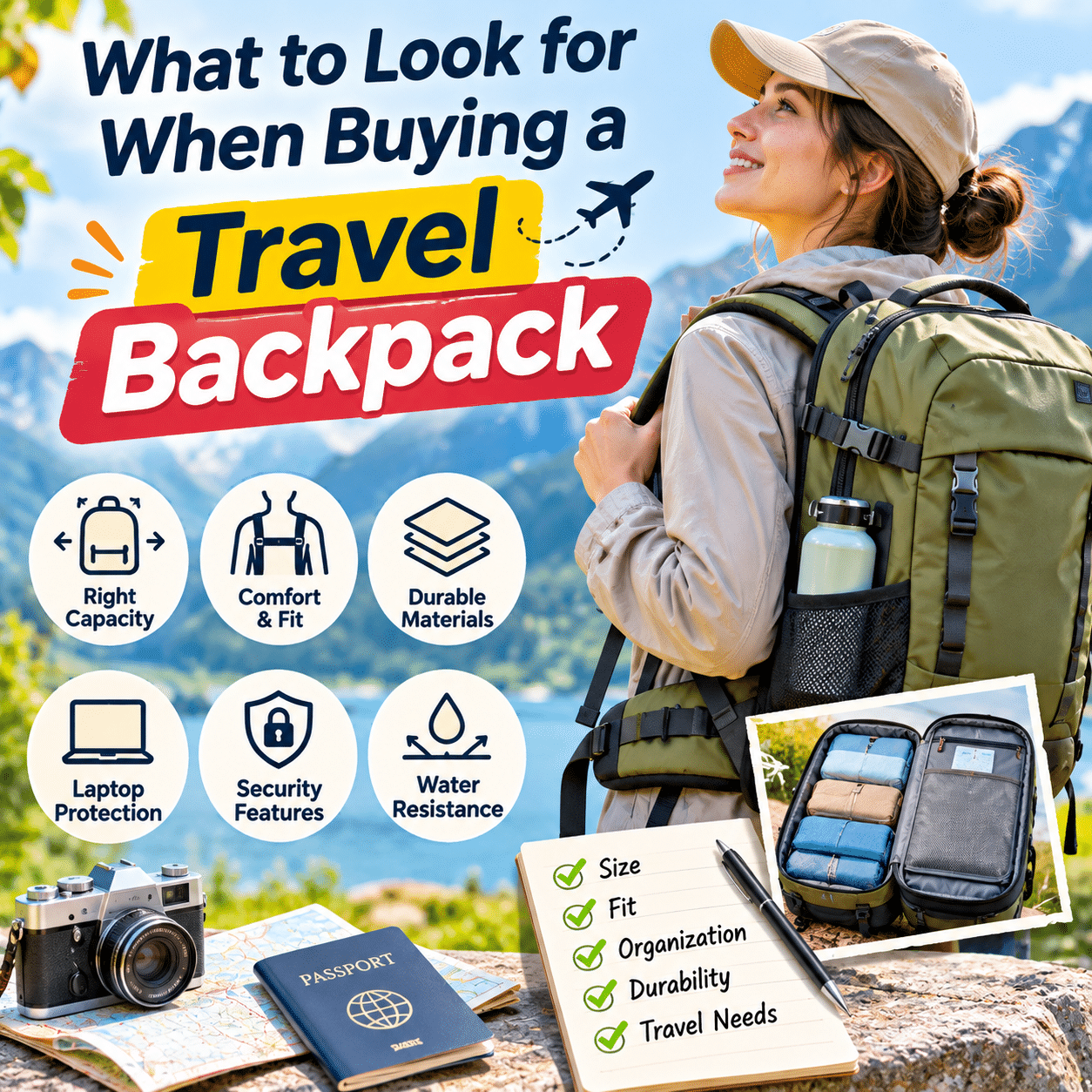
A well-chosen travel backpack can make journeys more comfortable, organized, and convenient. Whether you are exploring a new city, traveling internationally, taking a weekend getaway, or moving between multiple destinations, the right backpack allows you to carry essential belongings while keeping your hands free.
Unlike traditional suitcases, travel backpacks are designed to be carried on your body. This makes them particularly useful when navigating stairs, crowded transportation, uneven sidewalks, and locations where rolling luggage may be impractical.
However, not every backpack is suitable for travel. Some models prioritize outdoor performance, while others focus on laptop protection, everyday organization, or maximum packing capacity. A backpack that looks spacious may become uncomfortable when fully loaded, and one with numerous compartments may not necessarily offer efficient storage.
Choosing the right travel backpack requires understanding capacity, fit, carrying comfort, materials, organization, security, durability, and the practical demands of your travel style.
This comprehensive guide explains what to look for when buying a travel backpack, how to compare important features, and how to select a bag that remains useful across different journeys.
1. Understand What Makes a Travel Backpack Different
Travel backpacks are designed to accommodate the practical requirements of journeys rather than simply carrying everyday belongings.
Although designs vary, many travel backpacks include features such as:
- Larger main storage compartments
- Full or partial clamshell openings
- Dedicated laptop storage
- Internal packing organizers
- Adjustable shoulder straps
- Reinforced carrying handles
- Lockable zipper pulls
- Compression straps
- Water-resistant materials
- Luggage handle attachments
Some also include hip belts, sternum straps, and adjustable suspension systems.
The most useful combination depends on how and where you travel.
A backpack intended for airport-to-hotel travel may have different priorities from one used for extended walking or outdoor adventures.
2. Identify Your Primary Travel Style
Before comparing backpack specifications, determine how you expect to use the bag.
Weekend Travel
Short trips generally require compact storage, convenient organization, and easy handling.
A relatively small travel backpack may accommodate clothing, toiletries, electronics, and personal essentials.
International Travel
International journeys may involve flights, security checkpoints, trains, buses, and long transfers.
Useful priorities include comfortable carrying systems, secure storage, manageable dimensions, and organized access to documents.
Multi-City Travel
Travelers moving frequently between destinations often benefit from backpacks that are easy to carry through stations, stairs, and narrow streets.
Weight distribution and carrying comfort become especially important.
Business Travel
Business travelers may prioritize laptop protection, document organization, professional styling, and quick access to electronics.
Adventure Travel
Outdoor-oriented journeys may require durable fabrics, weather protection, supportive suspension systems, and attachment points for specialized equipment.
Everyday and Travel Combination
Some travelers prefer one backpack for commuting, short trips, and daily activities.
Versatile designs can reduce the need to own several specialized bags.
The best backpack is the one that supports your most common activities without introducing unnecessary weight or complexity.
3. Choose the Right Backpack Capacity
Backpack capacity is commonly measured in liters.
This measurement describes approximate internal volume, but it does not fully explain how efficiently a backpack can hold your belongings.
Common Travel Backpack Capacity Ranges
| Capacity | Typical Uses | Main Considerations |
|---|---|---|
| 15–20 liters | Day trips and minimal essentials | Compact and lightweight |
| 20–30 liters | Overnight trips and minimalist travel | Easy mobility |
| 30–40 liters | Weekend trips and light travel | Balanced storage and portability |
| 40–45 liters | Longer carry-on-oriented travel | Airline restrictions and packed weight |
| 45–60 liters | Extended trips and bulkier equipment | Greater carrying demands |
| 60+ liters | Specialized or equipment-heavy journeys | Weight, fit, and transportation limitations |
These ranges are approximate. Actual usable capacity depends on compartment design, construction, and manufacturer measurements.
Avoid Choosing Capacity Based Only on Trip Length
A traveler with access to laundry facilities may need less luggage for a two-week trip than someone preparing for a shorter winter vacation.
Consider clothing bulk, destination climate, activities, and packing habits.
Remember That Larger Bags Encourage Overpacking
A backpack with additional capacity may tempt you to bring items that are not essential.
The resulting weight can reduce comfort and mobility.
Choose enough space for realistic needs rather than maximizing volume automatically.
4. Understand Backpack Dimensions
Capacity and dimensions are related but different.
Two backpacks with the same stated volume may have very different shapes.
Height
Taller backpacks may distribute storage vertically but can be awkward for shorter travelers or tight spaces.
Width
Wider backpacks can accommodate clothing and equipment efficiently, but excessive width may interfere with arm movement.
Depth
Deep backpacks may protrude significantly from the body, affecting balance and maneuverability.
External Pockets and Attachments
Exterior pockets, straps, and attached accessories can increase the backpack’s overall dimensions.
Measure the Fully Packed Bag
A soft backpack may expand beyond its advertised dimensions when overfilled.
This matters particularly when traveling with airlines that enforce baggage size limits.
5. Check Airline Carry-On Requirements
Airline compatibility is a major consideration for travelers planning to use a backpack as cabin luggage.
There is no universal carry-on size accepted by every airline.
Requirements can vary according to:
- Airline
- Fare category
- Aircraft
- Route
- Operating carrier
- Personal-item allowance
- Cabin baggage weight restrictions
Carry-On Backpack Versus Personal-Item Backpack
A carry-on backpack is generally intended for larger cabin baggage allowances.
A personal-item backpack is typically smaller and may need to fit beneath the seat in front of you.
However, the exact rules depend on the airline.
Check Complete External Dimensions
Measure the packed backpack, including protruding pockets and accessories.
Do not rely solely on marketing descriptions such as “airline approved.”
Consider Weight Restrictions
Even when a backpack fits within size limits, it may exceed the permitted weight.
A lightweight backpack provides more flexibility for packing essential belongings.
Practical Buying Advice
If you frequently travel with multiple airlines, compare their current baggage policies and choose dimensions that suit your usual routes.
6. Choose a Backpack That Fits Your Body
Proper fit is one of the most important factors in carrying comfort.
A backpack that fits poorly can place unnecessary strain on your shoulders, neck, and back.
Torso Length
Torso length is often more relevant than overall height when selecting backpacks with structured carrying systems.
Manufacturers may provide torso-length guidance for different sizes.
Shoulder Width
Shoulder straps should sit comfortably without digging into the neck or sliding excessively outward.
Hip Position
For backpacks equipped with load-bearing hip belts, the belt should sit appropriately around the pelvis according to the manufacturer’s fitting instructions.
Backpack Length
An excessively long backpack may interfere with movement or place weight awkwardly.
Adjustable Suspension Systems
Some travel backpacks offer adjustable torso lengths or shoulder harness positions.
These can be especially useful for travelers whose body proportions do not match standard sizing.
Whenever possible, try the backpack with a realistic load before purchasing.
7. Understand the Importance of Weight Distribution
Comfort depends not only on backpack weight but also on how that weight is distributed.
Keep Heavy Items Close to Your Back
Positioning heavier items near the back panel can help reduce the leverage created by a load extending away from the body.
Avoid Excessive External Bulk
Bulky items attached far from the backpack can affect balance.
Use Compression Straps
Compression straps may help stabilize packed contents and reduce unnecessary movement.
Balance Both Sides
Uneven loading can create uncomfortable pressure.
Adjust the Carrying System
Properly adjusted shoulder straps, sternum straps, and hip belts can improve stability and carrying comfort.
The most comfortable arrangement depends on the backpack design and individual fit.
8. Evaluate Shoulder Strap Design
Shoulder straps are essential because they connect the backpack’s weight to your body.
Look for Appropriate Padding
Padding should provide comfort without excessive bulk.
Consider Strap Shape
Contoured shoulder straps may follow the body’s natural shape more comfortably than simple straight straps.
Check Adjustability
Straps should allow the backpack to sit securely without restricting movement.
Examine Stitching
Shoulder strap attachment points experience substantial stress.
Look for reinforced stitching and secure construction.
Test Under Load
A backpack that feels comfortable when empty may become uncomfortable after several hours of carrying.
Load testing is more informative than examining padding alone.
9. Understand Hip Belts
Hip belts can help transfer some backpack weight from the shoulders toward the pelvis when properly designed and fitted.
They are particularly useful on heavier backpacks intended for extended carrying.
Padded Hip Belts
These may provide additional comfort and support.
Simple Webbing Belts
Lightweight webbing belts can improve stability but may provide limited load transfer.
Removable Hip Belts
Some travel backpacks include removable belts for flexibility.
Stowable Hip Belts
Stowable designs can reduce loose straps during airport handling.
Do You Need a Hip Belt?
For a compact backpack used mainly between airports and hotels, a substantial hip belt may be unnecessary.
For heavier loads or prolonged walking, a properly fitted load-bearing hip belt can be valuable.
10. Consider Sternum Straps
A sternum strap connects the shoulder straps across the chest.
Its primary role is to help stabilize the shoulder harness.
Potential Benefits
- Reduced shoulder strap movement
- Improved stability during walking
- More consistent strap positioning
- Additional comfort for some travelers
Important Considerations
The strap should be adjustable and should not restrict breathing or movement.
A sternum strap is not a substitute for proper backpack fit.
11. Evaluate Back Panel Comfort
The back panel influences how a backpack feels against your body.
Padded Back Panels
Padding may improve comfort by reducing pressure from internal objects.
Ventilation Channels
Some backpacks use raised padding or airflow channels.
These may improve ventilation under certain conditions.
Mesh Suspension Systems
Certain designs create a gap between the backpack and the wearer’s back.
These can improve airflow but may affect packing geometry or load positioning.
Understand Ventilation Limitations
No backpack design completely prevents perspiration during warm weather or physical activity.
Choose a system that balances ventilation, stability, and carrying comfort.
12. Compare Clamshell and Top-Loading Backpacks
How a backpack opens can significantly affect packing convenience.
Clamshell Opening
A clamshell backpack opens widely, often in a suitcase-like manner.
Advantages
- Easy access to clothing
- Convenient packing cube organization
- Better visibility of contents
- Reduced need to unpack everything
Potential limitations
- Requires space to open
- Some designs are less convenient for accessing items while standing
- Zippers may extend around much of the bag
Top-Loading Opening
Top-loading backpacks are accessed primarily from the upper opening.
Advantages
- Simple construction
- Convenient for certain outdoor activities
- May accommodate irregularly shaped equipment
- Often compatible with compression systems
Potential limitations
- Items at the bottom can be difficult to reach
- Organization may require additional packing accessories
Panel-Loading Designs
Some backpacks offer a front panel opening that provides access without fully separating the bag into two halves.
These designs can balance travel organization with convenient access.
13. Choose the Right Internal Organization
A well-organized backpack helps prevent unnecessary searching and unpacking.
Useful Compartments
- Main clothing compartment
- Laptop sleeve
- Document pocket
- Toiletry storage
- Small accessory pockets
- Mesh organizers
- Hidden valuables compartment
- External water bottle pocket
Avoid Excessive Compartments
Too many pockets can create confusion and reduce usable storage.
The goal is not maximum compartment count.
Instead, choose an arrangement that matches how you pack and retrieve belongings.
Consider Packing Cubes
Packing cubes can provide flexible organization even in backpacks with simple interiors.
They are particularly useful for separating clothing categories.
14. Evaluate Laptop Protection
Travelers carrying computers should pay close attention to laptop compartment design.
Check Device Compatibility
Manufacturer laptop-size labels are approximate.
Compare the actual device dimensions with the compartment’s usable measurements.
Look for Padding
Padding can help reduce impacts from routine handling.
Consider a Suspended Laptop Sleeve
Some backpacks position the laptop compartment above the bottom of the bag.
This can reduce direct contact with the ground when the backpack is set down.
Evaluate Accessibility
A separate laptop opening may be convenient during airport screening and work-related travel.
However, security procedures vary by airport.
Consider Weight Placement
A laptop compartment positioned close to the back panel may support more balanced carrying.
Avoid Assuming Complete Protection
Even padded compartments cannot guarantee protection against crushing, drops, or severe impacts.
15. Consider Tablet and Electronics Storage
Travelers often carry several electronic accessories.
A practical backpack may include storage for:
- Tablets
- E-readers
- Chargers
- Power adapters
- Cables
- Headphones
- Portable batteries
- Small cameras
Use Dedicated Organizers
An electronics pouch can prevent loose cables from becoming tangled.
Separate Electronics From Liquids
Avoid packing water bottles or toiletries where leaks could damage electronic devices.
Keep Essential Electronics Accessible
Frequently used devices should be easy to retrieve without opening the entire main compartment.
16. Compare Backpack Materials
Travel backpacks are commonly made from synthetic woven fabrics.
Material selection influences durability, weight, flexibility, and weather resistance.
Polyester
Polyester is widely used in travel backpacks.
Potential benefits include:
- Practical abrasion resistance
- Relatively low maintenance
- Broad availability
- Compatibility with water-resistant coatings
Performance varies by fabric construction.
Nylon
Nylon is commonly selected for its strength and flexibility.
Different nylon constructions offer different levels of abrasion and tear resistance.
Ripstop Fabrics
Ripstop fabrics incorporate a reinforcement pattern intended to limit the spread of certain tears.
However, ripstop construction does not automatically make a fabric indestructible.
Laminated Fabrics
Some backpacks use laminated materials for additional weather resistance or structural characteristics.
These may introduce tradeoffs involving weight, flexibility, cost, or long-term wear.
Canvas
Canvas backpacks can offer a distinctive appearance and durable woven construction.
However, weight and moisture resistance depend on the fabric and treatment.
17. Understand Fabric Denier
Denier is a measure of fiber linear mass density.
It is commonly used in backpack fabric specifications.
What Higher Denier Can Indicate
Within comparable materials and constructions, higher denier often means thicker fibers.
What Denier Does Not Guarantee
Denier alone does not establish:
- Abrasion resistance
- Tear strength
- Waterproof performance
- Overall durability
- Manufacturing quality
Weave structure, coatings, fiber type, and reinforcement also matter.
Compare complete material specifications rather than relying on a single number.
18. Evaluate Water Resistance
Travel backpacks may encounter rain, spills, and damp environments.
Water-Resistant Fabrics
These are designed to resist some moisture penetration.
Waterproof Fabrics
Waterproof materials are intended to prevent water passage under specified conditions.
However, waterproof fabric does not automatically mean the entire backpack is waterproof.
Vulnerable Areas
Water can enter through:
- Zippers
- Seams
- Stitching holes
- Openings
- Damaged coatings
Rain Covers
A rain cover can provide additional protection during wet conditions.
However, it may not fully protect the bag in severe weather or prolonged immersion.
Waterproof Packing Organizers
For electronics, documents, and sensitive belongings, protective dry bags or waterproof pouches may offer an additional layer of protection.
19. Examine Zipper Quality
Zippers are among the most frequently used backpack components.
Important Features
- Smooth operation
- Strong attachment stitching
- Reliable zipper sliders
- Durable pulls
- Appropriate zipper size
- Minimal snagging
Lockable Zipper Pulls
Some travel backpacks include zipper pulls designed to accommodate a small lock.
These may discourage casual access but do not guarantee security.
Water-Resistant Zippers
Certain zippers include protective coatings or specialized designs.
Their effectiveness depends on construction and closure conditions.
Avoid Overpacking
Excessive pressure can damage zipper teeth, sliders, and surrounding seams.
20. Understand Backpack Security Features
Travel security is especially important in crowded transportation areas.
Useful Security Features
- Lockable main compartments
- Concealed pockets
- Internal valuables storage
- Durable zipper pulls
- Minimal exposed openings
- Secure laptop compartments
Hidden Pockets
Hidden pockets may provide discreet storage for small belongings.
However, accessibility should remain practical.
Anti-Theft Marketing Claims
Terms such as “anti-theft” may refer to different combinations of features.
They do not guarantee protection against theft.
Practical Security Habits
Keep passports, payment cards, and essential documents in secure, accessible locations.
Avoid leaving backpacks unattended.
Use additional precautions in crowded environments.
21. Consider Backpack Weight
Empty backpack weight directly affects the total load carried.
Why Weight Matters
A heavy backpack can become uncomfortable during:
- Airport transfers
- Long walking routes
- Public transportation
- Stair climbing
- Multi-city travel
Lightweight Versus Structured Designs
Lightweight backpacks may offer greater carrying flexibility.
Structured backpacks may include additional padding, frames, and compartments that increase weight.
Find a Practical Balance
The lightest backpack is not necessarily the most comfortable.
A slightly heavier bag with a supportive carrying system may feel better under load.
Evaluate weight together with fit and intended carrying duration.
22. Understand Backpack Frames and Structure
Some travel backpacks include internal frames, frame sheets, or reinforced back panels.
Internal Frames
These may help distribute weight and maintain structural shape.
Frame Sheets
A frame sheet can add rigidity and help prevent packed objects from pressing directly against the back.
Frameless Backpacks
Frameless designs may be lighter and more flexible.
However, they may provide less support under heavier loads.
Choose Based on Carrying Requirements
For compact loads, a simple structure may be sufficient.
For heavier loads carried over longer distances, a supportive frame system can improve comfort.
23. Evaluate Compression Straps
Compression straps help control backpack volume and stabilize packed contents.
Internal Compression Straps
These can secure clothing and reduce movement inside the main compartment.
External Compression Straps
These may reduce the bag’s profile when partially packed.
Potential Advantages
- Improved load stability
- Reduced unnecessary bulk
- Better packing control
- More compact carrying profile
Potential Limitations
Loose straps can catch on surrounding objects.
Some designs may interfere with access to compartments.
Look for secure strap management features.
24. Consider External Pockets
External pockets provide convenient access to frequently used belongings.
Water Bottle Pockets
A secure water bottle pocket can be useful during travel.
Check whether it accommodates your preferred bottle shape.
Quick-Access Pockets
These may hold small items such as tissues, sunglasses, or travel accessories.
Front Organizational Pockets
Useful for cables, pens, documents, and personal essentials.
Hidden Rear Pockets
May provide discreet storage for certain valuables.
Avoid Excessive Exterior Storage
Overfilled external pockets can increase backpack dimensions and make movement through crowded spaces more difficult.
25. Look for Comfortable Carrying Handles
Travel backpacks are not always worn on the shoulders.
You may need to lift or carry the bag while boarding transportation or placing it into storage.
Useful Handle Positions
- Top carrying handle
- Side carrying handle
- Front grab handle
Evaluate Construction
Handles should be securely attached and comfortable to grip.
Side Handles
A side handle can allow the backpack to be carried like a suitcase for short distances.
Reinforcement Matters
Check stitching and attachment points, especially on larger backpacks.
26. Consider Stowable Shoulder Straps
Some travel backpacks allow shoulder straps to be tucked into a rear compartment.
Potential Benefits
- Reduced strap snagging
- Cleaner appearance during transportation
- Easier placement in overhead compartments
- Convenient handling during baggage checks
Potential Limitations
Stowable systems can add weight or complexity.
They may also reduce the space available for padding.
When They Are Useful
Stowable straps can be valuable for travelers who frequently alternate between carrying and storing their backpacks.
27. Evaluate Luggage Pass-Through Sleeves
A luggage pass-through sleeve allows the backpack to slide over the telescopic handle of a rolling suitcase.
Advantages
- Easier airport transfers
- Reduced shoulder carrying
- Convenient two-bag travel
- More organized luggage handling
Check Compatibility
Make sure the sleeve fits the handle width of your suitcase.
Consider Stability
A heavily packed backpack may affect the balance of the rolling suitcase.
Test the combination before traveling.
28. Choose a Backpack for Weekend Trips
Weekend travel usually requires a manageable bag with efficient storage.
Prioritize
- Compact capacity
- Lightweight construction
- Easy clothing organization
- Comfortable shoulder straps
- Accessible essentials
- Simple packing and unpacking
Consider a Clamshell Design
A suitcase-style opening can make short-trip packing particularly convenient.
Avoid Unnecessary Features
Large suspension systems and excessive compartments may be unnecessary for short journeys.
29. Choose a Backpack for International Travel
International travel often involves multiple transportation systems.
Important Priorities
- Airline-compatible dimensions
- Secure storage
- Comfortable carrying system
- Organized electronics
- Durable construction
- Practical weather resistance
Consider Long Transfers
You may need to carry the backpack through large airports, train stations, and unfamiliar streets.
Comfort matters more than appearance alone.
Keep Travel Documents Accessible
Passports, boarding documents, and essential items should be stored securely but conveniently.
Check Airline Requirements
Verify the current policies of every relevant carrier.
30. Choose a Backpack for Multi-City Travel
Frequent destination changes place additional demands on luggage.
Focus on Mobility
A travel backpack can be especially useful when navigating:
- Stairs
- Narrow streets
- Historic city centers
- Crowded trains
- Uneven sidewalks
- Frequent accommodation changes
Choose Manageable Capacity
A compact backpack may provide more freedom of movement than an oversized model.
Prioritize Carrying Comfort
Adjustable straps and appropriate weight distribution become particularly valuable.
Plan Laundry Access
Travelers who can wash clothing during their journeys may reduce the amount of luggage required.
31. Choose a Backpack for Business Travel
Business travelers often carry electronics, documents, and clothing that requires careful organization.
Useful Features
- Padded laptop compartment
- Document storage
- Organized accessory pockets
- Professional appearance
- Luggage pass-through sleeve
- Comfortable carrying handles
Consider Separate Compartments
Keeping electronics separate from clothing can simplify packing and access.
Evaluate Opening Design
A backpack that opens widely may make packing business attire easier.
Keep the Exterior Practical
Neutral styling and minimal loose straps may suit professional environments.
32. Choose a Backpack for Digital Nomads
Digital nomads often combine personal travel with remote work.
Prioritize Electronics Organization
Consider storage for:
- Laptop
- Tablet
- Charging equipment
- Headphones
- Portable accessories
- Documents
Balance Work and Personal Storage
A backpack should provide enough space for both work essentials and travel belongings.
Consider Daily Use
Some travelers prefer a backpack that works as both main luggage and a daily work bag.
Others may benefit from a separate compact daypack.
Protect Sensitive Equipment
Look for padding, weather protection, and secure compartments.
33. Choose a Backpack for Adventure Travel
Adventure travel may require specialized equipment and rugged construction.
Important Features
- Durable fabric
- Supportive carrying system
- Adjustable straps
- Weather protection
- Secure compression
- Equipment attachment points
Consider the Terrain
Uneven trails and outdoor environments may require more supportive designs than conventional urban travel.
Evaluate Equipment Requirements
Specialized activities may require dedicated storage for footwear, outdoor clothing, or other gear.
Avoid Assuming Every Travel Backpack Is a Hiking Backpack
Travel-oriented designs may lack the suspension, ventilation, and equipment features needed for extended hiking.
Choose a purpose-built outdoor backpack when the activity demands it.
34. Choose a Backpack for Urban Exploration
City travel often involves public transportation, walking, and frequent access to personal items.
Useful Features
- Compact profile
- Secure compartments
- Comfortable straps
- Lightweight construction
- Convenient water bottle storage
- Organized small-item pockets
Avoid Excessive Bulk
Large backpacks can be awkward in crowded spaces.
Consider a Daypack
For travelers using a separate main suitcase, a compact daypack may be more practical than carrying a large travel backpack throughout the day.
35. Choose a Backpack for Outdoor Day Trips
Outdoor day trips often require water, snacks, weather protection, and personal essentials.
Consider
- Comfortable carrying system
- Suitable capacity
- Water bottle or hydration storage
- Weather-resistant construction
- Accessible compartments
- Secure attachment points
Prioritize Stability
A backpack that shifts excessively during movement can become uncomfortable.
Consider Activity-Specific Requirements
Hiking, cycling, and other outdoor activities may require specialized features beyond those found in standard travel backpacks.
36. Choose a Backpack for Family Travel
Family travelers often carry a combination of personal and shared essentials.
Useful Storage
- Spare clothing
- Snacks
- Travel documents
- Small accessories
- Personal care supplies
- Entertainment items
Consider Accessibility
Frequently needed items should be easy to retrieve.
Avoid Excessive Weight
A large family backpack can become uncomfortable when overloaded.
Distribute Belongings Thoughtfully
When appropriate, dividing items between multiple bags may improve convenience.
Children’s bags should be appropriately sized and lightweight.
37. Choose a Backpack for Minimalist Travel
Minimalist travelers prioritize mobility and carrying only what is necessary.
Key Principles
- Choose versatile clothing
- Reduce duplicate items
- Use compact toiletries
- Select multipurpose accessories
- Plan laundry opportunities
- Avoid unnecessary equipment
Backpack Features
A compact clamshell backpack with simple organization may work well.
Benefits
Minimalist packing can make transfers easier and reduce physical carrying demands.
However, minimalism should not compromise essential comfort, safety, or preparedness.
38. Consider Weather and Climate
Climate affects both backpack construction and packing requirements.
Hot Climates
Prioritize breathable carrying systems and manageable weight.
Rainy Destinations
Consider water-resistant materials, protective covers, and waterproof internal organizers.
Cold Climates
Allow space for bulky clothing and weather-specific accessories.
Humid Environments
Choose materials that can be cleaned and dried appropriately.
Dusty Conditions
Look for secure closures and easily maintained exterior surfaces.
39. Understand Backpack Balance and Stability
A backpack’s shape and loading pattern affect how it moves with your body.
Keep the Load Compact
Avoid unnecessary items hanging far from the backpack.
Secure Loose Straps
Loose straps can catch on objects.
Distribute Weight Evenly
Balanced packing can improve comfort.
Adjust the Harness
A properly adjusted backpack should remain stable during normal movement.
Test Movement
Walk, turn, bend, and climb a few steps with a realistically packed bag when possible.
40. Consider Backpack Expandability
Expandable backpacks provide additional capacity through zippers or adjustable compartments.
Advantages
- Flexible packing space
- Adaptability between trip lengths
- Extra storage when needed
Limitations
- Increased external dimensions
- Additional zipper stress
- Potential balance changes
- Greater temptation to overpack
Airline Considerations
An expanded backpack may exceed carry-on or personal-item allowances.
Check the dimensions in the configuration you intend to use.
41. Evaluate Backpack Appearance and Versatility
Appearance may influence how comfortably a backpack fits into different environments.
Professional Designs
Often feature understated colors, structured shapes, and minimal external attachments.
Casual Travel Designs
May prioritize flexibility, accessible pockets, and relaxed styling.
Outdoor Designs
Often emphasize technical fabrics, supportive harnesses, and equipment attachments.
Choose Long-Term Versatility
A neutral, practical design may work across several travel situations.
However, functionality should remain the primary consideration.
42. Consider Backpack Color
Color can affect visibility, maintenance, and personal preference.
Dark Colors
Often conceal some stains and marks.
Light Colors
May make certain dirt and wear more visible.
Bright Colors
Can make a backpack easier to identify.
Reflective Details
Reflective elements may improve visibility in low-light conditions when illuminated.
However, they do not replace appropriate safety precautions.
43. Examine Stitching and Reinforcement
Construction quality is critical for long-term durability.
High-Stress Areas
Inspect:
- Shoulder strap attachments
- Carrying handles
- Hip belt connections
- Zipper ends
- Compression strap anchors
- Bottom panels
Reinforced Stitching
Additional reinforcement may improve strength at stress points.
Examine Overall Construction
Look for consistent stitching, secure seams, and properly aligned components.
Remember That Fabric Strength Is Only One Factor
Even strong fabric cannot compensate for poorly constructed attachment points.
44. Understand Backpack Warranty Coverage
Warranty policies vary between manufacturers.
Check Coverage For
- Manufacturing defects
- Zipper failures
- Strap attachment problems
- Buckle defects
- Material defects
- Structural issues
Understand Exclusions
Normal wear, accidental damage, misuse, and transportation damage may be excluded.
Evaluate Repair Support
Check whether replacement buckles, straps, and other components are available.
A repairable backpack may provide better long-term value.
45. Consider Sustainability and Longevity
A durable backpack can reduce the need for frequent replacement.
Prioritize Practical Durability
Choose materials and construction appropriate for your travel habits.
Look for Repairability
Replaceable components can extend product life.
Consider Recycled Materials
Some backpacks use recycled synthetic fabrics.
However, recycled content alone does not establish overall environmental performance.
Avoid Unnecessary Purchases
A versatile backpack that serves several purposes may be more practical than owning multiple specialized bags.
Maintain Your Backpack
Proper cleaning, drying, and storage can help preserve functionality.
46. Compare Budget and Premium Travel Backpacks
Price can reflect differences in materials, construction, design, and service support.
However, higher cost does not guarantee better suitability.
Budget Backpacks
May provide essential functionality for occasional travel.
Potential limitations can include simpler carrying systems and limited repair support.
Mid-Range Backpacks
May offer a practical balance of comfort, organization, and durability.
Premium Backpacks
May include advanced fabrics, adjustable suspension systems, refined organization, and stronger service support.
Evaluate Value
Consider:
- Travel frequency
- Carrying comfort
- Durability
- Organization
- Warranty
- Repairability
- Weight
- Versatility
Choose the backpack that best matches your actual requirements.
47. Common Mistakes to Avoid When Buying a Travel Backpack
Choosing Capacity Without Considering Weight
A large backpack can become uncomfortable when fully packed.
Better approach: Select capacity according to realistic packing needs.
Ignoring Torso Fit
Poor fit can reduce comfort even when the backpack has extensive padding.
Better approach: Check manufacturer sizing guidance and test the fit.
Buying Based Only on Appearance
A stylish backpack may lack practical organization or supportive straps.
Better approach: Evaluate functionality before aesthetics.
Assuming All Travel Backpacks Are Carry-On Compatible
Airline requirements vary.
Better approach: Verify dimensions and weight limits.
Overlooking Shoulder Strap Quality
Thin or poorly shaped straps may create pressure points.
Better approach: Test comfort under realistic load.
Choosing Too Many Compartments
Excessive organization can reduce flexibility and make items harder to locate.
Better approach: Select a logical layout suited to your habits.
Ignoring Weather Protection
Sensitive belongings may be vulnerable to moisture.
Better approach: Assess water resistance and use protective organizers.
Overvaluing Security Claims
No backpack can guarantee theft prevention.
Better approach: Combine practical security features with careful travel habits.
Forgetting Repairability
Damaged buckles or zippers can limit backpack usefulness.
Better approach: Investigate warranty and replacement components.
Skipping a Loaded Fit Test
An empty backpack does not reveal how it will feel during travel.
Better approach: Test the backpack with realistic weight whenever possible.
48. How to Choose a Travel Backpack: Step by Step
Step 1: Identify Your Main Travel Purpose
Determine whether the backpack will be used primarily for business, leisure, multi-city travel, outdoor activities, or everyday use.
Step 2: Estimate Your Packing Requirements
Consider clothing, electronics, toiletries, and specialized equipment.
Step 3: Choose an Appropriate Capacity
Select enough space without encouraging unnecessary overpacking.
Step 4: Check Transportation Restrictions
Verify relevant airline and other operator baggage requirements.
Step 5: Evaluate Body Fit
Check torso length, shoulder strap positioning, and overall comfort.
Step 6: Compare Carrying Systems
Consider padding, hip belts, sternum straps, and back panel construction.
Step 7: Choose an Opening Style
Decide whether clamshell, panel-loading, or top-loading access best suits your packing habits.
Step 8: Evaluate Organization
Look for compartments that solve real packing and accessibility needs.
Step 9: Compare Materials and Weather Protection
Choose construction appropriate for expected conditions.
Step 10: Examine Durability
Inspect zippers, seams, straps, and attachment points.
Step 11: Review Security and Convenience
Consider secure storage, luggage sleeves, and accessible essentials.
Step 12: Test With a Realistic Load
Assess comfort, balance, and movement.
Step 13: Check Warranty and Repair Options
Understand long-term ownership requirements.
Step 14: Make a Practical Final Comparison
Choose the backpack that provides the best combination of comfort, capacity, durability, and usability.
49. Travel Backpack Comparison by Use Case
| Travel Scenario | Suggested Backpack Capacity | Main Priorities |
|---|---|---|
| City day trip | 15–25 liters | Compact size and easy access |
| Overnight getaway | 20–30 liters | Lightweight organization |
| Weekend trip | 25–40 liters | Clothing storage and portability |
| Business travel | 20–35 liters | Laptop protection and organization |
| Minimalist international travel | 30–40 liters | Mobility and efficient packing |
| Longer carry-on travel | 35–45 liters | Capacity and airline compatibility |
| Multi-city travel | 30–40 liters | Comfort and manageable weight |
| Digital nomad travel | 30–45 liters | Electronics and clothing organization |
| Outdoor day trip | 15–30 liters | Fit, stability, and hydration access |
| Equipment-heavy adventure | 45–65+ liters | Supportive suspension and durability |
These capacities are illustrative starting points, not universal requirements.
Always consider personal fit, packed weight, and transportation restrictions.
50. Practical Travel Backpack Buying Checklist
Travel Requirements
- I have identified my main travel style.
- I understand my typical trip duration.
- I have estimated realistic packing needs.
- I have checked transportation baggage restrictions.
- I know whether I need a main travel bag or a smaller daypack.
Capacity and Dimensions
- The capacity is appropriate for my belongings.
- The external dimensions suit my travel requirements.
- The backpack is not unnecessarily large.
- The empty weight is manageable.
- The packed shape remains practical.
Fit and Comfort
- The backpack fits my torso appropriately.
- Shoulder straps feel comfortable.
- The back panel provides suitable support.
- The sternum strap is adjustable if included.
- The hip belt fits properly if needed.
- The backpack remains stable while walking.
Organization
- The main compartment is easy to access.
- The opening style suits my packing habits.
- Laptop storage is appropriate if required.
- Important items are accessible.
- Compartments are useful rather than excessive.
- Compression straps work effectively.
Durability and Protection
- Fabric quality suits expected travel conditions.
- Zippers operate smoothly.
- High-stress seams appear reinforced.
- Carrying handles feel secure.
- Weather protection is appropriate.
- Security features meet my needs.
Long-Term Ownership
- Warranty terms are clear.
- Repair options are available.
- Maintenance requirements are manageable.
- The backpack can serve multiple future trips.
- The overall value matches my expected use.
51. Frequently Asked Questions
What is the best travel backpack size?
The ideal size depends on trip duration, packing habits, and transportation restrictions.
Many travelers find backpacks in the 30–40-liter range useful for short trips and minimalist travel, but smaller or larger options may be more appropriate.
Is a 40-liter backpack suitable for carry-on travel?
Some 40-liter backpacks meet certain airline carry-on requirements.
However, capacity alone does not determine compliance.
Check the fully packed external dimensions and weight against the airline’s current rules.
Is a travel backpack better than a suitcase?
A backpack may be more convenient for stairs, uneven surfaces, and frequent transfers.
A suitcase may be easier to transport across smooth surfaces without carrying the full load on your body.
The better option depends on your itinerary and physical preferences.
Should I choose a clamshell backpack?
Clamshell designs are useful for travelers who prefer suitcase-style packing and organized clothing storage.
Top-loading designs may be more suitable for certain outdoor activities.
Do I need a hip belt?
A load-bearing hip belt can improve comfort with heavier loads when properly fitted.
It may be unnecessary for compact backpacks carried only for short periods.
Are expensive travel backpacks worth buying?
Premium backpacks may offer refined carrying systems, durable materials, or better repair support.
However, value depends on how well those features match your needs.
What material is best for a travel backpack?
Polyester and nylon are common practical options.
Fabric quality, construction, coatings, and intended use are more important than material names alone.
Are travel backpacks waterproof?
Most conventional travel backpacks are water-resistant rather than fully waterproof.
Use suitable protective organizers for sensitive belongings when traveling in wet conditions.
How important is laptop compartment padding?
Padding can reduce some everyday impacts, but it cannot guarantee complete protection.
A well-positioned compartment with appropriate fit and secure closure is important.
Can I use a hiking backpack for international travel?
Yes, provided it meets transportation requirements and suits your packing needs.
However, hiking backpacks may have different opening systems and external attachments from travel-oriented designs.
Is a 30-liter backpack enough for a week?
It may be sufficient for minimalist travelers, especially when packing versatile clothing and using laundry facilities.
Packing needs vary according to climate and activities.
Should I buy a backpack with many pockets?
Choose pockets based on practical usefulness.
A simple layout with packing cubes may be more efficient than numerous small compartments.
Are anti-theft backpacks necessary?
Security features can provide additional convenience, but they do not guarantee theft prevention.
Good travel habits remain essential.
What is the best backpack for frequent flyers?
Frequent flyers often benefit from manageable dimensions, reliable zippers, comfortable straps, organized electronics storage, and durable construction.
Airline compatibility should be verified for regular routes.
How do I know whether a backpack fits properly?
The backpack should sit comfortably, remain stable, and distribute weight without creating excessive pressure.
Follow manufacturer fitting instructions and test it with a realistic load.
Can a travel backpack replace checked luggage?
For some travelers, yes.
Efficient packing and access to laundry can make carry-on-only travel practical.
Others may require checked luggage for bulky equipment or extended trips.
Are expandable backpacks useful?
Expandable designs provide flexibility but can increase dimensions and weight.
They are useful when additional capacity is genuinely needed and transportation restrictions permit it.
How much should an empty travel backpack weigh?
There is no universal ideal weight.
The appropriate balance depends on capacity, materials, suspension design, and expected load.
Compare weight alongside comfort and durability.
What is the difference between a travel backpack and a daypack?
Travel backpacks generally prioritize larger packing capacity and journey-related organization.
Daypacks are typically smaller and intended for daily essentials or short excursions.
How long should a travel backpack last?
Lifespan depends on construction quality, frequency of use, loading habits, environmental exposure, and maintenance.
Repairable components can help extend useful life.
52. How to Pack a Travel Backpack Efficiently
Choosing a suitable backpack is only part of the process.
Efficient packing can improve comfort and accessibility.
Start With Essential Items
Identify the belongings required for the trip before filling the backpack.
Use Packing Cubes
Group clothing into logical categories.
Position Heavy Items Carefully
Place heavier belongings close to your back when appropriate for the backpack design.
Separate Frequently Used Essentials
Keep travel documents, electronics, and small accessories accessible.
Protect Liquids
Use suitable leak-resistant containers and protective pouches.
Avoid Excessive External Attachments
Keep the backpack compact and balanced.
Test the Packed Weight
Wear the backpack and walk for several minutes.
Adjust straps and redistribute items if necessary.
53. How to Maintain a Travel Backpack
Proper maintenance can help preserve the backpack’s appearance and functionality.
Clean According to Manufacturer Instructions
Different fabrics and coatings require different cleaning methods.
Remove Loose Dirt
Use a soft brush or cloth to remove dust and debris.
Spot-Clean Stains
Use appropriate cleaning products and avoid harsh chemicals unless recommended.
Clean Zippers
Remove accumulated dirt carefully.
Inspect Straps and Buckles
Check for wear, looseness, or damage.
Dry Thoroughly
Allow the backpack to dry completely before storage.
Avoid Unnecessary Machine Washing
Machine washing can damage coatings, padding, frames, or structural components.
Follow the manufacturer’s care instructions.
Store in a Dry Location
Avoid prolonged moisture exposure and excessive heat.
54. Build a Flexible Travel Bag System
A travel backpack can serve as the foundation of a versatile luggage setup.
Main Travel Backpack
Carries clothing and essential belongings.
Compact Daypack
Provides convenient storage during sightseeing or daily activities.
Electronics Organizer
Keeps cables and small accessories organized.
Packing Cubes
Help manage clothing and reduce unpacking.
Protective Pouches
Separate toiletries and moisture-sensitive items.
Not every traveler needs all these accessories.
Start with the backpack and add supporting items only when they solve genuine travel problems.
55. Think About Long-Term Travel Needs
A useful travel backpack should remain practical beyond a single journey.
Consider whether your travel habits may change.
You might eventually take:
- More frequent flights
- Longer vacations
- Business trips
- Multi-city adventures
- Outdoor excursions
- Remote-work journeys
A versatile backpack can adapt to several situations.
However, attempting to accommodate every possible activity may result in unnecessary features or compromises.
Prioritize the requirements most relevant to your regular travel habits.
Final Thoughts
Choosing the right travel backpack involves much more than selecting an attractive design or a large storage capacity.
The most important considerations include proper fit, carrying comfort, appropriate capacity, durable construction, efficient organization, and compatibility with your travel plans.
A compact backpack may be ideal for weekend trips and urban exploration, while a larger model with a supportive carrying system may better suit extended journeys or equipment-heavy adventures. Business travelers may prioritize laptop protection and professional organization, while frequent international travelers may value secure compartments, manageable dimensions, and reliable construction.
Before purchasing, think about how far you will carry the backpack, what you need to pack, and which environments you expect to encounter. Test the fit whenever possible, examine the quality of important components, and avoid choosing features that add complexity without providing practical benefits.
A thoughtfully selected travel backpack can simplify packing, improve mobility, and make travel more comfortable for years to come.
The best travel backpack is not the one that holds the most—it is the one that carries what you need comfortably, securely, and efficiently wherever your journey takes you.