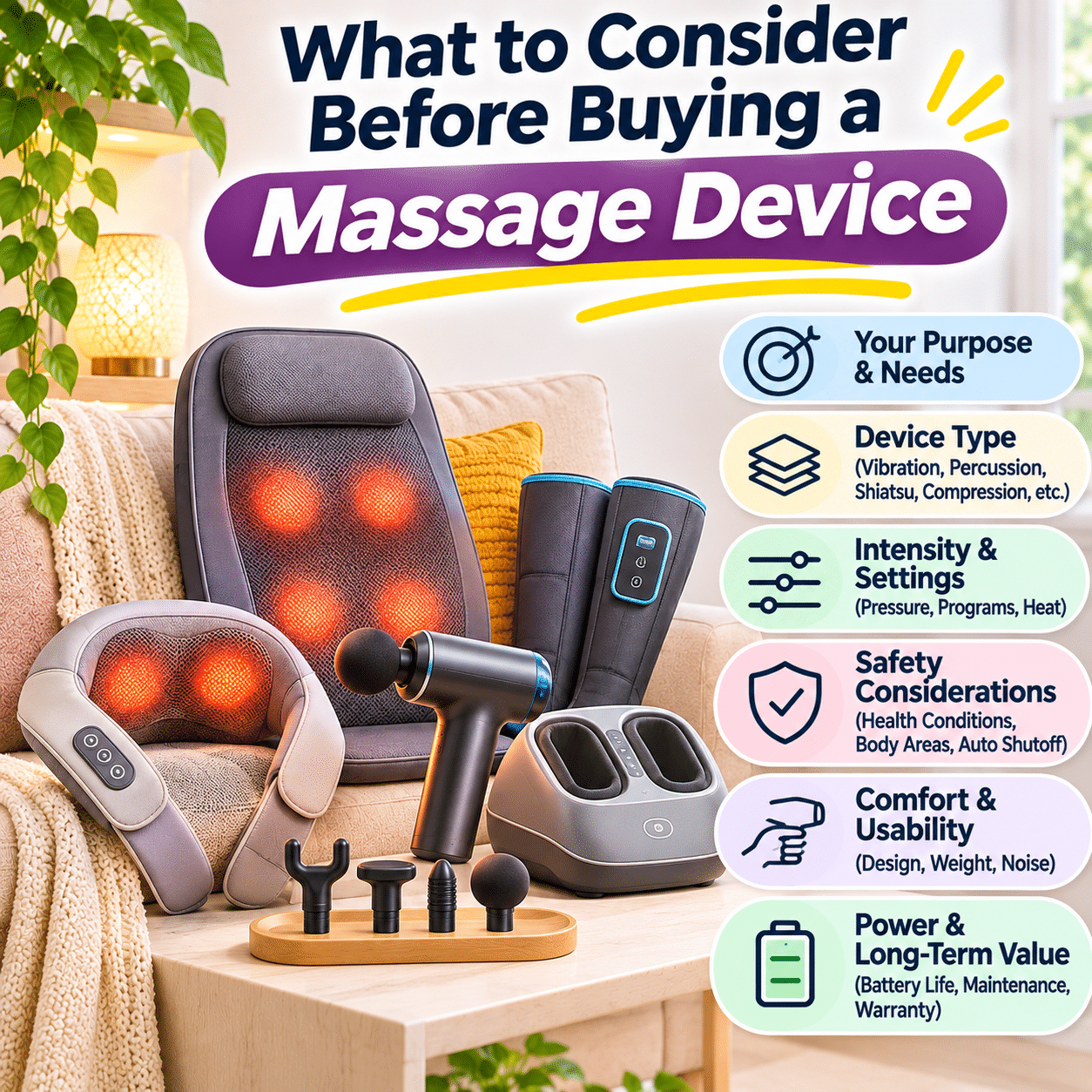
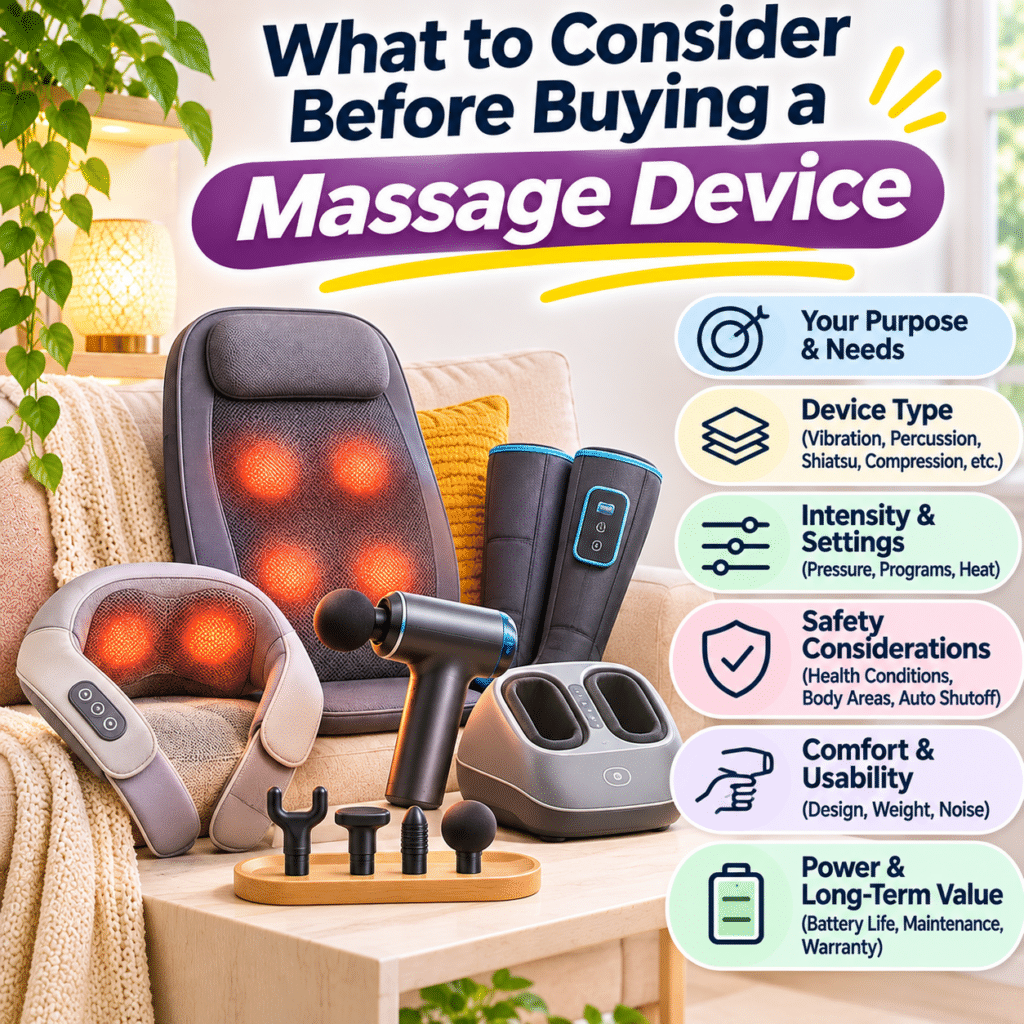
A massage device can be a convenient addition to an everyday relaxation and personal care routine. Whether you want to unwind after a busy day, ease the sensation of muscle tightness, or enjoy a gentle massage at home, choosing the right device can make the experience more comfortable, practical, and enjoyable.
However, massage devices vary considerably in design, intensity, operating mechanism, and intended use. A handheld percussion massage gun works differently from a vibrating massage cushion, a shiatsu-style neck massager, or an air-compression leg massager. Each offers a different sensation and requires different considerations for comfort, safety, and everyday usability.
Modern massage devices may include adjustable intensity levels, multiple massage patterns, interchangeable attachments, heating functions, rechargeable batteries, automatic shutoff timers, and ergonomic controls. While these features can improve convenience, a more powerful or expensive device is not necessarily a better choice.
The most suitable massage device is one that matches your intended body area, provides comfortable and controllable pressure, fits your daily routine, and includes appropriate safety features.
It is also important to distinguish between general relaxation and medical treatment. Consumer massage devices may provide temporary comfort, but they should not be assumed to diagnose, prevent, or treat medical conditions. Persistent pain, unexplained swelling, numbness, or other concerning symptoms deserve professional medical evaluation rather than increasingly intense self-massage.
This comprehensive buying guide explains the main types of massage devices, how their mechanisms differ, which features matter most, how to compare options for different body areas, and what to consider before making a long-term purchase.
1. Understand What a Massage Device Is Designed to Do
A massage device is an appliance or handheld tool designed to apply mechanical stimulation to the body.
Depending on the design, it may produce:
- Vibration.
- Repeated tapping or percussion.
- Rolling or kneading movements.
- Air compression.
- Oscillating pressure.
- Gentle surface stimulation.
- Heat combined with mechanical massage.
These mechanisms create different sensations and may be suitable for different relaxation preferences.
Common Reasons People Buy Massage Devices
People often consider massage devices for:
- Relaxation after everyday activities.
- Temporary relief from the sensation of muscle tightness.
- Comfortable self-massage.
- Post-activity relaxation.
- Convenient massage at home.
- Reducing the need for assistance during simple relaxation routines.
- Enjoying a calming personal care experience.
What Massage Devices Cannot Guarantee
A consumer massage device should not be expected to:
- Cure chronic pain.
- Repair damaged muscles.
- Treat nerve disorders.
- Eliminate inflammation.
- Correct structural problems.
- Prevent sports injuries.
- Replace physical therapy.
- Treat circulatory diseases.
- Resolve unexplained medical symptoms.
Some massage techniques may provide short-term benefits for certain people, but outcomes vary by device, technique, individual health, and the condition being addressed.
2. Identify Your Main Purpose Before Shopping
The first step is understanding why you want a massage device.
Everyday Relaxation
For general relaxation, comfort and gentle operation are usually more important than maximum intensity.
Neck and Shoulder Comfort
A device designed to fit around the shoulders or upper back may be more practical than a general-purpose handheld tool.
Back Relaxation
A massage cushion, chair pad, or suitable handheld device may provide convenient access to larger muscle areas.
Leg and Foot Relaxation
Foot massagers and air-compression devices are designed around different sensations and body areas.
Post-Exercise Comfort
Some people prefer controlled percussion or vibration after physical activity.
However, massage should not replace appropriate recovery, rest, or medical evaluation when needed.
Travel and Portability
A compact rechargeable device may be more useful than a large stationary appliance.
Hands-Free Convenience
Massage cushions and wearable devices can be easier to use while sitting.
Your primary purpose should guide the choice of mechanism, size, controls, and accessories.
3. Understand the Main Types of Massage Devices
Massage devices can be grouped by the way they apply mechanical stimulation.
Handheld Vibration Massagers
These devices produce vibration through a motorized head or surface.
Potential advantages include:
- Simple operation.
- Relatively compact designs.
- Adjustable vibration on some models.
- Convenient use on accessible muscle areas.
Considerations include vibration comfort, handle design, weight, and noise.
Percussion Massage Guns
Massage guns use repeated forward-and-back movements to apply rapid mechanical pulses.
Potential advantages include:
- Targeted application to larger muscle groups.
- Multiple speed settings.
- Interchangeable attachments.
- Rechargeable operation.
Considerations include pressure control, amplitude, noise, weight, and suitability for the intended body area.
Shiatsu-Style Massagers
These devices typically use rotating or kneading mechanisms intended to imitate certain massage movements.
Potential advantages include:
- A kneading sensation.
- Hands-free or semi-hands-free operation.
- Comfortable use while seated.
- Optional heat on selected models.
Considerations include pressure intensity, body positioning, and whether the mechanism feels comfortable.
Massage Cushions and Chair Pads
Massage cushions are designed to be placed on chairs, sofas, or other supported seating surfaces.
They may provide vibration, rolling, kneading, or combinations of these movements.
Foot Massagers
Foot massagers may use rollers, vibration, compression, or kneading mechanisms.
Air-Compression Massagers
These use inflatable chambers to apply and release pressure around selected body areas.
They require particular attention to fit, pressure settings, and medical contraindications.
Heated Massage Devices
These combine mechanical stimulation with a heating function.
Heat can feel soothing, but temperature control and skin safety are important.
4. Compare the Main Massage Device Types
| Device Type | Main Mechanism | Typical Use | Important Consideration |
|---|---|---|---|
| Vibration massager | Rapid vibration | General relaxation | Vibration intensity |
| Percussion massage gun | Repeated mechanical pulses | Targeted muscle massage | Pressure and placement |
| Shiatsu-style massager | Rotating kneading nodes | Neck, shoulders, back | Kneading pressure |
| Massage cushion | Vibration, rolling, or kneading | Seated relaxation | Positioning and fit |
| Foot massager | Rolling, vibration, or compression | Foot relaxation | Foot size and sensitivity |
| Air-compression device | Inflating air chambers | Legs or other specified areas | Pressure and medical suitability |
| Heated massager | Heat plus massage | Comfort and relaxation | Temperature and burn prevention |
No single mechanism is ideal for every person.
The best option depends on the intended body area, comfort preferences, and individual health considerations.
5. Understand the Difference Between Vibration and Percussion
Vibration and percussion are frequently confused.
Although both use mechanical movement, they operate differently.
Vibration Massage
Vibration devices produce relatively small, rapid movements.
The sensation may feel like buzzing or shaking.
Percussion Massage
Percussion devices repeatedly move a massage head toward and away from the body.
The sensation is often more like tapping or pulsing.
Key Differences
| Feature | Vibration | Percussion |
|---|---|---|
| Typical movement | Small rapid oscillations | Repeated forward-and-back pulses |
| Sensation | Buzzing or shaking | Tapping or pulsing |
| Targeting | Broad or localized | Often localized |
| Pressure | Depends on design | Depends on device and user force |
| Common design | Handheld or cushion | Massage gun |
| Main caution | Excessive vibration or duration | Excessive force or unsafe placement |
Neither mechanism should automatically be considered more effective.
The appropriate choice depends on comfort, purpose, and safe use.
6. Understand Percussion Massage Gun Specifications
Massage guns are often marketed using technical specifications.
Understanding these terms helps avoid misleading comparisons.
Percussions Per Minute
This describes the number of repeated movements produced by the massage mechanism during a minute.
A higher number does not automatically mean better performance.
Amplitude
Amplitude generally describes the distance traveled by the moving massage head during its stroke.
Different amplitudes create different sensations.
Stall Force
Stall force refers to the force required to stop or significantly slow the mechanism under specified conditions.
However, testing methods and published values are not necessarily standardized across manufacturers.
Motor Power
Motor specifications may influence operation but do not independently establish comfort or effectiveness.
Speed Levels
Multiple speeds allow users to adjust the sensation.
Pressure Indicators
Some devices provide feedback about applied force.
These may help users avoid unnecessarily aggressive application.
Avoid Choosing by Maximum Specifications Alone
A massage gun with a very high advertised speed or stall force may not be suitable for someone who prefers gentle massage.
7. Choose the Right Intensity Range
Adjustable intensity is one of the most useful features in a massage device.
Low Intensity
Gentle settings may be preferable for:
- First-time users.
- General relaxation.
- People sensitive to mechanical stimulation.
- Short, comfortable massage sessions.
Medium Intensity
Moderate settings may suit users who prefer a more noticeable massage sensation.
High Intensity
Higher settings produce stronger mechanical stimulation but can increase the risk of discomfort or injury if misused.
More Levels Do Not Always Mean Better Control
A device with many speed settings may still have a minimum intensity that feels too strong.
Evaluate the Lowest Setting
For many buyers, a genuinely gentle minimum setting is more useful than an exceptionally powerful maximum setting.
8. Consider Massage Pressure and Force
Intensity settings and physical pressure are not the same.
Device Intensity
This refers to the mechanical movement produced by the device.
User-Applied Pressure
Handheld devices allow users to increase force by pressing harder against the body.
Why Pressure Matters
Excessive pressure may cause bruising, irritation, or tissue injury.
Avoid Forcing the Device
A stronger sensation does not necessarily produce a better result.
Look for Pressure Feedback
Some massage guns provide visual or electronic feedback.
Use Comfortable Pressure
A massage should not cause sharp pain, numbness, significant bruising, or worsening symptoms.
9. Choose a Massage Device for Neck and Shoulder Relaxation
The neck and shoulder region requires careful consideration.
Neck-Specific Massagers
Some devices use kneading nodes positioned around the upper shoulders.
Shoulder Massagers
These may use straps or handles to adjust the pressure.
Massage Cushions
Certain cushions can support relaxation around the upper back.
Important Safety Considerations
Avoid applying strong percussion or concentrated pressure directly over:
- The front or sides of the neck.
- The throat.
- Major blood vessels.
- The cervical spine.
- Prominent bones.
Choose Gentle Controls
A device with adjustable pressure and easy shutoff is preferable.
Seek Medical Advice for Concerning Symptoms
Neck pain accompanied by weakness, dizziness, severe headache, numbness, or other neurological symptoms should not be managed through unsupervised massage.
10. Choose a Massage Device for Back Relaxation
Back massagers are available in several formats.
Massage Cushions
These can provide convenient support while seated.
Chair Pads
Larger designs may cover more of the back.
Handheld Massagers
These allow targeted use but may be difficult to position independently.
Shiatsu-Style Devices
Rotating nodes can provide a kneading sensation.
Fit and Positioning
The massage mechanism should align comfortably with the intended muscle areas.
Avoid Direct Pressure on the Spine
Strong mechanical stimulation should not be applied directly to bony spinal structures.
Consider Hands-Free Convenience
For people who want to relax while seated, a cushion may be more practical than a heavy handheld device.
11. Choose a Massage Device for Legs
Leg massage devices vary significantly in mechanism.
Handheld Massage Devices
These may be used gently over appropriate muscle areas.
Air-Compression Leg Massagers
These use inflatable chambers that apply pressure around the legs.
Vibration Devices
Some products provide surface vibration.
Fit Matters
Compression devices must accommodate the user’s leg dimensions appropriately.
Pressure Adjustment
Look for clearly adjustable compression settings.
Important Medical Precautions
Leg compression or massage may be inappropriate for people with certain vascular, circulatory, or other medical conditions.
Do not use a massage device on a leg with unexplained swelling, redness, warmth, or pain. These symptoms can indicate a serious condition, including a blood clot, and require prompt medical assessment.
12. Choose a Foot Massager
Foot massagers are popular for relaxation after standing or walking.
Roller-Based Foot Massagers
These use rotating components to apply pressure beneath the feet.
Compression Foot Massagers
These use inflatable chambers around parts of the feet.
Vibration Foot Massagers
These produce mechanical vibration.
Heated Foot Massagers
Some include warming functions.
Foot Size Compatibility
Check the manufacturer’s fit specifications.
Adjustable Intensity
A gentle starting level is important.
Hygiene
Removable, washable liners may improve maintenance.
Sensation and Circulation Considerations
People with reduced foot sensation, neuropathy, diabetes-related complications, or vascular disease should seek medical guidance before using devices that apply pressure or heat.
13. Choose a Massage Device for Hands and Forearms
Hand and forearm massagers may use vibration, compression, or gentle mechanical pressure.
Common Designs
- Handheld vibration devices.
- Hand-enclosing compression massagers.
- Compact rolling tools.
- Specialized forearm massage accessories.
Consider Finger and Hand Fit
Enclosed devices should not feel restrictive.
Avoid Excessive Compression
Pressure should remain comfortable.
Consider Dexterity
Controls should be accessible.
Medical Considerations
People with unexplained hand swelling, significant numbness, recent injuries, or circulation problems should obtain professional advice before using compression devices.
14. Choose a Massage Device for Post-Exercise Relaxation
Massage devices are often promoted to physically active users.
Potential Uses
Some users find gentle massage comfortable after activity.
Evidence Limitations
Research on massage and percussive devices suggests possible short-term benefits for certain outcomes, such as perceived soreness or range of motion, but findings vary and the evidence for many specific products remains limited.
Avoid Aggressive Application
More force is not necessarily better.
Do Not Massage Acute Injuries
Avoid using massage devices over suspected muscle tears, fresh sprains, significant swelling, or unexplained pain.
Recovery Requires More Than Massage
Sleep, appropriate activity, hydration, nutrition, and medical care when needed remain important.
Choose Practical Features
Adjustable intensity, manageable weight, and appropriate attachments may be more useful than maximum power.
15. Understand Massage Attachments
Some handheld devices include interchangeable massage heads.
Round Ball Attachment
Often used for general massage over larger muscle areas.
Flat Attachment
Designed to provide contact over a relatively broad surface.
Fork-Shaped Attachment
Sometimes marketed for use alongside certain muscle groups.
It should not be used directly over the spine, major blood vessels, or other vulnerable structures.
Bullet Attachment
Provides a smaller contact area.
Because pressure is concentrated, it requires particular caution and is unsuitable for many sensitive or vulnerable areas.
Soft Cushion Attachment
Some manufacturers offer softer heads intended to create a gentler sensation.
Choose Attachments Based on Comfort
More attachments do not automatically make a massage device more useful.
16. Compare Common Massage Gun Attachments
| Attachment | Typical Shape | General Purpose | Main Caution |
|---|---|---|---|
| Round ball | Rounded | Broad muscle contact | Avoid excessive pressure |
| Flat head | Flat surface | General surface contact | Avoid bony areas |
| Fork head | Two prongs | Contact alongside selected muscle areas | Never apply directly over the spine |
| Bullet head | Narrow tip | Highly localized contact | Greater risk of concentrated pressure |
| Soft cushion | Padded surface | Gentler contact | Still requires careful placement |
Attachment recommendations vary by manufacturer.
Always follow the specific device’s instructions.
17. Evaluate Heating Functions
Some massage devices include built-in heat.
Why Heat May Feel Comfortable
Gentle warmth can create a relaxing sensation.
Temperature Settings
Look for adjustable temperature levels.
Automatic Temperature Control
A regulated heating system may help reduce overheating risks.
Automatic Shutoff
A timed shutoff is particularly useful for heated devices.
Important Safety Precautions
Avoid using heat over areas with:
- Reduced sensation.
- Acute inflammation.
- Recent injury.
- Unexplained swelling.
- Broken or irritated skin.
People with impaired circulation or conditions affecting temperature sensation should obtain medical guidance before using heated devices.
Heat Is Not Always Appropriate
Heat should not be treated as a universal solution for pain or injury.
18. Understand Air-Compression Massage Technology
Air-compression devices use inflatable chambers that repeatedly inflate and deflate.
Main Components
These devices may include:
- Inflatable sleeves.
- Air pumps.
- Pressure controls.
- Multiple compression zones.
- Timers.
- Connection hoses.
Sequential Compression
Some systems inflate different chambers in a programmed sequence.
Consumer Versus Medical Devices
Consumer relaxation products should not automatically be equated with clinically prescribed compression systems.
Medical Suitability
Compression can be inappropriate or risky for certain medical conditions.
Choose Carefully
Before using compression devices, people with a history of blood clots, significant vascular disease, heart failure, unexplained swelling, or other relevant conditions should seek professional medical advice.
19. Evaluate Massage Programs and Operating Modes
Massage devices may offer several programmed patterns.
Continuous Massage
The device maintains a consistent movement pattern.
Pulsing Massage
The device alternates between stronger and weaker movements.
Alternating Programs
Some devices vary intensity automatically.
Kneading Patterns
Shiatsu-style devices may change direction or movement sequences.
Compression Cycles
Air-compression devices may inflate chambers in different patterns.
Heat-and-Massage Combinations
Some programs combine warmth and mechanical movement.
Are Multiple Programs Necessary?
Not always.
A simple device with reliable intensity control may be sufficient for general relaxation.
20. Consider Automatic Shutoff Timers
Automatic shutoff is a valuable safety and convenience feature.
Why Timers Matter
They help limit unattended or excessively long operation.
Session Duration
Appropriate duration varies by device, intensity, body area, and individual health.
Avoid Assuming Longer Is Better
Extended sessions may increase irritation or discomfort.
Manufacturer Instructions
Follow recommended limits for each body area.
Sleep Safety
Do not fall asleep while using a massage device unless the manufacturer specifically permits that use.
Heated devices require particular caution.
21. Consider Device Size and Weight
Massage devices range from small handheld tools to large chair systems.
Compact Devices
Advantages may include:
- Easy storage.
- Portability.
- Convenient travel use.
Larger Devices
Advantages may include:
- Wider contact areas.
- More integrated mechanisms.
- Hands-free operation.
Weight
A heavy handheld device may become uncomfortable during extended use.
Balance
Weight distribution influences control.
Storage Requirements
Consider where the device will be kept when not in use.
Match Size to Your Routine
A compact device may be preferable if you have limited storage space.
22. Evaluate Ergonomic Design
Comfortable handling is especially important for handheld massagers.
Handle Shape
The grip should allow natural hand positioning.
Nonslip Surface
Textured materials may improve control.
Button Placement
Controls should be easy to reach.
Weight Distribution
A balanced device may reduce wrist strain.
Angled Handles
Some designs help users reach certain muscle areas.
Accessibility
People with limited hand strength or mobility may benefit from larger grips or hands-free designs.
23. Consider Hands-Free Versus Handheld Devices
Both designs have advantages.
Handheld Devices
Potential advantages include:
- Flexible positioning.
- Targeted massage.
- Portable design.
- Direct control over contact.
Limitations include:
- Arm fatigue.
- Difficulty reaching the back.
- Greater dependence on user technique.
Hands-Free Devices
Potential advantages include:
- Convenient seated use.
- Less manual effort.
- Consistent positioning.
- Relaxation during quiet activities.
Limitations include:
- Less precise targeting.
- Fixed massage locations.
- Fit limitations.
Choose Based on Accessibility
A device that is easy to use consistently is often more practical than one with more features.
24. Evaluate Noise Levels
Noise can affect the relaxation experience.
Motor Noise
Electric motors generate sound.
Mechanical Movement
Kneading, rolling, and percussion mechanisms may produce additional noise.
Air Pumps
Compression devices can produce pump noise.
Noise Ratings
Some manufacturers provide decibel measurements.
However, measurements may not be directly comparable unless testing conditions are similar.
Consider Your Environment
Noise may matter when using the device in shared living spaces.
Avoid Assuming Expensive Means Quiet
Premium pricing does not guarantee low-noise operation.
25. Understand Power Sources
Massage devices may use rechargeable batteries, replaceable batteries, or direct electrical power.
Rechargeable Devices
These are common among handheld massagers.
Potential advantages include:
- Cordless convenience.
- Portability.
- Reduced dependence on disposable batteries.
Plug-In Devices
These are common among massage cushions and larger appliances.
Potential advantages include:
- Continuous operation within recommended session limits.
- No battery charging requirement.
Replaceable-Battery Devices
These are less common in larger massage systems but may appear in compact products.
Choose Based on Location
Consider whether you primarily use the device near an electrical outlet.
26. Evaluate Battery Runtime
Battery life affects portability and convenience.
Manufacturer Claims
Battery estimates may assume specific intensity levels.
Real-World Variation
Runtime may depend on:
- Motor speed.
- Applied pressure.
- Heating functions.
- Battery age.
- Operating patterns.
- Ambient temperature.
Charging Time
A long charging period may be inconvenient.
Battery Indicators
Clear indicators help users monitor remaining power.
Avoid Comparing Claims Without Context
Two products may advertise different runtimes based on different test conditions.
27. Understand Charging Systems
Rechargeable massage devices may use different charging arrangements.
USB Charging
Some compact devices use USB-based charging.
Proprietary Adapters
Other products require dedicated chargers.
Charging Docks
Certain devices include stands or docking stations.
Electrical Compatibility
Check the required input voltage and charging specifications.
Battery Safety
Avoid damaged batteries, cables, or charging equipment.
Heat During Charging
Unusual heating, swelling, or abnormal odors are warning signs.
Replacement Availability
Consider whether compatible chargers can be obtained if the original is lost.
28. Evaluate Materials and Skin Contact
Massage devices may contact the skin directly or through clothing.
Surface Materials
Common materials include:
- Silicone.
- Plastic.
- Synthetic leather.
- Fabric.
- Foam.
- Rubber-like coatings.
Skin Comfort
Choose smooth surfaces without rough seams or sharp edges.
Cleaning Compatibility
Materials should tolerate the manufacturer’s recommended cleaning methods.
Sensitive Skin
People with sensitive skin should consider contact materials and avoid prolonged friction.
Latex and Other Material Concerns
Check material disclosures when relevant.
Durability
Surface coatings should resist normal wear and cleaning.
29. Consider Hygiene and Cleaning
A massage device should be easy to maintain.
Wipeable Surfaces
Smooth surfaces can simplify cleaning.
Removable Covers
Some cushions and foot massagers include washable covers.
Attachment Cleaning
Interchangeable massage heads may require regular cleaning.
Avoid Excess Moisture
Do not immerse electrical components unless specifically permitted.
Allow Drying
Cleaned components should dry according to manufacturer instructions.
Shared Use
When multiple people use the same device, appropriate cleaning becomes especially important.
30. Understand Water Resistance
Not every massage device is designed for wet environments.
Water-Resistant Designs
Some devices tolerate limited moisture exposure.
Waterproof Claims
These should be verified against the manufacturer’s specifications.
IP Ratings
Ingress Protection ratings describe specific protection levels.
Bathroom Use
Do not assume a device is suitable for use near a bathtub or shower.
Charging Safety
Keep chargers and electrical connections away from water.
Follow Manufacturer Instructions
Use only under permitted conditions.
31. Consider Massage Device Safety Features
Safety features are important because massage devices apply mechanical force or heat to the body.
Adjustable Intensity
Allows users to begin gently.
Automatic Shutoff
Limits operating duration.
Overheating Protection
May reduce risks associated with abnormal temperatures.
Pressure Monitoring
Some devices provide force feedback.
Emergency Stop or Accessible Power Button
Controls should be easy to operate immediately.
Clear Warnings
Manufacturers should provide instructions for contraindications and safe placement.
Reliable Construction
Poorly designed moving parts may create pinching or mechanical hazards.
32. Understand When Massage Devices May Be Unsafe
Massage devices are not appropriate for every situation.
Avoid Massage Over Certain Areas
Do not apply strong mechanical massage directly over:
- The spine or prominent bones.
- The front or sides of the neck.
- The throat.
- Open wounds.
- Broken or infected skin.
- Significant bruises.
- Fresh injuries.
- Unexplained swelling.
- Areas with suspected blood clots.
Conditions Requiring Medical Guidance
Consult a qualified healthcare professional before using a massage device if you have relevant conditions such as:
- Deep vein thrombosis or a history of blood clots.
- Significant cardiovascular or vascular disease.
- Bleeding disorders.
- Use of anticoagulant medication.
- Severe osteoporosis.
- Peripheral neuropathy or reduced sensation.
- Recent surgery.
- Certain implanted medical devices.
- Pregnancy, particularly for abdominal, pelvic, or compression applications.
- Active cancer or other conditions requiring individualized precautions.
Stop if Symptoms Occur
Discontinue use if you experience pain, numbness, dizziness, unusual swelling, bruising, or worsening discomfort.
A massage device should never be used to push through concerning symptoms.
33. Understand the Difference Between Relaxation and Medical Treatment
Massage devices are often marketed using medical-sounding language.
General Relaxation
A consumer device may help users feel more comfortable or relaxed.
Temporary Symptom Relief
Some people experience short-term reductions in perceived muscle tightness or soreness.
Medical Treatment
Treating a diagnosed condition requires appropriate clinical assessment and care.
Avoid Unsupported Claims
Be cautious of statements such as:
- “Cures chronic pain.”
- “Repairs injured muscles.”
- “Eliminates inflammation.”
- “Removes toxins.”
- “Prevents blood clots.”
- “Treats nerve damage.”
- “Guarantees faster recovery.”
Evidence Matters
Look for credible research relevant to the specific mechanism and claimed benefit.
34. Understand Massage Devices and Circulation Claims
Many products claim to improve circulation.
Mechanical Stimulation
Massage and compression can influence local physiological responses under certain conditions.
Important Distinction
Temporary changes in blood flow are not the same as treating circulatory disease.
Consumer Claims
Broad statements about improving circulation should not be interpreted as medical guarantees.
Compression Devices
These require particular caution because inappropriate pressure may be harmful in some conditions.
Seek Professional Guidance
People with known vascular problems should not rely on consumer massage devices without appropriate advice.
35. Understand Massage Devices and Muscle Recovery Claims
Some products are marketed as recovery tools.
Perceived Soreness
Massage may temporarily change how soreness is experienced.
Range of Motion
Certain massage interventions may produce short-term changes in flexibility or range of motion.
Performance Recovery
Evidence is mixed, and effects depend on the intervention and outcome being measured.
Muscle Repair
A massage device should not be assumed to accelerate tissue healing.
Practical Perspective
Choose a device for comfort and convenience rather than unsupported promises of dramatically improved recovery.
36. Consider Heat Versus Mechanical Massage
Heat and massage are different forms of stimulation.
Mechanical Massage
Applies movement or pressure.
Heat
Applies thermal energy.
Combined Devices
Some products provide both.
Potential Convenience
Combination devices may offer a more relaxing experience for some users.
Safety Considerations
Heat can increase burn risk, especially with reduced sensation.
Mechanical pressure can increase irritation or injury risk.
Choose Based on Tolerance
A combination device is not automatically more effective or safer.
37. Evaluate Massage Cushions and Chair Pads
Massage cushions can be practical for home use.
Chair Compatibility
Check whether the cushion fits your seating.
Body Position
The massage mechanism should align with comfortable muscle areas.
Adjustable Height
Some models allow adjustment of massage positions.
Straps
Securing straps can help prevent shifting.
Heat Settings
Evaluate temperature control.
Power Cord
The cord should reach the outlet without creating a hazard.
Storage
Consider whether the cushion folds or stores conveniently.
38. Evaluate Massage Chairs
Massage chairs are larger and more complex than portable massage devices.
Main Features
Depending on the model, they may include:
- Rolling mechanisms.
- Kneading nodes.
- Air-compression chambers.
- Reclining positions.
- Heating functions.
- Multiple massage programs.
- Adjustable body positioning.
Space Requirements
Measure the available floor area.
Reclining Clearance
Some chairs require additional space behind or around them.
Body Fit
Seat dimensions and massage track positioning matter.
Weight Capacity
Verify the manufacturer’s limits.
Maintenance
Complex mechanisms may require specialized service.
Cost Considerations
Purchase, delivery, repair, and long-term maintenance costs can be substantial.
39. Consider Massage Devices for Small Living Spaces
Limited space makes storage and portability important.
Compact Handheld Devices
These fit easily into drawers or cabinets.
Foldable Cushions
Some designs can be stored vertically or folded.
Multi-Purpose Devices
A versatile handheld device may replace the need for several specialized products.
Storage Cases
Cases help organize attachments.
Cord Management
Choose devices with manageable cables.
Avoid Oversized Equipment
A large massage chair may be impractical in a compact room.
Choose Based on Actual Use
A small device that is easy to access may be used more consistently than bulky equipment.
40. Choose a Massage Device for Travel
Travel-friendly massage devices should be compact and convenient.
Weight
A lighter device reduces luggage burden.
Size
Compact designs are easier to pack.
Battery Runtime
Longer runtime can reduce charging needs.
Travel Lock
Some devices prevent accidental activation.
Protective Case
A case can protect attachments and controls.
Voltage Compatibility
Check charger requirements.
Airline Battery Rules
Rechargeable lithium-battery devices must comply with applicable airline and aviation security requirements.
41. Consider Ease of Use for Beginners
A first massage device should be straightforward to operate.
Simple Controls
Clearly labeled buttons reduce confusion.
Gentle Starting Intensity
A low minimum setting is particularly valuable.
Clear Instructions
The manufacturer should explain safe body areas and recommended use.
Easy Attachment Changes
Attachments should be secure but simple to replace.
Accessible Shutoff
Users should be able to stop the device quickly.
Avoid Unnecessary Complexity
Advanced programs are not essential for a basic relaxation routine.
42. Consider Accessibility and Limited Mobility
Some users may find handheld devices difficult to operate.
Hands-Free Designs
Massage cushions may reduce manual effort.
Large Controls
Accessible buttons improve convenience.
Lightweight Construction
A manageable weight reduces strain.
Easy Positioning
Devices should not require uncomfortable twisting or reaching.
Stable Support
Seated devices should remain secure.
Individual Needs
People with mobility limitations or medical conditions may require professional guidance regarding safe use.
43. Consider Noise and Household Comfort
Massage devices are often used during quiet relaxation periods.
Quiet Operation
Lower noise may make a device more pleasant.
Mechanical Sound
Kneading devices may produce clicking or rolling sounds.
Vibration Transfer
Some devices transfer vibration into chairs or floors.
Shared Spaces
Noise and vibration may disturb other household members.
Product Testing
When possible, evaluate demonstrations under realistic conditions.
Prioritize Comfort
A powerful device that is unpleasantly loud may not suit your routine.
44. Evaluate Build Quality and Durability
Massage devices contain moving components that experience repeated mechanical stress.
Motor Quality
A reliable motor supports consistent operation.
Housing
The casing should resist normal handling.
Attachment Connections
Attachments should fit securely.
Buttons and Controls
Controls should operate consistently.
Fabric and Upholstery
Cushion materials should resist normal wear.
Air Hoses
Compression devices should have secure, durable connections.
Warranty Support
Clear warranty terms can improve long-term value.
45. Evaluate Brand Reliability
Brand recognition can be useful but should not be the only deciding factor.
Clear Documentation
Look for detailed instructions and specifications.
Safety Warnings
Responsible manufacturers should identify relevant contraindications.
Replacement Parts
Check whether accessories and chargers are available.
Customer Support
Accessible support may help resolve problems.
Warranty Terms
Review coverage and exclusions.
Credible Reviews
Look for consistent feedback about durability, comfort, and actual usability.
Avoid Unsupported Rankings
A product is not automatically superior because it is heavily promoted.
46. Understand Product Safety Certifications
Massage devices may be subject to electrical, mechanical, or medical-device requirements depending on their design and market.
Electrical Safety
Look for relevant safety compliance information.
Battery Safety
Rechargeable products should use appropriate battery and charging protections.
Medical Device Classification
Some products may be regulated as medical devices when intended for specific medical purposes.
Important Distinction
A consumer relaxation product is not automatically a medical device.
Verify Claims
Certification marks should be relevant, authentic, and applicable to the specific product.
Avoid Misinterpreting Certifications
A certification does not necessarily prove every advertised therapeutic benefit.
47. Understand Warranty and Repairability
A massage device may contain components that wear over time.
Warranty Duration
Review the stated coverage period.
Motor Coverage
Check whether mechanical components are included.
Battery Coverage
Battery warranty terms may differ.
Accessory Coverage
Attachments and fabric covers may have separate conditions.
Repair Availability
Some products are easier to repair than others.
Replacement Parts
Check whether chargers, attachments, and other components can be purchased.
Long-Term Value
Repairability can be more important than decorative features.
48. Evaluate Environmental Considerations
Massage devices use materials, energy, and electronic components.
Durable Construction
Long-lasting products may reduce replacement frequency.
Rechargeable Batteries
Rechargeable systems can reduce disposable battery use.
Replaceable Accessories
Replacing a worn accessory may extend the useful life of the main device.
Packaging
Avoid unnecessary accessories and excessive packaging when practical.
Electronic Waste
Dispose of batteries and electronic equipment through appropriate collection systems.
Avoid Unsupported Sustainability Claims
Environmental impact depends on materials, manufacturing, energy use, lifespan, and disposal.
49. Understand Energy Consumption
Electrical consumption varies by device type.
Small Handheld Devices
These generally use less power than large massage chairs, although actual consumption varies.
Heated Devices
Heating functions can increase power use.
Massage Chairs
Larger motors, air pumps, and heating systems may require more electricity.
Energy Calculation
A basic estimate is:
Energy (kWh) = Power (kW) × Operating Time (hours)
For example, a hypothetical 60-watt device operating continuously at that power for 20 minutes would consume:
0.06 kW × (20 ÷ 60) hours = 0.02 kWh.
Actual consumption may differ because operating power can vary.
Avoid Unnecessary Operation
Turn off the device when not in use.
50. Understand Long-Term Ownership Costs
The purchase price is only one component of total cost.
Initial Purchase
The cost of the device and included accessories.
Electricity
Power consumption depends on device type and use.
Replacement Accessories
Some attachments may wear or become damaged.
Batteries
Rechargeable batteries may lose capacity over time.
Cleaning Materials
Fabric covers or specialized cleaning requirements may create additional expenses.
Repairs
Complex devices may require professional service.
Storage
Large massage chairs may create space-related costs.
Practical Value
Choose a device whose ongoing requirements fit your lifestyle.
51. Compare Budget, Mid-Range, and Premium Massage Devices
Budget Massage Devices
Typical features may include:
- Basic vibration or mechanical massage.
- Limited intensity settings.
- Simple controls.
- Compact construction.
These may be sufficient for occasional relaxation.
Mid-Range Massage Devices
Potential features include:
- Multiple intensity levels.
- Rechargeable batteries.
- Improved ergonomics.
- Interchangeable attachments.
- Automatic shutoff.
- More durable materials.
Premium Massage Devices
Potential features include:
- Advanced pressure feedback.
- Multiple massage programs.
- Heating functions.
- Specialized attachments.
- Sophisticated motor systems.
- More elaborate construction.
Are Premium Devices Worth It?
They may be worthwhile when specific features improve comfort or usability.
However, price alone does not establish better therapeutic outcomes.
52. Compare Features by Intended Use
| Intended Use | Useful Features | Possible Device Type | Main Priority |
|---|---|---|---|
| General relaxation | Gentle intensity, simple controls | Vibration massager | Comfort |
| Shoulder relaxation | Adjustable pressure, easy positioning | Shiatsu-style massager | Safe placement |
| Back relaxation | Hands-free operation, adjustable intensity | Massage cushion | Body fit |
| Post-exercise comfort | Controlled percussion, manageable weight | Massage gun | Gentle application |
| Foot relaxation | Adjustable pressure, washable liner | Foot massager | Fit and hygiene |
| Leg compression | Pressure controls, appropriate sizing | Air-compression device | Medical suitability |
| Travel | Compact size, rechargeable battery | Mini handheld device | Portability |
| Small spaces | Compact storage, versatile design | Handheld massager | Convenience |
| Sensitive users | Low minimum intensity, easy shutoff | Gentle vibration device | Safety and comfort |
53. Common Mistakes to Avoid When Buying a Massage Device
Mistake 1: Choosing the Most Powerful Device
Higher intensity does not automatically mean better relaxation.
Better approach: Prioritize comfortable control.
Mistake 2: Ignoring the Intended Body Area
A device designed for large muscles may be unsuitable for sensitive regions.
Better approach: Match the mechanism to the intended use.
Mistake 3: Trusting Medical Claims Without Evidence
Consumer products may use exaggerated therapeutic language.
Better approach: Distinguish relaxation benefits from medical treatment.
Mistake 4: Overlooking Minimum Intensity
Some devices may feel too strong even at their lowest setting.
Better approach: Evaluate gentle operation first.
Mistake 5: Ignoring Device Weight
Heavy handheld devices may cause fatigue.
Better approach: Consider ergonomics.
Mistake 6: Buying Too Many Attachments
Extra accessories may add cost without improving usefulness.
Better approach: Choose attachments you actually need.
Mistake 7: Ignoring Medical Contraindications
Certain conditions make massage or compression potentially unsafe.
Better approach: Review warnings and seek professional guidance when appropriate.
Mistake 8: Overlooking Automatic Shutoff
Long or unattended operation may increase risks.
Better approach: Prefer devices with clear session controls.
Mistake 9: Ignoring Heat Safety
Heating functions can cause burns.
Better approach: Choose controlled temperature settings.
Mistake 10: Forgetting Cleaning Requirements
Foot massagers and shared devices may require regular maintenance.
Better approach: Choose easy-to-clean materials.
Mistake 11: Ignoring Battery Runtime
Short runtime can reduce convenience.
Better approach: Compare realistic operating conditions.
Mistake 12: Choosing Based Only on Appearance
Attractive design does not guarantee comfort or durability.
Better approach: Evaluate performance and usability.
Mistake 13: Ignoring Noise
A loud device may interfere with relaxation.
Better approach: Consider operating sound.
Mistake 14: Overlooking Warranty Support
Repair costs can reduce long-term value.
Better approach: Review warranty and service options.
Mistake 15: Using Massage Instead of Seeking Medical Care
Persistent or unexplained symptoms may require evaluation.
Better approach: Treat massage devices as optional comfort tools rather than substitutes for medical care.
54. How to Choose a Massage Device: Step by Step
A structured buying process can simplify the decision.
Step 1: Define Your Primary Purpose
Decide whether you want general relaxation, targeted muscle massage, foot comfort, or another specific experience.
Step 2: Identify the Intended Body Area
Choose a device designed for the area you plan to massage.
Step 3: Consider Personal Health and Safety
Review contraindications and obtain medical advice when relevant.
Step 4: Choose the Massage Mechanism
Compare vibration, percussion, kneading, rolling, and compression.
Step 5: Evaluate Intensity Control
Prioritize a comfortable minimum setting.
Step 6: Check Pressure Adjustment
Avoid devices that apply uncomfortable or poorly controlled force.
Step 7: Consider Heat Carefully
Choose temperature control and automatic shutoff if heat is desired.
Step 8: Evaluate Ergonomics
Consider weight, grip, positioning, and accessibility.
Step 9: Choose Necessary Attachments
Avoid paying for accessories that do not serve your intended use.
Step 10: Compare Power Sources
Decide whether rechargeable or plug-in operation is more practical.
Step 11: Review Noise
Choose a device suitable for your environment.
Step 12: Evaluate Cleaning Requirements
Look for accessible surfaces and removable covers where appropriate.
Step 13: Verify Safety Information
Review manufacturer instructions and credible compliance information.
Step 14: Compare Warranty and Durability
Consider long-term service and replacement parts.
Step 15: Choose the Simplest Reliable Device That Meets Your Needs
Prioritize comfort, safety, and practical value over unnecessary complexity.
55. Practical Massage Device Buying Checklist
Use this checklist before purchasing.
Intended Use
- I know which body area I want to massage.
- I understand the device’s massage mechanism.
- The device is designed for my intended purpose.
- I have realistic expectations about its benefits.
- I have considered relevant health conditions.
Comfort and Performance
- The minimum intensity is comfortable.
- Intensity can be adjusted.
- Pressure is controllable.
- The device fits the intended body area.
- Attachments are appropriate.
- The device is not unnecessarily heavy.
- Noise is acceptable.
Convenience
- Controls are easy to operate.
- Battery runtime or cord length is suitable.
- Storage requirements fit my space.
- The device is easy to position.
- Cleaning is straightforward.
- Replacement accessories are available.
Safety
- Manufacturer warnings are clear.
- Automatic shutoff is available if needed.
- Heating functions have appropriate controls.
- Electrical specifications are compatible.
- The device has relevant safety documentation.
- I understand where it should not be used.
- I know when to stop using it.
Long-Term Value
- The purchase price fits my budget.
- Warranty terms are clear.
- Customer support is available.
- The device appears durable.
- Ongoing costs are reasonable.
- I am not paying for unnecessary features.
56. Frequently Asked Questions
What Should I Look for When Buying a Massage Device?
Focus on the intended body area, massage mechanism, adjustable intensity, comfort, safety features, ergonomics, cleaning requirements, and long-term reliability.
What Is the Best Type of Massage Device?
There is no universally best type.
The appropriate choice depends on whether you prefer vibration, percussion, kneading, rolling, or compression.
Are Massage Devices Worth Buying?
They may be worthwhile for people who enjoy regular massage and find the device comfortable and convenient.
However, benefits vary, and medical claims should be evaluated carefully.
Do Massage Devices Really Work?
Some devices may provide temporary comfort or relaxation.
Evidence for specific health benefits varies by mechanism, condition, and outcome.
Are Massage Guns Better Than Vibration Massagers?
Not necessarily.
Massage guns provide a different mechanical sensation, but greater force does not automatically mean better results.
What Is the Difference Between Percussion and Vibration?
Percussion uses repeated mechanical pulses, while vibration generally involves smaller rapid movements.
Is a More Powerful Massage Gun Better?
No.
Excessive power can increase discomfort and injury risk.
What Does Massage Gun Amplitude Mean?
Amplitude describes the travel distance of the moving massage head.
It does not independently establish effectiveness.
What Is Stall Force?
Stall force refers to the force required to stop or slow the mechanism under specified conditions.
Manufacturer measurements may not be directly comparable.
How Many Massage Speed Settings Do I Need?
A few useful and clearly differentiated settings may be sufficient.
The lowest setting should be comfortable.
Should Massage Feel Painful?
No.
Massage should not cause sharp pain, significant bruising, numbness, or worsening symptoms.
Can Massage Devices Cause Bruising?
Yes.
Excessive force, prolonged use, or individual susceptibility can cause bruising or tissue injury.
Can I Use a Massage Device Every Day?
Frequency depends on the device, intensity, body area, and individual health.
Follow manufacturer instructions and avoid use that causes irritation or discomfort.
How Long Should a Massage Session Last?
There is no universal duration appropriate for every device.
Follow product-specific instructions and avoid prolonged application to one area.
Can I Use a Massage Gun on My Neck?
Strong percussion should not be applied to the front or sides of the neck, throat, or cervical spine.
Neck-specific devices also require careful use.
Can I Use a Massage Device on My Back?
Some devices are suitable for back muscle relaxation.
Avoid direct force over the spine and other bony structures.
Are Massage Devices Safe for the Spine?
Strong direct mechanical pressure over the spine is not recommended.
Can I Use a Massage Gun on My Legs?
Some people use percussion devices gently over appropriate muscle areas.
Avoid use over suspected blood clots, unexplained swelling, or injuries.
Are Air-Compression Leg Massagers Safe?
They may be appropriate for some users, but they can be unsafe with certain medical conditions.
Medical guidance is important when relevant.
Can Massage Devices Improve Circulation?
Some massage techniques can influence local physiological responses.
This does not mean consumer devices treat circulatory diseases.
Can Massage Devices Prevent Blood Clots?
Do not rely on consumer massage devices to prevent or treat blood clots.
Can Massage Devices Help With Muscle Soreness?
Some users experience temporary relief from perceived soreness.
Evidence varies, and massage does not replace appropriate recovery or treatment.
Can Massage Guns Speed Up Muscle Recovery?
Research is still developing, and claims of substantially faster tissue recovery are not firmly established.
Can Massage Devices Treat Chronic Pain?
They should not be considered a substitute for professional evaluation or treatment.
Can Massage Devices Help With Stress?
Some people find massage relaxing.
Individual experiences vary.
Are Heated Massage Devices Better?
Heat may improve comfort for some users, but it adds temperature-related safety considerations.
Can Heated Massagers Cause Burns?
Yes.
Excessive heat or prolonged exposure can cause burns, especially when sensation is reduced.
Are Foot Massagers Safe?
They may be suitable for many users, but people with neuropathy, reduced sensation, or circulatory conditions should seek professional advice.
Can People With Diabetes Use Foot Massagers?
Diabetes can be associated with neuropathy and circulation problems.
Individual medical guidance is recommended before using foot compression, strong massage, or heat.
Are Massage Devices Safe During Pregnancy?
Safety depends on the device, body area, and individual pregnancy circumstances.
Seek guidance from a qualified healthcare professional before use.
Can I Use a Massage Device After Surgery?
Do not use a massage device over or near a recent surgical area without clearance from the treating clinician.
Can I Use a Massage Device With a Pacemaker?
Some massage devices may be inappropriate for people with implanted medical devices.
Consult the device manufacturer and treating clinician.
Are Massage Devices Safe for Older Adults?
Some may be suitable, but factors such as skin fragility, osteoporosis, medications, and circulation should be considered.
Are Massage Devices Safe for Children?
Children should not use adult massage devices without appropriate professional guidance and supervision.
Do Massage Devices Help With Flexibility?
Some interventions may produce short-term improvements in range of motion.
Results vary.
Can Massage Devices Replace Stretching?
No.
Massage and stretching serve different purposes.
Can Massage Devices Replace Physical Therapy?
No.
They do not replace individualized clinical assessment or rehabilitation.
What Is a Shiatsu Massage Device?
It is a device designed to create a kneading or pressure sensation inspired by certain massage techniques.
Are Shiatsu Massagers Better Than Massage Guns?
They provide different sensations and usage experiences.
Choose based on comfort and intended use.
Are Massage Cushions Worth Buying?
They can be practical for people who prefer hands-free seated relaxation.
Are Massage Chairs Worth the Cost?
They may be worthwhile for users who value their features and have sufficient space and budget.
However, high cost does not guarantee medical benefits.
Are Mini Massage Guns Effective?
Compact devices may provide a useful massage sensation, but performance varies by design.
Is a Lightweight Massage Device Better?
Lightweight devices can reduce handling fatigue, but balance and construction also matter.
Are Cordless Massage Devices Better?
Cordless devices offer portability, while plug-in devices avoid battery charging.
How Long Do Massage Device Batteries Last?
Runtime depends on battery capacity, motor operation, intensity, heat functions, and battery age.
Can I Use a Massage Device While Charging?
Only if the manufacturer explicitly permits operation during charging.
Are Massage Devices Waterproof?
Some have limited water resistance, but many are not designed for wet environments.
Check the manufacturer’s specifications.
How Do I Clean a Massage Device?
Follow the manufacturer’s instructions.
Use appropriate cleaning methods and avoid exposing electrical components to unnecessary moisture.
How Often Should I Clean Massage Attachments?
Clean them according to manufacturer guidance and usage conditions, particularly when the device is shared.
Do I Need Multiple Massage Attachments?
Not necessarily.
A small selection of suitable attachments may be sufficient.
Are Expensive Massage Devices Better?
Higher prices may reflect additional features or materials, but they do not guarantee better comfort or outcomes.
What Is the Most Important Safety Feature?
There is no single feature that replaces safe use.
Appropriate intensity control, clear instructions, accessible shutoff, and relevant protective mechanisms are all important.
What Should Beginners Look for in a Massage Device?
Choose gentle adjustable intensity, simple controls, comfortable ergonomics, clear safety instructions, and reliable automatic shutoff where appropriate.
57. How to Use a Massage Device More Safely
Selecting the right device is only the beginning.
Proper use matters just as much.
Read the Instructions First
Different devices have different operating limits and contraindications.
Start With the Lowest Comfortable Setting
Allow yourself to assess the sensation before considering adjustments.
Use Appropriate Body Areas
Avoid vulnerable structures, injuries, and areas identified as unsafe by the manufacturer.
Avoid Excessive Pressure
Do not press harder simply to create a stronger sensation.
Keep Sessions Within Recommended Limits
Follow the manufacturer’s duration guidance.
Monitor Your Comfort
Stop immediately if the massage causes pain, numbness, dizziness, bruising, or unusual symptoms.
Use Heat Carefully
Avoid prolonged heating, especially when skin sensation is reduced.
Keep Devices Clean
Follow appropriate cleaning and storage instructions.
Do Not Ignore Persistent Symptoms
Massage is not a substitute for medical evaluation when symptoms are unexplained, severe, or persistent.
58. Building a Practical Home Relaxation Routine
A massage device may fit into a broader routine focused on comfort and relaxation.
Choose a Comfortable Environment
Use the device in a stable, well-supported position.
Avoid Rushing
Allow enough time to operate the device carefully.
Begin Gently
Use low intensity and assess comfort.
Focus on Relaxation Rather Than Maximum Force
Stronger stimulation is not necessarily more beneficial.
Combine With Other Comfortable Habits
Depending on personal preferences, a relaxation routine may include:
- Gentle movement.
- Comfortable seating.
- Quiet music.
- Rest breaks.
- Calm breathing.
- Appropriate hydration.
- Adequate sleep.
Keep Expectations Realistic
A massage device is one optional comfort tool within a broader approach to everyday well-being.
Final Thoughts
Choosing a massage device requires balancing comfort, intended use, safety, convenience, and long-term value.
Begin by identifying the body area you want to massage and the type of sensation you prefer. Vibration devices may suit general relaxation, percussion massage guns provide targeted mechanical pulses, shiatsu-style devices offer kneading movements, and massage cushions provide convenient hands-free operation. Foot and air-compression massagers offer other experiences but require careful attention to fit and medical suitability.
Adjustable intensity is one of the most important features because comfortable massage does not require maximum power. A gentle starting setting, accessible controls, automatic shutoff, and clear manufacturer instructions can make a device easier and safer to use.
Practical considerations also matter. Evaluate weight, ergonomics, noise, battery runtime, cleaning requirements, storage space, warranty coverage, and replacement accessories before purchasing.
Advanced programs, heating functions, and numerous attachments may be convenient, but they should not distract from the fundamentals of comfortable operation and appropriate use.
Most importantly, approach therapeutic marketing claims cautiously. Massage devices may provide temporary relaxation or comfort, but they are not substitutes for medical diagnosis, treatment, or rehabilitation.
For people with circulatory problems, reduced sensation, recent injuries, implanted medical devices, or other relevant health conditions, professional guidance may be necessary before using mechanical massage, compression, or heat.
The best massage device is not the strongest or most expensive model. It is the one that fits your needs, feels comfortable, offers appropriate safety controls, and makes everyday relaxation easier to enjoy over time.