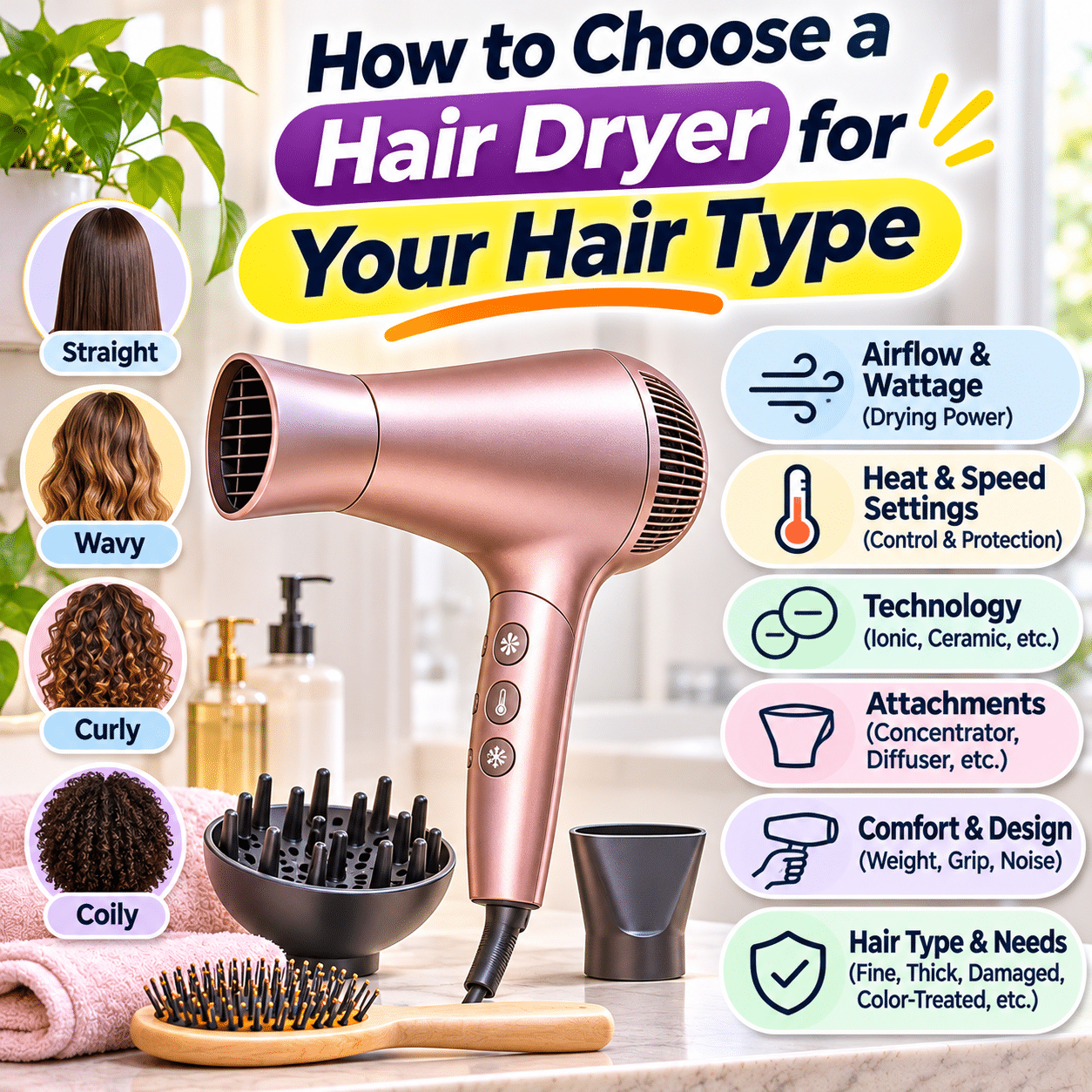
A hair dryer is one of the most commonly used personal care appliances, but choosing the right one involves more than comparing power ratings, styling attachments, or attractive designs. Different hair types respond differently to airflow, heat, and styling techniques, which means a dryer that works well for one person may not be the most comfortable or practical option for another.
Fine hair may benefit from controlled heat and gentle airflow, while thick or dense hair often requires efficient drying performance. Curly and coily hair may need a diffuser and carefully managed airflow to preserve curl patterns, while fragile or chemically treated hair may require extra attention to temperature control and mechanical handling.
Modern hair dryers offer a wide range of features, including multiple heat settings, adjustable fan speeds, ionic technology, ceramic heating components, concentrator nozzles, diffusers, cool-air functions, and automatic temperature regulation. Some of these features can improve styling convenience, but not every technology or premium feature provides meaningful benefits for every user.
The best hair dryer is one that helps you dry your hair efficiently while minimizing unnecessary heat exposure, supporting your preferred hairstyle, and remaining comfortable to use.
This comprehensive buying guide explains how to choose a hair dryer for different hair types, understand airflow and heat settings, compare drying technologies, evaluate attachments, consider safety and ergonomics, and make a practical purchasing decision that balances performance, comfort, durability, and long-term value.
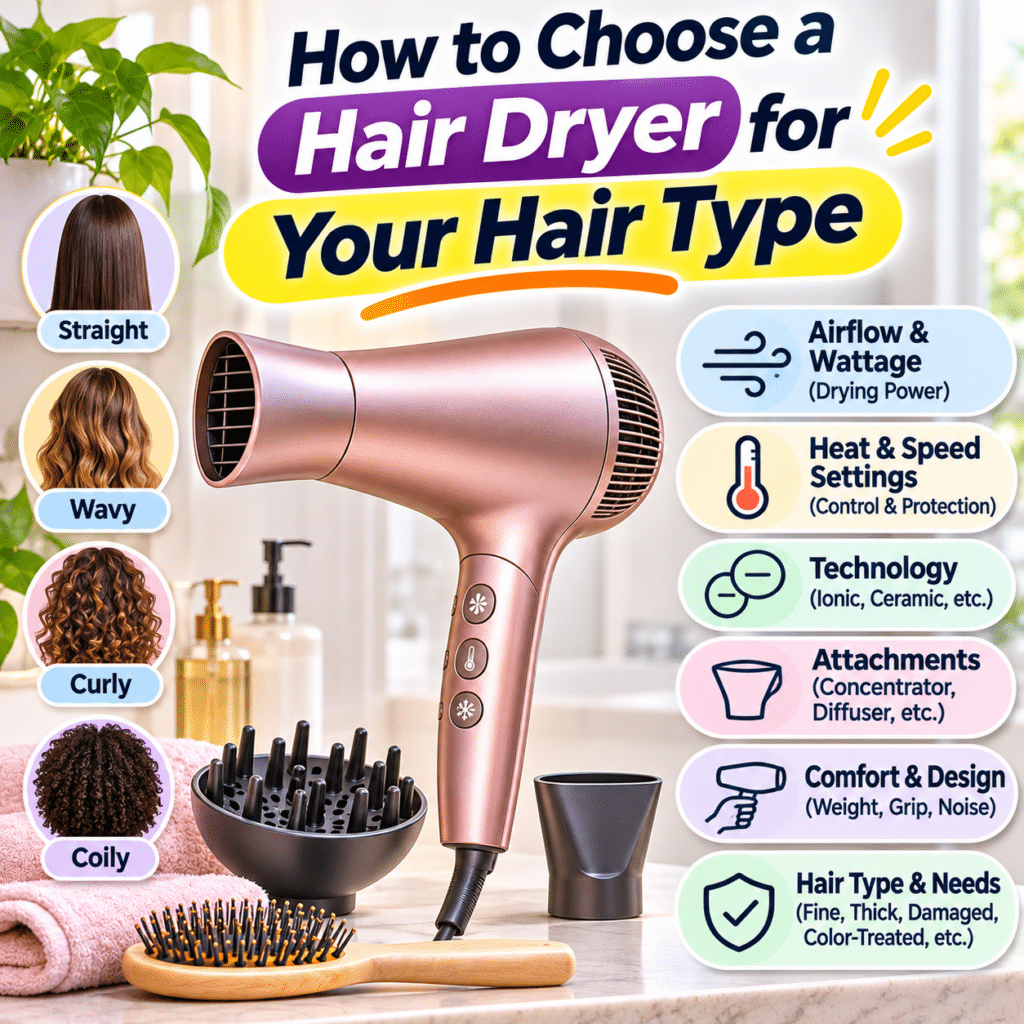
1. Understand Why Hair Type Matters When Choosing a Hair Dryer
Hair varies in thickness, density, curl pattern, porosity, condition, and length.
These characteristics influence how hair responds to drying and styling.
Hair Strand Thickness
Hair strands may be fine, medium, or coarse.
Fine strands have a smaller diameter and may be more vulnerable to certain forms of mechanical and heat-related damage.
Coarse strands have a larger diameter but can still experience damage from excessive heat.
Hair Density
Density refers to the number of hair strands growing within an area of the scalp.
A person may have fine individual strands but very dense hair.
This distinction matters because dense hair can take longer to dry.
Curl Pattern
Hair may be straight, wavy, curly, or coily.
Curl pattern affects how airflow influences the hair’s shape during drying.
Hair Porosity
Porosity describes how readily hair absorbs and releases moisture.
It is influenced by the structure and condition of the hair fiber.
Hair Condition
Bleaching, coloring, chemical treatments, frequent heat styling, and environmental exposure may affect hair strength and moisture retention.
Hair Length
Long hair often requires more drying time, although density and thickness can be equally important.
Understanding these characteristics helps you select a dryer based on actual needs rather than broad marketing categories.
2. Identify Your Main Hair Drying Goals
Before comparing hair dryers, decide what you want the appliance to accomplish.
Everyday Drying
If your primary goal is simply drying hair after washing, prioritize efficient airflow, adjustable heat, and comfortable handling.
Smooth Blowouts
For smoother styling, a concentrator nozzle and suitable brush technique may be useful.
Curl Definition
For curly or wavy hair, a diffuser can help distribute airflow more gently.
Volume
People seeking volume may benefit from controlled airflow and styling techniques that lift the hair near the roots.
Reduced Styling Time
A dryer with efficient airflow and appropriate heat control may shorten the time required for drying.
Travel Convenience
Compact size, voltage compatibility, and portability may be important for frequent travelers.
Gentle Drying
People with fragile or damaged hair should prioritize adjustable temperature and controlled airflow.
A dryer should match your routine rather than require you to change your routine around unnecessary features.
3. Understand How a Hair Dryer Works
A typical hair dryer uses a motor-driven fan to move air through a heating system.
The resulting airflow helps evaporate moisture from the hair.
Main Components
Most hair dryers include:
- An electric motor.
- A fan or airflow mechanism.
- A heating element.
- Air intake openings.
- An outlet nozzle.
- Heat and speed controls.
- A handle and power cord.
- Protective components such as thermal cutoffs.
Some models include sensors, digital controls, or specialized attachments.
The Role of Airflow
Moving air carries moisture away from the hair surface.
Airflow is an important part of drying efficiency.
The Role of Heat
Warm air can increase evaporation, but excessive temperature may damage the hair fiber or irritate the scalp.
The Role of Distance
The distance between the dryer and hair affects localized heat exposure.
The Role of Movement
Keeping the dryer moving can help prevent prolonged heating of one area.
Why Balance Matters
Efficient drying requires an appropriate combination of airflow, temperature, distance, and technique.
Maximum heat is not necessarily the best approach.
4. Understand Hair Dryer Wattage
Wattage describes the electrical power consumed by an appliance under specified conditions.
It is often prominently displayed in hair dryer advertising.
What Wattage Can Tell You
Wattage provides information about electrical power consumption.
It may relate to the energy available for heating and motor operation.
What Wattage Does Not Tell You
Wattage alone does not establish:
- Airflow speed.
- Airflow volume.
- Drying efficiency.
- Temperature consistency.
- Hair protection.
- Motor quality.
- Styling performance.
Two dryers with similar wattage may perform differently.
Higher Wattage Is Not Always Better
A higher-powered dryer may produce substantial heat or airflow, but design efficiency and control are equally important.
Lower Wattage Is Not Automatically Gentler
A lower-wattage dryer may still produce concentrated heat.
Choose Based on Performance
Evaluate airflow, temperature settings, attachments, and real-world usability rather than relying only on wattage.
5. Understand Airflow Speed and Volume
Airflow is one of the most important factors in hair drying performance.
Airflow Speed
Airflow speed describes how quickly air moves through the outlet.
Airflow Volume
Airflow volume describes how much air is moved over time.
Why Both Matter
A narrow nozzle can produce high local air velocity without necessarily moving a large total volume of air.
High Airflow
Strong airflow may help dry dense or thick hair more efficiently.
Gentle Airflow
Lower airflow can help reduce disruption to curls and delicate styles.
Adjustable Speed
Multiple fan speeds allow users to adapt drying intensity.
Evaluate Control Rather Than Maximum Output
The best dryer offers airflow appropriate for your hair type and styling goals.
6. Understand Heat Settings
Temperature control is essential for comfortable and responsible hair drying.
Low Heat
Low heat may be suitable for:
- Fine hair.
- Fragile hair.
- Sensitive scalps.
- Gentle finishing.
- Certain curl-drying techniques.
Medium Heat
Medium heat often provides a practical balance between drying speed and temperature exposure.
High Heat
High heat may accelerate evaporation under some conditions, but it also increases the risk of excessive thermal exposure.
Cool-Air Setting
A cool-air setting provides airflow with little or no intentional heating.
Independent Heat and Speed Controls
Separate controls provide more flexibility than systems that automatically link high airflow with high heat.
Temperature Regulation
Some advanced dryers monitor or regulate outlet temperature.
These systems may improve consistency, but performance depends on their actual design.
7. Compare Heat and Airflow Combinations
| Setting Combination | Potential Use | Main Consideration |
|---|---|---|
| Low heat + low airflow | Gentle drying, delicate curls | May take longer |
| Low heat + high airflow | Efficient drying with reduced intentional heat | Strong airflow may disturb styles |
| Medium heat + medium airflow | General everyday drying | Balance comfort and speed |
| Medium heat + high airflow | Dense or thick hair | Keep dryer moving |
| High heat + high airflow | Faster drying in some situations | Greater thermal exposure |
| Cool air + low airflow | Gentle finishing | Limited evaporation acceleration |
| Cool air + high airflow | Cooling and final styling | May disturb some hairstyles |
The appropriate combination depends on hair condition, density, styling technique, and personal comfort.
8. Choose a Hair Dryer for Fine Hair
Fine hair has relatively small individual strand diameters.
It may become weighed down by products or affected by excessive styling.
Prioritize Adjustable Heat
A dryer with low and medium temperature options provides flexibility.
Choose Controlled Airflow
Very strong airflow may make fine hair difficult to manage.
Consider a Concentrator Nozzle
A concentrator can help direct airflow during controlled styling.
Look for Lightweight Design
Fine hair often does not require an especially bulky appliance.
Avoid Unnecessary High Heat
Use the lowest effective temperature.
Consider Volume Techniques
Drying hair in sections or directing airflow near the roots can help create volume.
Recommended Feature Priorities
- Adjustable heat.
- Multiple airflow speeds.
- Comfortable weight.
- Concentrator attachment.
- Cool-air function.
- Reliable temperature control.
9. Choose a Hair Dryer for Thick Hair
Thick hair may refer to coarse strands, high density, or both.
These characteristics should be considered separately.
Prioritize Efficient Airflow
Strong, controllable airflow may reduce drying time.
Choose Multiple Heat Settings
Adjustable temperature helps balance drying speed and heat exposure.
Consider a Concentrator
A concentrator may help direct air through dense sections.
Evaluate Motor Performance
Consistent airflow under extended use can be important.
Consider Weight
Drying dense hair may take longer, making ergonomic design particularly valuable.
Avoid Relying Only on High Heat
Strong airflow and sectioning may improve efficiency without requiring maximum temperature.
Recommended Feature Priorities
- Strong adjustable airflow.
- Independent heat controls.
- Comfortable balance.
- Suitable concentrator.
- Durable motor construction.
- Easy-to-clean air filter.
10. Choose a Hair Dryer for Straight Hair
Straight hair may be fine, medium, or coarse.
Its styling needs depend on strand characteristics and desired finish.
For Everyday Drying
Choose adjustable airflow and temperature.
For Smooth Styling
A concentrator nozzle can help direct airflow along sections of hair.
For Volume
Controlled airflow and brushing techniques may help lift roots.
For Fine Straight Hair
Avoid excessive heat and unnecessary tension.
For Thick Straight Hair
Efficient airflow may improve drying convenience.
Consider Flyaways
Styling technique, humidity, and hair condition influence flyaways.
Ionic features may affect static under certain conditions, but results vary.
11. Choose a Hair Dryer for Wavy Hair
Wavy hair can range from loose bends to well-defined waves.
Airflow can either support or disrupt the natural pattern.
Consider a Diffuser
A diffuser can distribute airflow over a wider area.
Use Adjustable Speed
Lower or moderate airflow may help preserve wave definition.
Control Heat
Low or medium heat is often a practical starting point.
Avoid Excessive Handling
Frequent brushing or touching during drying may alter the wave pattern.
Consider Styling Preferences
People who prefer smooth blowouts may benefit from a concentrator instead.
Recommended Feature Priorities
- Diffuser compatibility.
- Adjustable airflow.
- Multiple heat settings.
- Comfortable handling.
- Cool-air function.
12. Choose a Hair Dryer for Curly Hair
Curly hair often benefits from controlled airflow that minimizes unnecessary disruption.
Prioritize a Suitable Diffuser
A diffuser can help distribute air and support curl shape during drying.
Choose Low and Medium Airflow Options
Strong concentrated airflow may separate curl groups.
Use Controlled Heat
Avoid prolonged high-temperature exposure.
Consider Diffuser Size
A larger diffuser bowl may accommodate longer or denser curls.
Evaluate Attachment Stability
A diffuser should attach securely without becoming unstable during use.
Consider Drying Technique
Some users prefer gently placing sections of hair into the diffuser bowl.
Others prefer hovering the diffuser near the hair.
Recommended Feature Priorities
- Well-designed diffuser.
- Low airflow setting.
- Adjustable heat.
- Comfortable weight.
- Secure attachment system.
- Cool-air option.
13. Choose a Hair Dryer for Coily Hair
Coily hair often has tightly curved strands that may be more vulnerable to breakage from certain mechanical handling techniques.
Prioritize Gentle Temperature Control
Avoid unnecessary high heat.
Choose Adjustable Airflow
Controlled airflow can support different drying methods.
Consider Diffuser Compatibility
A diffuser may be useful when preserving natural texture.
Consider Comb Attachments Carefully
Some dryers offer comb or pick attachments.
These can assist with stretching or styling but may create tension if used aggressively.
Minimize Mechanical Stress
Avoid excessive pulling and repeated passes.
Evaluate Handle Comfort
Longer styling sessions make weight and balance important.
Recommended Feature Priorities
- Independent heat and speed controls.
- Diffuser option.
- Appropriate comb attachments if desired.
- Comfortable ergonomics.
- Reliable temperature regulation.
14. Choose a Hair Dryer for Damaged or Fragile Hair
Hair affected by bleaching, chemical processing, frequent heat styling, or mechanical wear may require extra care.
Prioritize Lower Temperature Options
Choose a dryer that provides genuinely usable low and medium heat settings.
Consider Temperature Regulation
Consistent temperature control may help avoid unnecessary overheating.
Avoid Excessive Airflow Concentration
A narrow nozzle positioned too close to hair can increase localized exposure.
Reduce Repeated Passes
Efficient sectioning may help limit repeated heating.
Avoid Aggressive Brushing
Mechanical tension can contribute to breakage.
Use Appropriate Hair Care Products
Some heat-protective styling products may reduce certain forms of heat-related damage, but they do not make high temperatures harmless.
Recommended Feature Priorities
- Gentle heat settings.
- Adjustable airflow.
- Temperature monitoring.
- Comfortable weight.
- Cool-air function.
- Suitable attachments.
15. Choose a Hair Dryer for Color-Treated Hair
Color-treated hair may have different care requirements depending on the coloring process.
Consider Hair Condition
Permanent coloring, bleaching, and other chemical treatments can affect the hair fiber.
Avoid Excessive Heat
Repeated high-temperature styling may contribute to dryness and damage.
Choose Adjustable Settings
Low and medium heat provide flexibility.
Consider Gentle Drying Techniques
Use controlled airflow and avoid prolonged heating.
Understand Color Fading
Color fading depends on many factors, including washing, sunlight, product formulation, and hair condition.
A hair dryer alone does not determine color longevity.
Prioritize Overall Hair Health
Choose a dryer that supports efficient drying without unnecessary thermal stress.
16. Choose a Hair Dryer for Short Hair
Short hair often requires less drying time, although density and texture still matter.
Compact Designs
A smaller dryer may be convenient.
Precise Airflow
A concentrator can help style shorter sections.
Adjustable Heat
Lower settings may be sufficient.
Comfortable Handling
A lightweight dryer can make quick daily styling easier.
Avoid Unnecessary Features
A simple dryer may meet the needs of many short hairstyles.
17. Choose a Hair Dryer for Long Hair
Long hair can require extended drying and styling.
Consider Airflow Efficiency
Consistent airflow can help manage drying time.
Evaluate Weight
A heavy dryer may cause arm fatigue.
Consider Cord Length
Adequate cord length improves movement around the head.
Use Sectioning
Dividing long hair into manageable sections can improve control.
Choose Suitable Attachments
A concentrator or diffuser may be useful depending on hair texture.
Avoid Prolonged Heat Exposure
Keep the dryer moving and use appropriate temperature settings.
18. Understand Hair Porosity
Hair porosity influences how hair interacts with water.
Lower-Porosity Hair
Hair with relatively low porosity may resist water penetration.
However, drying behavior also depends on density, length, and product buildup.
Higher-Porosity Hair
Hair with higher porosity may absorb water readily and may also lose moisture quickly under certain conditions.
High porosity can be associated with hair damage.
Avoid Oversimplified Porosity Tests
Popular home tests, such as floating a strand of hair in water, are not reliable scientific measurements of hair porosity.
Choose Based on Observed Behavior
Consider how your hair responds to washing, drying, and styling.
Prioritize Adjustable Controls
A dryer with flexible settings is more useful than one marketed for a single porosity category.
19. Understand Ionic Hair Dryer Technology
Ionic hair dryers are commonly marketed as reducing static and improving smoothness.
What Ionic Technology Means
Some dryers generate charged particles, often described as negative ions.
Potential Effects
Ionic systems may influence electrostatic behavior and moisture interactions under certain conditions.
Important Limitations
Performance depends on device design, hair characteristics, environmental humidity, and styling technique.
Marketing Claims
Statements that ionic technology universally prevents damage, seals the cuticle, or dramatically improves hair health should be evaluated cautiously.
Is Ionic Technology Necessary?
No.
A conventional dryer with good airflow and temperature control can provide effective drying.
Who May Find It Useful?
Users concerned about static or flyaways may wish to compare ionic and non-ionic designs, but results are individual.
20. Understand Ceramic Hair Dryer Technology
Ceramic materials may be used in heating components or coatings.
Potential Advantages
Ceramic components can influence heat distribution within a device.
What Ceramic Does Not Guarantee
A ceramic label does not establish:
- A specific outlet temperature.
- Superior hair protection.
- Faster drying.
- Better airflow.
- Uniform performance across all models.
Evaluate the Complete Dryer
Temperature control, airflow design, and safety mechanisms matter more than material labels alone.
21. Understand Tourmaline Technology
Tourmaline is sometimes incorporated into hair dryer components or coatings.
Common Marketing Claims
Tourmaline dryers may be promoted for ionic effects or smooth styling.
Evidence Considerations
Actual performance depends on product design and operating conditions.
Avoid Assuming Universal Benefits
The presence of tourmaline does not automatically make a dryer safer or more effective.
Compare Practical Specifications
Prioritize airflow, temperature adjustment, attachments, and comfort.
22. Understand Infrared Hair Dryer Claims
Some dryers are marketed as using infrared heat.
What Infrared Radiation Is
Infrared radiation is a form of electromagnetic radiation associated with thermal energy.
Conventional Heat Also Involves Radiation
Ordinary heated objects emit infrared radiation.
Marketing Distinctions
A product’s use of the term “infrared” does not by itself establish a unique drying benefit.
Evaluate Evidence
Look for credible product-specific testing.
Avoid Unsupported Assumptions
Claims of dramatically reduced damage or unusually deep moisture protection require appropriate evidence.
23. Understand Digital Motors and High-Speed Hair Dryers
Some modern hair dryers use compact high-speed motors and specialized airflow systems.
Potential Advantages
Depending on design, these may provide:
- Strong airflow.
- Compact motor configurations.
- Precise electronic control.
- Different weight distribution.
Important Considerations
High motor speed does not automatically mean better drying.
Airflow Engineering Matters
Fan design, outlet geometry, and resistance affect performance.
Noise Characteristics
High-speed motors may produce different sound frequencies.
Repairability
Compact electronic systems may be difficult to repair.
Long-Term Value
Evaluate durability, warranty, and replacement availability.
24. Compare Common Hair Dryer Technologies
| Technology | Main Purpose or Claim | What to Evaluate |
|---|---|---|
| Conventional heating | Warm airflow for evaporation | Temperature and airflow control |
| Ionic system | Influence static and hair behavior | Product-specific evidence |
| Ceramic components | Heat distribution characteristics | Overall temperature regulation |
| Tourmaline components | Often marketed for ionic effects | Real performance, not terminology |
| Infrared features | Specialized heat delivery claims | Evidence and operating temperature |
| High-speed motor | Strong airflow potential | Actual airflow and ergonomics |
| Digital temperature sensing | Monitor or regulate heat | Sensor design and control accuracy |
The most useful technologies are those that improve practical performance in ways relevant to your hair.
25. Understand Hair Dryer Attachments
Attachments change how air exits the dryer.
They can significantly influence styling.
Concentrator Nozzle
A concentrator narrows and directs airflow.
Diffuser
A diffuser spreads airflow across a wider area.
Comb Attachment
A comb attachment combines airflow with a comb-like structure.
Smoothing Attachment
Some specialized attachments are designed to help guide hair during smoothing.
Styling Brush Attachment
Certain appliances combine drying and brushing functions.
Attachment Compatibility
Not every accessory fits every dryer.
Secure Fit
Attachments should remain stable during normal operation.
26. Choose the Right Concentrator Nozzle
Concentrator nozzles are particularly useful for controlled styling.
Narrow Concentrators
These direct air into a relatively focused stream.
Wider Concentrators
These distribute air across a broader section.
Styling Applications
Concentrators may help with:
- Smooth blowouts.
- Directional drying.
- Root styling.
- Controlled brush work.
Heat Concentration
A narrow nozzle can concentrate hot airflow.
Avoid holding it too close to the hair or scalp.
Check Attachment Design
Look for secure attachment and suitable heat-resistant construction.
27. Choose the Right Diffuser
Diffusers are popular among people with wavy, curly, and coily hair.
Bowl Size
Larger bowls may accommodate more hair at once.
Finger Design
Some diffusers have projecting fingers that help position hair.
Airflow Distribution
The diffuser should distribute air in a manner suitable for the intended styling technique.
Attachment Stability
A secure connection is important.
Compatibility
Universal diffusers may not fit every dryer.
Heat Resistance
Choose attachments designed for the dryer’s operating temperatures.
Cleaning
A diffuser should be easy to remove and clean.
28. Compare Concentrators and Diffusers
| Feature | Concentrator | Diffuser |
|---|---|---|
| Airflow pattern | Focused | Distributed |
| Typical styling goal | Smoothing and directional styling | Curl and wave definition |
| Common hair applications | Straightening, blowouts, root control | Curly, wavy, coily styling |
| Airflow intensity at hair | More concentrated | Generally more dispersed |
| Technique | Direct air along sections | Hover or gently support sections |
| Main caution | Localized heat exposure | Attachment fit and drying time |
Neither attachment is universally better.
Choose according to the desired hairstyle.
29. Understand the Cool-Shot Function
Many hair dryers include a cool-shot button.
What It Does
The function reduces or interrupts intentional heating while airflow continues.
Styling Uses
Cool air may help hair cool after warm styling.
Comfort
It can provide a more comfortable finishing stage.
Limitations
Cool air does not reverse existing heat damage.
Button Design
Some dryers require the button to be held continuously.
Others offer a selectable cool setting.
Practical Value
A cool-air function is useful but should not take priority over safe heat control and efficient airflow.
30. Evaluate Hair Dryer Weight
Weight affects comfort, especially during extended use.
Lightweight Dryers
These may reduce arm fatigue.
Heavier Dryers
Some heavier designs may offer different motor configurations or materials.
Balance Matters
A well-balanced dryer can feel more comfortable than a lighter but poorly balanced one.
Consider Wrist Position
The handle and nozzle arrangement influence wrist movement.
Try the Grip When Possible
A brief handling test can reveal whether the design feels awkward.
Long Styling Sessions
People with long or dense hair may benefit particularly from comfortable weight distribution.
31. Consider Handle Design and Ergonomics
The handle should support natural, controlled movement.
Grip Size
Choose a handle appropriate for your hand.
Surface Texture
Nonslip materials may improve control.
Button Placement
Controls should not be accidentally activated during use.
Handle Angle
Different handle angles may feel more comfortable depending on styling technique.
Folding Handles
Folding designs can improve portability.
Accessibility
People with limited hand strength or mobility may benefit from larger grips and simplified controls.
32. Evaluate Hair Dryer Noise
Hair dryers can produce substantial noise.
Motor Sound
Motor design influences the sound profile.
Airflow Noise
High-speed air movement contributes to noise.
Frequency Characteristics
Two dryers with similar sound levels may have different perceived noise characteristics.
Published Noise Ratings
Some manufacturers provide decibel measurements.
However, measurements may not be directly comparable unless testing methods are similar.
Consider Household Needs
Noise may matter in shared homes, apartments, or early-morning routines.
Avoid Assuming Premium Means Quiet
Expensive dryers are not automatically quieter.
33. Consider Cord Length and Flexibility
Cord design affects convenience and safety.
Adequate Length
The cord should allow comfortable movement without excessive tension.
Swivel Connections
Some dryers use swivel mechanisms to reduce twisting.
Cord Thickness
A durable cord should be suitable for the appliance’s electrical requirements.
Storage
Avoid tightly wrapping the cord around the dryer if the manufacturer advises against it.
Electrical Safety
Do not use damaged cords or plugs.
Extension Cords
Hair dryers can draw substantial electrical power.
Follow manufacturer guidance and applicable electrical safety requirements rather than relying on unsuitable extension cords.
34. Understand Electrical Safety Features
Electrical safety should be a priority.
Thermal Protection
Many dryers include protective components that interrupt operation under abnormal overheating conditions.
Air Intake Protection
Protective grilles help prevent objects from entering the fan.
Appropriate Electrical Certification
Look for credible compliance information relevant to the market where the dryer will be used.
Voltage Compatibility
Verify the required voltage and frequency.
Bathroom Safety
Use hair dryers away from water and according to local electrical safety requirements.
Residual Current Protection
Appropriate residual current protection may reduce certain electrical hazards.
Damaged Appliances
Stop using a dryer with exposed wiring, abnormal overheating, sparking, or damaged components.
35. Understand Overheating and Airflow Blockage
Hair dryers rely on airflow for both drying and internal temperature management.
Blocked Air Intakes
Dust, lint, and hair can restrict airflow.
Reduced Cooling
Restricted airflow may cause internal temperatures to rise.
Automatic Shutoff
Some dryers stop operating when thermal protection activates.
Maintenance
Clean removable filters according to manufacturer instructions.
Avoid Covering Air Openings
Do not place the dryer on soft materials that block ventilation while operating.
Persistent Overheating
Repeated overheating may indicate a problem requiring inspection or replacement.
36. Evaluate Removable Filters
A removable air intake filter can simplify maintenance.
Why Filters Matter
Air intakes may accumulate dust, lint, and loose hair.
Cleaning Convenience
Removable filters can make routine cleaning easier.
Follow Instructions
Some filters can be rinsed, while others require dry cleaning methods.
Dry Completely
Never reinstall a washable filter while wet unless the manufacturer specifically permits it.
Inspect for Damage
Damaged filters or grilles may compromise safe operation.
Long-Term Value
Easy maintenance can support reliable airflow over time.
37. Choose a Hair Dryer for Sensitive Scalps
People with sensitive scalps may find high temperatures uncomfortable.
Prioritize Low Heat
A usable low-temperature setting is important.
Maintain Distance
Avoid directing hot airflow too close to the scalp.
Keep the Dryer Moving
Do not hold concentrated heat over one area for extended periods.
Consider Gentle Airflow
Lower speed may improve comfort.
Avoid Irritating Attachments
Comb attachments should not scratch the scalp.
Seek Professional Advice When Needed
Persistent scalp pain, irritation, or inflammation should be assessed by an appropriate healthcare professional.
38. Choose a Hair Dryer for Children
Hair dryers used for children require careful supervision.
Adult Operation
Young children should not operate heated electrical appliances without appropriate supervision.
Low Heat
Choose gentle settings.
Comfortable Noise
Some children may be sensitive to loud airflow.
Safe Distance
Keep the outlet away from the scalp and skin.
Cord Safety
Prevent pulling, entanglement, or accidental contact with water.
Avoid Unnecessary Styling Heat
Basic gentle drying is generally preferable to prolonged heated styling.
39. Choose a Hair Dryer for Older Adults
Ergonomics and ease of operation can be particularly important.
Lightweight Construction
A manageable dryer may reduce arm fatigue.
Simple Controls
Clearly labeled switches improve convenience.
Comfortable Grip
Handle shape should suit the user’s mobility.
Cord Management
Avoid cords that create tripping or entanglement hazards.
Moderate Heat
Choose settings that provide comfortable drying without excessive temperature.
Stable Storage
Store the dryer where it can be retrieved without awkward reaching.
40. Choose a Hair Dryer for Travel
Travel hair dryers should balance portability and performance.
Compact Size
Smaller appliances are easier to pack.
Folding Handles
These may reduce storage space.
Dual Voltage
Some dryers support more than one voltage range.
Voltage Selection
Certain dual-voltage dryers require manual switching.
Plug Adapters
A plug adapter changes physical plug compatibility but does not necessarily convert voltage.
Lightweight Construction
Weight matters when luggage space and limits are restricted.
Travel Accessories
Protective pouches can help organize cords and attachments.
41. Understand Voltage Compatibility
Hair dryers can consume substantial electrical power, making voltage compatibility especially important.
Single-Voltage Dryers
These are designed for a specified electrical supply.
Dual-Voltage Dryers
Some travel models support multiple voltage systems.
Automatic Versus Manual Selection
Check whether voltage adjustment is automatic or requires a switch.
Frequency Compatibility
Electrical frequency requirements should also be verified.
Avoid Improvised Solutions
Do not assume a small travel adapter can safely operate a high-power dryer on an incompatible supply.
Check Manufacturer Instructions
Use the appliance only with a suitable electrical system.
42. Compare Full-Size and Travel Hair Dryers
| Feature | Full-Size Hair Dryer | Travel Hair Dryer |
|---|---|---|
| Portability | Depends on design | Usually compact |
| Handle | Often fixed | May fold |
| Airflow options | Wide range | Varies |
| Heat settings | Often multiple | May be limited |
| Attachments | Often available | Sometimes limited |
| Voltage compatibility | Model-specific | Dual-voltage options common |
| Everyday comfort | Often optimized for home use | Depends on size and grip |
| Storage | Requires more space | Easier to pack |
A travel dryer can work well at home, but compact size does not automatically mean better performance.
43. Consider Hair Dryer Storage
Proper storage helps protect the appliance.
Allow Cooling
Let the dryer cool before placing it in an enclosed cabinet or bag.
Protect the Cord
Avoid sharp bends and excessive tension.
Keep Away From Moisture
Store electrical appliances in a suitable dry location.
Use Appropriate Holders
Wall-mounted or countertop holders should be stable and heat-resistant where necessary.
Protect Attachments
Store nozzles and diffusers where they will not be crushed.
Keep Air Intakes Clear
Avoid storing the dryer in dusty conditions when possible.
44. Evaluate Durability and Construction Quality
A hair dryer should withstand regular use.
Motor Quality
Motor durability influences long-term reliability.
Housing Materials
The housing should resist normal handling and operating temperatures.
Switches
Controls should operate consistently.
Attachment Connections
Nozzles and diffusers should fit securely.
Cord Strain Relief
The connection between the cord and handle should be appropriately protected.
Filter Design
Accessible filters support maintenance.
Warranty Support
A clear warranty and service options may improve ownership value.
45. Understand Hair Dryer Motor Types
Hair dryers use different motor technologies.
Traditional AC Motors
Some dryers use alternating-current motor designs.
These may be found in certain professional or heavy-duty models.
DC Motors
Direct-current motor designs are common in many household dryers.
Brushless Motors
Some modern dryers use electronically controlled brushless motors.
Important Differences
Motor technologies vary in:
- Size.
- Weight.
- Efficiency.
- Noise.
- Control capabilities.
- Durability.
- Manufacturing cost.
Avoid Universal Rankings
An AC motor is not automatically more durable than every DC motor, and a brushless motor does not guarantee superior drying.
Evaluate the complete product.
46. Understand Hair Dryer Energy Consumption
Hair dryers use electricity while operating.
Basic Energy Calculation
Energy consumption can be estimated using:
Energy (kWh) = Power (kW) × Operating Time (hours)
For example, a 1,500-watt dryer operating at its rated power for 10 minutes would consume approximately:
1.5 kW × (10 ÷ 60) hours = 0.25 kWh.
Actual consumption depends on operating settings and device behavior.
Higher Wattage Does Not Always Mean Higher Total Energy Use
A higher-powered dryer may complete drying more quickly.
Drying Time Matters
Total energy consumption depends on both power and duration.
Avoid Excessive Drying
Continuing to heat hair after it is sufficiently dry wastes energy and increases unnecessary exposure.
Compare Practical Efficiency
Evaluate drying performance and operating time rather than wattage alone.
47. Understand Total Cost of Ownership
The purchase price is only one component of long-term cost.
Initial Purchase
The cost of the dryer and included accessories.
Electricity
Energy use depends on power and operating time.
Replacement Attachments
Some specialized accessories may need replacement.
Repairs
Serviceability varies.
Product Lifespan
Durable construction can reduce replacement frequency.
Warranty
Warranty coverage may affect repair costs.
Long-Term Value
A reliable mid-range dryer may provide better value than an expensive model with features you rarely use.
48. Compare Budget, Mid-Range, and Premium Hair Dryers
Budget Hair Dryers
Common characteristics may include:
- Basic heat settings.
- Simple airflow controls.
- Standard motor designs.
- Limited attachments.
These may be sufficient for straightforward daily drying.
Mid-Range Hair Dryers
Potential features include:
- Independent heat and speed controls.
- Improved ergonomics.
- Multiple attachments.
- Better temperature regulation.
- Removable filters.
Premium Hair Dryers
Potential features include:
- Advanced motor systems.
- Digital temperature monitoring.
- Specialized attachments.
- Distinctive airflow engineering.
- Premium materials.
- Additional electronic controls.
Are Premium Dryers Worth It?
They may be worthwhile for users who benefit from specific features or frequently perform detailed styling.
However, higher prices do not guarantee better results for every hair type.
49. Compare Hair Dryer Features by Hair Type
| Hair Type or Need | Priority Features | Useful Attachments | Main Consideration |
|---|---|---|---|
| Fine hair | Gentle heat, adjustable airflow | Concentrator | Avoid excessive heat |
| Thick or dense hair | Efficient airflow, comfortable weight | Concentrator | Drying time |
| Straight hair | Controlled airflow, adjustable heat | Concentrator | Smooth styling |
| Wavy hair | Low-to-medium airflow | Diffuser | Preserve wave pattern |
| Curly hair | Gentle airflow, multiple heat settings | Diffuser | Minimize curl disruption |
| Coily hair | Controlled heat, adjustable speed | Diffuser or suitable comb | Avoid tension and breakage |
| Damaged hair | Low heat, temperature regulation | Suitable concentrator or diffuser | Minimize thermal stress |
| Color-treated hair | Adjustable temperature | Depends on style | Protect fragile hair |
| Short hair | Compact, easy-to-control design | Concentrator | Precision |
| Long hair | Efficient airflow, lightweight balance | Concentrator or diffuser | Comfort during extended use |
| Sensitive scalp | Gentle heat and airflow | Optional | Avoid localized overheating |
| Travel | Compact size, compatible voltage | Compact attachments | Portability and electrical safety |
50. Common Mistakes to Avoid When Buying a Hair Dryer
Mistake 1: Choosing Based Only on Wattage
Wattage does not directly measure drying quality.
Better approach: Compare airflow, heat control, and usability.
Mistake 2: Assuming Maximum Heat Is Best
High heat can increase thermal exposure.
Better approach: Use the lowest effective temperature.
Mistake 3: Ignoring Hair Texture
A dryer without suitable attachments may be inconvenient for certain hairstyles.
Better approach: Match attachments and airflow to your hair type.
Mistake 4: Buying a Dryer Without Adjustable Heat
Limited controls reduce flexibility.
Better approach: Choose multiple usable temperature settings.
Mistake 5: Overlooking Airflow Control
Strong airflow can disrupt curls or delicate styles.
Better approach: Look for adjustable fan speeds.
Mistake 6: Ignoring Dryer Weight
A heavy dryer may cause fatigue.
Better approach: Consider balance and comfort.
Mistake 7: Buying Incompatible Attachments
Not all diffusers and concentrators fit every dryer.
Better approach: Confirm compatibility.
Mistake 8: Trusting Technology Labels Without Evidence
Terms such as ionic, ceramic, and infrared do not guarantee superior performance.
Better approach: Evaluate practical results and credible specifications.
Mistake 9: Forgetting Electrical Compatibility
Incorrect voltage can damage appliances and create hazards.
Better approach: Verify electrical requirements before use.
Mistake 10: Ignoring Filter Maintenance
Blocked air intakes may cause overheating.
Better approach: Choose accessible filters and clean them properly.
Mistake 11: Using a Dryer Too Close to Hair
Concentrated heat can increase localized exposure.
Better approach: Maintain appropriate distance and keep the dryer moving.
Mistake 12: Choosing Based Only on Appearance
An attractive design may not be comfortable or practical.
Better approach: Prioritize performance and ergonomics.
Mistake 13: Overpaying for Unused Features
Advanced technology may add cost without meaningful benefit.
Better approach: Focus on features relevant to your routine.
Mistake 14: Ignoring Warranty Support
Repair or replacement may become difficult.
Better approach: Review service availability.
Mistake 15: Forgetting Long-Term Maintenance
Poor maintenance can shorten product life.
Better approach: Follow cleaning and storage instructions.
51. How to Choose a Hair Dryer: Step by Step
A structured buying process can simplify the decision.
Step 1: Identify Your Hair Type
Consider strand thickness, density, curl pattern, length, and condition.
Step 2: Define Your Styling Goals
Decide whether you primarily need everyday drying, smoothing, curl definition, volume, or travel convenience.
Step 3: Prioritize Adjustable Heat
Choose a dryer with appropriate low, medium, and higher settings.
Step 4: Evaluate Airflow
Look for airflow strength and control suitable for your hair.
Step 5: Choose Necessary Attachments
Consider a concentrator, diffuser, or other accessories.
Step 6: Evaluate Temperature Regulation
Look for reliable and understandable heat controls.
Step 7: Consider Weight and Balance
Choose a design comfortable for your typical drying duration.
Step 8: Check Noise
Consider whether operating sound is acceptable.
Step 9: Review Electrical Specifications
Verify voltage, frequency, plug compatibility, and safety information.
Step 10: Check Maintenance Requirements
Look for accessible filters and clear cleaning instructions.
Step 11: Evaluate Storage
Consider cord length, attachment storage, and available space.
Step 12: Compare Durability
Review construction quality and warranty support.
Step 13: Estimate Long-Term Costs
Consider energy consumption, repairs, and replacement.
Step 14: Evaluate Marketing Claims
Prioritize practical features over unsupported promises.
Step 15: Choose the Simplest Dryer That Meets Your Needs
A reliable dryer with suitable airflow and temperature control is often more valuable than unnecessary complexity.
52. Practical Hair Dryer Buying Checklist
Use this checklist before purchasing.
Hair Compatibility
- I understand my hair texture and density.
- I have considered my hair’s current condition.
- The dryer supports my styling goals.
- Suitable attachments are available.
- The airflow can be adjusted.
Heat and Performance
- The dryer has usable low and medium heat settings.
- Airflow is appropriate for my hair.
- Heat and speed controls are sufficiently flexible.
- The dryer has a cool-air function if desired.
- Temperature control is clearly explained.
Comfort and Convenience
- The weight is manageable.
- The handle is comfortable.
- The controls are accessible.
- The cord length is practical.
- Noise is acceptable.
- Attachments fit securely.
Safety and Maintenance
- Electrical specifications are compatible.
- Relevant safety information is available.
- The air filter can be maintained.
- Overheating protection is included.
- Cleaning instructions are clear.
- The appliance can be stored safely.
Long-Term Value
- The price fits my budget.
- Warranty terms are clear.
- Replacement accessories are available.
- The dryer appears durable.
- I have considered electricity use.
- I am not paying for unnecessary features.
53. Frequently Asked Questions
What Is the Best Hair Dryer for My Hair Type?
The best dryer depends on hair thickness, density, curl pattern, condition, and styling goals.
Choose adjustable heat, appropriate airflow, and suitable attachments.
Does Hair Type Really Matter When Choosing a Hair Dryer?
Yes.
Different hair types respond differently to airflow, temperature, and styling techniques.
What Hair Dryer Is Best for Fine Hair?
A dryer with gentle heat, adjustable airflow, and a suitable concentrator can be practical.
Avoid unnecessary high-temperature exposure.
What Hair Dryer Is Best for Thick Hair?
Efficient airflow, multiple heat settings, and comfortable weight are important.
What Hair Dryer Is Best for Curly Hair?
A dryer with adjustable low airflow and a compatible diffuser is often useful.
What Hair Dryer Is Best for Coily Hair?
Look for controlled heat, flexible airflow, comfortable handling, and suitable attachments.
What Hair Dryer Is Best for Damaged Hair?
Prioritize gentle temperature settings, reliable control, and techniques that minimize repeated heat exposure.
What Hair Dryer Is Best for Color-Treated Hair?
A dryer with adjustable temperature and airflow is generally preferable to one that relies heavily on maximum heat.
Is a High-Wattage Hair Dryer Better?
Not necessarily.
Wattage alone does not determine airflow, drying efficiency, or hair protection.
How Many Watts Should a Hair Dryer Have?
There is no universal ideal wattage.
Choose based on actual performance, electrical compatibility, and intended use.
Does Higher Wattage Mean Faster Drying?
Not always.
Airflow engineering, heat settings, hair characteristics, and technique also influence drying time.
Is Strong Airflow Better Than High Heat?
Efficient airflow can help remove moisture without relying exclusively on high temperatures.
However, the best combination depends on the hair and styling goal.
Are Ionic Hair Dryers Better?
Ionic technology may influence static under certain conditions, but results vary.
It does not guarantee superior performance for every user.
Do Ionic Hair Dryers Prevent Heat Damage?
No technology eliminates the risk of damage from excessive heat.
Are Ceramic Hair Dryers Better?
Ceramic components may influence heat distribution, but overall performance depends on the complete dryer design.
Are Tourmaline Hair Dryers Worth Buying?
Tourmaline-related claims should be evaluated alongside practical specifications and credible evidence.
Do Infrared Hair Dryers Dry Hair More Gently?
Some products make this claim, but benefits depend on actual design and operating conditions.
Are Digital Hair Dryers Better Than Traditional Hair Dryers?
Digital controls may offer useful features, but they do not automatically provide better drying results.
What Is a High-Speed Hair Dryer?
It generally refers to a dryer using a motor and airflow system designed for relatively high-speed operation.
The term is not a universal measure of drying quality.
Do I Need a Diffuser?
A diffuser is particularly useful for some wavy, curly, and coily styling routines.
It is not necessary for everyone.
What Does a Diffuser Do?
A diffuser distributes airflow over a wider area, helping reduce concentrated air movement.
Can a Diffuser Reduce Frizz?
It may help some users preserve curl groups and reduce airflow-related disruption, but results depend on technique and hair condition.
Do I Need a Concentrator Nozzle?
A concentrator is useful for controlled airflow and smoothing techniques.
Can I Use a Concentrator on Curly Hair?
Yes, particularly when the goal is smoothing or stretching rather than preserving the natural curl pattern.
What Does the Cool-Shot Button Do?
It reduces intentional heating while maintaining airflow.
It can be useful during styling and finishing.
Does Cool Air Prevent Hair Damage?
Cool air reduces heat exposure during use, but it does not reverse damage already present.
How Hot Should a Hair Dryer Be?
Use a temperature that dries hair effectively without causing discomfort or excessive heat exposure.
There is no single ideal temperature for every hair type.
Is Low Heat Always Better?
Lower heat can reduce thermal exposure, but drying efficiency and total drying time also matter.
Use a balanced approach.
Can Hair Dryers Damage Hair?
Yes.
Excessive heat, prolonged exposure, and aggressive styling techniques can contribute to hair damage.
Is Air-Drying Always Healthier Than Blow-Drying?
Not necessarily.
Hair condition, drying duration, mechanical handling, and blow-drying technique all influence outcomes.
Should I Blow-Dry Hair When It Is Completely Wet?
Gently removing excess water with an appropriate towel or cloth before blow-drying can reduce the amount of moisture that must be evaporated.
Avoid aggressive rubbing.
How Far Should I Hold a Hair Dryer From My Hair?
Maintain a comfortable distance that avoids excessive localized heat.
Follow manufacturer guidance and keep the dryer moving.
Should I Keep the Hair Dryer Moving?
Yes.
Moving the dryer helps avoid concentrating heat on one area for too long.
Can a Hair Dryer Cause Scalp Irritation?
Excessive heat or concentrated airflow may cause discomfort or irritation.
Are Lightweight Hair Dryers Better?
Lightweight dryers can improve comfort, especially during long styling sessions.
However, balance and handle design also matter.
Does Hair Dryer Weight Affect Styling?
Yes.
A heavy or poorly balanced dryer may increase arm and wrist fatigue.
Are Expensive Hair Dryers Worth Buying?
They may offer useful features, but higher prices do not guarantee better results.
How Long Should a Hair Dryer Last?
Lifespan varies according to construction, use, maintenance, and operating conditions.
Do Professional Hair Dryers Work Better?
Professional models may be designed for frequent use, but their suitability for home users depends on individual needs.
What Is the Difference Between AC and DC Hair Dryer Motors?
These terms describe different motor technologies.
Performance depends on the specific design rather than motor type alone.
Are Brushless Motors Better?
Brushless motors can offer design advantages, but quality and performance vary.
Are Hair Dryers Energy-Efficient?
Energy consumption depends on electrical power and operating time.
Efficient drying techniques can help avoid unnecessary energy use.
Can I Use a Hair Dryer Every Day?
Daily use may be appropriate when performed carefully with suitable heat and airflow.
Avoid excessive thermal exposure.
Should I Use Heat Protectant?
Suitable heat-protective products may help reduce certain forms of heat-related damage, but they do not eliminate all risks.
Can I Use a Hair Dryer on Children’s Hair?
Yes, with appropriate adult supervision, gentle settings, and safe handling.
Are Hair Dryers Safe in Bathrooms?
They must be used according to electrical safety instructions and kept away from water.
Can I Use a Hair Dryer With an Extension Cord?
Follow manufacturer instructions and electrical safety requirements.
High-power appliances should not be connected through unsuitable extension cords.
What Happens if a Hair Dryer Overheats?
Some dryers activate thermal protection and shut off.
Persistent overheating requires attention.
How Often Should I Clean the Hair Dryer Filter?
Follow the manufacturer’s guidance and clean it whenever dust or lint accumulation affects airflow.
Can a Dirty Filter Damage a Hair Dryer?
Restricted airflow can contribute to overheating and reduced performance.
Are Travel Hair Dryers Good for Everyday Use?
Some are suitable, but compact models may offer fewer controls or attachments.
Do I Need a Dual-Voltage Hair Dryer?
Dual voltage is useful when traveling between regions with different electrical supplies.
Does a Plug Adapter Change Voltage?
No.
A basic plug adapter changes the physical plug connection, not the electrical voltage.
What Should I Prioritize When Buying a Hair Dryer?
Prioritize appropriate airflow, adjustable heat, comfort, suitable attachments, electrical safety, and long-term reliability.
54. Practical Drying Tips for Different Hair Types
Choosing a suitable dryer is important, but technique also affects the results.
Fine Hair
- Remove excess water gently.
- Use controlled heat.
- Avoid concentrating hot air on one section.
- Use a concentrator when appropriate.
- Finish with cooler air if desired.
Thick or Dense Hair
- Divide hair into manageable sections.
- Use efficient airflow.
- Keep the dryer moving.
- Avoid relying exclusively on maximum heat.
- Adjust settings as sections become drier.
Straight Hair
- Direct airflow in a controlled manner.
- Use a concentrator for smoothing.
- Avoid unnecessary repeated passes.
- Adjust heat according to hair condition.
Wavy Hair
- Consider a diffuser.
- Use low or moderate airflow.
- Minimize unnecessary handling.
- Adjust drying technique to preserve waves.
Curly Hair
- Use a compatible diffuser.
- Start with gentle airflow.
- Avoid aggressively separating curls.
- Keep heat exposure controlled.
Coily Hair
- Use appropriate sectioning.
- Minimize excessive tension.
- Choose gentle temperature settings.
- Use attachments suited to the desired style.
Damaged Hair
- Prioritize lower heat.
- Avoid repeated high-temperature passes.
- Use gentle handling.
- Consider reducing the frequency of heated styling.
Final Thoughts
Choosing a hair dryer for your hair type is about finding the right balance between airflow, temperature control, styling flexibility, comfort, and long-term reliability.
Fine hair may benefit from gentle heat and controlled airflow, while thick or dense hair often requires efficient drying performance. Wavy, curly, and coily hair may benefit from diffusers and adjustable airflow, while fragile or chemically treated hair requires particular attention to minimizing unnecessary heat exposure.
Features such as ionic technology, ceramic components, digital motors, and advanced temperature sensors may offer advantages in certain designs, but they should not distract from the fundamentals of effective drying.
A practical hair dryer should provide adjustable heat and speed settings, comfortable ergonomics, suitable attachments, reliable safety features, and straightforward maintenance.
Before purchasing, consider how often you dry your hair, how long your usual styling sessions last, which attachments you actually need, and whether the appliance fits your budget and storage space.
The right dryer should make your routine easier without encouraging excessive heat or complicated styling habits.
The best hair dryer is not simply the one that dries hair the fastest. It is the one that works comfortably with your hair type, supports your preferred styling routine, minimizes unnecessary thermal stress, and provides dependable performance for years to come.