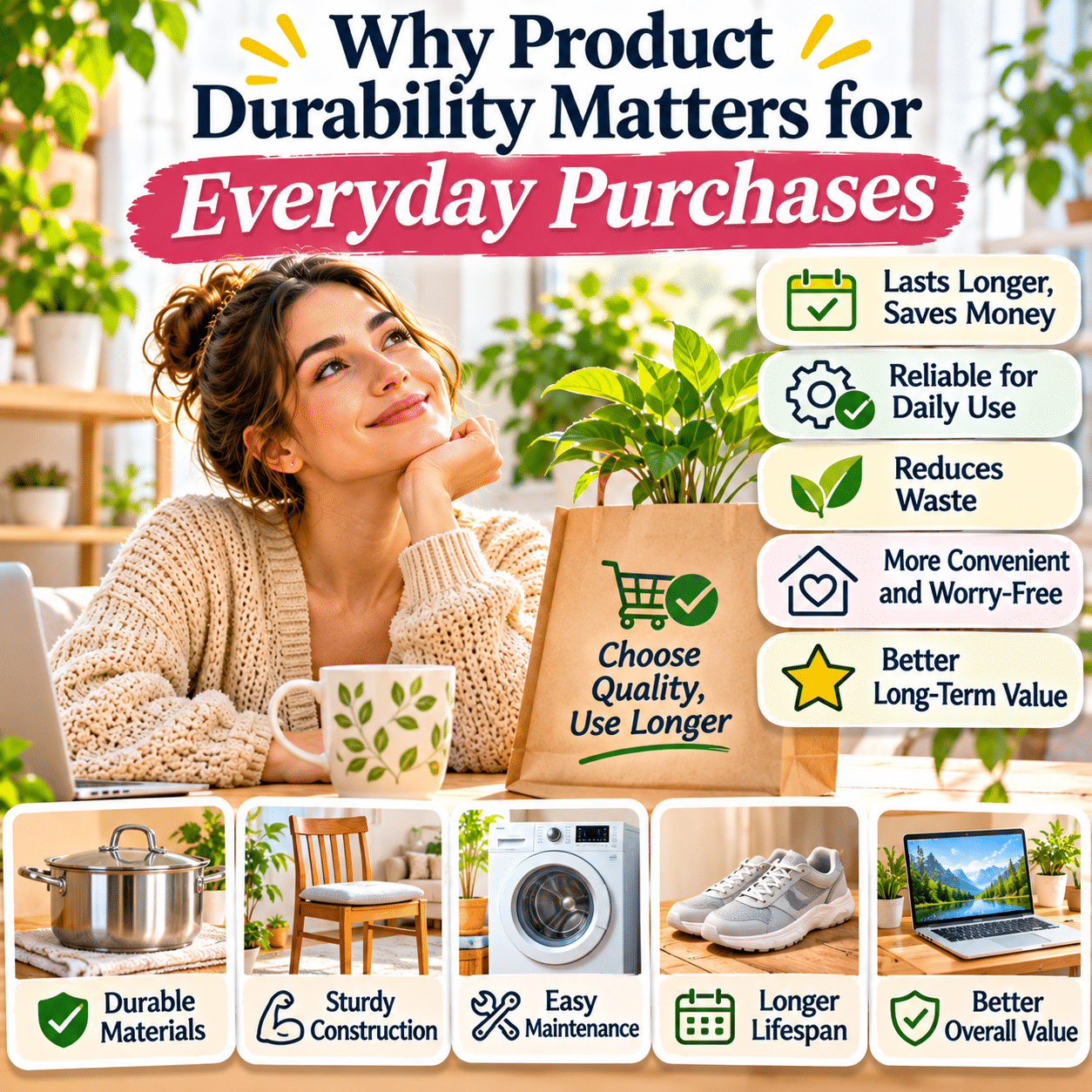
Everyday products play an important role in making modern life comfortable, practical, and convenient. From kitchen utensils and household appliances to clothing, furniture, electronics, and personal accessories, people rely on countless items to complete daily tasks and enjoy familiar routines.
When choosing these products, it is natural to consider appearance, features, convenience, and price. A product that looks attractive or offers an appealing discount may seem like an excellent purchase. However, one important factor deserves just as much attention: durability.
Product durability refers to how well an item maintains its intended function and acceptable condition over time under appropriate use and care. A durable product is designed and constructed to withstand the demands it is reasonably expected to encounter.
Durability matters because purchasing a product is rarely the end of the consumer experience. Items must be used, cleaned, stored, maintained, and sometimes repaired. Their long-term performance influences household expenses, convenience, satisfaction, and the resources required for replacement.
A low-priced product that breaks after a short period may eventually cost more than a moderately priced alternative that remains useful for years. Likewise, a beautiful piece of furniture may become disappointing if its materials cannot withstand ordinary household activity.
However, durability is not simply about buying the most expensive or heaviest product available. Higher prices do not automatically guarantee better quality, and different products require different levels of strength, maintenance, and longevity.
The most useful approach is to understand what durability means for a particular item, evaluate how it will be used, and choose products that provide a reasonable balance of performance, affordability, convenience, and expected lifespan.
By making durability part of everyday purchasing decisions, consumers can develop more practical buying habits, reduce avoidable replacement costs, and build a collection of belongings that genuinely supports daily life.
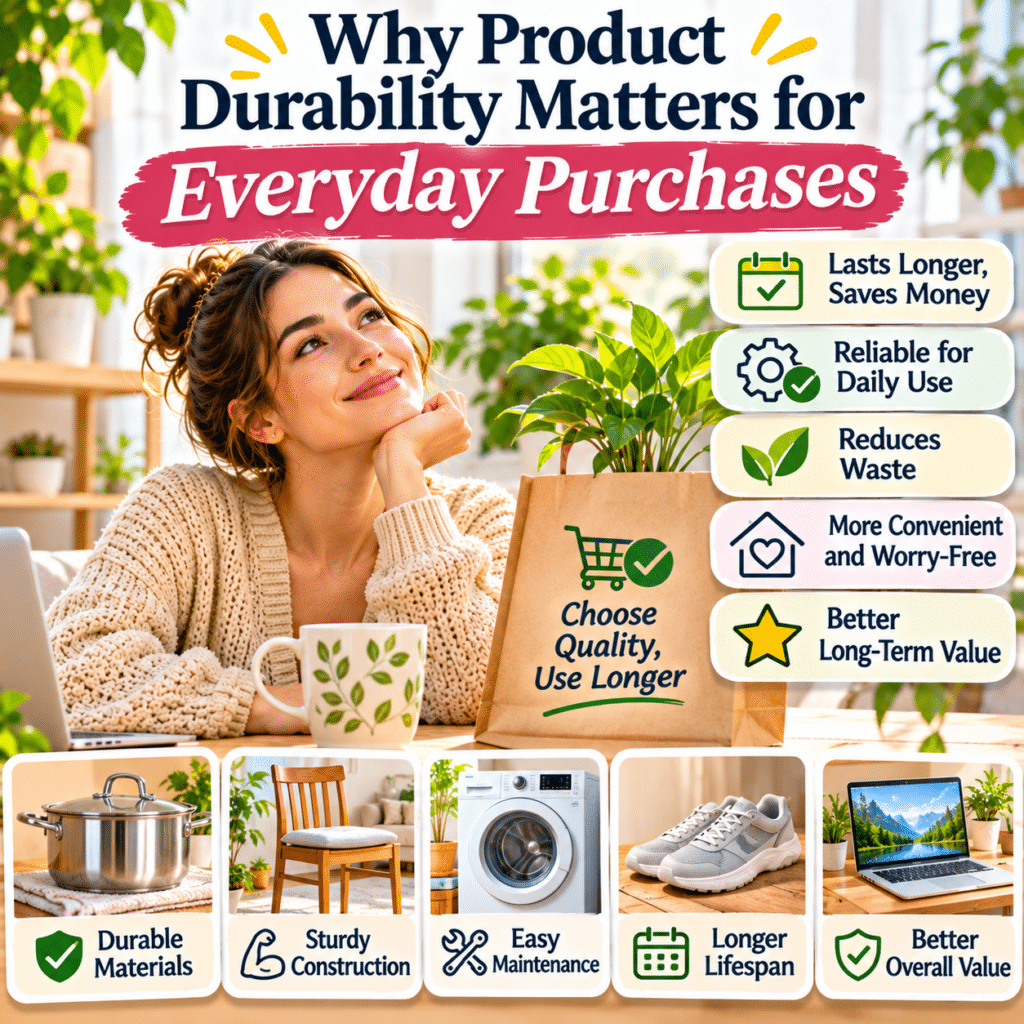
1. Understanding What Product Durability Really Means
Product durability describes an item’s ability to remain functional and suitable for its intended purpose over time.
This involves more than simply resisting visible damage.
A durable kitchen tool should continue performing its intended task. A durable chair should maintain appropriate stability and support. A durable garment should remain wearable after reasonable use and care.
Different products have different durability expectations.
A reusable shopping bag and a refrigerator are not expected to last for the same number of years.
The important consideration is whether the product performs reliably throughout a reasonable period of use.
2. Durability Is Different From Initial Product Quality
A product may appear well made when first purchased but perform poorly after repeated use.
Initial quality often involves visible characteristics such as finishing, appearance, construction, and immediate functionality.
Durability concerns how those characteristics hold up over time.
For example, a decorative finish may look attractive initially but wear away quickly with ordinary cleaning.
Similarly, a household appliance may operate smoothly during its first few uses but develop problems after repeated operation.
Evaluating durability requires looking beyond first impressions.
3. Everyday Products Experience Repeated Wear
Many household products are used frequently.
Kitchen utensils may be washed daily, furniture may support repeated movement, and clothing may undergo regular washing and drying.
These activities gradually place stress on materials and components.
Durable products are designed to tolerate appropriate levels of repeated use.
The type of wear varies according to the product.
Understanding expected wear helps consumers evaluate whether an item’s construction matches their lifestyle.
4. Durability Can Influence Long-Term Household Expenses
The purchase price is only one part of a product’s financial impact.
Repeated replacements, repairs, maintenance supplies, and related expenses may increase the total cost of ownership.
A product that remains useful for longer may reduce the frequency of replacement purchases.
However, durability must be considered alongside the initial price.
An extremely expensive product is not automatically the most economical choice.
The goal is to identify reasonable long-term value.
5. The Cheapest Option Is Not Always the Best Value
Low prices can be helpful, especially when managing a limited budget.
However, the least expensive product may not provide the lowest cost over time.
Consider two household items serving the same purpose.
One costs less but requires frequent replacement. The other costs more initially but remains functional for significantly longer.
Depending on their actual lifespans, the second item may offer better value.
Nevertheless, consumers should avoid assuming that every higher-priced product will last longer.
Evidence of construction quality and suitability matters more than price alone.
6. Cost Per Use Helps Explain Practical Value
Cost per use is a simple way to consider how much value a product provides throughout its useful life.
For example, an item purchased for $60 and used 300 times has a purchase cost of approximately $0.20 per use.
An item purchased for $20 and used only 40 times has a purchase cost of approximately $0.50 per use.
These calculations do not include maintenance, energy, or repair expenses.
They also depend on actual usage rather than optimistic predictions.
Still, cost per use can provide useful context when comparing products intended for frequent use.
7. Durable Products Can Reduce Replacement Frequency
Replacing household belongings requires time and effort.
Consumers may need to research alternatives, compare specifications, arrange delivery, dispose of damaged items, and learn how to use replacements.
Products that remain functional for longer can reduce how often these tasks become necessary.
This may be especially valuable for frequently used essentials.
Durability therefore offers a convenience benefit in addition to possible financial savings.
8. Reliability Is an Important Part of Everyday Convenience
An item that works consistently can make daily routines easier.
A reliable kitchen appliance, desk chair, or storage system allows people to focus on their activities rather than unexpected product problems.
Durability contributes to reliability when a product maintains performance through appropriate use.
However, reliability also depends on design, manufacturing consistency, maintenance, and operating conditions.
A product can be physically sturdy yet unreliable because of poorly designed internal components.
Consumers should consider both characteristics.
9. Materials Influence How Products Withstand Use
Different materials have different strengths and limitations.
Stainless steel, wood, glass, ceramics, textiles, plastics, and composite materials behave differently under pressure, moisture, temperature changes, and repeated handling.
No single material is best for every application.
Glass may resist certain types of staining but can break when dropped.
Metal may provide strength but can corrode under unsuitable conditions.
Material selection should match the product’s intended environment and function.
10. Construction Quality Matters as Much as Materials
Even high-quality materials can perform poorly when assembled incorrectly.
Joints, seams, fasteners, hinges, connectors, and supporting structures all influence durability.
A wooden chair, for example, depends not only on the wood but also on the design and strength of its joints.
Clothing durability depends partly on stitching, seam construction, and fabric compatibility.
Consumers can look for consistent finishing, secure connections, and appropriate construction details.
However, visual inspection alone cannot reveal every potential weakness.
11. Product Design Can Improve or Limit Longevity
Design influences how stress is distributed throughout a product.
A well-designed item should accommodate its intended use without placing unnecessary strain on vulnerable components.
For example, a storage shelf should be designed for its stated load capacity.
A reusable bottle should have a closure suited to repeated opening and cleaning.
A product with unnecessary complexity may also contain additional components that could fail, although complexity does not automatically indicate poor durability.
Practical design supports long-term performance.
12. Durability Should Match Frequency of Use
Not every purchase requires the same durability standard.
An item used several times a day may justify greater attention to construction and maintenance.
A specialty tool used only occasionally may have different requirements.
Frequency of use affects expected wear.
Consumers should consider realistic usage rather than assuming every product needs professional-grade construction.
Choosing according to actual demand can help balance affordability and longevity.
13. Kitchen Tools Benefit From Durable Construction
Kitchen utensils, cookware, cutting boards, and food-preparation equipment often experience repeated cleaning and handling.
Durability is especially relevant because these products may encounter moisture, heat, friction, and contact with food.
Suitable materials, secure handles, and appropriate cleaning requirements matter.
Food-contact safety should always take priority.
A durable product is not necessarily suitable for every cooking temperature or appliance.
Following manufacturer instructions helps preserve performance and safety.
14. Household Appliances Require Long-Term Evaluation
Appliances often represent significant household purchases.
Refrigerators, washing machines, vacuum cleaners, and other equipment may be expected to operate for years.
Durability depends on components, manufacturing quality, maintenance, operating conditions, and repair support.
Consumers should consider warranty terms, service availability, replacement parts, and energy performance.
A durable appliance should also meet household capacity and functionality needs.
Long lifespan alone does not make an appliance the right choice.
15. Furniture Durability Affects Everyday Comfort
Furniture experiences repeated physical stress through sitting, movement, storage, and cleaning.
Frames, joints, upholstery, finishes, and supporting materials all influence longevity.
A durable chair should remain stable under appropriate use.
A table should maintain structural integrity within its intended load limits.
Furniture selection should also consider ergonomics, dimensions, and comfort.
An exceptionally sturdy item may still be unsuitable if it does not fit the space or user.
16. Clothing Durability Depends on Fabric and Care
Garments experience wear through movement, friction, washing, and environmental exposure.
Fabric construction, fiber characteristics, stitching, and finishing all influence how clothing ages.
However, thicker fabric is not automatically more durable or suitable.
Lightweight technical materials may perform well in certain applications.
Proper care also matters.
Following garment labels, avoiding unsuitable washing conditions, and addressing small repairs can help preserve useful clothing.
17. Footwear Durability Requires Attention to Intended Use
Shoes must withstand repeated movement and contact with different surfaces.
Sole materials, stitching, bonding, support structures, and upper materials influence performance.
Footwear intended for occasional indoor use has different requirements from shoes designed for daily walking or outdoor activities.
Fit, comfort, traction, and safety remain essential.
A durable shoe that causes discomfort is not necessarily a good purchase.
Durability should complement suitability rather than replace it.
18. Bags and Everyday Accessories Experience Frequent Handling
Backpacks, handbags, wallets, and travel accessories often experience repeated opening, closing, lifting, and movement.
Handles, straps, zippers, seams, and attachment points may be particularly important.
A bag’s durability depends on both material quality and construction.
Consumers should also consider weight, storage requirements, and intended load.
Overloading an item beyond its design limits can shorten its lifespan.
19. Electronics Have Several Types of Durability
Electronic products combine physical materials with internal components and software.
Physical durability involves resistance to appropriate handling, wear, and environmental conditions.
Functional longevity depends on batteries, processors, displays, connectors, and other components.
Software support can also affect how long a device remains practical and secure.
A physically intact device may become less useful if essential software is no longer supported.
Evaluating electronic durability therefore requires a broader perspective.
20. Battery Longevity Influences Device Lifespan
Rechargeable batteries gradually lose capacity through use and aging.
Battery performance can affect the practical lifespan of phones, laptops, wireless accessories, and other electronics.
Consumers may benefit from considering whether battery replacement is possible and reasonably priced.
Charging practices should follow manufacturer guidance.
Battery longevity is only one aspect of device durability, but it can become an important factor in long-term ownership.
21. Repairability Can Extend Product Usefulness
Some products are easier to repair than others.
Accessible components, available replacement parts, clear maintenance instructions, and service support may extend useful life.
For example, replacing a worn component can sometimes restore a product without replacing the entire item.
However, repairs are not always economical or safe.
Electrical equipment, damaged batteries, and other potentially hazardous components may require qualified technicians.
Repairability is valuable when it supports practical and safe maintenance.
22. Replaceable Components Can Improve Long-Term Value
Products with replaceable wear parts may remain useful for longer.
Examples include certain appliance filters, vacuum accessories, furniture fittings, and compatible electronic components.
However, replacement parts must remain available and reasonably priced.
Consumers should verify compatibility rather than assuming that all products support easy replacement.
A replaceable component offers little benefit if it cannot be obtained when needed.
23. Maintenance Plays a Major Role in Durability
Even well-constructed products may deteriorate prematurely without appropriate care.
Cleaning, lubrication, inspection, storage, and replacement of consumable parts may be necessary depending on the item.
Maintenance requirements should be considered before purchasing.
Some products require minimal attention, while others involve ongoing tasks.
Choosing a product with manageable maintenance needs can improve the ownership experience.
24. Storage Conditions Can Affect Product Lifespan
Heat, moisture, sunlight, dust, and physical pressure may influence product condition.
Textiles can deteriorate under unsuitable storage conditions.
Some electronics are sensitive to excessive heat or humidity.
Wooden furniture may respond to changes in moisture.
Proper storage depends on material characteristics and manufacturer guidance.
A durable product still needs an environment appropriate for its intended use.
25. Environmental Conditions Influence Wear
Products used outdoors may face sunlight, rain, temperature changes, and other environmental stresses.
Indoor products may not be designed to tolerate these conditions.
Weather resistance, corrosion resistance, and ultraviolet exposure can matter when selecting outdoor equipment.
However, labels such as weather-resistant and waterproof have different meanings.
Consumers should review specific product claims and limitations.
Choosing an item suited to its environment is an important part of durability.
26. Safety Must Come Before Longevity
A product should not be kept in use simply because it can still function.
Damaged electrical cords, unstable furniture, compromised safety equipment, and deteriorated food-contact materials may present hazards.
Some products have safety-related expiration dates or replacement guidelines.
These should be respected.
Durability is valuable only when continued use remains appropriate and safe.
The goal is not to keep every product indefinitely.
27. Warranties Provide Useful but Limited Information
A warranty may indicate the manufacturer’s willingness to support certain product problems.
However, warranty duration does not guarantee actual lifespan.
Coverage may exclude normal wear, accidental damage, improper use, or particular components.
Consumers should review warranty terms, service procedures, and regional availability.
A generous warranty can be helpful, but it should be considered alongside product quality and manufacturer reliability.
28. Customer Reviews Can Reveal Long-Term Patterns
Customer reviews sometimes describe how products perform after extended use.
Reports about recurring failures, weak components, or maintenance problems may provide useful information.
However, reviews vary in reliability and detail.
Some customers use products differently or under unsuitable conditions.
A single negative review does not establish a widespread defect.
Look for consistent patterns across credible, specific experiences.
29. Independent Testing Can Support Better Comparisons
Independent product testing may provide information about wear resistance, performance, and construction quality.
Some organizations conduct standardized durability or reliability evaluations.
The relevance of these tests depends on their methods and how closely they reflect everyday use.
A product that performs well in one test may still have limitations in other conditions.
Independent evidence can complement specifications, warranties, and customer experiences.
30. Brand Reputation Is Helpful but Not Conclusive
Established brands may have experience with manufacturing, quality control, and customer support.
However, reputation does not guarantee that every product model will perform equally well.
Companies may offer different quality levels across product categories.
Newer or less familiar brands may also produce durable items.
Consumers should evaluate specific products rather than relying entirely on brand recognition.
31. Durability Can Support More Thoughtful Consumption
Choosing products that remain useful for longer can reduce unnecessary replacement purchases.
This supports a more intentional approach to household consumption.
However, durability should be considered alongside actual need.
Buying a highly durable product that is never used may provide little practical value.
The most useful purchase is one that combines suitable longevity with meaningful everyday use.
32. Longer Product Lifespans May Reduce Material Demand
Manufacturing new products requires materials, energy, transportation, and other resources.
When an existing product remains useful, replacement may be delayed.
This can sometimes reduce demand for new manufacturing.
However, environmental outcomes depend on the product category, production methods, maintenance, and energy use.
For certain energy-consuming products, replacing an inefficient older model may sometimes offer environmental benefits.
Durability is an important consideration, but not the only factor.
33. Durable Products Can Reduce Some Forms of Waste
Products that break frequently may contribute to discarded household goods.
Longer-lasting items can reduce how often replacements and associated packaging are needed.
However, the overall environmental impact depends on material choices, repairability, disposal systems, and actual use.
A durable product made from difficult-to-recycle materials may involve tradeoffs.
Consumers should avoid assuming that longevity automatically makes every product environmentally superior.
34. Durable Products Can Reduce Shopping Fatigue
Repeatedly replacing disappointing products can require research and decision-making.
Consumers may spend time comparing alternatives, reading reviews, arranging returns, or contacting customer service.
Reliable products can reduce these repeated tasks.
This convenience may be especially meaningful for busy households.
A product that performs consistently allows people to focus on the activity it supports rather than the product itself.
35. Long-Term Satisfaction Depends on More Than Strength
Durability contributes to satisfaction, but it does not determine the entire ownership experience.
Comfort, usability, appearance, maintenance, compatibility, and personal preferences also matter.
A product may be extremely durable yet difficult to use.
Another may remain functional for years but no longer meet changing household needs.
The best purchasing decision balances longevity with practical suitability.
36. Durability Expectations Should Be Realistic
No product lasts forever.
Materials age, components wear, and technologies change.
Consumers should evaluate durability according to reasonable use and expected product lifespan.
Expecting inexpensive consumable items to last indefinitely is unrealistic.
Likewise, assuming every product must be replaced after a short period may lead to unnecessary spending.
Realistic expectations help create more informed decisions.
37. Overbuying Durable Products Can Still Be Wasteful
Durability does not justify purchasing more items than necessary.
A collection of expensive, long-lasting tools may remain unused if the household does not need them.
Storage, maintenance, and initial spending still matter.
Thoughtful purchasing begins with identifying a genuine purpose.
Durability becomes valuable when the item is appropriate and regularly useful.
38. Product Lifespan Should Match Changing Needs
Some purchases are intended for temporary circumstances.
Children’s clothing, short-term equipment, or items needed during a transitional living arrangement may not require the same lifespan as permanent household furniture.
In these cases, affordability, adaptability, resale potential, or borrowing may matter more.
Durability should be evaluated in relation to expected use.
The longest-lasting product is not always the most practical choice.
39. Consumers Can Develop Better Durability Judgment Over Time
Experience with products provides useful information.
People gradually learn which materials, designs, and maintenance requirements suit their routines.
Keeping track of recurring failures or particularly reliable purchases can improve future decisions.
This does not require a formal system.
Simply noticing which products perform well over time can help refine purchasing habits.
Durability awareness develops through observation and informed comparison.
40. Durability Is About Lasting Usefulness
The most important measure of durability is not how long an item can physically exist.
It is how long the item remains useful, safe, and appropriate for its intended purpose.
A product that stays functional but no longer meets essential needs may have limited practical value.
Likewise, a durable item that is difficult to maintain may not provide the best ownership experience.
Lasting usefulness combines construction quality, reliability, suitability, care, and reasonable lifespan.
That broader perspective makes durability a valuable part of everyday purchasing decisions.
Understanding the Main Factors That Influence Product Durability
Durability depends on several connected characteristics.
| Factor | What it means | Why it matters |
|---|---|---|
| Material quality | Suitability of materials for intended use | Influences resistance to wear and damage |
| Construction | How components are assembled | Affects structural integrity |
| Product design | How the item accommodates expected use | Helps manage repeated stress |
| Frequency of use | How often the product is operated or handled | Influences wear over time |
| Operating environment | Temperature, moisture, sunlight, and other conditions | Can accelerate deterioration |
| Maintenance | Cleaning, servicing, and appropriate care | Helps preserve functionality |
| Repairability | Ability to restore damaged or worn components | May extend useful lifespan |
| Replacement parts | Availability of compatible components | Supports continued use |
| Manufacturer support | Warranty, servicing, and technical guidance | Can simplify ownership |
| User suitability | How well the product matches actual needs | Determines practical long-term value |
These factors should be evaluated together rather than individually.
For example, strong materials cannot compensate for poor assembly, while excellent construction may provide limited benefit if a product is used outside its intended conditions.
How to Evaluate Product Durability Before Buying
A structured approach can help consumers compare everyday products more effectively.
Step 1: Define the Product’s Intended Purpose
Begin by identifying what the item needs to accomplish.
Consider where it will be used, how frequently it will be handled, and what conditions it may encounter.
A product intended for occasional use may have different durability requirements from one used daily.
Step 2: Examine Material Suitability
Review the materials listed in product specifications.
Consider whether they are appropriate for expected temperature, moisture, movement, cleaning, and physical stress.
Avoid assuming that one material is universally superior.
Step 3: Review Construction Details
Where possible, examine seams, joints, fasteners, handles, hinges, and other important components.
Look for secure assembly and finishing appropriate to the product category.
For online purchases, detailed photographs and credible reviews may provide additional context.
Step 4: Consider Maintenance Requirements
Determine whether the product requires special cleaning, servicing, or replacement parts.
Choose maintenance requirements that fit your household’s available time and resources.
Step 5: Investigate Repair Options
Check whether common wear components can be replaced.
For more expensive purchases, consider the availability of authorized servicing or qualified repair professionals.
Step 6: Review Warranty Coverage
Understand which defects or failures are covered.
Check the duration, exclusions, service process, and geographic limitations.
Step 7: Compare Long-Term Ownership Costs
Consider the purchase price together with likely maintenance, energy use, repairs, and replacement frequency.
The lowest initial price may not provide the best long-term value.
Step 8: Read Relevant Product Feedback
Look for detailed experiences from people who have used the item over time.
Give greater weight to consistent patterns than isolated opinions.
Step 9: Check Safety and Suitability
Confirm that the product meets relevant safety requirements and fits the intended environment.
Durability should never replace safety as a purchasing priority.
Step 10: Make a Balanced Decision
Choose the product that best combines suitable durability, functionality, affordability, and convenience.
The objective is not maximum lifespan at any cost.
It is reasonable long-term usefulness.
Product Durability Across Common Household Categories
| Product category | Important durability considerations | Practical evaluation |
|---|---|---|
| Cookware | Material suitability, handles, coatings | Review heat limits and care requirements |
| Kitchen utensils | Construction, repeated cleaning | Check joints and material compatibility |
| Furniture | Frames, joints, upholstery | Evaluate stability and intended load |
| Clothing | Fabric construction, seams, care | Examine stitching and maintenance needs |
| Footwear | Soles, upper materials, attachment methods | Match construction to intended activity |
| Backpacks | Straps, zippers, seams | Review load suitability and attachment points |
| Appliances | Components, service support | Check maintenance and replacement parts |
| Electronics | Hardware, battery, software support | Consider repairability and update availability |
| Outdoor equipment | Weather resistance, corrosion protection | Review environmental limitations |
| Storage containers | Closures, material stability | Check suitability for intended contents |
Different categories require different evaluation methods.
A useful durability checklist for a sofa will not be identical to one for a smartphone or a pair of shoes.
Understanding Purchase Price, Lifespan, and Cost Per Year
Consider three hypothetical products that serve the same purpose.
| Product | Purchase price | Assumed useful lifespan | Purchase cost per year |
|---|---|---|---|
| Option A | $30 | 2 years | $15 |
| Option B | $75 | 6 years | $12.50 |
| Option C | $120 | 8 years | $15 |
In this simplified example, Option B provides the lowest annualized purchase cost.
However, this comparison assumes that each product actually reaches its estimated lifespan.
It also excludes maintenance, repair, energy, and other ownership expenses.
The calculation is:
Annualized purchase cost = Purchase price ÷ Years of useful service
This approach can help compare long-lasting household items, but it should not be treated as a guarantee of future performance.
For frequently used products, cost per use may provide an additional perspective.
Example: Cost Per Use
Suppose two reusable household items are purchased:
- Product A costs $24 and is used 120 times.
- Product B costs $48 and is used 400 times.
Their purchase costs per use are:
- Product A: $24 ÷ 120 = $0.20 per use.
- Product B: $48 ÷ 400 = $0.12 per use.
Product B offers a lower purchase cost per use in this example.
The comparison illustrates why frequency of use and longevity can matter alongside price.
Durable Versus Disposable Products: Understanding the Tradeoffs
| Consideration | Durable or reusable products | Disposable or short-life products |
|---|---|---|
| Initial cost | May be higher | Often lower per unit |
| Repeated use | Designed for multiple uses | May be intended for limited use |
| Maintenance | May require cleaning or servicing | Often requires little maintenance |
| Storage | Requires space between uses | May require storage before use |
| Replacement frequency | Potentially lower | Typically higher |
| Convenience | Depends on design and circumstances | Can be useful in specific situations |
| Waste generation | May reduce repeated disposal | May generate more frequent waste |
| Safety and hygiene | Requires appropriate care | May be necessary in certain applications |
| Environmental impact | Depends on production and actual usage | Depends on materials and disposal |
Disposable products are not automatically inappropriate.
Some medical, hygiene, and safety applications require single-use items.
Likewise, reusable products are not automatically better in every situation.
The most responsible choice depends on purpose, safety, practicality, and actual use.
How to Make Everyday Products Last Longer
Appropriate maintenance can help preserve useful belongings.
Follow Manufacturer Instructions
Read relevant guidance about cleaning, storage, operating conditions, and maintenance.
Different materials and products require different care.
Avoid Overloading Products
Respect stated weight limits, capacities, and intended applications.
Excessive loads may damage structural components.
Clean Products Appropriately
Use cleaning methods suitable for the materials involved.
Harsh chemicals, abrasive tools, or excessive moisture may damage certain surfaces.
Store Items in Suitable Conditions
Protect belongings from inappropriate heat, humidity, sunlight, or physical pressure.
Address Minor Problems Early
Loose fasteners, damaged seams, and worn components may sometimes be repaired before larger problems develop.
Use Qualified Repair Services When Necessary
Electrical, mechanical, and safety-critical repairs may require professional expertise.
Avoid unsafe do-it-yourself repairs.
Replace Unsafe Items
Do not continue using products that present significant hazards merely to extend their lifespan.
Durability should always support safe and practical ownership.
Five Everyday Examples of Why Durability Matters
Example 1: Choosing a Frequently Used Water Bottle
A person uses a reusable water bottle every day.
Instead of selecting only by appearance, they evaluate the lid mechanism, cleaning requirements, material suitability, and availability of replacement seals.
A well-matched product may remain convenient for longer.
Example 2: Buying a Desk Chair
Someone working from home needs a chair for frequent use.
They compare comfort, adjustability, frame construction, upholstery, and warranty terms.
Durability matters because the chair will experience repeated use.
However, comfort and ergonomics remain equally important.
Example 3: Selecting Everyday Shoes
A person walks regularly and needs dependable footwear.
They consider sole construction, fit, comfort, and suitability for walking surfaces.
A shoe that maintains its condition under expected use may provide better long-term value.
Example 4: Purchasing a Kitchen Appliance
A household is comparing appliances with similar features.
One option has clear maintenance instructions, accessible servicing, and available replacement parts.
These characteristics may improve long-term ownership even if the initial price is slightly higher.
Example 5: Choosing Storage Furniture
A family needs shelves for regularly used household items.
They consider dimensions, stability, construction, and load capacity rather than appearance alone.
The chosen furniture must remain suitable for the weight and frequency of use expected.
These examples show how durability becomes meaningful when connected to real household requirements.
When Durability Should Be a Higher Purchasing Priority
Some products deserve particularly careful evaluation because they are expensive, frequently used, or difficult to replace.
| Situation | Why durability matters |
|---|---|
| Daily-use furniture | Experiences repeated physical stress |
| Essential household appliances | Failure may disrupt important routines |
| Work equipment | Reliability influences daily productivity |
| Frequently worn clothing | Repeated washing and movement cause wear |
| Everyday footwear | Experiences regular friction and impact |
| Outdoor equipment | Faces environmental exposure |
| Frequently handled accessories | Straps, zippers, and closures experience wear |
| Expensive electronics | Replacement costs can be significant |
| Products with limited repair options | Failure may require full replacement |
| Hard-to-install household fixtures | Replacement may involve labor and disruption |
Durability may be less important for items intended for very brief or specialized use, provided they remain safe and suitable.
Common Mistakes When Evaluating Product Durability
Mistake 1: Assuming Higher Prices Guarantee Longer Lifespans
Expensive products can still have design or manufacturing weaknesses.
Better approach: Evaluate specific materials, construction, support, and credible performance information.
Mistake 2: Choosing Products Based Only on Appearance
Attractive design does not necessarily indicate durable construction.
Better approach: Consider function and expected wear alongside visual preferences.
Mistake 3: Assuming Heavy Products Are Always Stronger
Weight does not automatically indicate quality.
Some lightweight materials offer excellent performance in suitable applications.
Better approach: Assess material suitability and structural design.
Mistake 4: Ignoring Maintenance Requirements
A product may require regular care to perform as intended.
Better approach: Review maintenance expectations before purchasing.
Mistake 5: Overlooking Replacement Parts
An otherwise functional product may become unusable because a small component cannot be replaced.
Better approach: Investigate parts availability for important long-term purchases.
Mistake 6: Treating Warranty Length as a Lifespan Guarantee
Warranty coverage and actual durability are different.
Better approach: Read warranty conditions and consider additional evidence.
Mistake 7: Using Products Outside Their Intended Conditions
Improper use can accelerate damage or create safety risks.
Better approach: Follow stated capacities, environmental limits, and operating instructions.
Mistake 8: Keeping Damaged Products Too Long
Continued use may become unsafe.
Better approach: Prioritize safety and replace items when necessary.
Mistake 9: Buying Professional-Grade Equipment Without Needing It
Highly specialized products may cost more and involve additional maintenance.
Better approach: Match durability requirements to realistic usage.
Mistake 10: Ignoring Comfort and Practicality
An extremely durable product may still be inconvenient or unsuitable.
Better approach: Balance longevity with usability, safety, and personal needs.
Product Durability Checklist
Use this checklist when evaluating important everyday purchases.
Before Buying
- I understand how frequently the product will be used.
- The product is designed for my intended purpose.
- Its materials are appropriate for expected conditions.
- Important construction details appear suitable.
- I have considered the purchase price and long-term value.
- I understand basic maintenance requirements.
- I have reviewed relevant warranty terms.
- I have considered replacement parts and repair options.
- I have evaluated credible product feedback.
- The product meets appropriate safety requirements.
During Ownership
- I use the product according to its instructions.
- I avoid exceeding stated capacities.
- I clean and maintain it appropriately.
- I store it in suitable conditions.
- I inspect important components when necessary.
- I address minor problems when practical and safe.
- I seek qualified repair assistance when appropriate.
- I replace items that are no longer safe to use.
Long-Term Evaluation
- The product continues to serve its intended purpose.
- Maintenance remains manageable.
- Repair costs remain reasonable.
- The item still suits my household needs.
- Continued use remains safe.
- Replacement would provide a meaningful benefit rather than only novelty.
This checklist is intended to support informed decisions without making ordinary shopping unnecessarily complicated.
Frequently Asked Questions About Product Durability
1. What does product durability mean?
Product durability refers to an item’s ability to maintain its intended function and acceptable condition over time under appropriate use and care.
2. Why is durability important when buying everyday products?
Durability can influence replacement frequency, household expenses, convenience, reliability, and the resources required to manufacture and replace products.
3. Are expensive products always more durable?
No. Higher prices may reflect materials, design, branding, features, or other factors. Actual durability depends on construction, suitability, usage, and maintenance.
4. How can I tell whether a product is durable before buying it?
Review materials, construction details, warranty terms, maintenance requirements, repair options, and credible long-term product feedback.
5. What is the difference between quality and durability?
Quality can describe a product’s overall characteristics and initial performance. Durability focuses specifically on how well it maintains useful performance over time.
6. Does durability always mean a product is environmentally friendly?
No. Longer lifespans may reduce replacement demand, but environmental impact also depends on materials, manufacturing, energy use, transportation, and disposal.
7. Is a heavier product usually more durable?
Not necessarily. Weight alone does not establish strength or longevity. Material properties and design are more relevant.
8. How does maintenance affect product lifespan?
Appropriate maintenance may help reduce premature wear, preserve functionality, and identify problems before they become more serious.
9. Should I repair a damaged product instead of replacing it?
Repair may be appropriate when it is safe, practical, and reasonably priced. Replacement may be better when repairs are unsafe, unavailable, or uneconomical.
10. What does cost per use mean?
Cost per use is the purchase cost divided by the number of times an item is used. It provides one perspective on value but does not include every ownership expense.
11. Are warranties reliable indicators of durability?
Warranties provide information about manufacturer support and certain covered problems, but they do not guarantee a product’s actual lifespan.
12. Which everyday products benefit most from durability?
Frequently used, expensive, difficult-to-replace, or essential products often deserve greater durability consideration. Examples include appliances, furniture, work equipment, and everyday footwear.
13. Can durable products help save money?
They may reduce replacement frequency and related expenses. Actual savings depend on purchase price, lifespan, maintenance, repair costs, and usage.
14. Is it worth paying more for a durable product?
Sometimes. A higher initial price may be justified when the product offers reliable long-term use and remains affordable. However, the additional cost should be supported by meaningful benefits.
15. What is the most important thing to remember about durability?
Durability should be evaluated according to lasting usefulness. The best product is not necessarily the one that lasts the longest, but the one that remains safe, functional, suitable, and reasonably economical throughout its intended use.
Final Thoughts
Product durability is an important consideration because everyday purchases are intended to do more than look appealing or function well on the day they are bought.
They must continue serving practical purposes through repeated use, ordinary wear, cleaning, maintenance, and changing household routines.
Choosing durable products can help reduce unnecessary replacement expenses, improve reliability, and make daily life more convenient.
However, durability should never be evaluated in isolation.
A product’s materials, construction, repairability, maintenance requirements, safety, comfort, and affordability all contribute to its long-term value.
Higher prices do not automatically guarantee longer lifespans, and the strongest or most technically advanced option is not always the most suitable.
Thoughtful purchasing begins with understanding how an item will actually be used.
For frequently used essentials, investing in appropriate construction and reliable performance may provide meaningful benefits over time.
For occasional or temporary needs, a simpler and more affordable option may be entirely reasonable.
Caring for belongings after purchase is equally important. Proper use, suitable storage, and practical maintenance can help preserve products and reduce premature wear.
At the same time, consumers should recognize when an item is no longer safe or appropriate to keep using.
The goal is not to make every possession last forever.
It is to choose and care for products in ways that provide dependable, practical value throughout their useful lives.
Durability matters because a worthwhile everyday purchase is not defined only by its initial price or appearance, but by how reliably and comfortably it continues to serve its purpose over time.