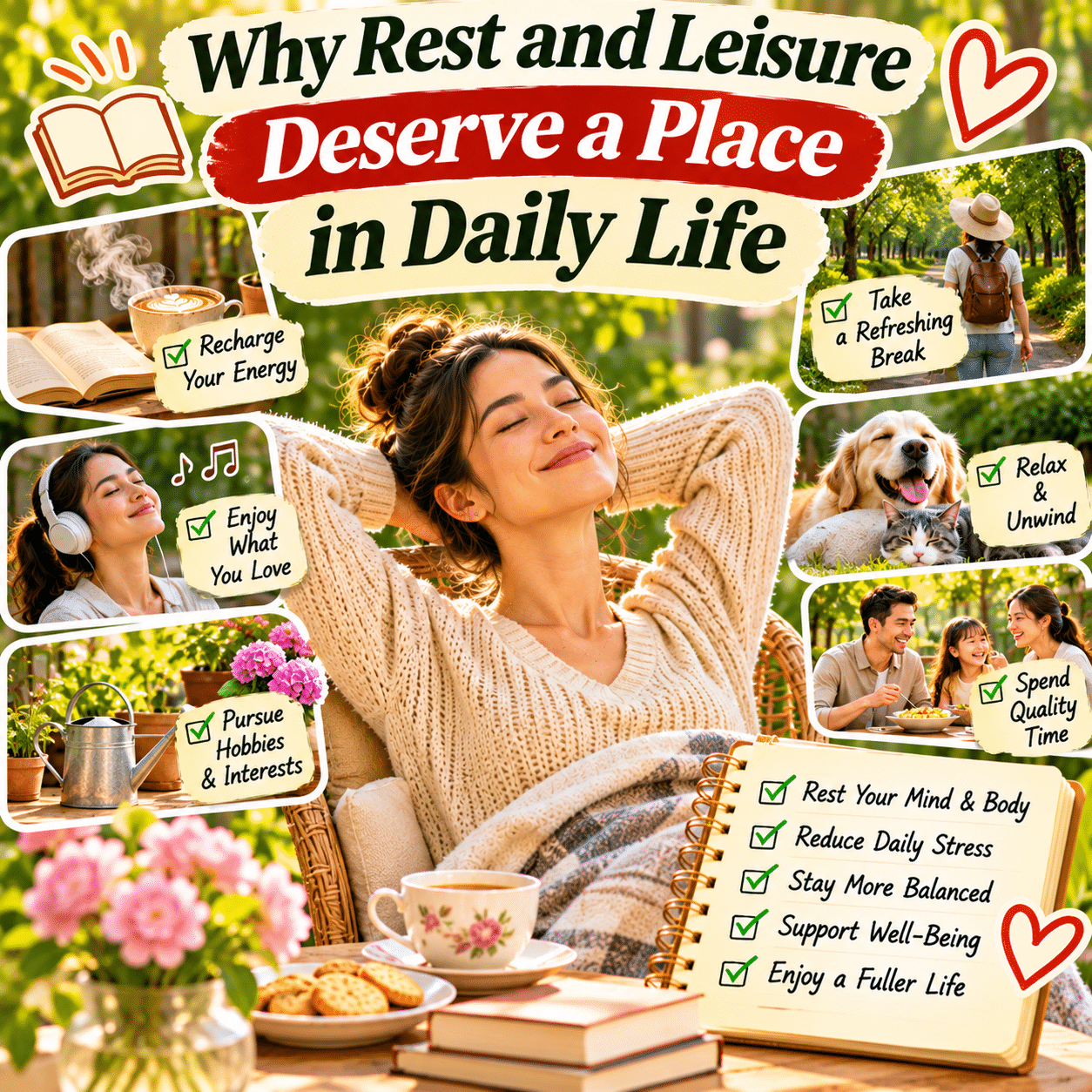
Modern life often places a strong emphasis on productivity, responsibility, and continuous activity. Work commitments, household responsibilities, family needs, personal projects, and digital communication can fill much of the day, leaving limited opportunities for rest and leisure.
In a culture where being busy is frequently associated with achievement, taking time to relax may sometimes feel unnecessary or even unproductive. People may postpone enjoyable activities until every task is completed, only to discover that new responsibilities continue to appear.
However, rest and leisure are not simply rewards for finishing work. They are meaningful parts of everyday living that deserve consideration alongside professional obligations, household activities, and personal goals.
Rest provides opportunities to recover from physical or mental demands. Leisure allows people to participate in activities they enjoy, explore personal interests, connect with others, and experience moments that are not defined by obligation.
These experiences can take many forms. Someone may enjoy reading quietly, gardening, preparing tea, listening to music, spending time outdoors, or sharing a relaxed conversation with family members. Others may prefer creative hobbies, recreational exercise, social gatherings, or simply having time without a particular task.
The most suitable activities depend on individual preferences, abilities, resources, and circumstances. Rest does not always require complete inactivity, and leisure does not necessarily involve entertainment or spending money.
A balanced daily routine recognizes that people have different needs at different times. After physically demanding work, sitting comfortably may be restorative. After hours of desk-based activity, a gentle walk or enjoyable hobby may provide a welcome change.
Understanding why rest and leisure deserve a place in daily life can help individuals develop more sustainable routines, appreciate ordinary experiences, and create room for well-being beyond constant productivity.
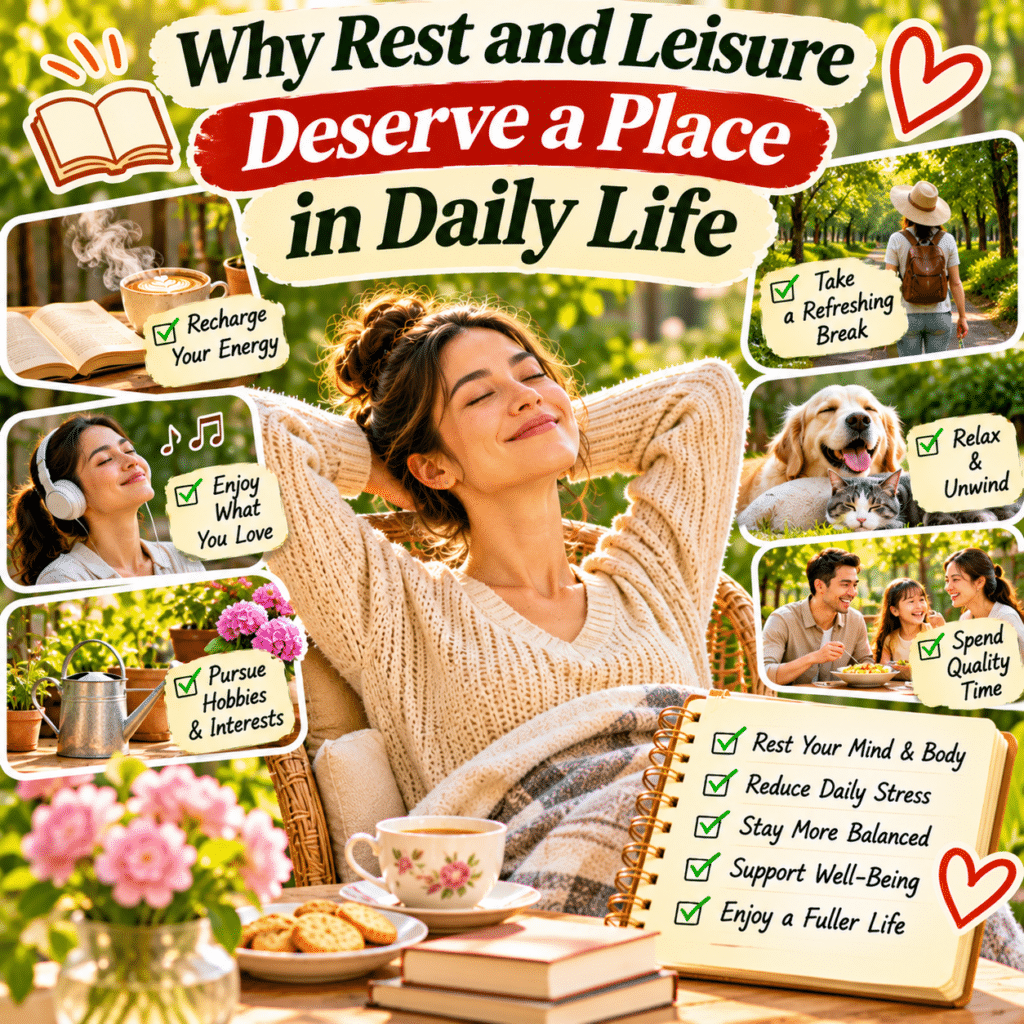
1. Rest and Leisure Are Important Parts of Everyday Living
Daily life involves a combination of responsibilities, relationships, and personal experiences.
Work and household activities often receive the greatest attention because they involve deadlines or immediate needs.
Rest and leisure may be postponed because they appear less urgent.
However, activities that do not involve obligations can still contribute meaningfully to daily life.
Rest creates opportunities to step away from demanding activities, while leisure allows people to pursue enjoyment and personal interests.
Both deserve consideration when organizing a sustainable routine.
The goal is not to eliminate responsibilities but to make room for experiences beyond them.
2. Understanding the Difference Between Rest and Leisure
Rest and leisure are related concepts, but they are not identical.
Rest generally involves reducing physical or mental demands and allowing opportunities for recovery.
Examples include sitting comfortably, sleeping, taking a quiet break, or stepping away from demanding tasks.
Leisure refers to discretionary activities chosen primarily for enjoyment, relaxation, personal interest, or fulfillment.
Examples include reading, gardening, photography, crafts, music, and recreational outings.
Some activities can serve both purposes.
A gentle walk, for instance, may provide leisure and a comfortable change from desk work.
Understanding this distinction helps people recognize that different circumstances may require different forms of personal time.
3. Rest Should Not Be Treated Only as a Reward
A common habit is postponing rest until every responsibility has been completed.
Someone may decide to relax only after finishing all professional tasks, household chores, and personal projects.
However, everyday responsibilities rarely disappear completely.
New tasks often replace completed ones.
Treating rest exclusively as a reward can make it difficult to establish consistent recovery opportunities.
A more sustainable approach recognizes rest as a legitimate need rather than something that must always be earned.
This does not mean ignoring important responsibilities.
It means considering rest when planning how those responsibilities will be managed.
4. Leisure Provides Meaning Beyond Productivity
Modern routines often encourage people to evaluate activities according to measurable results.
A hobby may be judged by whether it produces income, develops professional skills, or leads to a visible achievement.
However, leisure does not need to accomplish any of these goals.
Reading a novel, enjoying music, or spending time in a garden can be worthwhile simply because the experience is enjoyable.
Personal fulfillment cannot always be measured through output.
Allowing activities to exist without productivity expectations can create a more flexible relationship with free time.
5. Physical Rest Supports Recovery From Daily Demands
Many everyday activities involve physical effort.
Walking, standing, cleaning, gardening, carrying objects, and performing repetitive movements can create demands on the body.
Appropriate rest provides opportunities to reduce these demands.
The type of rest needed depends on the activity and individual circumstances.
Someone who has spent hours standing may prefer sitting comfortably.
A person who has been seated for an extended period may benefit from changing position or moving gently.
Physical rest should respond to actual needs rather than follow one universal routine.
6. Mental Rest Provides a Break From Continuous Demands
Modern life often requires frequent decisions, concentration, and information processing.
Professional tasks, financial planning, digital communication, and household management can all involve mental effort.
Mental rest creates opportunities to temporarily step away from these demands.
A person might sit quietly, listen to familiar music, or enjoy an uncomplicated activity.
The purpose is not necessarily to stop thinking altogether.
Instead, mental rest may involve reducing immediate responsibilities and allowing attention to shift naturally.
7. Rest Can Support More Sustainable Work Habits
Professional responsibilities can be meaningful and rewarding.
However, continuous work without reasonable recovery may become difficult to sustain.
Rest periods can help create clearer boundaries between demanding tasks and personal time.
For example, someone working from home may establish a consistent stopping point before beginning evening activities.
A person managing several projects may include breaks between major assignments.
These arrangements can support a more manageable routine.
However, rest alone cannot compensate for consistently excessive workloads or unreasonable professional expectations.
8. Leisure Encourages Personal Identity Beyond Work
Professional roles are often important parts of personal identity.
People may take pride in their careers, businesses, and accomplishments.
However, identity can also develop through relationships, interests, creativity, and everyday experiences.
Leisure provides opportunities to explore these other aspects of life.
Someone may enjoy being a gardener, reader, photographer, musician, or enthusiastic home cook without connecting those interests to employment.
Maintaining activities outside work can create a broader sense of personal meaning.
9. Quiet Time Can Be Valuable Without a Specific Purpose
Some people find it difficult to spend time without a planned activity.
Unstructured moments may feel uncomfortable in schedules dominated by tasks and deadlines.
However, quiet time does not need to produce a measurable outcome.
Sitting near a window, enjoying a comfortable chair, or observing the surroundings can be pleasant experiences.
These moments may provide a contrast to busy routines.
Not everyone enjoys quiet inactivity, and that preference is equally valid.
The important principle is allowing personal time without requiring constant achievement.
10. Leisure Can Encourage Creativity and Personal Expression
Creative activities are common forms of leisure.
Drawing, painting, writing, photography, crafts, and music provide opportunities for personal expression.
These activities can be enjoyable regardless of skill level.
Someone may experiment with watercolor painting without intending to become a professional artist.
Another person may enjoy writing personal reflections without publishing them.
Leisure creativity is not defined by the quality or commercial value of the finished result.
Its value often lies in the experience of exploring ideas and expressing individual preferences.
11. Hobbies Can Add Variety to Everyday Routines
Daily responsibilities often involve repeated activities.
Work, commuting, household chores, and administrative tasks can create familiar patterns.
Hobbies introduce opportunities to engage with different interests.
For example, someone who works primarily with computers may enjoy gardening or cooking during personal time.
Another person may prefer puzzles, reading, or collecting.
The activity does not need to be completely different from professional work.
What matters is that participation feels voluntary and enjoyable.
12. Leisure Activities Can Support Lifelong Learning
Learning does not need to occur only in schools or professional environments.
Personal interests often encourage people to explore new information and develop skills.
Someone may learn about plants through gardening, discover cultural traditions through cooking, or study photography techniques for enjoyment.
These experiences can be rewarding without formal assessments or deadlines.
Leisure learning allows curiosity to guide the process.
However, not every leisure activity needs an educational purpose.
Enjoyment alone remains a sufficient reason to participate.
13. Rest and Leisure Can Strengthen Everyday Relationships
Personal relationships often benefit from shared time.
Family members, friends, and partners may enjoy activities that do not involve immediate responsibilities.
Examples include preparing meals together, taking walks, playing games, or having relaxed conversations.
These experiences create opportunities for companionship.
They do not need to involve expensive outings or elaborate planning.
Ordinary moments can become meaningful when people have time to engage with one another.
14. Shared Leisure Can Create Lasting Memories
Many memorable experiences develop during relatively simple activities.
A family picnic, an afternoon of cooking, or a casual gathering with friends may become associated with positive memories.
Shared leisure provides opportunities for interaction outside formal obligations.
People may discover common interests or develop traditions around familiar activities.
However, shared time should remain enjoyable rather than becoming another source of pressure.
Different people may prefer different activities, and those preferences deserve respect.
15. Independent Leisure Is Equally Meaningful
Leisure does not always need to involve other people.
Reading alone, exploring a personal hobby, or spending time in a quiet outdoor setting can be fulfilling.
Independent activities allow individuals to follow their own preferences and schedules.
For people living alone, familiar leisure routines can provide structure and enjoyment.
Someone might spend an evening preparing a favorite meal, watching a documentary, or caring for indoor plants.
The value of leisure does not depend on whether it is shared.
16. Rest Can Be Especially Important During Busy Life Stages
Different periods of life involve different responsibilities.
Parents caring for young children, students managing examinations, and adults supporting older relatives may experience demanding schedules.
During these periods, rest opportunities may become limited.
Recognizing the importance of rest can encourage more realistic planning and requests for practical support.
However, personal scheduling cannot solve every challenge.
Caregiving, financial pressure, and demanding employment may require additional resources or assistance.
Rest should be understood as a legitimate need even when obtaining it is difficult.
17. Leisure Can Help People Maintain Social Connections
Social leisure activities provide opportunities to interact with others.
Community events, recreational groups, shared hobbies, and informal gatherings can create spaces for companionship.
These activities may help people meet others with similar interests.
However, social participation should reflect individual comfort and circumstances.
Some people enjoy frequent gatherings, while others prefer occasional interaction or smaller groups.
Meaningful social leisure does not require constant activity.
18. Outdoor Leisure Provides a Change of Environment
Spending time outdoors can introduce variety into daily routines.
Walking through a park, sitting in a garden, or enjoying a balcony can provide a change from indoor activities.
Outdoor leisure may involve movement, observation, or quiet enjoyment.
However, weather, air quality, accessibility, and safety should influence activity choices.
People do not need access to large natural spaces to enjoy outdoor moments.
A comfortable courtyard or nearby walking route may be sufficient.
19. Nature-Related Hobbies Can Be Enjoyable
Gardening, birdwatching, plant care, and nature photography are examples of leisure activities connected to the natural environment.
These hobbies can encourage observation and personal interest.
Someone may enjoy growing herbs on a balcony or learning to recognize local birds.
The activities can be adapted to different living spaces and abilities.
However, they should remain enjoyable rather than becoming demanding obligations.
A small, manageable hobby may be more sustainable than an elaborate project.
20. Reading Is a Flexible Form of Leisure
Reading can fit into many daily routines.
Some people enjoy novels, while others prefer history, biographies, essays, or illustrated books.
Reading can provide entertainment, information, and opportunities to explore different perspectives.
It can be enjoyed at home, during travel, or in quiet public spaces.
The activity does not require expensive equipment.
Libraries, borrowed books, and digital resources may provide accessible options.
Reading preferences vary, and no particular genre is necessary for meaningful leisure.
21. Music Can Become Part of Personal Relaxation
Music is a familiar part of leisure across cultures.
People may listen to favorite songs while resting, cooking, or spending time at home.
Others enjoy playing instruments or exploring unfamiliar musical styles.
Music preferences are highly individual.
A relaxing playlist for one person may feel distracting to another.
The most useful approach is to choose music that suits the activity and personal comfort.
Listening at safe volume levels is also important.
22. Creative Hobbies Do Not Need to Become Side Businesses
Modern digital platforms make it easier to share creative work or sell handmade products.
These opportunities can be appealing.
However, not every hobby needs to become a source of income.
Turning leisure into a business may introduce deadlines, customer expectations, and financial responsibilities.
Some people enjoy this transition, while others prefer to keep hobbies separate from professional obligations.
Maintaining a purely recreational activity is a valid choice.
Leisure can remain meaningful without commercial goals.
23. Rest Can Support Healthier Digital Habits
Digital devices provide entertainment, communication, and convenient access to information.
However, constant connectivity can blur the distinction between work and personal time.
Some people find it useful to include screen-free moments in their routines.
For example, an evening walk or quiet reading period may provide a change from digital activity.
This does not mean all screen-based leisure is harmful.
Watching films, playing games, and connecting with friends online can also be enjoyable.
The important consideration is whether digital habits support personal preferences and well-being.
24. Screen-Based Entertainment Can Be Legitimate Leisure
Television, films, video games, and online entertainment are common leisure activities.
They can provide enjoyment, storytelling, social interaction, and cultural experiences.
Their value should not automatically be dismissed because they involve screens.
However, extended screen use may create discomfort or interfere with other responsibilities for some individuals.
A balanced approach considers personal enjoyment, sleep needs, physical comfort, and daily obligations.
Leisure choices should reflect how an activity fits into the broader routine.
25. Leisure Does Not Have to Be Expensive
Commercial entertainment can create the impression that enjoyable free time requires spending money.
Travel, restaurants, concerts, and recreational services can be rewarding, but they are not the only options.
Affordable activities include reading, walking, gardening, drawing, listening to music, and spending time with friends.
Many hobbies can begin with materials already available at home.
Public parks, libraries, and community resources may also provide opportunities.
Meaningful leisure depends more on personal enjoyment than on expense.
26. Small Leisure Rituals Can Enrich Ordinary Days
A leisure routine does not need to occupy several hours.
Small activities can become familiar and enjoyable parts of daily life.
Someone may drink tea while reading in the afternoon.
Another person may listen to music while caring for plants.
A short evening walk may become a valued transition after work.
These rituals can provide continuity and personal meaning.
They should remain flexible enough to accommodate changing responsibilities.
27. Morning Leisure Can Create a Pleasant Start to the Day
Some people enjoy beginning the day with a personal activity before professional responsibilities.
This might involve reading, gentle movement, gardening, or enjoying breakfast without rushing.
A morning leisure routine can create a familiar transition into the day.
However, not everyone has flexible mornings.
Shift work, caregiving, commuting, and sleep requirements may limit available time.
Leisure can be equally meaningful at other times.
The goal is not to follow a particular morning routine but to identify suitable opportunities for enjoyment.
28. Afternoon Rest Can Provide a Useful Pause
Afternoons may involve transitions between work, household tasks, and personal responsibilities.
A short rest period can provide an opportunity to step away from continuous activity.
Someone may sit comfortably, enjoy a beverage, or take a brief walk.
Others may benefit from a longer rest depending on their schedule and needs.
There is no universal afternoon routine.
The most practical arrangement responds to individual energy patterns and responsibilities.
29. Evening Leisure Can Support Work-Life Boundaries
Evenings often provide opportunities for activities outside professional work.
Reading, cooking, watching a film, or spending time with loved ones may become familiar evening routines.
Protecting some personal time can help distinguish work responsibilities from leisure.
For people working from home, this separation may be particularly useful.
However, evening activities should not consistently interfere with necessary sleep.
A sustainable routine considers both enjoyment and rest.
30. Weekends Can Offer Opportunities for Longer Leisure Activities
People with conventional working weeks may use weekends for hobbies, social activities, or outings.
Longer periods of free time can make certain activities easier to enjoy.
Examples include visiting a museum, preparing a special meal, exploring a nearby park, or working on a creative project.
However, weekends often contain household responsibilities as well.
Not everyone has weekends free from work.
The broader principle is to protect suitable leisure opportunities during available personal time.
31. Unstructured Free Time Can Encourage Spontaneity
Highly organized schedules can be useful for managing responsibilities.
However, planning every available hour may leave little room for spontaneous experiences.
Unstructured leisure allows people to choose activities according to their interests at the moment.
Someone might decide to read, call a friend, or spend time outdoors without advance planning.
This flexibility can make free time feel less demanding.
Not everyone enjoys unstructured schedules, so the appropriate balance depends on personal preferences.
32. Leisure Can Adapt to Different Physical Abilities
People have different mobility levels, health considerations, and accessibility needs.
Meaningful leisure should not be limited to physically demanding activities.
Reading, music, accessible crafts, adapted gardening, and suitable digital entertainment can provide enjoyable options.
Some individuals may benefit from adaptive equipment or accessible facilities.
The goal is to support participation according to individual abilities.
Leisure should be inclusive rather than based on assumptions about what everyone can do.
33. Rest Needs Can Change With Age and Circumstances
The amount and type of rest people need can change over time.
Work demands, physical activity, health, caregiving responsibilities, and sleep patterns all influence recovery needs.
A routine that worked during one life stage may become less suitable later.
Regularly reviewing daily habits can help people make adjustments.
Persistent or unusual fatigue should not automatically be attributed to being busy.
When fatigue is unexplained, severe, or ongoing, appropriate medical evaluation may be necessary.
34. Leisure Can Encourage Cultural Appreciation
Leisure activities often provide opportunities to explore cultural traditions.
Cooking regional dishes, visiting museums, reading literature, and attending community events can introduce different perspectives.
Music, crafts, and storytelling also connect people with cultural experiences.
These activities can be enjoyable without requiring formal study.
Respectful curiosity helps make cultural exploration meaningful.
Leisure can therefore provide opportunities for both personal enjoyment and broader understanding.
35. Shared Traditions Can Make Leisure More Meaningful
Families and communities often develop recurring leisure traditions.
These may include weekend meals, seasonal gatherings, holiday activities, or regular visits to familiar places.
Repeated experiences can become part of shared memories.
Traditions do not need to be elaborate.
A monthly family dinner or weekly walk may be meaningful.
The most sustainable traditions remain adaptable to changing schedules, preferences, and circumstances.
36. Rest and Leisure Can Coexist With Ambition
Personal ambition and meaningful leisure are not opposing goals.
Someone can be dedicated to professional achievements while also protecting time for rest and personal interests.
The challenge is creating a realistic relationship between responsibilities and recovery.
Periods of intense work may occasionally be necessary.
However, continuously postponing personal life can make long-term routines difficult to sustain.
A balanced approach recognizes that achievement is only one part of a fulfilling life.
37. Rest Should Not Become Another Performance Goal
Wellness routines sometimes encourage people to optimize every activity.
Rest may become associated with tracking, measuring, or achieving particular outcomes.
Although some people find structured routines useful, excessive monitoring can make relaxation feel demanding.
Rest does not need to follow a perfect method.
A person may simply enjoy sitting comfortably or spending time without a plan.
The purpose is to respond to personal needs rather than perform relaxation correctly.
38. Leisure Preferences Should Be Respected
People enjoy different activities.
One person may find social gatherings energizing, while another prefers quiet hobbies.
Some enjoy sports, while others prefer creative projects or reading.
There is no universal leisure activity that suits everyone.
Respecting these differences allows individuals to choose experiences that feel meaningful.
Leisure should remain a personal choice rather than another source of comparison or social pressure.
39. Regular Reflection Can Help Protect Personal Time
Daily responsibilities can gradually expand.
Without occasional reflection, leisure activities may disappear from the schedule.
Reviewing how time is spent can help identify whether rest and enjoyment receive sufficient attention.
Useful questions include whether personal interests are being maintained and whether work regularly interrupts free time.
The goal is not to account for every minute.
Instead, reflection can encourage practical adjustments that support a more balanced routine.
40. Rest and Leisure Contribute to a More Complete Everyday Life
Everyday living involves more than fulfilling obligations.
Professional work, household responsibilities, and personal commitments are important, but they do not represent the entire human experience.
Rest provides opportunities to recover from demands.
Leisure creates space for enjoyment, creativity, relationships, curiosity, and personal expression.
Together, they help people develop routines that include both responsibility and fulfillment.
Their value does not depend on expensive activities, elaborate schedules, or measurable achievements.
The most meaningful approach is one that fits naturally into individual circumstances and remains sustainable over time.
Understanding the Everyday Value of Rest and Leisure
Rest and leisure can contribute to different aspects of everyday living.
| Rest or Leisure Activity | Potential Value | Everyday Example |
|---|---|---|
| Quiet rest | Reduced immediate demands | Sitting comfortably after work |
| Adequate sleep | Essential physical and mental functioning | Maintaining a suitable sleep schedule |
| Reading | Enjoyment and personal exploration | Reading a favorite novel |
| Gardening | Creative and nature-related leisure | Caring for balcony plants |
| Gentle walking | Movement and a change of environment | Walking around the neighborhood |
| Listening to music | Personal enjoyment | Playing a favorite album |
| Creative hobbies | Self-expression | Drawing or making crafts |
| Shared meals | Social connection | Cooking dinner with family |
| Social gatherings | Companionship | Meeting friends for conversation |
| Outdoor leisure | Environmental variety | Spending time in a park |
| Digital entertainment | Recreation and storytelling | Watching a film |
| Personal rituals | Familiarity and comfort | Enjoying afternoon tea |
| Cultural activities | Broader appreciation | Visiting a museum |
| Unstructured free time | Flexibility and personal choice | Choosing an activity spontaneously |
| Weekend hobbies | Extended personal enjoyment | Working on a craft project |
| Screen-free moments | A change from digital activity | Reading beside a window |
The value of each activity depends on personal preferences, available resources, and individual circumstances.
How to Make More Room for Rest and Leisure Step by Step
Creating space for rest and leisure does not require completely redesigning daily life. Small adjustments can help establish more realistic and enjoyable routines.
Step 1: Observe How You Currently Spend Your Time
Begin by reviewing a typical day or week.
Notice how much time is devoted to work, household responsibilities, commuting, caregiving, and other obligations.
Consider whether rest and leisure are regularly postponed.
The purpose is to understand the existing routine rather than judge it.
Step 2: Identify Your Personal Rest Needs
Consider which activities leave you physically or mentally tired.
Someone who performs physical work may need different recovery opportunities from someone who spends long hours at a computer.
Recognize that rest requirements vary.
Step 3: Choose Leisure Activities You Genuinely Enjoy
Think about activities that feel personally meaningful.
These may include reading, gardening, cooking, music, crafts, photography, or social interaction.
Avoid choosing hobbies solely because they are popular or associated with productivity.
Step 4: Begin With Small Opportunities
A meaningful leisure routine does not need to occupy several hours.
Start with a manageable activity that fits existing responsibilities.
For example, spend a short period reading after dinner or enjoying a walk during available free time.
Step 5: Protect Essential Rest
Allow suitable opportunities for sleep, meals, and recovery.
Avoid consistently sacrificing basic needs to complete optional tasks.
Consider professional guidance when health conditions affect rest requirements.
Step 6: Create Comfortable Spaces
Identify areas at home that support relaxation or leisure.
A favorite chair, small reading corner, or organized hobby shelf may be sufficient.
Avoid assuming that a dedicated room or expensive furniture is necessary.
Step 7: Establish Reasonable Work-Life Boundaries
When possible, communicate working hours and response expectations.
Reduce unnecessary professional interruptions during personal time.
Recognize that some responsibilities require flexibility.
Step 8: Include Both Independent and Shared Activities
Consider which leisure experiences you prefer alone and which you enjoy with others.
A combination can provide variety.
However, there is no requirement to divide leisure equally between social and independent activities.
Step 9: Allow Flexibility
Some days will be busier than others.
Adapt leisure activities when responsibilities change.
Avoid treating an interrupted routine as a failure.
Step 10: Review What Feels Sustainable
Periodically consider whether rest and leisure fit comfortably into daily life.
Keep activities that provide enjoyment and adjust those that become burdensome.
The goal is long-term balance rather than perfect scheduling.
Rest and Leisure Ideas for Different Lifestyles
Different circumstances create different opportunities and challenges.
| Lifestyle or Situation | Common Challenge | Practical Rest or Leisure Idea |
|---|---|---|
| Office employee | Long periods of desk work | Enjoy a walk or quiet hobby after work |
| Remote worker | Blurred work-life boundaries | Create a recognizable end-of-work routine |
| Freelancer | Irregular working hours | Reserve flexible periods for personal interests |
| Business owner | Continuous responsibilities | Separate routine management from leisure time |
| Student | Study deadlines | Include enjoyable activities between study periods |
| Person living alone | Work expanding into personal time | Develop familiar home leisure rituals |
| Parent with young children | Limited uninterrupted time | Coordinate rest opportunities and shared family activities |
| Caregiver | Demanding responsibilities | Seek practical support and appropriate respite |
| Shift worker | Unconventional schedules | Protect suitable rest periods around shifts |
| Retired adult | Changing daily structure | Explore hobbies, volunteering, or social activities |
| Creative professional | Hobbies overlapping with work | Maintain some activities without professional expectations |
| Person with limited mobility | Accessibility barriers | Choose suitable, adapted leisure activities |
| Small-apartment resident | Limited dedicated space | Create a compact reading or hobby corner |
| Busy household | Competing schedules | Plan simple shared leisure traditions |
| Person with a limited budget | Cost of entertainment | Explore libraries, public spaces, and affordable hobbies |
The most suitable activities are those that reflect individual needs and practical circumstances.
Creating a Comfortable Rest and Leisure Space at Home
A dedicated leisure area can make personal time more inviting, but it does not need to be large or elaborate.
Choose a Comfortable Location
Identify an area that feels suitable for relaxation.
This may be a living room chair, balcony, bedroom corner, or small space near a window.
Consider Lighting
Choose lighting appropriate for the activity.
Reading and crafts may require task lighting, while quiet relaxation may feel more comfortable with softer illumination.
Keep Essential Items Accessible
Store frequently used books, hobby supplies, or comfortable accessories nearby.
Avoid allowing storage to overwhelm the available space.
Add Personal Details
Artwork, plants, cushions, and meaningful objects can make the area feel welcoming.
Choose items according to personal preferences rather than decorative trends.
Manage Noise and Distractions
Consider whether the activity requires quiet or whether background sound is enjoyable.
Adjust the environment when practical.
Keep Maintenance Simple
A leisure space should not create excessive cleaning or organizational responsibilities.
Use manageable arrangements that support regular enjoyment.
Allow Multiple Uses
Small homes may require one area to support several activities.
Flexible furniture and simple storage can make transitions easier.
Common Rest and Leisure Mistakes to Avoid
1. Waiting Until Every Task Is Finished
Responsibilities often continue indefinitely.
Make reasonable room for rest rather than postponing it without limits.
2. Treating Leisure as Unproductive Time
Enjoyment and personal fulfillment are legitimate reasons to participate in activities.
Not every experience needs a measurable outcome.
3. Turning Every Hobby Into a Goal
Hobbies do not need deadlines, performance targets, or financial objectives.
Allow some activities to remain purely recreational.
4. Assuming Rest Means Doing Nothing
Rest can involve quiet inactivity, but it may also include gentle movement or a change from demanding activities.
Choose what suits individual needs.
5. Comparing Leisure Habits With Others
People have different interests, resources, and responsibilities.
Avoid treating another person’s routine as a universal standard.
6. Overscheduling Free Time
Planning every leisure moment can make personal time feel demanding.
Allow room for spontaneity.
7. Ignoring Sleep Requirements
Leisure should not consistently replace necessary sleep.
Restful activities and adequate sleep serve different purposes.
8. Spending More Than Necessary
Meaningful leisure does not require expensive equipment or frequent purchases.
Begin with accessible activities.
9. Expecting One Activity to Meet Every Need
A favorite hobby may provide enjoyment but may not replace social connection, physical recovery, or other important needs.
Maintain flexibility.
10. Feeling Guilty About Taking Personal Time
Rest and leisure are legitimate aspects of everyday living.
They do not need to be earned through exhaustion.
A Practical Rest and Leisure Checklist
Use this checklist to reflect on whether everyday routines include reasonable opportunities for recovery and enjoyment.
Rest and Recovery
- I recognize when physical or mental demands require rest.
- I protect suitable opportunities for adequate sleep.
- I allow breaks during demanding activities when practical.
- I avoid treating rest only as a reward.
- I understand that persistent fatigue may require additional attention.
Personal Leisure
- I have activities that I genuinely enjoy.
- I allow hobbies to exist without productivity goals.
- I make room for occasional unstructured free time.
- I choose leisure activities that fit my abilities and resources.
- I allow my interests to change over time.
Relationships and Social Time
- I have opportunities for meaningful interaction with others.
- I respect different social and leisure preferences.
- I enjoy shared activities when appropriate.
- I recognize the value of independent leisure.
- I avoid turning social activities into obligations.
Home and Everyday Comfort
- I have a comfortable place to relax when possible.
- Frequently used leisure materials are reasonably accessible.
- My home routines allow some separation from work.
- I keep leisure arrangements manageable.
- I appreciate simple activities without requiring elaborate preparation.
Long-Term Balance
- My schedule includes more than professional and household responsibilities.
- I recognize when personal time is becoming limited.
- I adjust routines when life circumstances change.
- I avoid comparing my balance with unrealistic ideals.
- I value rest and enjoyment as meaningful parts of life.
Frequently Asked Questions About Rest and Leisure
1. Why are rest and leisure important in everyday life?
Rest provides opportunities for recovery from physical and mental demands, while leisure allows people to enjoy personal interests, relationships, creativity, and experiences beyond obligations.
2. What is the difference between rest and leisure?
Rest generally involves reducing demands and allowing recovery. Leisure involves discretionary activities chosen for enjoyment or personal fulfillment. Some activities can serve both purposes.
3. Is leisure the same as being unproductive?
No. Leisure does not need to produce measurable results to be meaningful. Enjoyment, curiosity, and personal expression are legitimate purposes.
4. How much leisure time should someone have each day?
There is no universal amount suitable for everyone. Available time and personal needs vary according to work, caregiving, health, and other responsibilities.
5. Can reading be considered rest?
Reading can be relaxing leisure for some people. However, demanding reading may require considerable concentration, so it does not always provide mental rest.
6. Are hobbies necessary for a balanced life?
Hobbies can provide enjoyment and personal meaning, but no specific hobby is required. People can find leisure through many different activities.
7. Is watching television a valid leisure activity?
Yes. Television and other screen-based entertainment can provide enjoyment. The important consideration is how these activities fit into personal needs and daily routines.
8. Can someone enjoy meaningful leisure without spending money?
Absolutely. Walking, reading borrowed books, listening to music, drawing, and spending time with friends are examples of affordable leisure activities.
9. Why do some people feel guilty when resting?
Social expectations, personal habits, demanding workloads, and productivity-focused beliefs may contribute. Recognizing rest as a legitimate need can help people reconsider these expectations.
10. Is spending time alone a healthy form of leisure?
Independent leisure can be enjoyable and meaningful. Preferences for solitude and social interaction differ between individuals.
11. Can gardening be both leisure and physical activity?
Yes. Gardening may involve enjoyable creative activity and physical movement. The demands vary according to the tasks involved.
12. How can busy people make time for leisure?
Small, realistic adjustments may help, such as protecting short personal activities, reviewing unnecessary commitments, and establishing reasonable work-life boundaries.
13. Does rest always require sleeping?
No. Rest can include quiet breaks, reduced activity, and comfortable changes in routine. However, these activities do not replace adequate sleep.
14. Should leisure activities be scheduled?
Scheduling can help protect personal time, but flexibility is important. Some people prefer planned activities, while others enjoy spontaneous leisure.
15. What is the most important principle of meaningful rest and leisure?
The most important principle is sustainability. Rest and leisure should fit individual needs, provide genuine opportunities for recovery or enjoyment, and remain flexible as circumstances change.
Final Thoughts
Rest and leisure deserve a meaningful place in daily life because human well-being involves more than completing responsibilities and achieving goals.
Work, household management, caregiving, and personal commitments are important parts of everyday living. However, a routine devoted entirely to obligations may leave limited opportunities for recovery, enjoyment, creativity, and connection.
Rest provides space to step away from physical and mental demands. Leisure offers opportunities to explore interests, spend time with others, appreciate familiar activities, and experience moments that are not defined by productivity.
These experiences do not need to be expensive or elaborate. Reading a favorite book, enjoying music, tending to plants, preparing a comforting beverage, or spending a quiet afternoon at home can all become meaningful parts of daily life.
Individual preferences and circumstances should guide the approach. Some people enjoy active recreation, while others prefer quiet hobbies. Some have flexible schedules, while others face demanding responsibilities that require additional support to make rest possible.
The goal is not to create a perfect balance every day. It is to recognize that recovery and enjoyment are legitimate needs that deserve consideration over time.
A sustainable lifestyle allows room for ambition and responsibility while also protecting opportunities for personal fulfillment.
Small leisure rituals, realistic boundaries, and flexible routines can help make ordinary days feel more complete.
Most importantly, rest should not be viewed as something that must always be earned, and leisure should not be judged solely by what it produces.
Ultimately, the lasting value of rest and leisure lies in allowing people to experience everyday life not only through what they accomplish, but also through the comfort, enjoyment, relationships, and personal meaning they discover along the way.