Busy days are a familiar part of modern life. Professional responsibilities, household tasks, family commitments, personal projects, and digital communication can fill schedules with activities that demand continuous attention. When responsibilities accumulate, taking a break may seem less important than completing another task.
Many people respond to demanding schedules by working longer, postponing meals, skipping rest periods, or moving directly from one responsibility to another. Although these approaches may occasionally be necessary, maintaining them over extended periods can make everyday routines more difficult to manage.
Taking breaks is not simply about stopping work. It is about creating reasonable opportunities to rest, change activities, move the body, and temporarily step away from demanding responsibilities.
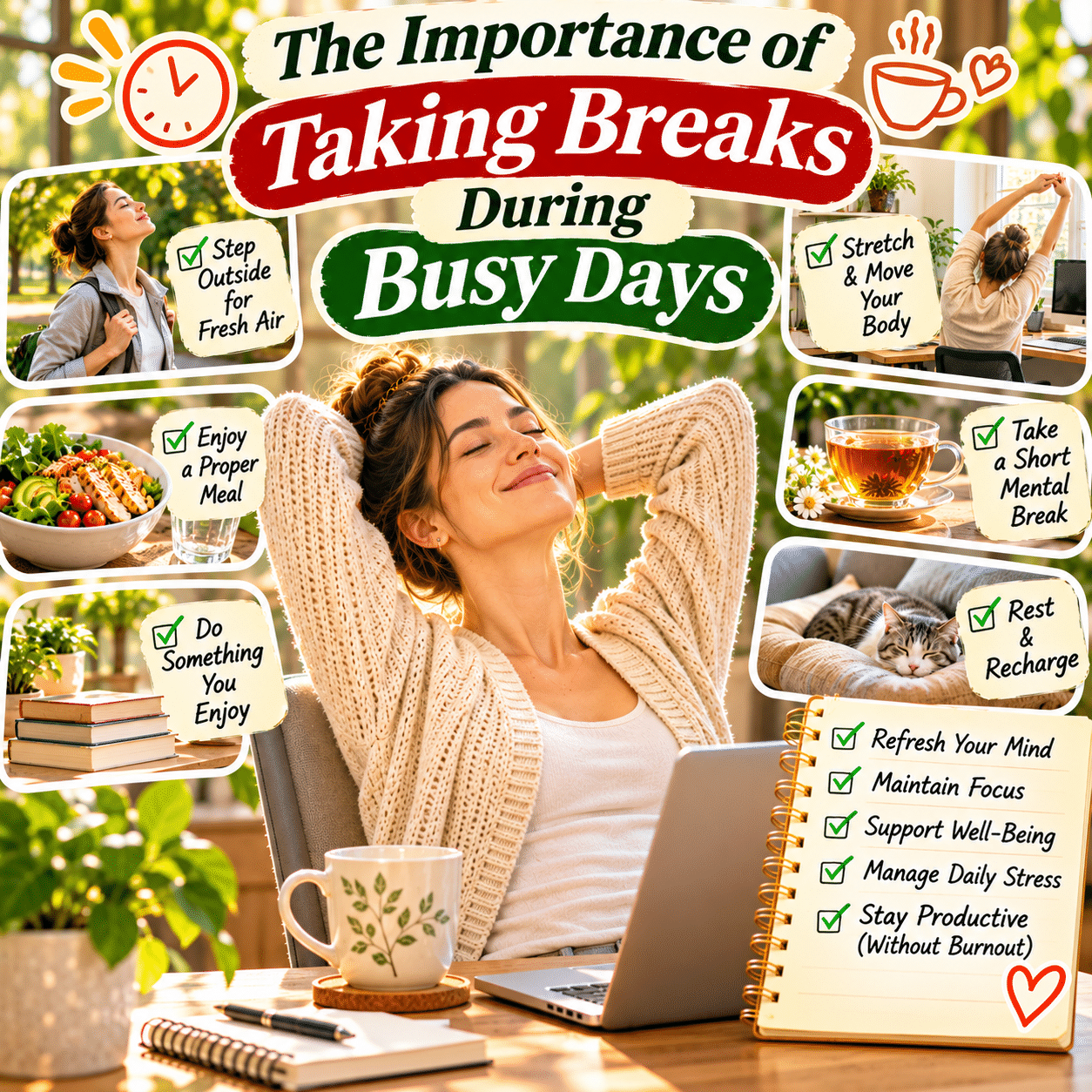
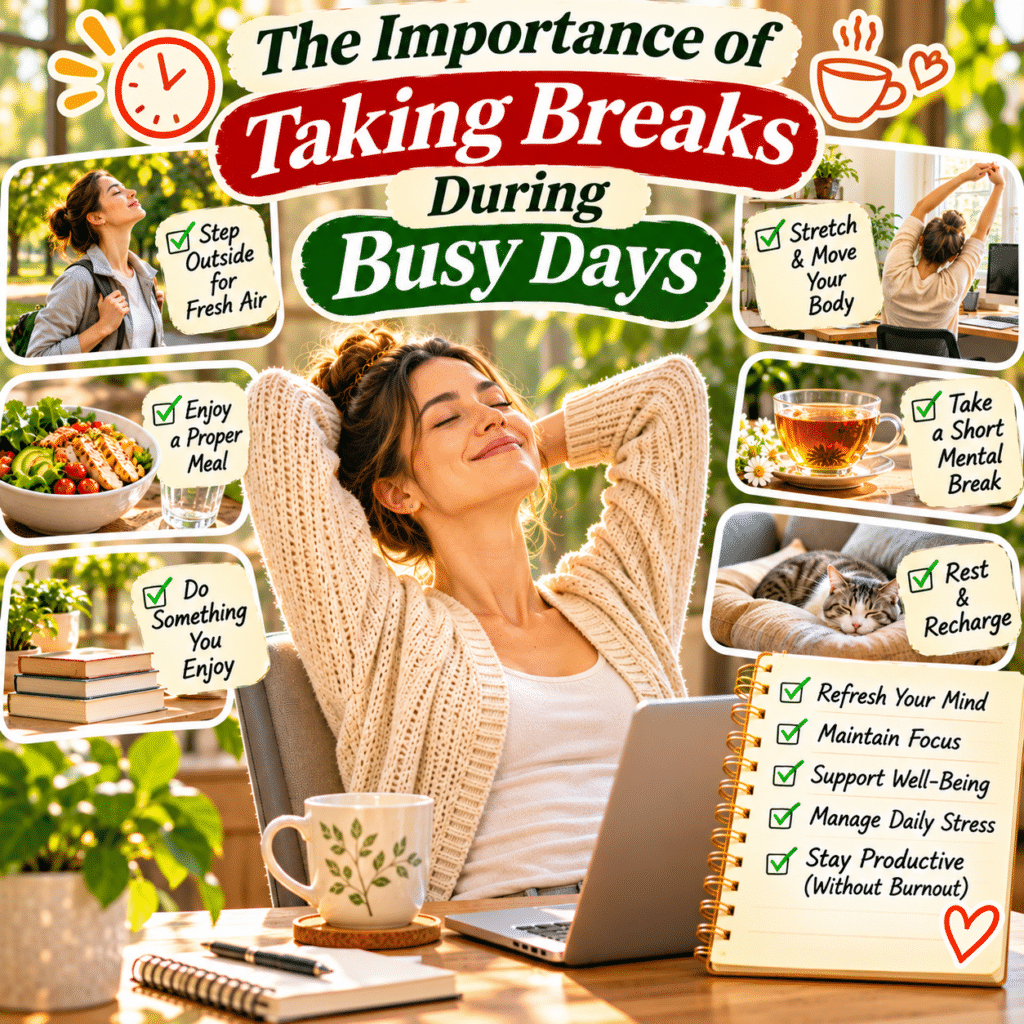
A break might involve a short walk, a comfortable meal, a few minutes away from a computer screen, or a quiet moment between household tasks. Some breaks provide physical movement, while others offer a change in mental activity or an opportunity for social connection.
The value of a break depends on individual needs and circumstances. Someone performing physically demanding work may benefit from sitting and resting, while a person working at a desk may prefer standing, stretching, or walking. A caregiver may need practical assistance to obtain uninterrupted rest, while a remote worker may benefit from clearer boundaries around digital communication.
Breaks do not need to be lengthy, expensive, or carefully structured. Small pauses can become part of a sustainable routine when they are realistic and appropriate for the activities involved.
However, breaks are not a substitute for adequate sleep, manageable workloads, necessary medical care, or supportive working conditions. Their benefits are most meaningful when they form part of a broader approach to everyday well-being.
Understanding the importance of taking breaks during busy days can help people develop healthier relationships with time, attention, productivity, and personal responsibilities.
1. Breaks Help Create a More Sustainable Daily Routine
A busy schedule often involves moving between activities with little time for recovery.
Without reasonable pauses, responsibilities may begin to feel like one continuous period of effort.
Taking breaks introduces natural transitions into the day.
For example, someone completing several hours of computer work might step away briefly before beginning another assignment.
A person managing household chores may pause after cleaning one room before continuing with another.
These moments can make routines feel more manageable.
The purpose is not to interrupt every task but to recognize that sustainable daily living includes periods of activity and rest.
2. Continuous Work Can Become Mentally Demanding
Many everyday tasks require sustained attention.
Reading detailed documents, managing financial information, solving problems, and making decisions can place demands on mental resources.
As time passes, some people notice that concentration becomes more difficult or that tasks require greater effort.
Short breaks may provide an opportunity to step away from these demands.
However, the relationship between breaks and mental performance varies according to the task, individual, and working conditions.
A pause can support a more comfortable routine, but it does not guarantee improved concentration or eliminate mental fatigue.
3. Breaks Can Support Attention During Long Work Sessions
Attention is influenced by numerous factors, including sleep, interest, task difficulty, environmental distractions, and personal circumstances.
Long periods of uninterrupted work may become challenging, particularly when tasks are repetitive or mentally demanding.
A break creates an opportunity to change activities before returning to the original task.
For example, someone writing a report may find it helpful to step away after completing a major section.
The most suitable timing depends on the work involved.
Rather than following a universal schedule, people can observe when pauses help them maintain a comfortable and practical working rhythm.
4. Taking Breaks Encourages a Healthier Relationship With Productivity
Productivity is often associated with continuous activity.
However, spending more time working does not always mean completing more meaningful work.
Task quality, priorities, resources, and working conditions also influence results.
Breaks can encourage a more balanced understanding of productivity.
A person can remain committed to responsibilities while recognizing the need for rest.
This perspective shifts attention away from constant busyness and toward sustainable effort.
Rest should not need to be justified solely by whether it increases productivity.
5. Short Pauses Can Reduce the Feeling of Being Constantly Rushed
Busy days sometimes create a sense of urgency even when every task is not equally important.
People may move quickly between activities without considering whether the pace is necessary.
A short pause can provide an opportunity to review the next responsibility.
For example, someone finishing a work meeting might take a moment to organize notes before beginning another task.
This transition can make the schedule feel more deliberate.
Although breaks cannot remove external deadlines, they may help individuals approach everyday demands with greater awareness.
6. Physical Movement Breaks Can Support Comfort
Desk-based activities often involve remaining in similar positions for extended periods.
Some people experience stiffness or discomfort when movement is limited.
Standing, walking, or changing posture during a break may provide welcome variation.
A person might walk around the room, refill a water glass, or perform comfortable movements suited to their abilities.
There is no single movement routine appropriate for everyone.
People with injuries, disabilities, or medical conditions may need individualized guidance about suitable activity.
7. Breaks Are Important for People Who Work at Computers
Computer work combines visual attention, repetitive movements, and prolonged sitting.
Taking breaks provides opportunities to look away from the screen, adjust posture, and change activities.
For example, someone editing documents might pause between assignments to stand or move around.
Breaks can also provide an opportunity to notice whether the workstation remains comfortable.
However, screen-related symptoms may require additional changes to lighting, equipment placement, or vision care.
Breaks are one part of a practical computer-work routine.
8. Eye Breaks Can Support Visual Comfort
Extended screen use may be associated with eye discomfort, dryness, or temporary focusing difficulties.
Looking away from a screen periodically can provide a change in visual demand.
One commonly suggested practice is the 20-20-20 rule: approximately every 20 minutes, look at something around 20 feet away for 20 seconds.
This can serve as a convenient reminder, although it is not a guaranteed solution or a universally established requirement.
Blinking regularly, reducing glare, and adjusting screen positioning may also support comfort.
Persistent eye symptoms should be evaluated by an appropriate healthcare professional.
9. Breaks Can Help People Notice Physical Needs
Busy schedules sometimes make it easy to overlook basic needs.
Someone concentrating on work may delay drinking water, eating, or using the restroom.
A break creates an opportunity to check whether these needs require attention.
For example, a person might pause after completing a task to prepare a snack or refill a water bottle.
These actions should respond to individual needs rather than rigid schedules.
Breaks can support everyday self-care without requiring complicated routines.
10. Meal Breaks Deserve Attention During Busy Days
Meals are an important part of everyday living.
However, people sometimes eat while answering messages, attending meetings, or completing other tasks.
When practical, setting aside time for meals can make eating more comfortable.
A lunch break might involve moving away from the workstation or temporarily reducing nonessential notifications.
Shared meals can also provide opportunities for conversation.
The goal is not to make every meal formal or distraction-free but to allow sufficient time for nourishment and enjoyment.
11. Breaks Can Create Opportunities for Hydration
Water is essential for normal bodily functioning.
Hydration needs vary according to activity, climate, health, and individual circumstances.
During busy periods, some people may find it useful to incorporate drinking opportunities into their routines.
A break might involve getting a glass of water or another suitable beverage.
There is no need to force excessive fluid intake or follow a universal drinking schedule.
People with medical conditions affecting fluid requirements should follow appropriate professional guidance.
12. Mental Breaks Do Not Always Require Physical Rest
A break from mentally demanding work does not necessarily mean sitting still.
Some people prefer light movement, simple household activities, or spending a few minutes outdoors.
Others benefit from quiet reflection.
The most useful activity may differ according to what someone has been doing.
After extended desk work, movement may feel welcome.
After a physically demanding task, sitting comfortably may be more appropriate.
A good break responds to the demands of the preceding activity.
13. Changing Activities Can Provide a Useful Transition
Switching from one type of activity to another can create a natural pause.
For example, someone working on detailed calculations might step away to prepare tea.
A person engaged in creative writing might briefly organize their desk before continuing.
These activities can provide variety.
However, replacing one demanding task with another may not offer meaningful rest.
The purpose of a break is to reduce or change the demands being placed on the individual.
14. Quiet Moments Can Be Valuable During Demanding Days
Not every break needs an activity.
Sometimes a few minutes of quiet can provide a welcome contrast to a busy environment.
A person might sit near a window, enjoy a comfortable chair, or simply stop working temporarily.
Quiet breaks do not require meditation or formal relaxation techniques.
Their value may come from the absence of immediate demands.
For people who find silence uncomfortable, other forms of rest may be more suitable.
15. Breaks Can Support More Intentional Time Management
Time management involves deciding how responsibilities fit into available hours.
Including breaks in a schedule can encourage more realistic planning.
Rather than assuming every minute will be devoted to productive tasks, people can acknowledge the need for transitions and personal care.
For example, a workday plan might include time for lunch, movement, and short pauses between demanding activities.
This approach may make schedules easier to maintain.
However, people should avoid creating such rigid break schedules that rest becomes another source of pressure.
16. Breaks Help Separate Different Responsibilities
A busy day may involve professional work, household tasks, caregiving, and personal commitments.
Moving immediately between these responsibilities can feel overwhelming.
A brief transition can help distinguish one activity from another.
For example, someone finishing remote work might take a short walk before preparing dinner.
A student might pause after studying before beginning household chores.
These transitions can make daily routines feel more organized.
17. Regular Pauses Can Support Work-Life Boundaries
Work-life boundaries help distinguish professional responsibilities from personal activities.
Breaks can reinforce these distinctions.
A proper lunch period, a short afternoon pause, or a consistent end-of-work routine can create recognizable limits.
Remote workers may find this especially useful because work and home activities occur in the same environment.
However, breaks alone cannot resolve unrealistic workload expectations.
Clear communication and supportive working conditions are also important.
18. Breaks Can Encourage Better Awareness of Personal Energy Patterns
People often experience changes in energy and alertness throughout the day.
These patterns vary with sleep, meals, activity, health, and individual biology.
Observing when concentration feels easier or more difficult may help with scheduling.
For example, someone may prefer completing demanding work during periods when they generally feel most alert.
Breaks can be arranged around these patterns when circumstances allow.
There is no universal best time of day for everyone to work or rest.
19. Taking Breaks Can Reduce Unnecessary Task Switching
Modern work often involves frequent interruptions from messages, applications, and unrelated requests.
These interruptions are not always equivalent to restorative breaks.
Checking multiple notifications may simply replace one mental demand with another.
A deliberate break can provide a clearer separation from the original task.
For example, stepping away from a computer may offer a different experience from scrolling through work-related messages.
The quality of the break matters as well as its duration.
20. Digital Breaks Can Reduce Constant Connectivity
Smartphones and computers make information available almost continuously.
This convenience can also make it difficult to disconnect from messages, news, and entertainment.
Some people find it useful to spend part of their break away from screens.
Possible activities include walking, preparing a drink, stretching, or looking outdoors.
However, digital entertainment can also be enjoyable and relaxing for some individuals.
The most useful approach is to consider whether a particular activity feels restorative or adds to mental demands.
21. Social Breaks Can Support Everyday Connection
Breaks sometimes create opportunities for informal social interaction.
A short conversation with a colleague, friend, or family member may make a demanding day feel less isolated.
Shared coffee or tea breaks are familiar examples.
These moments can provide companionship without requiring elaborate planning.
However, social interaction is not relaxing for everyone in every situation.
People should have opportunities for quiet or independent breaks when preferred.
22. Breaks Can Be Meaningful for People Living Alone
People who live alone may organize their schedules without shared household routines.
This flexibility can be convenient, but it may also make it easy to continue working for extended periods.
Creating personal break habits can provide structure.
A person might pause to water plants, prepare a snack, or enjoy a few minutes on a balcony.
These activities can become familiar transitions.
Taking breaks remains important regardless of household size.
23. Home-Based Workers Benefit From Recognizable Break Routines
Working from home often removes the natural transitions associated with commuting or moving between workplace areas.
People may remain at the same desk for much of the day.
A recognizable break routine can help.
For example, someone might leave the work area during lunch or walk around the home between assignments.
These changes can distinguish work periods from personal moments.
The routine should remain practical for the household environment.
24. Household Tasks Also Require Breaks
Household work can involve sustained physical or mental effort.
Cleaning, cooking, organizing, gardening, and maintenance may take considerable time.
People sometimes overlook the need for breaks because these activities are not formal employment.
However, personal responsibilities can also be demanding.
Pausing between tasks may help maintain comfort and reduce unnecessary rushing.
The appropriate rest period depends on the activity, physical demands, and individual needs.
25. Caregiving Responsibilities Make Rest Especially Important
Caregiving may involve unpredictable schedules and continuous attention to another person’s needs.
Finding time for breaks can be difficult.
When possible, practical support from family members, community services, or other appropriate resources may create opportunities for rest.
Caregivers should not be expected to solve demanding circumstances through personal scheduling alone.
Adequate support and manageable responsibilities are essential considerations.
Even brief pauses may be useful, but they cannot replace meaningful respite when it is needed.
26. Students Can Benefit From Breaks Between Study Sessions
Studying often requires sustained reading, memorization, writing, and problem-solving.
Breaks can provide opportunities to change activities and manage fatigue.
A student might pause after completing a chapter or practice assignment.
Some people prefer timed study sessions, while others find task-based breaks more natural.
The ideal arrangement depends on the subject, individual preferences, and available time.
Breaks should complement effective study habits and adequate sleep.
27. Creative Activities Can Benefit From Time Away
Creative work often involves generating ideas, evaluating possibilities, and making decisions.
Writers, artists, designers, and hobbyists may occasionally feel stuck during demanding projects.
Stepping away can provide a change of perspective.
A person might return to a drawing or written draft after a short break and notice details they previously overlooked.
However, breaks do not guarantee creative insights.
Their value lies partly in providing variety and preventing every moment from becoming a demand for output.
28. Physical Work Requires Appropriate Recovery
Jobs and activities involving lifting, standing, repetitive movements, or sustained exertion can create physical demands.
Breaks may help workers manage these demands.
The type and frequency of rest should reflect workplace safety requirements, task intensity, environmental conditions, and individual health.
For example, physically demanding work in hot environments may require specific rest and hydration arrangements.
General lifestyle advice should not replace occupational safety procedures.
Employers and workers share responsibility for maintaining safe working conditions.
29. Breaks Can Support Safer Performance During Demanding Tasks
Fatigue and reduced alertness can affect activities requiring careful attention.
Driving, operating machinery, and performing safety-sensitive tasks are examples.
Appropriate rest periods may be important for maintaining safety.
However, a brief break cannot reliably overcome significant sleep deprivation or severe fatigue.
People should follow relevant safety regulations and avoid continuing hazardous activities when they are not sufficiently alert.
In safety-sensitive situations, rest is a practical necessity rather than simply a productivity preference.
30. Outdoor Breaks Can Provide a Change of Environment
Spending time outdoors can introduce different sights, sounds, and physical activities.
A short walk in a garden, courtyard, or nearby outdoor area may provide a welcome contrast to indoor work.
Natural surroundings can feel pleasant for many people.
However, outdoor conditions vary.
Heat, air pollution, weather, accessibility, and personal safety should influence whether an outdoor break is appropriate.
A comfortable indoor alternative can be equally practical when outdoor conditions are unsuitable.
31. Nature-Inspired Breaks Can Be Simple
Not everyone has access to a garden or park during a busy day.
Small interactions with natural elements may still be enjoyable.
Someone might look through a window, spend time near indoor plants, or sit in a well-lit room.
These activities can provide visual variety.
However, they should not be presented as guaranteed methods for reducing stress or improving cognitive performance.
Their value often comes from personal enjoyment and a change in surroundings.
32. Stretching Breaks Should Be Comfortable and Appropriate
Gentle stretching may feel useful after prolonged sitting or repetitive activity.
Simple movements can provide variety and help people notice areas of discomfort.
However, stretching should not cause pain.
Different individuals have different mobility needs, and some movements may be inappropriate for certain conditions.
A person recovering from an injury or managing a medical concern should follow relevant professional guidance.
Breaks should support comfort rather than introduce unnecessary physical strain.
33. Breathing Exercises Can Be Optional Break Activities
Some people enjoy using brief breathing exercises during quiet breaks.
These practices may involve noticing natural breathing or gently slowing the pace.
They can provide a structured way to shift attention away from work.
However, breathing exercises are not necessary for everyone and may feel uncomfortable for some individuals.
People should avoid forcing breathing patterns or continuing exercises that cause dizziness or distress.
A break can be meaningful without any formal relaxation technique.
34. Enjoyable Activities Can Make Breaks More Appealing
A break may feel more inviting when it includes a pleasant activity.
Examples include listening to music, reading a few pages, preparing tea, or spending time with a pet.
These activities can provide a contrast to demanding responsibilities.
However, not every enjoyable activity is suitable for a short break.
Starting a complicated project or becoming absorbed in digital content may make returning to scheduled tasks difficult.
Choosing simple, manageable activities can help maintain flexibility.
35. Break Length Should Reflect Individual Needs
There is no single break duration that works for every person and task.
A brief pause may be enough to change posture or rest the eyes.
Longer periods may be needed for meals, physical recovery, or demanding work.
Some people find structured approaches helpful, such as working for a chosen period followed by a short break.
Others prefer to pause at natural task boundaries.
Break timing should consider personal comfort, workload, safety requirements, and the nature of the activity.
36. Breaks Should Not Become Another Rigid Obligation
A carefully planned routine can be useful, but excessive rules may create frustration.
Someone might feel pressured to take a break at an exact time even when finishing a task would be more practical.
A flexible approach allows reasonable adjustments.
The purpose is to create opportunities for rest, not to measure every minute of the day.
Consistency can be helpful without requiring perfection.
A sustainable break routine should fit naturally into everyday life.
37. Busy Periods May Require More Thoughtful Planning
Some days involve unusually demanding responsibilities.
Deadlines, travel, family needs, or unexpected events may reduce opportunities for rest.
During these periods, it may be useful to identify which breaks are essential and which activities can be postponed.
For example, protecting time for meals and necessary physical needs may take priority over optional leisure activities.
However, repeatedly sacrificing rest to meet unrealistic demands is not a sustainable long-term strategy.
Workload adjustments and additional support may be necessary.
38. Breaks Cannot Replace Adequate Sleep
A short pause may help someone feel more comfortable during the day.
However, breaks do not replace the biological need for sleep.
Chronic sleep restriction can affect attention, mood, health, and daily functioning.
People experiencing persistent fatigue should consider whether sleep, health conditions, medications, or other factors may be involved.
A balanced routine includes adequate opportunities for nighttime or scheduled sleep appropriate to individual circumstances.
Breaks are supportive additions rather than substitutes.
39. Regular Reflection Can Improve Break Habits
A break routine should evolve with daily responsibilities.
Occasionally reviewing how breaks fit into the schedule can help identify useful adjustments.
Consider whether pauses occur naturally, whether they feel comfortable, and whether important needs are being overlooked.
For example, someone may discover that a lunch break is more valuable than several short interruptions during the morning.
Another person may prefer brief movement breaks throughout the day.
The goal is practical improvement rather than detailed self-monitoring.
40. Taking Breaks Supports a More Balanced Approach to Everyday Living
Breaks matter because daily life involves more than continuous task completion.
People need opportunities for nourishment, movement, rest, relationships, and personal enjoyment.
Reasonable pauses can help make room for these needs within demanding schedules.
They also encourage recognition that attention and energy are not unlimited.
The most sustainable approach combines realistic responsibilities with appropriate recovery.
Taking breaks is not a sign of reduced commitment.
It is one practical way to respect the demands of everyday living while maintaining space for comfort and well-being.
Understanding the Everyday Benefits of Taking Breaks
Different types of breaks can support different aspects of daily life.
| Type of Break | Potential Benefit | Everyday Example |
|---|---|---|
| Short mental pause | Temporary relief from demanding tasks | Stepping away after completing a report section |
| Movement break | Greater postural variety | Walking around the room |
| Screen break | Change in visual demand | Looking away from the monitor |
| Meal break | Time for nourishment | Eating lunch away from the workstation |
| Hydration break | Opportunity to meet fluid needs | Refilling a water glass |
| Quiet break | Reduced immediate stimulation | Sitting comfortably for a few minutes |
| Outdoor break | Change of environment | Walking in a courtyard |
| Social break | Informal connection | Talking with a colleague |
| Creative break | Change in perspective | Returning to a draft after stepping away |
| Transition break | Clearer separation between activities | Pausing between work and household tasks |
| Stretching break | Comfortable movement variation | Performing gentle, suitable stretches |
| Digital break | Reduced screen exposure | Putting the phone aside temporarily |
| Longer rest period | Recovery from sustained demands | Taking an appropriate rest after physical work |
| End-of-day transition | Separation of work and personal time | Closing work applications before dinner |
The usefulness of each break depends on the individual, activity, and surrounding circumstances.
How to Build a Practical Break Routine Step by Step
A useful break routine does not need to follow a complicated schedule. Small adjustments can help make rest a natural part of everyday activities.
Step 1: Observe Your Current Daily Schedule
Begin by noticing how long you typically work or perform demanding tasks without pausing.
Identify periods when you feel physically uncomfortable, mentally overloaded, or unnecessarily rushed.
Consider whether breaks are available but overlooked or whether responsibilities genuinely prevent them.
Step 2: Identify the Main Demands of Your Activities
Different tasks create different needs.
Computer work may involve prolonged sitting and visual attention.
Physical work may require appropriate recovery from exertion.
Caregiving may involve emotional and practical demands.
Choose break activities that respond to the type of effort involved.
Step 3: Begin With One Manageable Break
Select a natural point in the day when a pause is practical.
For example, take a short break after completing a significant task.
Avoid introducing numerous new routines at once.
Step 4: Choose a Suitable Break Activity
Consider what would feel comfortable.
You might stand, walk, sit quietly, drink water, or enjoy a snack.
The activity should provide a meaningful change from the demands of the preceding task.
Step 5: Protect Necessary Meal and Rest Periods
Plan realistic opportunities for meals and essential personal needs.
When possible, avoid treating these activities as optional.
Consider workplace requirements and individual health needs.
Step 6: Reduce Unnecessary Digital Interruptions
During selected breaks, consider stepping away from routine messages and notifications.
If digital entertainment is genuinely relaxing, it may remain part of your routine.
Choose deliberately rather than automatically switching between screens.
Step 7: Use Natural Task Boundaries
Completing a document, finishing a meeting, or ending a household chore can provide convenient opportunities to pause.
Task-based breaks may feel more natural than strict timing rules.
Step 8: Communicate When Necessary
If breaks depend on colleagues, clients, or household members, clarify reasonable expectations.
Shared planning can make rest periods more predictable.
Step 9: Adjust During Unusually Busy Days
Some days require greater flexibility.
Protect essential needs and adapt optional breaks when circumstances change.
Avoid allowing exceptional schedules to become permanently unsustainable.
Step 10: Review What Works
After trying the routine, consider whether the breaks are practical and comfortable.
Keep useful habits and adjust those that create unnecessary complications.
The goal is a sustainable daily rhythm rather than a perfect schedule.
Break Ideas for Different Everyday Situations
| Everyday Situation | Common Challenge | Practical Break Idea |
|---|---|---|
| Computer-based office work | Prolonged screen use | Look away from the screen and change position |
| Remote work | Few natural transitions | Leave the workstation between assignments |
| Studying | Sustained mental effort | Pause after completing a chapter or exercise |
| Creative writing | Difficulty maintaining perspective | Step away briefly before reviewing a draft |
| Household cleaning | Continuous physical activity | Rest between demanding chores |
| Gardening | Repetitive movement or outdoor exertion | Pause in a comfortable, suitable location |
| Cooking several dishes | Multiple simultaneous responsibilities | Rest during safe, natural waiting periods |
| Long meetings | Limited movement | Stand or move during scheduled breaks |
| Freelance work | Unstructured working hours | Establish personal meal and rest periods |
| Living alone | Work extending into personal time | Create a familiar afternoon break ritual |
| Caregiving | Limited uninterrupted time | Arrange practical support or respite when possible |
| Shift work | Irregular schedules | Follow appropriate rest arrangements around shifts |
| Physically demanding employment | Fatigue and exertion | Follow task-specific safety and recovery requirements |
| Busy family day | Competing household responsibilities | Coordinate short pauses and shared support |
| Long travel day | Extended sitting or fatigue | Use safe, appropriate rest stops |
Different circumstances require different forms of rest. A useful break should respond to the activity rather than follow a universal formula.
Simple Break Activities That Fit Into Everyday Life
Take a Short Walk
Walking can provide a change of position and surroundings.
Choose a safe, accessible location and a comfortable pace.
Enjoy a Quiet Beverage
Preparing coffee, tea, water, or another suitable drink can create a familiar pause.
Consider personal caffeine tolerance and hydration needs.
Look Away From Screens
Shift visual attention toward a comfortable distant view.
Adjust lighting or screen placement if glare remains a problem.
Change Your Posture
Stand, sit, or move according to your needs.
Avoid remaining in uncomfortable positions unnecessarily.
Spend a Moment Outdoors
A garden, balcony, or courtyard may provide a pleasant change of environment.
Consider weather, heat, pollution, and accessibility.
Listen to Music
A favorite song or gentle background audio may provide enjoyment.
Choose sound levels that remain comfortable.
Connect With Someone
A short conversation can create an opportunity for companionship.
Respect personal preferences for social or quiet breaks.
Sit Without a Specific Task
Not every moment needs to be filled with an activity.
A simple pause can be meaningful without a productivity goal.
Common Break-Taking Mistakes to Avoid
1. Waiting Until Exhaustion Before Resting
Breaks do not need to occur only after severe fatigue develops.
Consider practical opportunities for rest throughout demanding activities.
2. Treating Every Break as Wasted Time
Rest is a legitimate part of daily living.
Its value does not depend entirely on measurable productivity.
3. Replacing Every Break With More Digital Tasks
Checking messages may simply introduce additional demands.
Consider whether a change of activity would feel more restorative.
4. Following a Rigid Schedule That Does Not Fit the Task
Different activities require different timing.
Use structured breaks when helpful, but allow flexibility.
5. Ignoring Physical Discomfort
Persistent discomfort may indicate a need for equipment adjustments, changes in activity, or professional evaluation.
A short break is not always sufficient.
6. Skipping Meals to Finish More Work
Regularly sacrificing nourishment can create practical and health-related concerns.
Protect appropriate meal opportunities when possible.
7. Assuming Every Break Must Include Exercise
Some people need physical rest rather than additional movement.
Choose activities suited to individual needs.
8. Expecting Breaks to Solve Excessive Workloads
Breaks cannot compensate fully for unrealistic demands or inadequate staffing.
Organizational changes may be necessary.
9. Feeling Obligated to Make Every Break Productive
A break does not need to involve learning, planning, or completing another task.
Enjoyment and rest are valid purposes.
10. Using Breaks as a Substitute for Sleep
Brief pauses cannot replace adequate sleep or recovery.
Maintain realistic expectations about what breaks can accomplish.
A Practical Daily Break Checklist
Use this checklist as a flexible guide rather than a set of mandatory rules.
Daily Awareness
- I recognize when tasks require sustained mental or physical effort.
- I notice when my current position becomes uncomfortable.
- I understand that different activities may require different breaks.
- I avoid treating every moment of rest as wasted time.
- I allow flexibility when daily circumstances change.
Physical Comfort
- I have opportunities to change position during prolonged desk work.
- I consider suitable movement during long sitting periods.
- I take screen breaks when helpful.
- I avoid movements that cause pain or discomfort.
- I follow appropriate safety guidance for physically demanding tasks.
Meals and Personal Needs
- I allow reasonable time for meals.
- I have opportunities to drink fluids according to my needs.
- I do not routinely postpone essential personal care.
- I recognize when additional rest may be necessary.
- I understand that breaks cannot replace adequate sleep.
Mental and Digital Breaks
- I can step away from demanding tasks when practical.
- I reduce nonessential notifications during selected breaks.
- I choose activities that feel comfortable and appropriate.
- I allow quiet moments without requiring a specific achievement.
- I avoid turning every break into another demanding responsibility.
Long-Term Sustainability
- My break routine fits my actual schedule.
- I communicate reasonable needs when necessary.
- I recognize when workloads are becoming unsustainable.
- I adjust break habits as responsibilities change.
- I value rest as part of balanced everyday living.
Frequently Asked Questions About Taking Breaks During Busy Days
1. Why is taking breaks important during busy days?
Breaks create opportunities for rest, movement, nourishment, and transitions between demanding activities. They can support more comfortable and sustainable daily routines.
2. Do breaks improve concentration?
Breaks may help some people manage sustained attention, but the effects vary according to the task, break activity, and individual circumstances.
3. How often should someone take a break?
There is no universal schedule suitable for every person. Break timing should reflect task demands, personal comfort, working conditions, and relevant safety requirements.
4. Are short breaks useful?
Short breaks can provide opportunities to change posture, look away from screens, or pause between tasks. Their usefulness depends on the situation.
5. Is walking a good break activity?
Walking may provide a comfortable change of activity for people who have been sitting. However, individuals performing physically demanding work may prefer rest.
6. Should people avoid smartphones during breaks?
Not necessarily. Digital activities can be enjoyable, but constant notifications or demanding content may not provide the type of rest someone needs.
7. Can taking breaks help with stress?
Breaks may provide temporary relief from demanding activities, but they cannot eliminate all sources of stress or replace appropriate support when needed.
8. Are breaks important when working from home?
Yes. Home-based workers may benefit from recognizable pauses because their environment often lacks the natural transitions of a traditional workplace.
9. Can household chores require breaks?
Absolutely. Cleaning, gardening, cooking, and maintenance can involve sustained effort. Suitable rest periods may support comfort and safety.
10. Do students need breaks while studying?
Study breaks can provide opportunities to change activities and manage fatigue. The most effective timing varies between individuals and subjects.
11. Is drinking coffee considered a break?
Preparing and enjoying coffee can become part of a personal break routine. However, caffeine tolerance varies, and coffee is not necessary for effective rest.
12. Can breaks replace a full night’s sleep?
No. Breaks cannot replace adequate sleep or resolve the effects of chronic sleep deprivation.
13. What if someone is too busy to take breaks?
It may help to identify natural task transitions, protect essential personal needs, and review whether workloads are realistic. Some circumstances require additional organizational or practical support.
14. Is it better to take one long break or several short breaks?
Neither approach is universally superior. The best arrangement depends on the task, individual needs, available time, and the purpose of the break.
15. What is the most important principle of taking breaks?
The most important principle is sustainability. Breaks should provide realistic opportunities for rest and personal care without becoming another rigid obligation.
Final Thoughts
Taking breaks during busy days is an important part of maintaining a sustainable relationship with everyday responsibilities.
Modern life often encourages constant activity, immediate communication, and continuous task completion. Although these expectations can make rest seem inconvenient, personal needs do not disappear during demanding periods.
Breaks create opportunities to step away from sustained effort, change physical positions, attend to meals and hydration, and move between different activities with greater intention.
Their value extends beyond professional work. Household responsibilities, studying, creative projects, caregiving, and personal commitments can all involve demands that make appropriate rest meaningful.
However, there is no single break routine suitable for everyone. A person working at a computer may benefit from movement and screen breaks, while someone performing physical labor may require different forms of recovery.
Flexibility matters. Some days allow regular pauses, while others involve unexpected responsibilities. The goal is not perfect scheduling but a practical approach that protects important needs over time.
Breaks should also be understood within a broader context. Adequate sleep, realistic workloads, supportive environments, and appropriate healthcare remain essential considerations.
Small changes can make rest easier to incorporate into everyday life. A short walk, a comfortable meal, a few minutes away from a screen, or a quiet moment between responsibilities can become part of a familiar routine.
Most importantly, rest does not need to be earned through exhaustion or justified by improved productivity. It is a legitimate part of living and working sustainably.
Ultimately, the lasting importance of taking breaks lies in recognizing that a balanced day is not defined by constant activity, but by creating enough space for effort, recovery, personal needs, and the everyday experiences that make life meaningful.