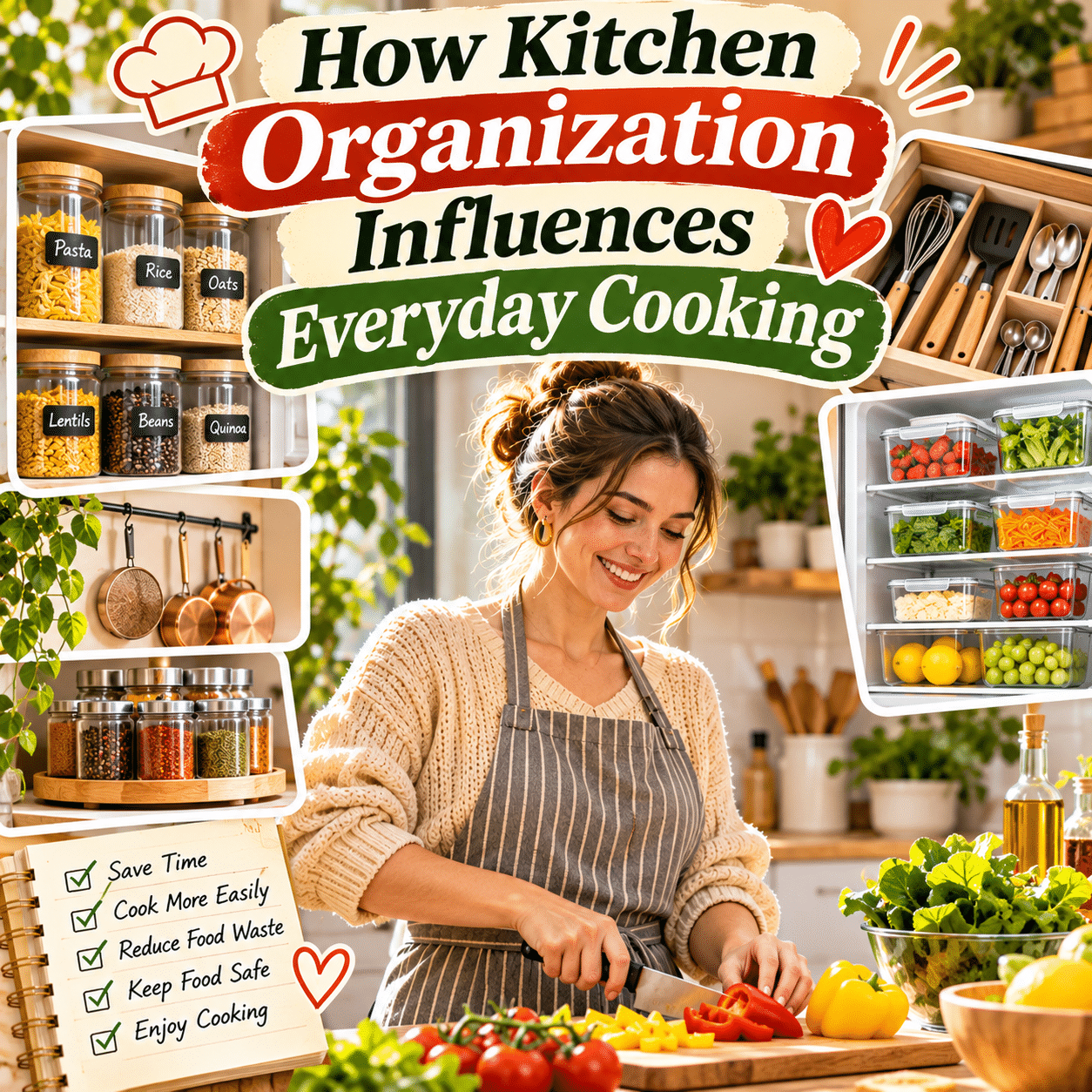
The kitchen is one of the most frequently used spaces in many homes. It is where ingredients are prepared, meals are cooked, dishes are cleaned, and everyday food routines take place. Yet the way a kitchen is organized can significantly influence how comfortable, efficient, and enjoyable these activities feel.
A well-organized kitchen does not necessarily need to be large, expensive, or perfectly designed. Even a compact cooking area can function effectively when essential tools, ingredients, and storage spaces are arranged thoughtfully.
When frequently used items are difficult to find, countertops become crowded, or pantry supplies are poorly arranged, preparing a simple meal may require more time and effort than necessary. These small inconveniences can accumulate and make everyday cooking feel unnecessarily complicated.
By contrast, practical organization can create a smoother cooking experience. Knowing where utensils belong, keeping ingredients accessible, and maintaining clear preparation areas can help people move through cooking tasks with greater confidence.
Kitchen organization also affects grocery planning, food storage, cleaning routines, and household cooperation. A thoughtful arrangement can make it easier to use ingredients before they spoil, maintain hygienic preparation areas, and share cooking responsibilities.
However, there is no single organizational system that works for every household. Kitchen size, available equipment, cooking frequency, physical abilities, family routines, and personal preferences all influence what makes a space functional.
Understanding how kitchen organization influences everyday cooking can help people create practical systems that support their real needs without requiring expensive renovations or complicated storage solutions.
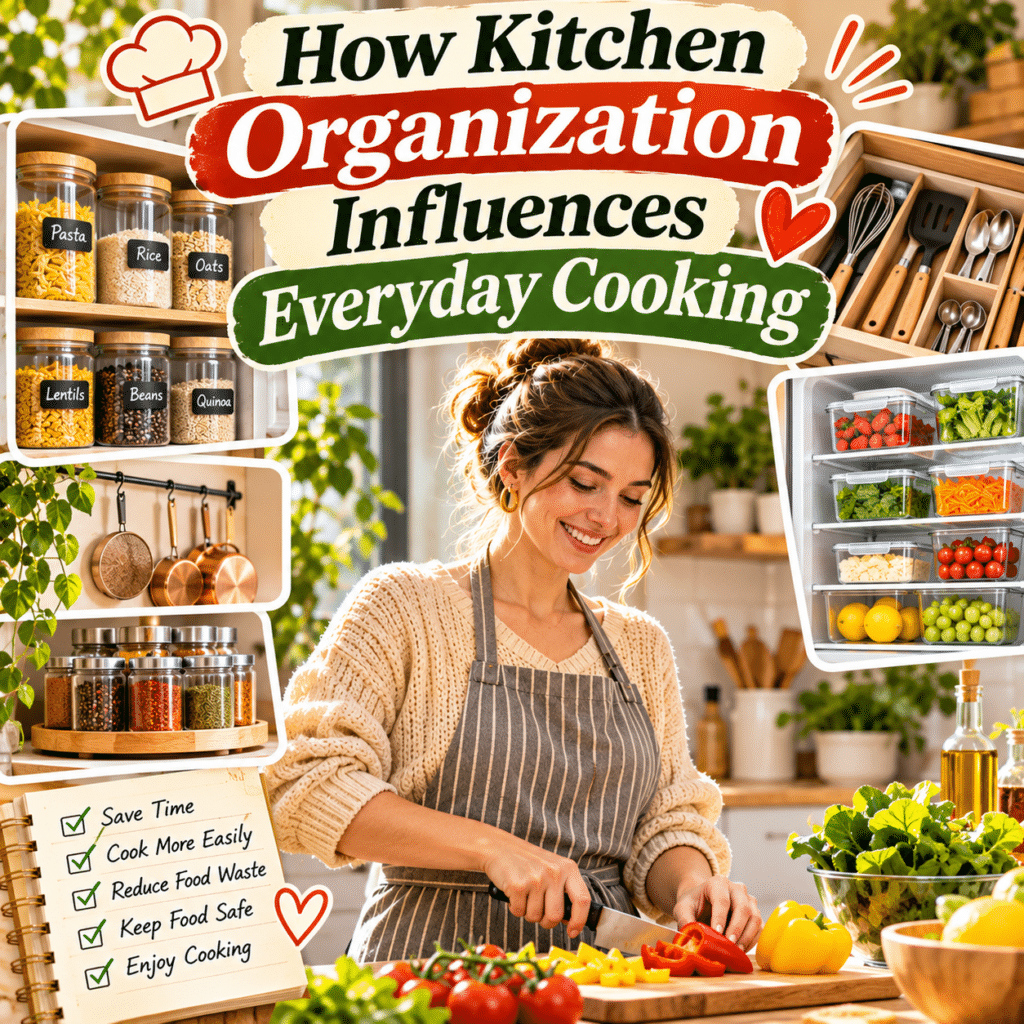
1. Kitchen Organization Creates a More Functional Cooking Environment
A functional kitchen allows people to complete everyday tasks without unnecessary obstacles.
Cooking involves several activities, including gathering ingredients, washing produce, preparing food, applying heat, serving meals, and cleaning afterward.
When the kitchen supports these activities logically, the overall process becomes easier to manage.
For example, keeping cutting boards near a suitable preparation surface can reduce unnecessary movement, while storing cookware close to the cooking area can make frequently used tools easier to access.
The goal is not to create a perfect arrangement but to make ordinary cooking tasks more practical and comfortable.
2. Organized Kitchens Reduce Time Spent Searching for Items
Searching for utensils or ingredients can interrupt the cooking process.
A misplaced measuring spoon, hidden spice container, or unfamiliar storage location may require extra attention during meal preparation.
Assigning consistent locations to frequently used items helps reduce these interruptions.
When household members know where things belong, they can retrieve and return items more easily.
Over time, this familiarity may make cooking routines feel smoother, particularly when preparing meals under time constraints.
3. Clear Countertops Make Food Preparation Easier
Countertops provide essential space for washing, chopping, mixing, and assembling ingredients.
When these surfaces are crowded with appliances, containers, and unrelated household items, available preparation space becomes limited.
Keeping at least one suitable work area reasonably clear can improve everyday functionality.
This does not mean every countertop must remain completely empty.
Frequently used appliances and tools can remain accessible when they do not interfere with safe food preparation.
4. Kitchen Zones Support a Logical Cooking Workflow
Organizing a kitchen into functional zones can help simplify movement between tasks.
Common zones include food storage, preparation, cooking, serving, and cleaning.
For example, knives and cutting boards may be stored near the main preparation area, while pots and pans are placed close to the stove.
A cleaning zone might contain dishwashing supplies and appropriate waste containers.
These zones do not require separate rooms or large spaces. Even a small kitchen can benefit from grouping related items together.
5. Accessible Utensils Encourage More Efficient Meal Preparation
Cooking utensils are most useful when they are easy to reach.
Frequently used spatulas, ladles, measuring tools, and mixing bowls should have practical storage locations.
Drawers, wall-mounted rails, countertop containers, and cabinet organizers can all serve this purpose.
However, items should not be positioned where they create safety hazards or interfere with cooking surfaces.
Thoughtful accessibility helps reduce unnecessary movement while maintaining a safe working environment.
6. Organized Pantries Make Ingredient Planning Easier
A pantry can contain many different foods, including grains, canned goods, spices, baking ingredients, and snacks.
Without a consistent arrangement, ingredients may become difficult to locate or forgotten behind other items.
Grouping similar foods together helps create a clearer overview of available supplies.
For example, grains might occupy one shelf while canned vegetables and legumes are stored together elsewhere.
An organized pantry can support meal planning by making it easier to see which ingredients are already available.
7. Clear Food Storage Can Help Reduce Waste
Food waste sometimes occurs because ingredients are overlooked until they are no longer suitable to use.
Organized storage can help people identify foods that should be used soon.
Placing appropriate older supplies toward the front of a shelf may encourage their use before newer purchases.
Labels can also help distinguish similar ingredients and identify storage dates.
Organization alone cannot prevent spoilage, but it can support better awareness when combined with appropriate storage temperatures and food-safety practices.
8. Kitchen Organization Supports Better Grocery Shopping
An organized kitchen makes it easier to check existing supplies before shopping.
When pantry shelves and refrigerator compartments are arranged clearly, people can identify missing ingredients more accurately.
This may reduce duplicate purchases and unnecessary spending.
A practical system can also make grocery lists easier to prepare.
Instead of relying entirely on memory, household members can review available ingredients and plan purchases around actual needs.
9. Organized Refrigerators Improve Ingredient Visibility
Refrigerators often contain fresh produce, dairy products, leftovers, beverages, and other perishable foods.
Crowded or poorly arranged shelves can make ingredients difficult to find.
Grouping suitable items and using clear containers may improve visibility.
Raw animal products should be stored securely and positioned to prevent juices from contaminating ready-to-eat foods.
Refrigerator organization should also maintain proper airflow and temperatures rather than simply maximizing the number of items stored.
10. Freezer Organization Makes Prepared Ingredients More Useful
Freezers can support convenient meal preparation by storing ingredients and prepared portions for later use.
However, unmarked packages and crowded compartments may make frozen foods difficult to identify.
Labeling containers with their contents and freezing dates can simplify selection.
Grouping similar foods together may also help households understand what is available.
Appropriate packaging and storage practices are essential for maintaining food quality and preventing unnecessary waste.
11. Proper Storage Helps Preserve Ingredient Quality
Different ingredients require different storage conditions.
Some foods benefit from refrigeration, while others are best kept in cool, dry locations.
Understanding these requirements helps prevent inappropriate storage.
For example, dry grains should generally be protected from moisture and pests, while perishable foods need suitable temperature control.
A good organizational system considers both convenience and the conditions necessary to maintain food quality and safety.
12. Organized Spice Storage Simplifies Flavor Preparation
Spices and seasonings are frequently used in everyday cooking.
When containers are scattered across several cabinets, finding the correct seasoning can interrupt meal preparation.
Grouping spices in a dedicated drawer, rack, or cabinet can make them easier to locate.
Labels should remain readable, particularly when containers have similar appearances.
Spices should also be stored according to their requirements, generally away from excessive heat, moisture, and direct sunlight.
13. Kitchen Organization Can Make Cooking Feel Less Overwhelming
A crowded or confusing cooking space may increase the number of decisions required before preparing a meal.
People may need to clear surfaces, locate equipment, or rearrange supplies before beginning.
A practical organizational system can reduce some of these preliminary tasks.
For certain individuals, this may make cooking feel more approachable.
However, organization is not a guaranteed solution to stress. Cooking experiences also depend on time, energy, responsibilities, and personal preferences.
14. Organized Kitchens Support Cooking Confidence
Confidence often develops when people become familiar with their cooking environment.
Knowing where equipment and ingredients are stored can make it easier to follow recipes.
Beginners may particularly benefit from a predictable arrangement that reduces unnecessary searching.
Repeatedly using the same functional setup helps build familiarity with preparation routines.
As confidence grows, cooks may become more comfortable experimenting with new dishes and techniques.
15. Kitchen Organization Makes Simple Recipes More Convenient
Many everyday meals rely on a small collection of familiar ingredients and tools.
When these essentials are readily accessible, simple recipes can be prepared with fewer interruptions.
For example, preparing a vegetable stir-fry may require a cutting board, knife, skillet, cooking oil, vegetables, and seasonings.
Keeping these items in practical locations can make the process more straightforward.
This convenience may encourage people to use their kitchen more regularly.
16. Organizing Ingredients Before Cooking Improves Preparation
Preparing ingredients before beginning a recipe is a useful cooking habit.
This approach is sometimes called mise en place, a culinary term referring to having ingredients and equipment ready.
It may involve measuring ingredients, washing vegetables, and gathering necessary tools.
An organized kitchen makes these steps easier because supplies are easier to locate.
This preparation can be especially useful for recipes that require quick cooking or careful timing.
17. Kitchen Organization Supports Better Time Management
Meal preparation often involves coordinating several activities.
A cook may need to prepare vegetables while grains cook or assemble ingredients before heating a pan.
When equipment and supplies are arranged logically, fewer interruptions may occur.
This can make it easier to focus on timing and task order.
Efficient organization does not eliminate the need for attention, particularly when working with hot surfaces, sharp tools, or foods requiring specific cooking temperatures.
18. Accessible Storage Helps Reduce Unnecessary Movement
Poorly positioned storage may require repeated bending, stretching, or walking between kitchen areas.
Frequently used items can often be placed within comfortable reach.
Heavy cookware is generally safer to store on stable shelves that do not require awkward lifting.
Less frequently used equipment may be placed in less accessible locations when appropriate.
Storage arrangements should reflect individual height, mobility, strength, and physical needs.
19. Kitchen Organization Can Improve Safety
Kitchen safety depends partly on how equipment and ingredients are stored.
Sharp knives should be secured appropriately, and heavy items should not be positioned where they could fall.
Electrical cords should be kept away from water and hot surfaces.
Combustible materials should not be stored too close to cooking appliances.
A well-organized kitchen can help reduce avoidable hazards, although safe cooking practices remain essential.
20. Organized Cleaning Supplies Support Kitchen Hygiene
Cleaning is an important part of food preparation.
Dish soap, appropriate cleaning products, brushes, and cloths should be stored where they can be used safely.
However, household chemicals must remain separate from food and food-contact items.
Cleaning products should be stored according to label instructions and kept away from children when necessary.
An organized cleaning area can make routine hygiene tasks easier without compromising safety.
21. Clear Storage Systems Make Cleanup More Manageable
Cleaning after cooking can feel more complicated when utensils and dishes do not have designated storage locations.
A consistent system helps household members return items after washing and drying.
For example, plates, bowls, and glasses may be grouped according to how frequently they are used.
Drawers and cabinets should be arranged so items can be stored without excessive stacking or awkward handling.
Simple storage routines can reduce the effort required to restore the kitchen after meals.
22. Kitchen Organization Encourages Shared Household Responsibility
In households with multiple members, kitchen organization can support cooperation.
When storage locations are clear, different people can participate in cooking, serving, and cleaning.
Children may help with age-appropriate tasks, while adults can share more complex responsibilities.
Labels and predictable arrangements may make it easier for everyone to locate supplies.
However, an organized kitchen does not automatically create fair household responsibilities. Clear communication and shared expectations are also necessary.
23. Organized Kitchens Can Make Family Cooking Easier
Cooking together often involves several people using the same space.
A clear layout helps participants understand where ingredients and tools are located.
Designated preparation areas may reduce unnecessary crowding.
Tasks can also be divided according to age, ability, and available space.
Safety remains important, particularly when children are present near sharp tools, hot cookware, or electrical appliances.
24. Kitchen Organization Helps Small Spaces Function Better
Compact kitchens require thoughtful use of available storage.
Vertical shelves, drawer dividers, cabinet organizers, and multipurpose equipment may help maximize usable space.
However, additional storage accessories are not always necessary.
Removing rarely used items and keeping essential equipment accessible may provide greater benefits than adding more containers.
A small kitchen can support effective cooking when its layout reflects everyday needs.
25. Vertical Storage Can Make Better Use of Limited Space
Walls, cabinet interiors, and suitable shelving can provide additional storage opportunities.
Hooks, rails, and racks may keep certain utensils accessible without occupying countertop space.
Vertical storage should be installed securely and used within its weight limits.
Items should not interfere with ventilation, appliance clearance, or safe movement.
When used appropriately, vertical storage can improve accessibility in kitchens with limited floor and counter space.
26. Drawer Organization Makes Small Tools Easier to Find
Kitchen drawers often contain utensils of different sizes and functions.
Without separation, small tools may become mixed together.
Dividers or simple containers can help group related items.
For example, measuring spoons, peelers, and small preparation tools can be assigned separate sections.
The most useful drawer system is one that makes everyday items easy to retrieve and return.
27. Cabinet Organization Improves Cookware Accessibility
Pots, pans, lids, baking dishes, and mixing bowls can occupy substantial cabinet space.
Thoughtful grouping can make these items easier to manage.
Frequently used cookware may be stored near the cooking area, while occasional equipment can occupy less accessible shelves.
Lid organizers or stable stacking arrangements may improve convenience.
Heavy items should be stored securely to reduce the risk of falling or awkward lifting.
28. Organizing by Frequency of Use Supports Practical Storage
Not every kitchen item needs equally convenient access.
Everyday utensils and cookware should generally be easier to reach than equipment used only occasionally.
For example, a frequently used saucepan may belong in a convenient lower cabinet, while specialized baking equipment may be stored elsewhere.
This approach can free valuable storage space for essential items.
Organization becomes more effective when it reflects actual cooking habits rather than purely decorative arrangements.
29. Kitchen Organization Can Reduce Duplicate Purchases
Households sometimes purchase items they already own because existing supplies are difficult to locate.
Duplicate spices, utensils, or pantry ingredients may accumulate over time.
Clear storage systems make inventory easier to understand.
Checking cabinets before shopping can reduce unnecessary purchases.
This habit may support more manageable household spending and prevent overcrowded storage areas.
30. An Organized Kitchen Can Support Budget-Friendly Cooking
Practical organization may contribute to household budgeting.
Knowing which ingredients are available can help people plan meals around existing supplies.
Storing staples appropriately may also reduce avoidable spoilage.
A clear inventory can make it easier to compare grocery needs with available resources.
However, organization does not automatically reduce food costs. Savings depend on shopping habits, ingredient prices, portion planning, and waste management.
31. Kitchen Organization Supports Flexible Meal Planning
Meal plans often change because of work schedules, family responsibilities, or ingredient availability.
An organized pantry and refrigerator can make adjustments easier.
For example, a household may prepare soup instead of a planned stir-fry when certain ingredients need to be used sooner.
Knowing what is available allows meals to be adapted without extensive searching.
This flexibility can make meal planning more realistic and sustainable.
32. Organized Storage Makes Batch Cooking More Practical
Batch cooking involves preparing several portions of food for later use.
It can reduce repeated preparation tasks, but it also requires suitable storage.
Clearly labeled containers help identify prepared meals and ingredients.
Appropriate refrigeration and freezing practices are essential.
An organized kitchen can support batch cooking by providing space for preparation, cooling, storage, and later meal assembly.
33. Kitchen Organization Helps Manage Leftovers Safely
Leftovers can be useful for future meals when handled appropriately.
Designated refrigerator areas and clearly labeled containers can make them easier to identify.
Recording preparation or storage dates may help households monitor how long foods have been kept.
Perishable foods should be refrigerated promptly, and reheating should follow appropriate food-safety guidance.
Organization should support safe decisions rather than encourage keeping food beyond recommended storage periods.
34. Kitchen Organization Can Encourage More Frequent Home Cooking
Cooking at home may feel more convenient when ingredients and tools are easy to access.
A functional kitchen reduces some of the preparation tasks that can discourage cooking.
For example, a person may be more willing to prepare a quick meal when the main cooking surface is clear and essential cookware is available.
However, cooking frequency also depends on personal interest, available time, energy, and other responsibilities.
Organization is one supportive factor rather than the sole reason people choose to cook.
35. Organized Kitchens Can Support Health-Conscious Food Choices
Kitchen organization can make certain ingredients more visible and accessible.
For example, keeping washed fruit appropriately stored and easy to find may encourage its use.
Grouping ingredients for familiar balanced meals can also simplify preparation.
However, kitchen organization does not automatically improve nutrition.
Overall eating patterns depend on food availability, dietary needs, preferences, and many other factors.
36. Kitchen Organization Can Adapt to Different Cooking Styles
People use kitchens in different ways.
Some prepare quick everyday meals, while others enjoy baking, experimenting with recipes, or cooking for large groups.
A frequent baker may prioritize accessible measuring tools and baking supplies.
Someone who regularly prepares stir-fries may benefit from keeping suitable cookware and seasonings near the cooking area.
Effective organization reflects the activities that happen most often in the space.
37. Accessible Kitchen Design Supports Different Physical Needs
Kitchen organization should consider the needs of people who use the space.
Individuals with limited mobility, reduced grip strength, or other physical considerations may benefit from accessible storage arrangements.
Frequently used items can be positioned to reduce unnecessary reaching or lifting.
Easy-grip utensils, suitable work surfaces, and clear pathways may improve usability.
Accessibility needs vary, so practical arrangements should be based on individual circumstances rather than assumptions.
38. Kitchen Organization Should Evolve With Household Changes
A kitchen arrangement that works today may become less practical over time.
Household size, cooking habits, available equipment, and daily routines can change.
For example, a person who begins cooking more frequently may need easier access to preparation tools.
A household with young children may need to reconsider storage safety.
Periodic adjustments help keep the kitchen aligned with current needs.
39. Simple Organizational Systems Are Often More Sustainable
Complicated organizational systems may look appealing but require considerable maintenance.
Too many containers, labels, or storage rules can make everyday tasks unnecessarily difficult.
A simple system is often easier to understand and maintain.
For example, grouping similar ingredients and assigning consistent locations to frequently used tools may be sufficient.
The best organization is not necessarily the most elaborate. It is the arrangement that continues to work during ordinary daily use.
40. The Best Kitchen Organization Supports Real Cooking Habits
The purpose of kitchen organization is to make everyday cooking easier, safer, and more manageable.
A kitchen should support the people who use it rather than follow an idealized appearance.
Clear preparation surfaces, accessible tools, appropriate food storage, and logical arrangements can all contribute to better functionality.
However, no single layout or storage method suits every home.
The most valuable organizational system is one that adapts to real cooking habits, available space, and household responsibilities while remaining practical over time.
Understanding the Everyday Benefits of Kitchen Organization
Thoughtful kitchen organization can influence several aspects of meal preparation and household management.
| Kitchen Organization Practice | Potential Benefit | Practical Example |
|---|---|---|
| Keeping countertops clear | More preparation space | Maintaining a designated chopping area |
| Grouping cooking utensils | Easier access | Storing spatulas near the cooking area |
| Organizing pantry shelves | Better ingredient visibility | Keeping grains and canned foods together |
| Labeling storage containers | Easier identification | Marking flour and rice containers |
| Arranging refrigerator shelves | Improved food management | Separating raw and ready-to-eat foods |
| Organizing freezer contents | More convenient meal planning | Labeling frozen meal portions |
| Creating preparation zones | Smoother cooking workflow | Keeping cutting boards near the work surface |
| Storing cookware logically | Less unnecessary movement | Placing frequently used pans near the stove |
| Using drawer dividers | Easier tool retrieval | Separating measuring tools and peelers |
| Checking pantry inventory | Fewer duplicate purchases | Reviewing supplies before shopping |
| Organizing leftovers | Better storage awareness | Labeling containers with preparation dates |
| Sharing storage systems | Easier household cooperation | Establishing consistent locations for dishes |
| Using vertical storage safely | More usable space | Installing suitable utensil hooks |
| Reviewing storage periodically | Greater long-term functionality | Adjusting cabinets as cooking habits change |
The most effective improvements are usually those that solve specific everyday problems.
How to Organize Your Kitchen for Easier Everyday Cooking Step by Step
Improving kitchen organization does not require a complete renovation. A gradual process can make the space more functional while keeping the effort manageable.
Step 1: Observe Your Current Cooking Routine
Begin by considering how the kitchen is used.
Notice which tasks feel inconvenient and which items are difficult to locate.
Identify areas where clutter or awkward storage interrupts meal preparation.
These observations provide a practical starting point.
Step 2: Identify Your Most Frequently Used Items
Make a short list of cookware, utensils, appliances, and ingredients used regularly.
These items should generally receive the most convenient storage locations.
Less frequently used equipment can be placed elsewhere when appropriate.
Step 3: Clear and Evaluate Preparation Surfaces
Remove unrelated items from the main food-preparation area.
Decide which appliances genuinely need permanent countertop space.
Maintain enough room for safe chopping, mixing, and assembling ingredients.
Step 4: Group Similar Items Together
Organize utensils, cookware, pantry ingredients, and cleaning supplies into practical categories.
For example, keep baking tools together and store common seasonings in a designated location.
Avoid creating categories that are too complicated to maintain.
Step 5: Establish Functional Kitchen Zones
Identify suitable areas for food storage, preparation, cooking, serving, and cleaning.
Place frequently used items near the activities they support.
Adapt these zones to the available layout rather than forcing an unsuitable arrangement.
Step 6: Review Pantry and Refrigerator Storage
Check existing ingredients and remove foods that are no longer safe or suitable to use.
Group appropriate items together and improve visibility.
Follow food-storage requirements and maintain suitable refrigerator and freezer conditions.
Step 7: Improve Cabinet and Drawer Accessibility
Move frequently used items into practical locations.
Use dividers or organizers only when they solve a genuine storage problem.
Store heavy and sharp equipment securely.
Step 8: Create Simple Labeling Systems
Label containers when contents or storage dates are not immediately clear.
Use readable labels that can be updated easily.
Avoid unnecessary labeling when original packaging already provides useful information.
Step 9: Establish Manageable Cleaning Habits
Return items to their designated locations after use.
Keep food-preparation surfaces appropriately cleaned.
Store cleaning chemicals separately from food and follow product safety instructions.
Step 10: Review and Adjust the Arrangement
Use the kitchen for several days or weeks and observe how the new system performs.
Move items that remain inconvenient to access.
Remove organizational accessories that create more work than they save.
A useful kitchen arrangement should become easier to maintain through everyday use.
Kitchen Organization Strategies for Different Kitchen Sizes
The most suitable organization approach depends partly on available space.
| Kitchen Type | Common Challenge | Practical Organization Strategy |
|---|---|---|
| Small apartment kitchen | Limited countertops | Prioritize essential appliances and clear work surfaces |
| Narrow galley kitchen | Restricted movement | Keep pathways clear and group tools by task |
| Open-plan kitchen | Visible clutter | Use consistent storage locations and manageable countertop arrangements |
| Large family kitchen | Many users and supplies | Create clear zones and shared storage systems |
| Compact studio kitchen | Limited cabinets | Use safe vertical storage and multipurpose equipment |
| Kitchen with deep cabinets | Difficult item retrieval | Group supplies in accessible containers |
| Kitchen with limited drawers | Mixed small utensils | Use practical dividers or designated containers |
| Shared accommodation kitchen | Unclear ownership and responsibilities | Establish agreed storage areas |
| Kitchen used for frequent baking | Numerous specialized tools | Keep baking supplies together |
| Kitchen used for quick meals | Limited preparation time | Prioritize everyday cookware and ingredients |
A kitchen does not need to be spacious to function effectively. Practical arrangements are more important than the total number of cabinets or shelves.
Organizing Essential Kitchen Areas
Different kitchen areas benefit from different storage approaches.
Pantry and Dry-Food Storage
Keep dry foods in suitable conditions according to their storage requirements.
Group similar ingredients and make frequently used supplies easy to identify.
Avoid overcrowding shelves to the point that older products become hidden.
Refrigerator
Maintain appropriate refrigeration temperatures and avoid blocking airflow.
Store raw animal products securely to prevent contamination.
Use suitable containers and organize perishable foods so they can be monitored easily.
Freezer
Label frozen foods when necessary.
Use appropriate packaging to protect food quality.
Organize items so frequently used ingredients can be retrieved without excessive searching.
Cooking Area
Keep commonly used cookware accessible.
Maintain safe distances between combustible materials and heat sources.
Avoid placing loose utensils or other objects where they could interfere with burners or hot cookware.
Preparation Area
Maintain a clean, suitable surface for chopping and assembling ingredients.
Keep knives, cutting boards, and preparation tools accessible but safely stored.
Use separate equipment or appropriate cleaning procedures to prevent cross-contamination.
Cleaning Area
Store dishwashing supplies conveniently.
Keep household chemicals separate from food and cooking equipment.
Maintain clear access to the sink and suitable waste containers.
Common Kitchen Organization Mistakes to Avoid
1. Buying Organizers Before Understanding the Problem
Storage products may not solve the underlying issue.
Evaluate what needs improvement before purchasing additional containers or accessories.
2. Keeping Too Many Rarely Used Items
Excess equipment can occupy valuable storage space.
Review whether items are genuinely useful before assigning them permanent locations.
3. Prioritizing Appearance Over Functionality
A visually attractive kitchen is not necessarily practical.
Choose arrangements that support everyday cooking rather than focusing only on decorative presentation.
4. Storing Frequently Used Items Too Far Away
Placing everyday utensils in inconvenient locations creates unnecessary movement.
Prioritize accessibility according to actual use.
5. Overcrowding Refrigerator Shelves
Excessive crowding can reduce visibility and interfere with airflow.
Maintain suitable storage conditions and avoid unnecessary overfilling.
6. Ignoring Food-Safety Requirements
Convenient storage should never compromise hygiene or temperature control.
Follow appropriate guidance for raw foods, perishable ingredients, and leftovers.
7. Using Too Many Complicated Categories
An overly detailed storage system can become difficult to maintain.
Choose simple categories that household members can understand.
8. Storing Heavy Items in Unsafe Locations
Heavy cookware placed on high or unstable shelves may create injury risks.
Use secure, accessible storage appropriate to the item’s weight.
9. Failing to Communicate Storage Changes
In shared kitchens, moving supplies without informing others can create confusion.
Explain new arrangements and consider feedback from household members.
10. Never Reviewing the Organizational System
Cooking habits and household needs change.
Periodically reassess storage arrangements and make practical adjustments.
A Practical Kitchen Organization Checklist
Use this checklist to evaluate how well your kitchen supports everyday cooking.
Countertops and Preparation Areas
- At least one suitable food-preparation surface is reasonably clear.
- Frequently used tools are easy to access.
- Unnecessary appliances do not crowd the main work area.
- Cutting boards and knives have safe storage locations.
- Preparation surfaces can be cleaned effectively.
Pantry and Ingredient Storage
- Similar pantry ingredients are grouped logically.
- Frequently used staples are easy to locate.
- Older ingredients are visible when appropriate.
- Storage containers are suitable for their contents.
- Pantry supplies are reviewed before grocery shopping.
Refrigerator and Freezer
- Refrigerated foods are stored at appropriate temperatures.
- Raw animal products are separated from ready-to-eat foods.
- Refrigerator shelves are not excessively overcrowded.
- Frozen foods are labeled when necessary.
- Leftovers are stored and monitored safely.
Cookware and Utensils
- Frequently used cookware is stored conveniently.
- Heavy items are positioned securely.
- Small utensils have consistent storage locations.
- Drawers and cabinets are reasonably easy to access.
- Specialized equipment does not obstruct everyday tools.
Cleaning and Long-Term Maintenance
- Cleaning products are stored separately from food.
- Waste containers are appropriately positioned.
- Household members understand shared storage arrangements.
- Items can be returned easily after use.
- The kitchen organization system is reviewed as needs change.
Frequently Asked Questions About Kitchen Organization
1. Why is kitchen organization important for everyday cooking?
Kitchen organization helps make tools, ingredients, and preparation areas easier to access. It can reduce unnecessary searching, support food storage, and improve the overall cooking workflow.
2. Does an organized kitchen make cooking faster?
It may reduce time spent locating items and preparing the workspace. Actual cooking time still depends on recipes, equipment, ingredients, and individual experience.
3. How should a beginner start organizing a kitchen?
Begin by identifying frequently used items, clearing a suitable preparation area, and grouping similar supplies together. Make gradual changes rather than reorganizing everything at once.
4. What are kitchen zones?
Kitchen zones are areas organized around related activities, such as food storage, preparation, cooking, serving, and cleaning. They help create a more logical workflow.
5. How can a small kitchen be organized effectively?
Prioritize essential equipment, keep countertops functional, use available storage thoughtfully, and consider safe vertical storage where appropriate.
6. Should every pantry ingredient be transferred into a container?
No. Original packaging may already provide suitable storage and important product information. Additional containers are useful only when they improve safety, visibility, or convenience.
7. Can kitchen organization reduce food waste?
It can help by improving ingredient visibility, supporting inventory awareness, and making leftovers easier to identify. Proper food storage and realistic meal planning remain essential.
8. How should frequently used utensils be stored?
Keep them in safe, convenient locations near the activities where they are used. Drawers, utensil containers, and suitable wall-mounted storage can all work.
9. Is expensive kitchen equipment necessary for good organization?
No. Many organizational improvements involve rearranging existing items, reducing clutter, and establishing consistent storage locations.
10. How often should kitchen storage be reviewed?
There is no fixed schedule. Review the arrangement when items become difficult to find, storage becomes crowded, or cooking habits change.
11. Can kitchen organization help with meal planning?
Yes. Clear pantry and refrigerator storage can make it easier to identify available ingredients and plan meals around existing supplies.
12. What is the best way to organize kitchen drawers?
Group related tools together and use dividers when helpful. Keep frequently used items accessible and avoid overcrowding.
13. How can multiple people maintain an organized kitchen?
Agree on consistent storage locations, communicate changes, and share appropriate cleaning and maintenance responsibilities.
14. Does kitchen organization improve food safety?
It can support safer practices by separating appropriate food categories, securing equipment, and making cleaning supplies easier to manage. Proper food handling remains essential.
15. What is the most important principle of kitchen organization?
The most important principle is functionality. A kitchen should be arranged around the people who use it, the meals they prepare, and the space available.
Final Thoughts
Kitchen organization influences everyday cooking by shaping how people access ingredients, use equipment, prepare meals, and maintain their cooking environment. Small organizational decisions can affect the convenience and practicality of routine kitchen activities.
A thoughtfully arranged kitchen can reduce unnecessary searching, create more usable preparation space, and make common cooking tasks easier to manage. These improvements do not require expensive renovations or elaborate storage systems.
Organization also supports broader household responsibilities. Clear pantry and refrigerator arrangements can improve ingredient awareness, while practical storage systems can make cleaning and shared cooking tasks more manageable.
Food safety should remain a central consideration. Proper refrigeration, secure equipment storage, clean preparation surfaces, and separation of potentially hazardous materials are more important than achieving a perfectly styled kitchen.
Different households require different solutions. A compact apartment kitchen, a large family cooking space, and a shared kitchen may each benefit from distinct organizational approaches.
The most effective systems are flexible. As cooking habits, household responsibilities, and physical needs change, storage arrangements should evolve accordingly.
Rather than pursuing an idealized kitchen appearance, it is more useful to focus on simple improvements that make everyday cooking feel practical, comfortable, and sustainable.
Ultimately, the best kitchen organization is not about creating a flawless space. It is about building a functional environment where preparing everyday meals becomes easier, safer, and more enjoyable.