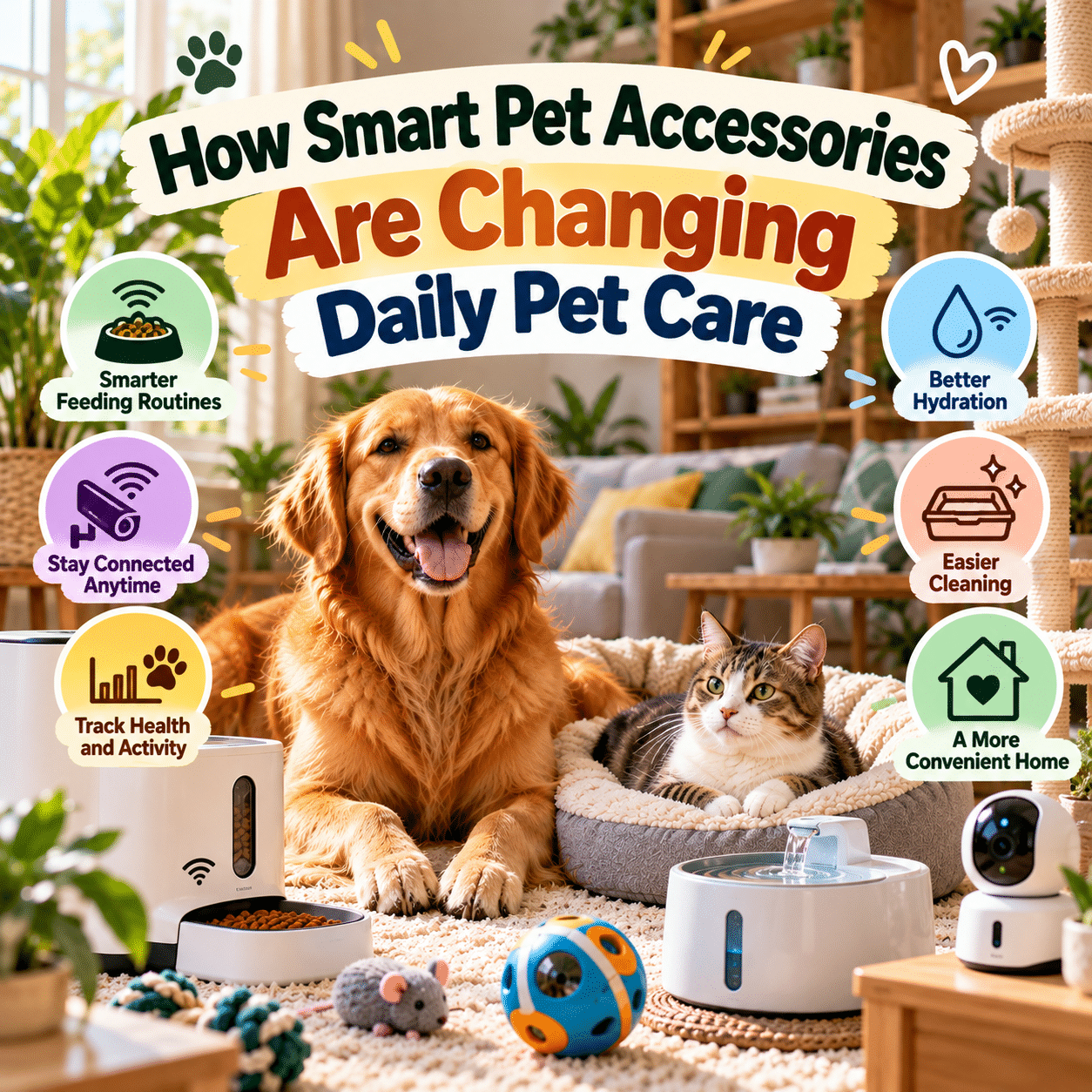
Caring for a pet involves countless small responsibilities that become part of everyday household life. Meals must be prepared, water refreshed, living spaces cleaned, exercise provided, and changes in behavior observed. For many pet owners, these routines are enjoyable parts of the relationship they share with their animals.
However, modern schedules can make consistency challenging.
Work commitments, commuting, family responsibilities, travel, and changing daily routines often require households to organize pet care more carefully. At the same time, advances in consumer technology have introduced new ways to manage recurring tasks and observe aspects of an animal’s daily activity.
Smart pet accessories are emerging as one response to these needs.
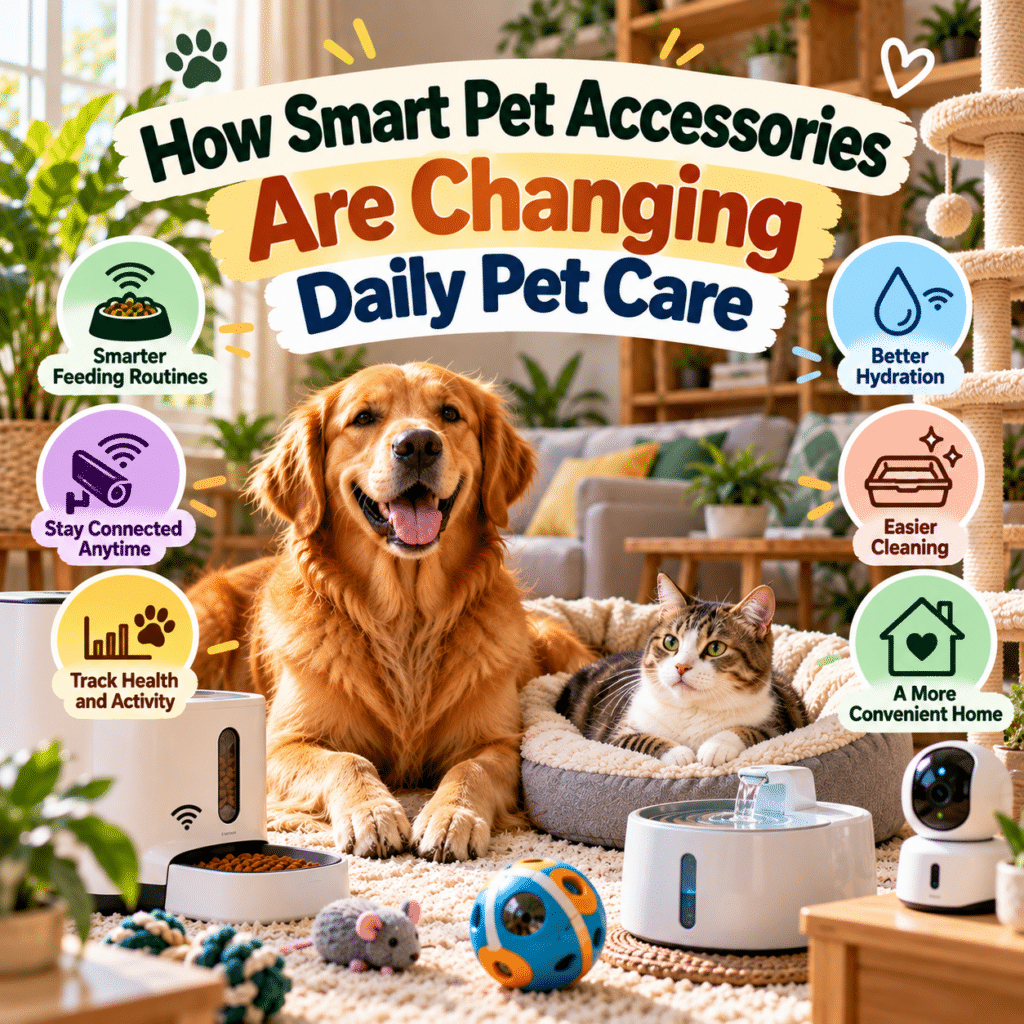
Automatic feeders can dispense measured portions of food at scheduled times. Connected water fountains may provide reminders about water levels or maintenance. Pet cameras allow owners to observe selected areas of the home remotely. Activity trackers can record movement patterns, while automated litter boxes aim to simplify certain cleaning tasks.
These products represent a broader shift toward connected, data-informed household care.
Yet the most meaningful change is not simply that pet accessories are becoming electronic. It is that technology can help owners organize routines, recognize patterns, and reduce some repetitive responsibilities.
Smart products also introduce new considerations. Devices can malfunction, software may become unsupported, sensors can produce misleading information, and connected cameras raise privacy concerns. Most importantly, automation cannot replace the attention, companionship, and judgment required for responsible animal care.
Understanding both the opportunities and limitations of smart pet accessories can help households make better decisions about which technologies are genuinely useful.
This guide explores how smart pet accessories work, how they are changing everyday routines, and what pet owners should consider before integrating connected devices into their homes.
1. What Are Smart Pet Accessories?
Smart pet accessories are products that use electronic components, sensors, programmable controls, wireless connectivity, or software to support particular aspects of animal care.
Some operate independently using built-in timers or mechanical systems. Others connect to mobile applications or household networks.
The term smart is used broadly in consumer marketing, so not every product offers the same capabilities.
Common Features of Smart Pet Products
Depending on the product, features may include:
- Programmable schedules.
- Automatic dispensing or movement.
- Motion detection.
- Weight or activity sensors.
- Mobile application controls.
- Remote notifications.
- Camera monitoring.
- Data recording.
- Maintenance reminders.
- Integration with other compatible devices.
A timed feeder that operates without internet access may be considered an automated accessory.
A feeder that connects to a smartphone and provides remote notifications is a connected accessory.
Both may be useful, but they solve somewhat different problems.
Automation Versus Connectivity
Automation allows a device to perform a task according to predefined instructions.
Connectivity allows information or commands to move between the device and another system.
For example, an automatic feeder may dispense food at 7:00 a.m. every morning using an internal clock.
A connected feeder may allow the owner to modify that schedule remotely.
Connectivity can add flexibility, but it also introduces dependence on software, network availability, and account security.
Why the Distinction Matters
Households should evaluate what a device actually does rather than relying on its marketing category.
A reliable standalone feeder may be more appropriate than a connected model if remote control is unnecessary.
Similarly, a smart camera may offer useful observations but cannot guarantee that a pet is safe or comfortable.
The right technology is the technology that addresses a clearly identified need.
2. Why Smart Pet Accessories Are Becoming More Relevant
Several long-term developments are influencing the adoption of smart pet care products.
Changing Household Schedules
Many households manage work, education, commuting, and other commitments outside the home.
Pet care routines must fit around these responsibilities.
Programmable accessories can support selected tasks when schedules vary.
For example, a timed feeder may help maintain a consistent feeding time even when a household member returns home later than expected.
However, animals still require appropriate supervision and direct care.
Greater Attention to Daily Routines
Pet owners increasingly recognize the importance of consistent feeding, hydration, exercise, hygiene, and observation.
Smart accessories can help organize some of these routines.
A feeding history may show when portions were dispensed.
A maintenance reminder may prompt cleaning of a water fountain.
These functions can reduce the need to remember every small task manually.
More Accessible Consumer Technology
Sensors, wireless modules, cameras, and mobile applications are now common components in household electronics.
Manufacturers can incorporate similar technologies into pet accessories.
However, greater technological availability does not automatically mean better product quality.
Reliability, safety, and usability remain essential.
Interest in Practical Convenience
Households often seek products that simplify repetitive responsibilities.
Smart pet accessories may reduce manual effort in selected areas, but they also require maintenance.
A device that saves a few minutes each day while demanding frequent troubleshooting may provide limited practical value.
3. Smart Feeders Are Changing How Households Manage Meals
Automatic feeders are among the most familiar smart pet accessories.
They are designed to dispense food according to a schedule or user command.
Scheduled Feeding
Many automatic feeders allow owners to program meal times and portions.
This can be useful for households that want a predictable feeding routine.
For example, a feeder may dispense a measured amount of dry food in the morning and another portion later in the day.
Consistency can be convenient, but feeding schedules should reflect the animal’s nutritional needs.
Portion Management
Some feeders allow users to adjust the amount of food dispensed.
However, portion accuracy varies by device and food type.
Different kibble sizes, shapes, and densities may affect dispensing.
Owners should verify actual portions using an appropriate measuring method, such as a kitchen scale, when necessary.
Remote Feeding Controls
Connected feeders may allow owners to change schedules or trigger dispensing through an application.
This can provide flexibility.
However, remote operation depends on device design and may require a functioning internet connection.
Feeding Records
Some models record scheduled or completed dispensing events.
These records can help owners review routines.
However, a record showing that food was dispensed does not prove that the animal consumed it.
Important Limitations
Automatic feeders can experience:
- Food jams.
- Empty reservoirs.
- Mechanical failures.
- Power interruptions.
- Incorrect portion settings.
- Software errors.
- Connectivity problems.
Wet food introduces additional food-safety considerations.
Unless a device is specifically designed to maintain appropriate food temperatures, perishable food should not be left unrefrigerated for extended periods.
Automatic feeders should be inspected regularly and should never be relied upon as the sole safeguard for an animal left without adequate care.
4. Smart Water Fountains Are Supporting Hydration Routines
Water is essential for animal health, and pets should have reliable access to clean drinking water.
Smart water fountains aim to make water management more convenient.
Circulating Water
Many fountains use a pump to circulate water through a reservoir.
Some animals prefer moving water, although preferences vary.
Circulation may make a fountain more appealing to certain pets.
It does not automatically make the water cleaner or safer.
Water-Level Monitoring
Some connected fountains use sensors to detect low water levels.
A notification may remind owners to refill the reservoir.
This can be useful, but sensors can fail or become inaccurate.
Physical inspection remains important.
Filter Maintenance Reminders
Some models provide reminders to replace filters or clean the fountain.
These reminders can help establish maintenance routines.
However, a filter does not eliminate the need to clean the reservoir, pump, and other components.
Hygiene Considerations
Water fountains may accumulate:
- Biofilm.
- Food particles.
- Hair.
- Mineral deposits.
- Other debris.
Regular cleaning is necessary even when the water appears clear.
Backup Water Access
A conventional water bowl can provide an alternative source if a fountain stops working.
This is particularly important when the fountain depends on electricity.
Smart hydration products should support reliable water access rather than create a single point of failure.
5. Pet Cameras Are Changing Remote Observation
Pet cameras allow owners to view selected areas of their homes while they are away.
These devices may use Wi-Fi connections, mobile applications, and cloud services.
Understanding Daily Behavior
A camera may reveal how a pet spends time when household members are absent.
For example, an owner might observe that a dog rests quietly for much of the afternoon.
A cat may spend time watching a window or moving between resting locations.
These observations can help owners understand routines.
Motion Alerts
Some cameras send notifications when movement is detected.
However, motion detection is not equivalent to health or welfare monitoring.
A camera may miss events outside its field of view.
It may also produce unnecessary alerts.
Two-Way Audio
Certain devices allow owners to speak through a built-in speaker.
Some pets may respond positively to a familiar voice.
Others may become confused or distressed when they hear a person who is not physically present.
Owners should observe individual reactions.
Treat-Dispensing Cameras
Some connected cameras include treat dispensers.
These combine remote observation with food delivery.
Portion size, dietary needs, mechanical reliability, and safety should all be considered.
Privacy and Security
Connected cameras may capture household conversations, images, and personal activities.
Important precautions include:
- Strong, unique passwords.
- Multifactor authentication when available.
- Regular software updates.
- Appropriate camera placement.
- Reviewing recording and cloud-storage settings.
- Restricting unnecessary account access.
A pet camera should be treated as a connected household security device, not simply as a toy.
6. Activity Trackers Are Introducing Data Into Pet Care
Wearable pet trackers may record movement, location, or other information.
Their capabilities vary widely.
Movement Tracking
Some devices estimate activity based on motion sensors.
They may record periods of movement and inactivity.
This information can help owners observe general patterns.
However, activity estimates are not always precise.
Establishing Individual Baselines
A tracker may be more useful for comparing an animal’s activity with its own typical pattern than for comparing it with other pets.
For example, a gradual reduction in recorded activity may encourage an owner to observe the animal more closely.
However, activity changes can result from many factors, including weather, routine changes, aging, and illness.
Location Tracking
Some devices use GPS or other positioning technologies.
They may help owners locate pets under suitable conditions.
However, tracking accuracy depends on the environment, device, network coverage, and power availability.
A tracker is not a substitute for secure containment, identification, or appropriate supervision.
Health Claims and Limitations
Consumer activity trackers should not be treated as medical diagnostic devices unless they have appropriate validation for a specific purpose.
Changes in activity data may be useful observations to discuss with a veterinarian.
They do not establish a diagnosis.
7. Automated Litter Boxes Are Changing Cleaning Routines
Cat litter maintenance is a recurring household responsibility.
Automatic litter boxes are designed to remove or separate waste using mechanical systems.
How Automated Litter Boxes Work
Depending on the design, a device may:
- Rotate a litter chamber.
- Move a rake through litter.
- Separate clumps from unused litter.
- Transfer waste into a collection compartment.
- Record selected usage events.
Some models operate after a delay, while others use sensors to detect when a cat has left the box.
Potential Convenience Benefits
Automation may reduce the frequency of manual scooping.
Some models also contain waste in enclosed compartments.
However, waste containers still require emptying.
The litter box itself must also be cleaned.
Safety Considerations
Moving mechanisms introduce potential hazards.
A device should not operate in a way that could trap or injure an animal.
Owners should evaluate:
- Reliable animal-detection sensors.
- Emergency stopping mechanisms.
- Appropriate size restrictions.
- Safe access and exit.
- Manufacturer safety guidance.
- Product reliability.
Some designs may be unsuitable for kittens, small cats, or animals with mobility limitations.
Monitoring Elimination
Changes in urination and defecation can be important indicators of health problems.
Automatic waste removal should not prevent owners from observing relevant changes.
For example, repeated attempts to urinate with little or no urine production may indicate an emergency, especially in male cats.
Veterinary care should not be delayed because a device appears to be functioning normally.
8. Smart Pet Doors and Access Systems
Some pet doors use electronic identification or connected controls.
These products are designed to manage access between designated areas.
Microchip-Activated Doors
Certain pet doors recognize compatible identification microchips or collar tags.
This may help restrict access to authorized animals.
Scheduled Access
Some models allow owners to control when a door can open.
This may be useful for managing routines.
However, access schedules must not interfere with essential needs such as toileting or safe shelter.
Connected Notifications
Some products record entry and exit events.
These records may help owners understand movement patterns.
However, missed detections and software errors are possible.
Security Considerations
Pet doors can affect household security and environmental control.
Owners should consider installation quality, weather resistance, locking reliability, and the possibility of unauthorized access.
A smart door does not replace secure property boundaries or responsible supervision.
9. Smart Toys and Automated Play Accessories
Electronic pet toys can create movement or activity without constant manual operation.
Some respond to touch, motion, or programmed schedules.
Motion-Activated Toys
A toy may begin moving when a pet approaches.
This can encourage investigation or play.
However, sudden movement or noise may frighten some animals.
Automated Chase Toys
Certain devices roll, rotate, or change direction.
They may provide opportunities for movement and exploration.
However, repetitive automated movement does not necessarily provide the same experience as responsive human-guided play.
Programmable Play Sessions
Some toys allow owners to schedule activity periods.
This may introduce variety into daily routines.
However, automatic activation should not disturb an animal’s rest or create unsafe situations.
Enrichment Still Requires Individualization
The best toy is one that supports natural behavior and matches the animal’s preferences.
A simple puzzle feeder or supervised wand toy may be more engaging than an expensive electronic device.
Technology should support enrichment rather than define it.
10. Smart Grooming Accessories and Hygiene Devices
Technology is also appearing in grooming and cleaning equipment.
Examples include grooming tools with vacuum attachments, automated cleaning systems, and electronic nail grinders.
Vacuum-Assisted Grooming
Some grooming devices collect loose hair while brushing.
This may reduce mess.
However, noise and suction can distress certain animals.
Gradual introduction is important.
Electric Nail Grinders
Nail grinders use rotating abrasive surfaces to shorten nails.
They can offer an alternative to conventional clippers.
However, incorrect use may cause discomfort, heat buildup, or injury.
Owners should follow appropriate techniques and seek professional guidance when needed.
Automated Cleaning Devices
Some household cleaning products are marketed for homes with pets.
Robot vacuums, for example, may help manage loose hair on suitable surfaces.
However, they can encounter pet toys, water bowls, or accidents.
Owners should prepare the environment and follow safety instructions.
Practical Value Over Novelty
A grooming accessory is useful when it improves comfort, cleanliness, or ease of care.
Electronic features should not be treated as inherently superior to simple tools.
11. How Smart Accessories Can Improve Household Organization
One of the less obvious benefits of smart pet accessories is their potential to support organization.
Pet care involves repeated tasks that can be difficult to coordinate across multiple household members.
Shared Responsibilities
Connected applications may allow more than one authorized person to view or manage selected routines.
For example, family members may be able to see whether a feeder completed a scheduled dispensing cycle.
However, shared access should be managed carefully.
Maintenance Reminders
Notifications may help households remember:
- Filter replacement.
- Device cleaning.
- Battery charging.
- Food reservoir refilling.
- Waste-container emptying.
These reminders can be convenient, but they should not replace physical inspection.
More Predictable Routines
Programmable equipment can help standardize selected tasks.
Consistency may be especially useful when household schedules vary.
However, predictable care still depends on people ensuring that the animal’s needs are met.
Reducing Repetitive Work
Automation can reduce some manual tasks.
The time saved may be used for play, exercise, grooming, or direct interaction.
This is one of the most practical ways technology can support responsible ownership.
12. Comparing Smart and Traditional Pet Accessories
Smart products offer additional features, but traditional alternatives often remain effective.
| Care Category | Traditional Accessory | Smart Alternative | Main Tradeoff |
|---|---|---|---|
| Feeding | Standard food bowl | Programmable feeder | Convenience versus mechanical complexity |
| Hydration | Water bowl | Connected fountain | Monitoring features versus maintenance |
| Observation | Direct household observation | Pet camera | Remote visibility versus privacy concerns |
| Activity | Manual observation and records | Wearable tracker | More data versus accuracy limitations |
| Litter care | Conventional litter box | Automated litter system | Reduced scooping versus cost and safety considerations |
| Play | Manual interactive toys | Motion-activated toys | Automated activity versus individual responsiveness |
| Access | Conventional pet door | Electronic access door | Controlled access versus technical dependence |
| Grooming | Manual brush | Vacuum-assisted grooming tool | Hair collection versus noise and complexity |
The best choice depends on the household’s needs.
A conventional product may be more reliable, affordable, and easier to maintain.
A smart alternative may be worthwhile when its additional functions provide clear benefits.
13. The Importance of Reliability in Smart Pet Products
Reliability is especially important when a device supports an essential care task.
A malfunctioning entertainment device may be inconvenient.
A malfunctioning feeder or water system may create more serious consequences.
Power Failures
Some devices stop operating when electricity is interrupted.
Others include battery backup systems.
Owners should understand how a product behaves during a power failure.
Internet Disruptions
Connected products may lose remote functionality when internet service is unavailable.
Some continue operating according to stored schedules.
Others may depend more heavily on cloud services.
This distinction should be verified before purchase.
Mechanical Wear
Moving components can wear out or become obstructed.
Regular inspection and cleaning help reduce problems.
Software Support
Connected devices may depend on mobile applications and manufacturer servers.
If software support ends, certain features may stop working.
Households should consider the manufacturer’s update practices and long-term support policies.
Backup Plans
Essential pet care should not depend entirely on one device.
Practical backup arrangements may include:
- Conventional water bowls.
- Manual feeding supplies.
- Alternative litter facilities.
- Emergency contact arrangements.
- Clear instructions for another caregiver.
Technology should improve resilience, not reduce it.
14. Data Privacy and Cybersecurity in Connected Pet Care
Smart pet accessories often collect information.
Depending on the device, this may include activity records, location data, feeding schedules, images, audio, or household network information.
Understanding Data Collection
Before using a connected product, owners should review what information it collects and how that information is handled.
Questions include:
- Is data stored locally or remotely?
- Is cloud storage required?
- Can recordings be deleted?
- Are third parties involved?
- Does the device require unnecessary permissions?
- Can data collection be limited?
Protecting Accounts
Strong passwords and multifactor authentication can reduce unauthorized access risks.
Reusing passwords across devices is best avoided.
Keeping Software Updated
Firmware and application updates may address security vulnerabilities.
Owners should install updates from legitimate sources.
Choosing Camera Locations Carefully
Pet cameras should be positioned to observe relevant areas without unnecessarily recording private household activities.
Considering Long-Term Support
A connected product may remain physically functional after its software becomes outdated.
However, unsupported software can create security and usability problems.
Long-term support is an important purchasing consideration.
15. Smart Pet Accessories and Animal Welfare
Convenience should never come at the expense of animal welfare.
A device may simplify a household task while creating discomfort or stress for the animal.
Observing Reactions
Pets may respond differently to unfamiliar sounds, lights, movements, and equipment.
A cat may avoid a noisy water fountain.
A dog may become distressed by a camera speaker.
An animal may refuse to enter an automatic litter box.
These reactions should be taken seriously.
Allowing Gradual Adjustment
New devices should be introduced gradually.
For example, a water fountain may initially be placed near a familiar bowl.
The animal can investigate it without losing access to its usual water source.
Maintaining Choice
Where appropriate, pets should have access to alternatives.
A cat transitioning to an automated litter box may need a conventional box available during the adjustment period.
Avoiding Excessive Automation
Animals benefit from direct human interaction.
Feeding, walking, grooming, and play are not merely tasks to eliminate.
They also provide opportunities to observe behavior and build positive relationships.
Technology as Assistance
Smart accessories are most valuable when they help people provide better care.
They should not be used to justify leaving animals without appropriate supervision or companionship.
16. Choosing Smart Pet Accessories for Different Households
The usefulness of smart pet products depends on household circumstances.
Busy Working Households
A programmable feeder may support consistent meal timing.
A camera may provide limited remote observation.
However, arrangements for exercise, toileting, social interaction, and supervision remain necessary.
Apartment Households
Compact fountains, organized feeding stations, and suitable monitoring devices may be useful.
Noise levels and available space should be considered.
Multi-Pet Households
Some connected feeders use identification systems intended to manage access to food.
These may be useful when pets have different dietary requirements.
However, owners must verify that the system reliably distinguishes animals and prevents inappropriate access.
Households With Senior Pets
Activity monitoring and accessible equipment may help owners observe routines.
However, changes in behavior or mobility require appropriate veterinary evaluation.
Households That Travel
Connected cameras and feeding systems may support caregivers.
They do not replace an appropriate person who can provide hands-on care and respond to emergencies.
17. How to Choose a Smart Pet Accessory
A structured purchasing process can help households avoid unnecessary complexity.
Step 1: Define the Need
Identify the specific problem.
Is the goal to maintain feeding schedules?
Monitor water levels?
Reduce litter scooping?
Observe activity patterns?
Avoid buying technology without a clear purpose.
Step 2: Evaluate the Pet’s Needs
Consider species, size, age, behavior, and health.
A device suitable for one animal may be inappropriate for another.
Step 3: Check Safety Features
Review construction, electrical safety, moving components, and manufacturer warnings.
Products involving automatic movement require particular care.
Step 4: Understand Offline Operation
Determine what happens when power or internet service fails.
Essential functions should have appropriate backup arrangements.
Step 5: Review Maintenance
Consider cleaning, consumables, battery charging, and replacement parts.
Step 6: Evaluate Privacy
Review data collection, account security, and software support.
Step 7: Calculate Long-Term Costs
Consider subscriptions, filters, batteries, repairs, and other recurring expenses.
Step 8: Test Before Depending on It
Operate the device under normal conditions and verify that it performs reliably.
Do not immediately depend on unfamiliar equipment for essential care.
18. Common Mistakes When Buying Smart Pet Products
Assuming Smart Means Better
More features do not necessarily improve the care experience.
Simple products may be more suitable.
Ignoring Mechanical Reliability
A device that looks impressive may still have unreliable moving parts.
Overlooking Cleaning Requirements
Automatic products still require maintenance.
Trusting Data Without Context
Activity records and sensor readings may be incomplete or inaccurate.
They should be interpreted alongside direct observation.
Forgetting Privacy Settings
Connected devices may collect sensitive household information.
Security settings should be reviewed.
Relying on Automation During Long Absences
Automated feeders and cameras do not replace appropriate caregiving arrangements.
Introducing Devices Too Quickly
Unfamiliar sounds or movements may frighten pets.
Gradual introduction can improve acceptance.
19. Building a Balanced Smart Pet Care Setup
A household does not need a fully connected pet care system to benefit from technology.
A balanced setup can begin with essential traditional products and add automation selectively.
Foundation: Reliable Basic Care
Start with appropriate food and water access, safe resting areas, hygiene supplies, exercise, enrichment, and veterinary care.
First Upgrade: Solve a Recurring Problem
Choose one device that addresses a genuine inconvenience.
For example, a timed feeder may help with consistent meal scheduling.
Second Upgrade: Improve Organization
A maintenance reminder or connected monitoring feature may help coordinate routines.
Third Upgrade: Consider Optional Features
Additional automation should be evaluated based on actual usefulness.
Review the System Regularly
Technology needs may change as pets age or household routines evolve.
Products should be reassessed rather than treated as permanent necessities.
20. A Practical Smart Pet Accessory Checklist
| Evaluation Area | Key Question | Why It Matters |
|---|---|---|
| Purpose | Does the device solve a real problem? | Prevents unnecessary purchases |
| Pet suitability | Is it appropriate for the animal? | Supports comfort and safety |
| Reliability | Does it work consistently? | Reduces disruption |
| Offline operation | What happens without internet? | Helps maintain essential routines |
| Power backup | Can it operate during an outage? | Reduces dependence on electricity |
| Maintenance | Is cleaning manageable? | Supports hygiene |
| Data accuracy | Are readings appropriately interpreted? | Avoids misleading conclusions |
| Privacy | How is information protected? | Reduces security risks |
| Software support | Will updates remain available? | Supports long-term usability |
| Long-term cost | Are subscriptions or consumables required? | Improves budgeting |
| Backup arrangements | Is there an alternative if it fails? | Protects animal welfare |
| Actual usefulness | Does it improve daily care? | Determines lasting value |
This checklist can help households compare products without becoming distracted by marketing claims.
21. The Future of Smart Pet Accessories
Smart pet accessories will likely continue evolving as sensor technology, software, and household automation develop.
However, the most valuable innovations will be those that address real care needs safely and reliably.
More Reliable Automation
Manufacturers may improve mechanical durability, error detection, and backup systems.
For essential tasks, reliability is more important than unnecessary complexity.
Better Integration Between Devices
Compatible accessories may increasingly share selected information.
For example, feeding records and activity data could become easier to review in one interface.
However, integration also introduces privacy and security considerations.
More Personalized Settings
Devices may offer settings that accommodate different animals, feeding routines, and household preferences.
Personalization should remain grounded in appropriate animal care rather than automated assumptions.
Improved Accessibility
Simpler controls and clearer interfaces could make connected products easier for a wider range of households to use.
Longer Product Lifespans
Replaceable components, software support, and repairable designs may become increasingly important.
Greater Attention to Animal-Centered Design
Future products may place stronger emphasis on noise reduction, comfortable interaction, safe movement, and species-specific needs.
Responsible Use of Artificial Intelligence
Some manufacturers may use machine learning to identify patterns in movement, feeding, or recorded behavior.
Such systems may provide useful observations, but their outputs require validation.
Consumer AI should not be assumed capable of diagnosing illness or replacing veterinary judgment.
The future of smart pet care should be measured by improvements in safety, reliability, usability, and animal well-being.
22. Frequently Asked Questions
1. What are smart pet accessories?
Smart pet accessories are products that use electronic controls, sensors, automation, or connectivity to support selected pet care activities.
Examples include automatic feeders, connected water fountains, pet cameras, activity trackers, and automated litter boxes.
2. Are smart pet products necessary for every household?
No.
Many households can provide excellent care using conventional products.
Smart accessories are optional tools that may improve convenience when they address specific needs.
3. Can automatic feeders safely feed pets while owners are away?
Automatic feeders can support scheduled feeding, but they may malfunction or become empty.
They do not replace appropriate supervision or caregiving arrangements.
Owners should test devices, inspect them regularly, and maintain backup plans.
4. Are pet activity trackers accurate?
Accuracy varies by device, sensor technology, environment, and the animal’s behavior.
Activity trackers may help identify general patterns, but their data should not be treated as a medical diagnosis.
5. Are automatic litter boxes safe for cats?
Safety depends on the design, sensor reliability, animal size, and correct use.
Some models may be unsuitable for kittens or cats with mobility limitations.
Owners should evaluate safety features carefully and maintain appropriate alternatives.
6. Do smart pet cameras help with separation anxiety?
A camera may help owners observe behavior, but it does not treat separation anxiety.
Some interactive features may even distress certain animals.
Persistent separation-related problems should be addressed with appropriate veterinary or behavioral guidance.
7. What should pet owners look for before buying connected accessories?
Important factors include safety, reliability, maintenance, offline operation, privacy protection, software support, long-term costs, and suitability for the individual pet.
The most useful product is one that solves a genuine problem without introducing unnecessary risks.
Conclusion: Smarter Technology Should Support Better Pet Care
Smart pet accessories are changing daily pet care by introducing new ways to automate selected tasks, organize routines, and observe aspects of animal activity.
Automatic feeders can support predictable meal schedules. Connected fountains may provide maintenance reminders. Cameras offer remote visibility, while activity trackers can help owners notice patterns over time.
These developments can make certain responsibilities more manageable.
However, technology also brings new obligations.
Connected devices require maintenance, reliable operation, privacy protection, and careful interpretation of data. Essential care should never depend entirely on a single electronic system.
Most importantly, pets continue to need direct attention, appropriate exercise, social interaction, comfortable environments, and veterinary care.
The best approach is not to automate every possible task.
It is to identify where technology can genuinely improve consistency, convenience, or awareness while preserving the human responsibilities at the center of animal care.
A simple product that works reliably may be more valuable than a sophisticated device with unnecessary features.
As smart pet accessories continue to evolve, thoughtful households can benefit by choosing technology that respects both practical needs and animal welfare.
The smartest pet care system is not the one with the most connected devices. It is the one that helps people provide safer, more consistent, and more attentive care for the animals they love.