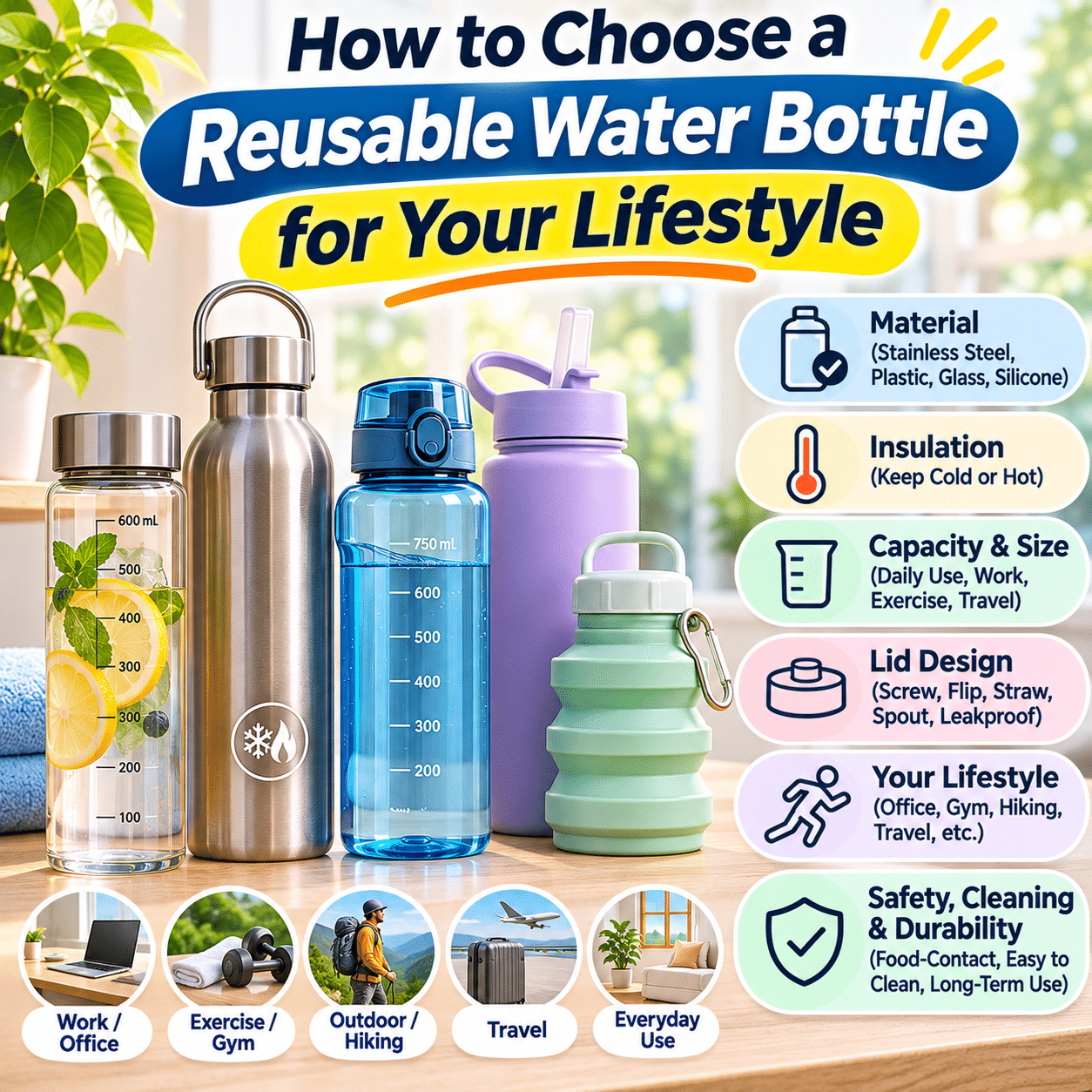
A reusable water bottle is one of the simplest everyday items that can make staying hydrated more convenient. Whether you spend most of your day at a desk, commute to work, exercise regularly, travel, or enjoy outdoor activities, having a suitable bottle nearby can make drinking water easier to incorporate into your routine.
However, not all reusable water bottles are designed for the same needs. Some prioritize lightweight portability, while others focus on insulation, durability, leak resistance, easy cleaning, or one-handed operation. A bottle that works perfectly for a short walk may be inconvenient for a long commute, and a large insulated bottle may be unnecessary for someone who mainly drinks water at home.
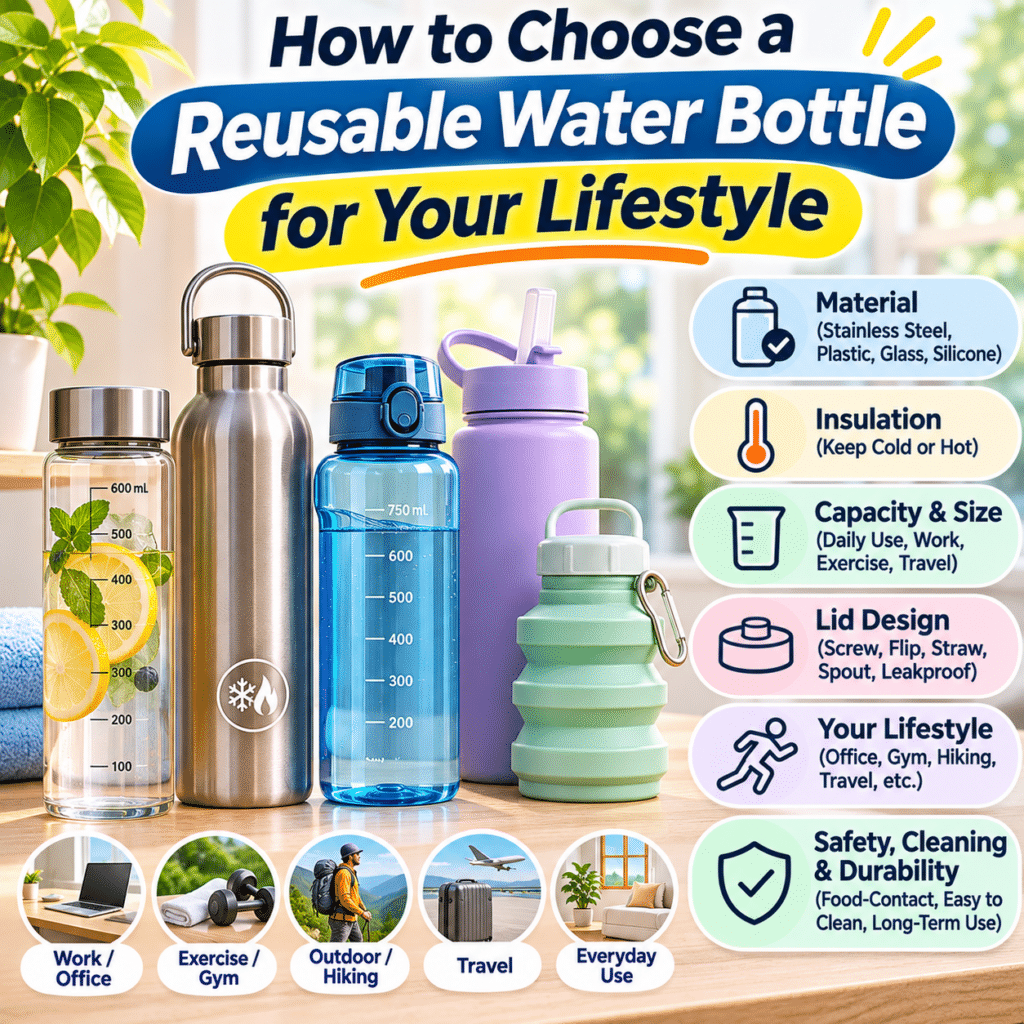
Reusable water bottles are available in stainless steel, plastic, glass, silicone, and other materials. They also come with different lid mechanisms, drinking openings, carrying handles, straws, filters, and insulation systems. Understanding how these features affect everyday use can help you avoid purchasing a bottle that looks appealing but does not fit your habits.
The best reusable water bottle is not necessarily the largest, most expensive, or most technologically advanced option. It is the one that suits your drinking preferences, daily activities, cleaning routine, and carrying needs.
This comprehensive buying guide explains how to choose a reusable water bottle based on your lifestyle, compare materials and insulation types, understand capacity and lid designs, evaluate safety and hygiene, and identify the features that provide the greatest long-term value.
1. Understand Why Choosing the Right Water Bottle Matters
A reusable water bottle is more than a container for drinking water.
It becomes part of your daily routine, which means convenience and usability can influence how often you reach for it.
Everyday Convenience
A bottle that is easy to fill, carry, open, and clean is more likely to fit naturally into daily activities.
Hydration Accessibility
Keeping water within reach can make drinking more convenient.
However, hydration needs vary by individual, activity level, environment, and health circumstances.
Portability
A suitable bottle should be comfortable to carry or store in the places you regularly visit.
Temperature Preferences
Some people prefer cold water throughout the day, while others are comfortable with room-temperature water.
Hygiene
A bottle that is easy to clean can help reduce residue and microbial buildup.
Long-Term Use
Durable construction and replaceable components may allow a bottle to remain useful for years.
Choosing carefully helps you find a practical everyday companion rather than another item that eventually sits unused in a cabinet.
2. Identify Your Lifestyle and Drinking Habits
Before comparing bottles, consider how and where you normally drink water.
Home Use
For home use, portability may be less important than comfortable handling and easy cleaning.
Office Work
An office bottle should fit comfortably on a desk, remain stable, and be convenient to open.
Commuting
A commuter bottle benefits from reliable leak resistance and a shape that fits a bag or vehicle cup holder.
Exercise
Sports and fitness routines may require quick access to water, a secure grip, and manageable weight.
Outdoor Activities
Hiking and outdoor recreation may call for durable materials, convenient carrying options, and sufficient capacity.
Travel
Travel bottles should balance portability, security, cleaning convenience, and compatibility with luggage or backpack compartments.
Everyday Errands
A compact bottle may be more practical than a large insulated container.
Family Use
Households may benefit from different bottle sizes and lid designs for different users.
Your lifestyle should determine which features deserve priority.
3. Understand the Main Types of Reusable Water Bottles
Reusable bottles can be categorized by their materials, insulation systems, and intended uses.
Single-Wall Bottles
These use one layer of material to hold liquids.
They are often relatively lightweight and straightforward.
Double-Wall Insulated Bottles
These use two walls separated by an insulating space.
Many stainless steel designs use vacuum insulation.
Collapsible Bottles
These are designed to compress or fold when empty.
Sports Bottles
These often prioritize convenient drinking during movement.
Straw Bottles
These use an integrated drinking straw.
Wide-Mouth Bottles
These provide a larger opening for filling, cleaning, and adding ice.
Filter Bottles
These incorporate filtration components intended for specific water-quality purposes.
Specialty Bottles
Some bottles include measurement markings, removable infusers, or electronic features.
Understanding these categories helps narrow the available choices.
4. Compare Common Water Bottle Materials
Material is one of the most important purchasing considerations.
It influences weight, durability, appearance, cleaning requirements, and temperature performance.
| Material | Main Advantages | Main Limitations | Common Uses |
|---|---|---|---|
| Stainless steel | Durable, reusable, available with insulation | Can be heavier and may dent | Office, travel, outdoor use |
| Reusable plastic | Lightweight, affordable, versatile | Can scratch, retain odors, or degrade | Fitness, commuting, everyday use |
| Glass | Nonporous, easy to inspect, generally resists odor retention | Breakable and relatively heavy | Home, office |
| Silicone | Flexible, collapsible designs available | May retain odors and require careful cleaning | Travel, compact storage |
| Aluminum | Lightweight and durable | Usually requires an interior lining | Outdoor and everyday use |
No material is universally superior.
The right choice depends on your priorities and how you maintain the bottle.
5. Understand Stainless Steel Water Bottles
Stainless steel is widely used in reusable water bottles.
Advantages
Stainless steel bottles are often valued for:
- Durability.
- Resistance to ordinary impacts.
- Long-term reusability.
- Compatibility with insulated designs.
- Resistance to many forms of everyday corrosion.
Stainless Steel Grades
Manufacturers may identify grades such as 18/8 stainless steel.
The designation generally refers to an alloy containing approximately 18% chromium and 8% nickel.
Material Quality
The grade alone does not establish overall product quality.
Welds, surface finishing, lid materials, and manufacturing processes also matter.
Potential Limitations
Stainless steel bottles may:
- Weigh more than plastic alternatives.
- Dent after impact.
- Have narrow openings that are difficult to clean.
- Include plastic or silicone lid components.
Who Should Consider Stainless Steel?
Stainless steel is a practical choice for people who prioritize durability and, when appropriately constructed, temperature retention.
6. Understand Reusable Plastic Water Bottles
Reusable plastic bottles are common because they can be lightweight and affordable.
Advantages
Potential benefits include:
- Low weight.
- Impact resistance.
- Wide design variety.
- Transparent construction.
- Convenient sports-oriented lids.
Common Plastic Materials
Reusable bottles may use materials such as:
- Tritan-type copolyesters.
- Polypropylene.
- Polyethylene.
- Other food-contact polymers.
Food-Contact Suitability
Choose bottles made from materials intended for repeated food or beverage contact.
BPA-Free Labels
A BPA-free label indicates that bisphenol A is not intentionally used in the relevant material or formulation, subject to the manufacturer’s claim.
However, BPA-free does not automatically establish that every component or substitute chemical has been comprehensively evaluated for every possible exposure.
Heat Limitations
Some plastic bottles are not designed for hot liquids or high-temperature cleaning.
Surface Wear
Scratches and damage may make cleaning more difficult.
Who Should Consider Plastic?
Reusable plastic can be suitable for users who value lightweight portability and convenient handling.
7. Understand Glass Water Bottles
Glass bottles appeal to people who prefer a nonporous drinking surface.
Advantages
Glass generally offers:
- Good resistance to flavor retention.
- Easy visual inspection.
- A smooth interior surface.
- Compatibility with many beverages when designed appropriately.
Limitations
Glass bottles can be:
- Heavier than plastic.
- Vulnerable to breakage.
- Less convenient for strenuous outdoor activities.
- Unsuitable for certain temperature changes.
Protective Sleeves
Some bottles include silicone sleeves to improve grip and provide limited impact cushioning.
A sleeve does not make glass unbreakable.
Thermal Shock
Rapid temperature changes can damage glass that is not designed for them.
Who Should Consider Glass?
Glass is often a practical choice for home or office environments where the risk of dropping the bottle is relatively low.
8. Understand Silicone Water Bottles
Silicone is commonly used in flexible and collapsible bottles.
Advantages
Potential benefits include:
- Flexible construction.
- Compact storage when empty.
- Lightweight portability.
- Soft-touch surfaces.
Limitations
Some silicone bottles may:
- Be less rigid when filled.
- Require more careful cleaning.
- Retain certain odors.
- Be awkward to fill or drink from.
Material Quality
Choose products designed for food contact and appropriate temperature conditions.
Collapsible Designs
Check whether the bottle remains stable when filled.
Who Should Consider Silicone?
Silicone bottles may be useful for travelers, hikers, and people with limited storage space.
9. Understand Aluminum Water Bottles
Aluminum is lightweight and commonly used in certain reusable bottles.
Advantages
- Relatively low weight.
- Durable metal construction.
- Convenient portability.
Interior Linings
Many aluminum bottles use an interior coating to separate the beverage from the metal.
Why Linings Matter
The lining should be appropriate for food contact and compatible with intended beverages.
Wear and Damage
Damaged interior coatings may affect suitability for continued use.
Cleaning
Follow the manufacturer’s instructions to avoid damaging the lining.
Who Should Consider Aluminum?
Aluminum may suit people seeking a lightweight metal bottle, provided the interior construction and maintenance requirements are appropriate.
10. Choose the Right Water Bottle Capacity
Capacity influences portability, refilling frequency, and overall weight.
Common sizes include approximately:
- 350–500 mL.
- 500–750 mL.
- 750 mL–1 L.
- 1–1.5 L.
- Larger specialty containers.
These are broad size categories rather than universal recommendations.
Small Bottles
Smaller bottles are easier to carry but require more frequent refilling.
Medium Bottles
Medium-capacity bottles often balance portability and convenience.
Large Bottles
Larger bottles reduce refilling frequency but can become heavy when full.
Extra-Large Bottles
These may be useful in specific situations but are not always practical for everyday carrying.
Capacity Is Not a Hydration Prescription
The amount of water you should drink depends on personal needs and circumstances.
A bottle’s capacity should reflect your access to refills and preferred carrying weight.
11. Compare Bottle Capacity by Lifestyle
| Lifestyle | Practical Capacity Range to Consider | Main Consideration |
|---|---|---|
| Short errands | 350–500 mL | Compact portability |
| Office desk | 500–1,000 mL | Refill convenience |
| Daily commuting | 500–750 mL | Bag compatibility |
| Gym workouts | 500–1,000 mL | Activity and refill access |
| Walking | 350–750 mL | Weight and duration |
| Hiking | 750 mL–1.5 L or more | Conditions and water access |
| Travel | 500–1,000 mL | Portability and refill availability |
| Home use | Any convenient size | Comfort and cleaning |
These ranges are starting points, not fixed requirements.
Hot weather, strenuous activity, trip duration, and individual needs may require different amounts of water.
12. Understand the Weight of a Filled Water Bottle
Bottle weight is often overlooked.
Water itself contributes substantial weight.
One liter of water weighs approximately one kilogram under ordinary conditions.
Example
A bottle with a capacity of one liter may contain approximately one kilogram of water when full, in addition to the weight of the bottle.
Why Weight Matters
Heavy bottles can be inconvenient when:
- Walking long distances.
- Carrying a backpack.
- Commuting.
- Exercising.
- Traveling.
Empty Weight
Check the manufacturer’s stated empty weight when available.
Consider Carrying Comfort
A smaller bottle with convenient refilling may be preferable to a larger bottle that is uncomfortable to transport.
13. Understand Insulated Water Bottles
Insulated bottles are designed to slow temperature changes.
Double-Wall Construction
Many insulated bottles use two layers of material.
Vacuum Insulation
A vacuum between the walls reduces heat transfer through conduction and convection across that space.
Temperature Retention
Insulation can help keep cold beverages cool and hot beverages warm for longer periods.
Important Limitations
Actual performance depends on:
- Bottle construction.
- Lid design.
- Starting beverage temperature.
- Ambient temperature.
- Fill level.
- Frequency of opening.
Who Benefits Most?
Insulated bottles may be useful for commuters, office workers, travelers, and outdoor users who prefer temperature-controlled drinks.
14. Compare Insulated and Non-Insulated Bottles
| Feature | Insulated Bottle | Non-Insulated Bottle |
|---|---|---|
| Temperature retention | Generally better | Limited |
| Weight | Often heavier | Often lighter |
| Construction | Usually double-wall | Usually single-wall |
| Exterior condensation | Often reduced | May occur |
| Cost | Often higher | Often lower |
| Portability | Depends on size | Often convenient |
| Cleaning | Depends on lid and opening | Depends on design |
| Best use | Temperature-sensitive drinks | General hydration |
If you mainly drink room-temperature water, insulation may not be necessary.
15. Understand Temperature Retention Claims
Manufacturers often advertise how long a bottle keeps beverages cold or hot.
Testing Conditions Matter
Claims may depend on specific starting temperatures and environmental conditions.
Lid Performance
Heat can transfer through the lid.
Opening Frequency
Repeated opening can reduce temperature retention.
Fill Level
A nearly empty bottle may behave differently from a full bottle.
Ice Retention
Claims about keeping ice for extended periods depend on the amount of ice and test conditions.
Compare Carefully
Avoid assuming that advertised temperature-retention durations are directly comparable across brands.
16. Choose Between Wide-Mouth and Narrow-Mouth Bottles
The bottle opening affects drinking, filling, and cleaning.
Wide-Mouth Bottles
Advantages include:
- Easier filling.
- Convenient ice insertion.
- Better access for cleaning.
- Easier visual inspection.
Potential limitations include:
- Greater risk of spilling while drinking.
- Less controlled pouring.
Narrow-Mouth Bottles
Advantages include:
- More controlled drinking.
- Potentially reduced splashing.
- Comfortable sipping for some users.
Potential limitations include:
- More difficult cleaning.
- Limited access for ice cubes.
- Greater dependence on bottle brushes.
Choose Based on Your Routine
A wide opening may be preferable for cleaning convenience, while a narrower opening may suit people who prioritize controlled drinking.
17. Understand Common Water Bottle Lid Types
The lid is one of the most important functional components.
Screw-Top Lids
These twist onto the bottle opening.
Flip-Top Lids
These open through a hinged mechanism.
Straw Lids
These allow drinking through an integrated straw.
Spout Lids
These provide a smaller drinking opening.
Push-Button Lids
These open through a button-operated mechanism.
Chug Lids
These are designed for relatively quick drinking through a larger opening.
Cup-Style Lids
Some insulated bottles include a removable outer cup.
Choosing the Right Lid
Consider leak resistance, cleaning requirements, drinking convenience, and how frequently you open the bottle.
18. Compare Water Bottle Lid Designs
| Lid Type | Main Advantage | Main Limitation | Common Use |
|---|---|---|---|
| Screw-top | Simple and secure when properly closed | Usually requires two hands | Travel, everyday use |
| Flip-top | Convenient access | Hinges and seals need cleaning | Office, fitness |
| Straw lid | Easy sipping | Straw requires thorough cleaning | Desk, commuting |
| Spout lid | Controlled drinking | Smaller openings may be harder to clean | Sports, everyday use |
| Push-button | Quick opening | More moving parts | Commuting |
| Chug lid | Faster drinking | May be less suitable during movement | Exercise |
| Cup-style lid | Can serve as a drinking cup | Additional component to clean | Travel, hot beverages |
A simple lid may provide better long-term convenience than a complicated mechanism with many small components.
19. Evaluate Leak Resistance
Leak resistance is especially important for bottles carried inside bags.
Leakproof Versus Spill-Resistant
These terms are not always used consistently.
A spill-resistant bottle may reduce accidental spills without remaining sealed when turned upside down.
Gaskets and Seals
Silicone or rubber-like seals help prevent leakage.
Locking Mechanisms
Some lids include locks to prevent accidental opening.
Straw Openings
Certain straw lids are not fully leakproof when the straw is exposed.
Pressure Changes
Temperature changes and pressure differences can affect some bottle designs.
Check Manufacturer Instructions
Verify whether the bottle is intended to remain sealed when tilted, inverted, or carried horizontally.
20. Consider One-Handed Operation
One-handed access can be useful during certain everyday activities.
Office Use
A push-button lid may allow convenient drinking while working.
Walking
A flip-top or straw lid may be easier to operate.
Commuting
Simple access can be convenient, although drinking should never distract from safe vehicle operation.
Exercise
Sports lids may reduce the need to unscrew a cap.
Potential Tradeoffs
More complicated opening mechanisms may require additional cleaning and maintenance.
Choose Practical Convenience
A lid should be easy to operate without compromising leak resistance.
21. Evaluate Straw Bottles
Straw bottles are popular for convenient sipping.
Advantages
They may offer:
- Easy access.
- Reduced need to tilt the bottle.
- Convenient drinking while seated.
- Comfortable use during certain activities.
Limitations
Straws can accumulate residue and require thorough cleaning.
Replaceable Straws
Replacement availability may extend the bottle’s useful life.
Cleaning Brushes
A suitable narrow brush can help clean internal surfaces.
Hot Beverage Safety
Straw lids may be unsuitable for hot liquids because of burn and pressure risks.
Follow manufacturer instructions.
22. Consider Carrying Handles and Loops
Carrying features influence portability.
Integrated Handles
These provide a dedicated grip.
Flexible Loops
These can make compact bottles easier to carry.
Carabiner-Compatible Loops
Some bottles can attach to external carrying systems.
Important Safety Considerations
Not every loop is designed to support the full weight of a filled bottle during strenuous movement.
Handle Durability
Check attachment points and material strength.
Comfort
A narrow handle may feel uncomfortable with a heavy bottle.
Choose Based on Carrying Style
A handle is useful only if it fits how you actually transport the bottle.
23. Check Cup Holder Compatibility
Bottle diameter matters for commuters and people who frequently use vehicles.
Base Diameter
Measure the bottle’s widest relevant section.
Cup Holder Size
Vehicle cup holders vary.
Tapered Designs
Some large bottles use narrower bases.
Stability
A bottle should sit securely without excessive movement.
Handle Position
Large side handles may interfere with cup holder placement.
Do Not Assume Compatibility
Check dimensions rather than relying on product photographs.
24. Consider Backpack and Bag Compatibility
A reusable bottle should fit your everyday carrying system.
Side Pockets
Many backpacks have bottle pockets with limited width or height.
Interior Storage
A leakproof bottle may be appropriate for internal compartments.
Bottle Height
Tall bottles may protrude from smaller pockets.
Bottle Shape
Slim designs can fit certain bags more easily.
Carrying Loops
Loops may improve accessibility.
Balance
Large filled bottles can affect backpack weight distribution.
25. Choose a Water Bottle for Office Work
An office bottle should be practical, stable, and easy to maintain.
Recommended Priorities
- Comfortable drinking opening.
- Stable base.
- Suitable capacity.
- Easy cleaning.
- Leak-resistant lid.
- Manageable desk footprint.
Insulation
An insulated bottle may be useful if you prefer cold water throughout the workday.
Straw Convenience
A straw lid may encourage convenient sipping without repeatedly lifting a heavy bottle.
Desk Safety
Avoid placing a bottle where accidental spills could damage electronic equipment.
Cleaning Routine
Wash the bottle regularly, especially when using flavored beverages.
26. Choose a Water Bottle for Commuting
Commuters often need a balance between portability and leak resistance.
Important Features
- Secure lid.
- Suitable capacity.
- Bag compatibility.
- Comfortable carrying loop.
- Durable construction.
- Easy opening.
Insulated Options
Temperature retention may be useful during long commutes.
Weight
A heavy bottle can become inconvenient when carried with a laptop or other belongings.
Cup Holder Fit
Check compatibility when relevant.
Avoid Overcomplicated Designs
A secure, easy-to-clean bottle may be more practical than one with numerous accessories.
27. Choose a Water Bottle for Exercise
Exercise bottles should support convenient drinking and handling.
Quick Access
A sports spout or suitable straw may be useful.
Grip
Textured surfaces can improve handling.
Capacity
Choose based on workout duration, intensity, environmental conditions, and refill availability.
Weight
Lightweight construction may be helpful.
Leak Resistance
A secure lid helps prevent spills inside gym bags.
Cleaning
Bottles used with sports drinks or flavored beverages may require especially thorough cleaning.
Hydration Needs
Fluid requirements vary. Excessive water consumption can also be harmful, particularly during prolonged endurance activity.
28. Choose a Water Bottle for Hiking
Hiking requires additional planning.
Water Availability
Consider whether safe refill sources are available.
Capacity
Longer routes, hot conditions, and strenuous activity may require carrying more water.
Weight
Large water volumes add significant pack weight.
Durability
Choose a bottle suitable for outdoor handling.
Opening Design
A wide opening may simplify filling and cleaning.
Carrying Compatibility
Check backpack pockets and attachment points.
Water Treatment
A standard reusable bottle does not make untreated water safe to drink.
Use an appropriate treatment method when necessary.
29. Choose a Water Bottle for Travel
Travel bottles should balance portability, hygiene, and security.
Compact Design
A manageable size fits luggage and day bags.
Leak Resistance
A reliable closure is especially important.
Refill Convenience
Wide-mouth bottles can be easier to fill.
Cleaning Access
Travel conditions may make thorough cleaning more difficult.
Airport Security
Rules for carrying liquids through airport security vary by jurisdiction and airport.
An empty reusable bottle may be permitted in many situations, but travelers should verify current requirements.
Water Safety
Refill only from sources considered safe for drinking.
30. Choose a Water Bottle for Children
Children’s bottles require special attention to size, usability, and safety.
Manageable Weight
A filled bottle should not be unnecessarily heavy.
Easy Opening
Children should be able to use the lid appropriately for their age and abilities.
Leak Resistance
Secure closures help prevent school-bag spills.
Durable Construction
Materials should withstand ordinary handling.
Cleaning
Straws and mouthpieces require regular cleaning.
Small Parts
Avoid components that create choking hazards for younger children.
Hot Liquids
Children’s bottles should not contain hot beverages unless specifically designed and used under appropriate supervision.
31. Choose a Water Bottle for Older Adults
Ease of handling can be important.
Comfortable Grip
Choose a shape that is easy to hold.
Manageable Weight
Smaller bottles may be easier to lift.
Simple Lid
Complicated closures may be difficult for people with limited hand strength.
Clear Measurement Markings
Visible markings may be useful when monitoring intake under professional guidance.
Straw Options
Some people may prefer straw lids, although suitability depends on individual swallowing and mobility needs.
Accessibility
A bottle should support comfortable, independent use whenever possible.
32. Consider Bottle Shape and Stability
Bottle shape affects storage and handling.
Cylindrical Bottles
These are common and often compatible with bottle holders.
Slim Bottles
These may fit narrow pockets.
Wide-Base Bottles
These may offer stability on flat surfaces.
Tapered Bottles
These can improve compatibility with some cup holders.
Square or Rectangular Bottles
These may fit certain storage spaces efficiently but can have more difficult-to-clean corners.
Choose Based on Use
A practical shape should support filling, carrying, cleaning, and storage.
33. Evaluate Bottle Surface and Grip
Exterior finishes affect handling.
Smooth Metal
This can look attractive but may feel slippery.
Powder-Coated Surfaces
Some metal bottles use textured coatings.
Silicone Sleeves
These can improve grip and provide limited cushioning.
Plastic Texture
Molded patterns may improve handling.
Condensation
Non-insulated bottles may become wet externally when filled with cold beverages.
Durability
Exterior coatings can scratch or wear over time.
34. Understand Condensation
Condensation occurs when moisture from the surrounding air collects on a sufficiently cold surface.
Single-Wall Bottles
Cold beverages can cause exterior condensation.
Insulated Bottles
Vacuum insulation often reduces external temperature changes and condensation.
Why Condensation Matters
Water droplets can:
- Make bottles slippery.
- Wet desks.
- Damp bags.
- Affect nearby objects.
Practical Solutions
Choose an insulated bottle or use an appropriate sleeve when condensation is inconvenient.
35. Evaluate Cleaning Convenience
Cleaning is one of the most important long-term considerations.
Wide Openings
These make interior cleaning easier.
Removable Components
Lids, straws, and seals should be accessible.
Smooth Interiors
Smooth surfaces may be easier to inspect.
Dishwasher Compatibility
Some bottles are dishwasher-safe, while others require handwashing.
Cleaning Brushes
Narrow bottles and straws may require specialized brushes.
Drying
All components should dry thoroughly before storage when practical.
Avoid Hidden Areas
Complex lid mechanisms can trap moisture and residue.
36. Understand Bottle Hygiene
Reusable bottles require regular cleaning.
Why Cleaning Matters
Moisture, saliva, and beverage residue can support microbial growth.
Water-Only Bottles
Even bottles used only for water need cleaning.
Flavored Beverages
Sugar-containing drinks and other additives can leave additional residue.
Mouthpieces
These frequently contact the mouth and hands.
Gaskets
Seals can trap moisture.
Storage
Avoid leaving a dirty bottle sealed for extended periods.
Practical Routine
Wash the bottle and drinking components regularly according to manufacturer instructions, with thorough cleaning after each day’s use being a sensible routine for many everyday bottles.
37. Understand Dishwasher Safety
Dishwasher compatibility depends on the bottle and its components.
Stainless Steel
Some stainless steel bottles are dishwasher-safe.
Others require handwashing to protect finishes or construction.
Plastic
Certain plastics tolerate dishwasher cleaning, while others may warp.
Glass
Many glass bottles can be dishwasher-safe, but sleeves and lids may have separate requirements.
Silicone
Some silicone components tolerate dishwasher cleaning.
Insulated Bottles
Follow manufacturer instructions because cleaning restrictions vary.
Check Each Component
A dishwasher-safe bottle body does not guarantee that the lid, gasket, or straw is also dishwasher-safe.
38. Understand Odor and Flavor Retention
Some bottles develop unpleasant smells or lingering flavors.
Common Causes
- Beverage residue.
- Inadequate cleaning.
- Moisture trapped in seals.
- Long-term storage while closed.
- Material absorption.
Plastic and Silicone
Certain materials may retain odors more readily than glass or stainless steel.
Cleaning
Follow manufacturer-approved cleaning methods.
Avoid Harsh Chemicals
Do not use cleaning substances that may damage food-contact materials.
Replace Damaged Components
Persistent odors from worn seals may indicate that replacement is appropriate.
39. Evaluate Food-Contact Safety
A reusable bottle should be suitable for its intended beverages.
Food-Contact Materials
Choose products with clear material information and relevant compliance documentation.
Temperature Limits
A bottle suitable for cold water may not be suitable for boiling liquids.
Coatings
Interior coatings should be appropriate for food contact.
Seals and Gaskets
These components also contact beverages.
Manufacturer Instructions
Follow restrictions regarding acidic drinks, carbonation, hot liquids, or other contents.
Avoid Unsupported Safety Claims
Labels such as “non-toxic” or “chemical-free” are not substitutes for meaningful material and compliance information.
40. Understand Hot Beverage Compatibility
Not every reusable bottle is designed for hot drinks.
Insulated Bottles
Some are specifically intended for hot beverages.
Plastic Bottles
Many are not suitable for high temperatures.
Glass Bottles
Thermal shock resistance depends on the glass design.
Straw Lids
These may create burn risks when used with hot liquids.
Pressure
Hot beverages can create pressure changes in sealed containers.
Safe Drinking
Use appropriate lids and allow beverages to reach a comfortable drinking temperature.
41. Understand Carbonated Beverage Compatibility
Carbonated drinks release dissolved gas and can create pressure inside sealed bottles.
Pressure Buildup
Shaking, warming, or agitation may increase internal pressure.
Lid Design
Some bottles are not intended for carbonation.
Opening Hazards
Pressure can cause sudden release of liquid or a lid component.
Manufacturer Guidance
Use carbonated beverages only in bottles explicitly designed for them.
Avoid Assumptions
A leakproof bottle is not necessarily pressure-rated.
42. Understand Freezer Compatibility
Freezing water causes expansion.
Expansion Risk
A completely filled rigid bottle may be damaged when water freezes.
Insulated Bottles
Some manufacturers advise against freezing.
Glass Bottles
Freezing can cause breakage if the bottle is not suitable.
Plastic Bottles
Compatibility varies by material and design.
Safe Approach
Follow manufacturer instructions rather than assuming every bottle is freezer-safe.
43. Consider Water Bottles With Measurement Markings
Measurement markings can help users estimate how much liquid remains.
Volume Markings
These indicate approximate liquid quantities.
Time Markers
Some bottles display suggested drinking times.
Practical Uses
Markings may be convenient for:
- Tracking refills.
- Preparing beverages.
- Estimating consumption.
- Following individualized hydration guidance.
Important Limitations
Printed schedules are not medical hydration recommendations.
Choose Readable Markings
Markings should remain visible and resist ordinary cleaning.
44. Understand Hydration Reminder Bottles
Some bottles include visual or electronic reminders.
Printed Time Markers
These provide a simple visual schedule.
Electronic Reminders
Some products use lights, notifications, or smartphone connections.
Potential Advantages
Reminders may be useful for people who frequently forget to drink.
Limitations
They can add cost, complexity, and charging requirements.
Individual Hydration Needs
Reminders should not encourage excessive fluid consumption.
Practical Alternative
A simple bottle placed within reach may be sufficient for many people.
45. Evaluate Smart Water Bottles
Smart bottles may include sensors and connectivity features.
Common Features
- Intake estimates.
- Smartphone applications.
- Reminder notifications.
- Temperature displays.
- Rechargeable electronics.
Accuracy
Measurement accuracy varies by device and technology.
Maintenance
Electronic components may complicate cleaning.
Battery Requirements
Charging becomes part of ownership.
Privacy
Connected applications may collect usage or account information.
Long-Term Support
Software compatibility and manufacturer support may change.
Are Smart Bottles Necessary?
No.
They are optional convenience products rather than essential hydration tools.
46. Understand Filter Water Bottles
Filter bottles include components intended to improve certain aspects of water quality.
Different Filter Technologies
Products may use:
- Activated carbon.
- Hollow-fiber membranes.
- Other specialized filtration media.
Activated Carbon
Activated carbon may reduce certain tastes, odors, or contaminants depending on filter design and certification.
Membrane Filtration
Certain membranes can physically remove specified microorganisms or particles.
Important Limitations
Not all filters remove bacteria, viruses, chemical contaminants, or dissolved substances.
Filter Certification
Look for independent certification relevant to the specific contaminant-reduction claim.
Replacement Requirements
Filters have defined service lives.
Water Safety
A filter bottle should never be assumed to make all untreated water safe to drink.
47. Compare Standard and Filter Water Bottles
| Feature | Standard Bottle | Filter Bottle |
|---|---|---|
| Main function | Store beverages | Store and filter specified water contaminants |
| Maintenance | Cleaning | Cleaning plus filter replacement |
| Weight | Varies | May be heavier |
| Cost | Often lower | Additional filter costs |
| Drinking flow | Usually unrestricted by filtration | May require more suction or pressure |
| Water treatment | None | Depends on verified filter capability |
| Best use | Known safe drinking water | Specific filtration needs |
Choose filtration based on the quality of the water source and the filter’s verified capabilities.
48. Consider Infuser Water Bottles
Infuser bottles include compartments for ingredients such as fruit or herbs.
Potential Benefits
They can make flavored water preparation convenient.
Removable Infusers
Removable compartments simplify cleaning.
Material Compatibility
Check whether the bottle supports acidic ingredients.
Hygiene
Fresh ingredients introduce additional residue and require careful cleaning.
Storage Temperature
Perishable ingredients should not remain unrefrigerated for extended periods.
Practical Value
An infuser is useful only if you regularly prepare flavored water.
49. Evaluate Durability and Impact Resistance
A reusable bottle should withstand ordinary use.
Stainless Steel
Metal bottles may dent but often remain functional after minor impacts.
Plastic
Some plastics resist impact but can scratch or crack.
Glass
Glass is vulnerable to breakage.
Silicone
Flexible construction may resist certain impacts but can deform.
Lid Durability
Lids and hinges may fail before the bottle body.
Base Protection
Some bottles include protective boots or sleeves.
Long-Term Reliability
Evaluate the entire construction, not just the main material.
50. Consider Replaceable Parts
Replaceable components can extend product life.
Common Replacement Parts
- Lids.
- Gaskets.
- Straws.
- Mouthpieces.
- Carrying handles.
- Protective sleeves.
- Filters.
Why Replacement Matters
A damaged lid should not always require replacing an otherwise functional bottle.
Compatibility
Check whether replacement components fit the exact model.
Availability
Some manufacturers maintain accessory availability longer than others.
Cost
Replacement parts should be reasonably priced.
Long-Term Value
A repairable bottle may provide better value than a disposable-feeling design.
51. Understand Reusable Water Bottles and Sustainability
Reusable bottles are often chosen to reduce dependence on single-use containers.
Reuse Matters
The environmental benefit of a reusable bottle depends partly on how frequently and how long it is used.
Material Production
Different materials have different manufacturing impacts.
Transportation
Weight and production location may influence environmental impacts.
Washing
Cleaning uses water, energy, and cleaning products.
Durability
Long-lasting products can reduce replacement frequency.
End-of-Life Disposal
Recycling options vary by material and location.
Avoid Oversimplified Claims
No bottle material is automatically the most environmentally friendly in every situation.
A practical approach is to choose a durable bottle and use it consistently for as long as it remains safe and functional.
52. Understand Total Cost of Ownership
The initial purchase price does not tell the whole story.
Purchase Cost
The bottle itself may range from inexpensive basic designs to premium insulated products.
Replacement Lids
Specialized lids may create additional expenses.
Filters
Filter bottles require periodic cartridge replacement.
Cleaning Accessories
Straw brushes and bottle brushes may be needed.
Electronic Components
Smart bottles may involve batteries or charging equipment.
Replacement Frequency
A durable bottle may remain useful longer than one with fragile components.
Practical Value
A reasonably priced, easy-to-maintain bottle can offer excellent long-term value.
53. Compare Budget, Mid-Range, and Premium Water Bottles
Budget Bottles
Common characteristics may include:
- Basic plastic or metal construction.
- Simple lids.
- Limited insulation.
- Few accessories.
These may be sufficient for everyday hydration.
Mid-Range Bottles
Potential features include:
- Better insulation.
- More durable finishes.
- Improved lid mechanisms.
- Comfortable carrying handles.
- Replaceable seals.
Premium Bottles
Potential features include:
- Specialized insulation systems.
- Advanced lid designs.
- Distinctive materials.
- Additional accessories.
- Electronic reminders or sensors.
Are Premium Bottles Worth It?
They may be worthwhile when specific features improve daily convenience.
However, a higher price does not guarantee better hygiene, durability, or usability.
54. Compare Water Bottle Features by Lifestyle
| Lifestyle | Priority Features | Suitable Options |
|---|---|---|
| Home | Easy cleaning, comfortable drinking | Glass, plastic, stainless steel |
| Office | Stable base, convenient lid | Insulated or non-insulated bottle |
| Commuting | Leak resistance, manageable size | Slim stainless steel or plastic bottle |
| Gym | Lightweight, quick drinking | Sports bottle with spout or straw |
| Hiking | Durability, capacity, carrying compatibility | Outdoor-oriented bottle |
| Travel | Compact size, secure lid | Lightweight or collapsible bottle |
| School | Easy opening, durability, cleaning | Age-appropriate reusable bottle |
| Outdoor work | Suitable capacity, temperature retention | Durable insulated bottle |
| Small bags | Slim design, low weight | Compact plastic or metal bottle |
| Flavored water | Removable infuser, easy cleaning | Infuser bottle |
| Specific filtration needs | Verified filtration capability | Appropriate filter bottle |
55. Common Mistakes to Avoid When Buying a Reusable Water Bottle
Mistake 1: Choosing Based Only on Appearance
An attractive bottle may be inconvenient to carry or clean.
Better approach: Prioritize everyday usability.
Mistake 2: Buying a Bottle That Is Too Large
Large bottles can become heavy and awkward.
Better approach: Choose capacity based on refill access and carrying needs.
Mistake 3: Ignoring Empty Weight
A heavy bottle becomes even heavier when filled.
Better approach: Consider total carrying weight.
Mistake 4: Assuming Every Lid Is Leakproof
Some lids are only spill-resistant.
Better approach: Verify intended leak performance.
Mistake 5: Choosing a Complicated Lid
Complex mechanisms may trap residue.
Better approach: Prefer designs that can be disassembled and cleaned.
Mistake 6: Ignoring Material Suitability
Not every bottle supports hot liquids, carbonation, or freezing.
Better approach: Check manufacturer restrictions.
Mistake 7: Assuming Insulation Is Always Necessary
Insulation adds weight and cost.
Better approach: Choose it only when temperature retention matters.
Mistake 8: Forgetting Cup Holder Compatibility
Wide bottles may not fit vehicle cup holders.
Better approach: Compare dimensions.
Mistake 9: Ignoring Backpack Fit
A bottle may be too tall or wide for your bag.
Better approach: Measure available storage space.
Mistake 10: Overlooking Cleaning Requirements
Straws and seals require attention.
Better approach: Choose accessible components.
Mistake 11: Trusting Unverified Material Claims
Marketing labels do not replace meaningful safety information.
Better approach: Review food-contact suitability and manufacturer documentation.
Mistake 12: Assuming Filter Bottles Purify All Water
Filtration capabilities vary significantly.
Better approach: Verify contaminant-specific performance.
Mistake 13: Buying Unnecessary Smart Features
Electronics may add maintenance requirements.
Better approach: Choose features you will actually use.
Mistake 14: Ignoring Replacement Parts
A damaged lid may make the entire bottle unusable.
Better approach: Check accessory availability.
Mistake 15: Replacing Bottles Too Frequently
Frequent replacement can reduce the benefits of reuse.
Better approach: Choose a durable design and maintain it properly.
56. How to Choose a Reusable Water Bottle: Step by Step
A structured approach can simplify the buying decision.
Step 1: Identify Your Main Use
Decide whether the bottle will primarily be used at home, work, during exercise, or while traveling.
Step 2: Choose a Practical Capacity
Consider how much water you want to carry and how often you can refill.
Step 3: Select the Material
Compare stainless steel, plastic, glass, silicone, and aluminum.
Step 4: Decide Whether Insulation Matters
Choose insulation if maintaining beverage temperature is important.
Step 5: Select a Drinking Opening
Compare wide-mouth, narrow-mouth, straw, and spout designs.
Step 6: Evaluate the Lid
Prioritize convenience, leak resistance, and cleaning.
Step 7: Check Dimensions
Verify bag, backpack, and cup holder compatibility.
Step 8: Consider Weight
Estimate how heavy the bottle will be when filled.
Step 9: Review Food-Contact Suitability
Check material information and temperature restrictions.
Step 10: Evaluate Cleaning Requirements
Look for removable parts and accessible surfaces.
Step 11: Consider Durability
Review body construction, lid quality, and impact resistance.
Step 12: Check Replacement Parts
Determine whether lids, seals, and straws are available.
Step 13: Review Specialized Features
Consider filtration, infusers, measurement markings, or reminders only when useful.
Step 14: Compare Long-Term Costs
Account for replacement parts, filters, and maintenance.
Step 15: Choose the Simplest Reliable Bottle That Fits Your Routine
A practical bottle should make everyday hydration easier without unnecessary complexity.
57. Practical Reusable Water Bottle Buying Checklist
Use this checklist before purchasing.
Lifestyle Compatibility
- I know where I will use the bottle most often.
- The capacity suits my routine.
- The filled weight is manageable.
- The bottle fits my bag or cup holder.
- The carrying design is comfortable.
- The drinking opening suits my preferences.
Material and Construction
- The material is appropriate for food contact.
- The bottle is suitable for my intended beverages.
- Temperature restrictions are clear.
- The construction appears durable.
- The exterior provides a comfortable grip.
- The base is stable.
Lid and Convenience
- The lid is easy to operate.
- Leak resistance meets my needs.
- The lid can be cleaned thoroughly.
- Seals and straws are removable when necessary.
- Replacement components are available.
- The bottle is easy to refill.
Hygiene and Maintenance
- The interior is accessible for cleaning.
- Cleaning instructions are clear.
- Dishwasher compatibility is understood.
- The bottle can dry thoroughly.
- There are no unnecessarily difficult-to-clean components.
- I can maintain the bottle consistently.
Long-Term Value
- The price fits my budget.
- I understand any ongoing filter costs.
- The bottle is suitable for repeated long-term use.
- Replacement parts are reasonably accessible.
- I am not paying for features I do not need.
- I expect to use the bottle regularly.
58. Frequently Asked Questions
What Should I Look for When Buying a Reusable Water Bottle?
Focus on material, capacity, weight, lid design, leak resistance, cleaning convenience, durability, and compatibility with your lifestyle.
What Is the Best Reusable Water Bottle Material?
There is no universally best material.
Stainless steel offers durability, plastic provides lightweight convenience, glass resists flavor retention, and silicone can support collapsible designs.
Are Stainless Steel Water Bottles Better Than Plastic?
Stainless steel may offer advantages in durability and insulation, while plastic is often lighter.
The best choice depends on your needs.
Are Glass Water Bottles Safe?
Glass bottles can be suitable for drinking water when designed for food contact and used appropriately.
However, they can break and may be unsuitable for certain temperature changes.
Are Silicone Water Bottles Safe?
Food-contact silicone bottles can be suitable when manufactured and used according to their intended specifications.
Are Aluminum Water Bottles Safe?
They can be suitable when properly manufactured with appropriate food-contact surfaces or linings.
What Does BPA-Free Mean?
It indicates that BPA is not intentionally used in the relevant material or formulation, according to the manufacturer’s claim.
It does not automatically guarantee the absence of every potential chemical concern.
Is Stainless Steel Better for Hot Water?
Many stainless steel insulated bottles are designed for hot beverages.
However, suitability depends on the specific product and lid.
What Size Water Bottle Should I Buy?
Choose based on your routine, refill access, carrying comfort, and individual hydration needs.
Is a One-Liter Water Bottle Too Big?
Not necessarily.
It may be convenient for desk use or longer activities but heavy for compact bags.
Is a 500 mL Bottle Enough?
It may be suitable for short activities with convenient refill access.
Longer or more demanding activities may require additional water.
Are Large Water Bottles Better for Hydration?
Not automatically.
Convenience and individual fluid needs matter more than bottle size alone.
Do I Need an Insulated Water Bottle?
Only if temperature retention is important to you.
How Long Does an Insulated Water Bottle Keep Water Cold?
Performance varies according to construction, starting temperature, environment, and opening frequency.
Do Insulated Water Bottles Keep Water Hot?
Models designed for hot beverages can slow cooling, but performance varies.
Are Double-Wall Bottles Better?
They may provide better temperature retention but can be heavier and more expensive.
What Is Vacuum Insulation?
It uses a low-pressure space between walls to reduce certain forms of heat transfer.
Do Insulated Bottles Sweat?
Vacuum-insulated bottles generally reduce exterior condensation compared with single-wall bottles.
Is a Wide-Mouth Bottle Better?
Wide-mouth bottles are often easier to fill and clean, but may be less convenient for controlled sipping.
Are Straw Bottles Hygienic?
They can be maintained hygienically when the straw and mouthpiece are cleaned thoroughly and regularly.
Are Straw Bottles Leakproof?
Some are, while others are only spill-resistant.
Check the specific design.
What Is the Difference Between Leakproof and Spill-Resistant?
Leakproof generally suggests stronger resistance to leakage, but terminology and testing vary by manufacturer.
Can I Put a Reusable Water Bottle in My Bag?
Choose a bottle designed for secure transport and verify its leak resistance.
Are Push-Button Lids Reliable?
They can be convenient, but hinges, springs, and seals may require maintenance.
Are Screw-Top Lids Better?
They are often simple and secure, but may be less convenient for frequent one-handed access.
What Is the Easiest Water Bottle to Clean?
Bottles with wide openings, smooth interiors, and easily removable lid components are generally convenient to clean.
How Often Should I Wash My Reusable Water Bottle?
Regular cleaning is important, with thorough cleaning after each day’s use being a practical routine for many everyday bottles.
Follow manufacturer instructions.
Do Water Bottles Grow Bacteria?
Microorganisms can accumulate when bottles are not cleaned and dried appropriately.
Can Mold Grow in a Water Bottle?
Yes.
Moisture and residue can support mold growth under suitable conditions.
How Do I Remove Odors From a Water Bottle?
Use manufacturer-approved cleaning methods and thoroughly clean seals, straws, and lids.
Can I Put My Water Bottle in the Dishwasher?
Only if the manufacturer identifies the bottle and relevant components as dishwasher-safe.
Can I Put Hot Water in a Plastic Bottle?
Only when the bottle is specifically designed for the intended temperature.
Can I Put Boiling Water in a Stainless Steel Bottle?
Only if the bottle and lid are designed for it.
Take precautions against burns and pressure buildup.
Can I Freeze Water in a Reusable Bottle?
Only if the manufacturer permits freezing.
Water expansion can damage unsuitable containers.
Can I Put Carbonated Drinks in a Water Bottle?
Only if the bottle is specifically designed for carbonated beverages and associated pressure.
Can I Put Juice in a Reusable Water Bottle?
Many bottles can hold juice, but check material compatibility and clean thoroughly after use.
Can I Put Coffee or Tea in a Water Bottle?
Some bottles are designed for these beverages.
Check temperature compatibility and cleaning instructions.
Do Reusable Water Bottles Affect Water Taste?
Material, cleaning condition, and beverage residue can influence perceived taste.
Are Filter Water Bottles Worth Buying?
They may be useful when a specific verified filtration capability meets your needs.
Do Filter Bottles Make River Water Safe?
Not necessarily.
Different filters remove different contaminants, and some do not address viruses or chemical hazards.
Do I Need a Smart Water Bottle?
No.
Smart features are optional conveniences.
Are Hydration Reminder Bottles Useful?
They may help some people remember to drink, but reminders should reflect individual needs.
Are Time-Marked Water Bottles Accurate?
Time markings are general prompts, not individualized hydration prescriptions.
What Is the Best Water Bottle for Office Work?
A stable, easy-to-clean bottle with a convenient lid and suitable capacity is often practical.
What Is the Best Water Bottle for the Gym?
A lightweight bottle with convenient drinking access and secure closure is often useful.
What Is the Best Water Bottle for Hiking?
Choose a durable bottle with suitable capacity, manageable weight, and compatibility with your carrying equipment.
What Is the Best Water Bottle for Travel?
A compact, leak-resistant, easy-to-clean bottle is generally convenient.
What Is the Best Water Bottle for Children?
Choose an age-appropriate bottle that is manageable, durable, easy to clean, and simple to operate.
Are Reusable Water Bottles Better for the Environment?
They can reduce reliance on single-use bottles when used consistently over a sufficiently long period.
Actual environmental impacts depend on materials, manufacturing, cleaning, and lifespan.
How Long Should a Reusable Water Bottle Last?
Lifespan depends on material, construction, maintenance, and damage.
When Should I Replace a Water Bottle?
Replace a bottle or affected component when damage, deterioration, contamination that cannot be removed, or loss of safe functionality makes continued use inappropriate.
Are Expensive Water Bottles Worth It?
They may offer useful features, but higher prices do not guarantee better everyday performance.
What Is the Most Important Water Bottle Feature?
The most important feature is compatibility with your actual routine, supported by safe materials, convenient cleaning, and reliable construction.
59. How to Maintain a Reusable Water Bottle for Long-Term Use
Proper maintenance can extend the useful life of a bottle.
Clean Regularly
Wash the bottle and drinking components according to manufacturer instructions.
Disassemble the Lid
Remove accessible seals, straws, and mouthpieces when appropriate.
Use Suitable Cleaning Tools
Bottle brushes and straw brushes can reach difficult areas.
Rinse Thoroughly
Remove cleaning product residue.
Dry Properly
Allow components to dry before storing when practical.
Inspect Seals
Check for cracks, deformation, or deterioration.
Avoid Improper Temperatures
Do not expose the bottle to temperatures outside its intended range.
Protect From Impact
Avoid unnecessary drops and damage.
Replace Worn Parts
Use compatible replacement components.
Store Appropriately
Keep the bottle clean and dry when not in use.
60. Build a Practical Everyday Hydration Routine
A suitable reusable water bottle works best when it supports simple habits.
Keep Water Accessible
Place your bottle where it is convenient to reach.
Refill When Needed
Use safe drinking water sources.
Match Capacity to Your Activities
Carry an appropriate amount based on your routine and conditions.
Pay Attention to Individual Needs
Hydration requirements vary with activity, climate, diet, and health.
Avoid Rigid Drinking Rules
Not everyone needs the same amount of water at the same times.
Consider Personal Preferences
Some people prefer chilled water, while others prefer room-temperature beverages.
Clean Consistently
Make bottle cleaning part of your daily routine.
Use the Bottle Long Term
A durable bottle becomes more valuable when used regularly rather than frequently replaced.
Final Thoughts
Choosing a reusable water bottle for your lifestyle is about balancing convenience, capacity, material quality, portability, hygiene, and long-term durability.
Begin by considering where you will use the bottle most often. Office workers may prefer stable bottles with convenient lids, commuters often benefit from reliable leak resistance, fitness enthusiasts may prioritize lightweight designs and quick drinking access, and outdoor users may need greater durability and carefully planned capacity.
Material choice is equally important. Stainless steel offers durability and insulated options, reusable plastic provides lightweight convenience, glass offers a nonporous drinking surface, and silicone can support compact, collapsible designs. Each material has advantages and limitations.
Lid design deserves particular attention because it influences how easily you can drink, carry, and clean the bottle. A simple, reliable lid with accessible components may provide better everyday value than a complicated mechanism.
Insulation, measurement markings, filtration, and smart features can be useful, but they should be selected according to actual needs rather than marketing appeal.
Before purchasing, check the bottle’s dimensions, filled weight, food-contact suitability, cleaning requirements, replacement-part availability, and compatibility with your usual beverages.
Remember that a reusable bottle supports convenient access to water but does not determine how much fluid your body needs. Hydration requirements vary, and drinking habits should reflect individual circumstances rather than rigid schedules printed on a bottle.
Finally, consider long-term ownership. A durable bottle that is comfortable to use, easy to clean, and maintained properly can provide years of practical service while reducing the need for frequent replacements.
The best reusable water bottle is not simply the one with the largest capacity or the most features. It is the one that fits naturally into your lifestyle, makes drinking water convenient, remains easy to maintain, and provides dependable value through everyday use.