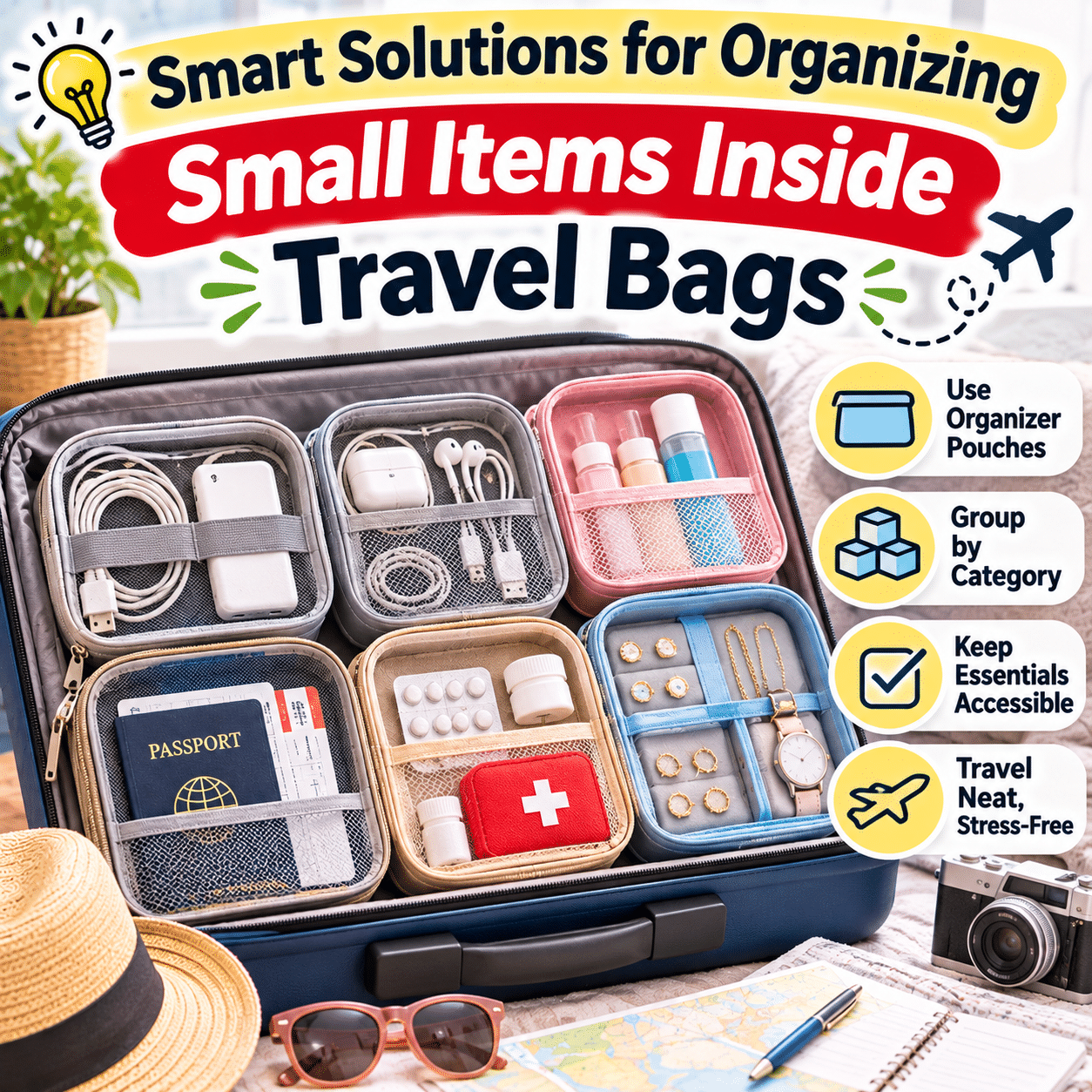
Travel bags are designed to carry everything needed for a journey, but even a well-packed suitcase or backpack can become frustrating when small belongings disappear into crowded compartments. Charging cables, earbuds, keys, travel adapters, lip balm, jewelry, medication, and other compact essentials are easy to overlook when they are mixed with larger items.
The problem becomes particularly noticeable during busy travel moments. Searching for a charging cable at an airport, locating a payment card while boarding transportation, or finding a small toiletry item in a crowded hotel room can create unnecessary stress.
Fortunately, organizing small items inside travel bags does not require expensive accessories or complicated packing techniques. A thoughtful system of compartments, pouches, labels, and consistent placement can make belongings easier to find while protecting them from damage.
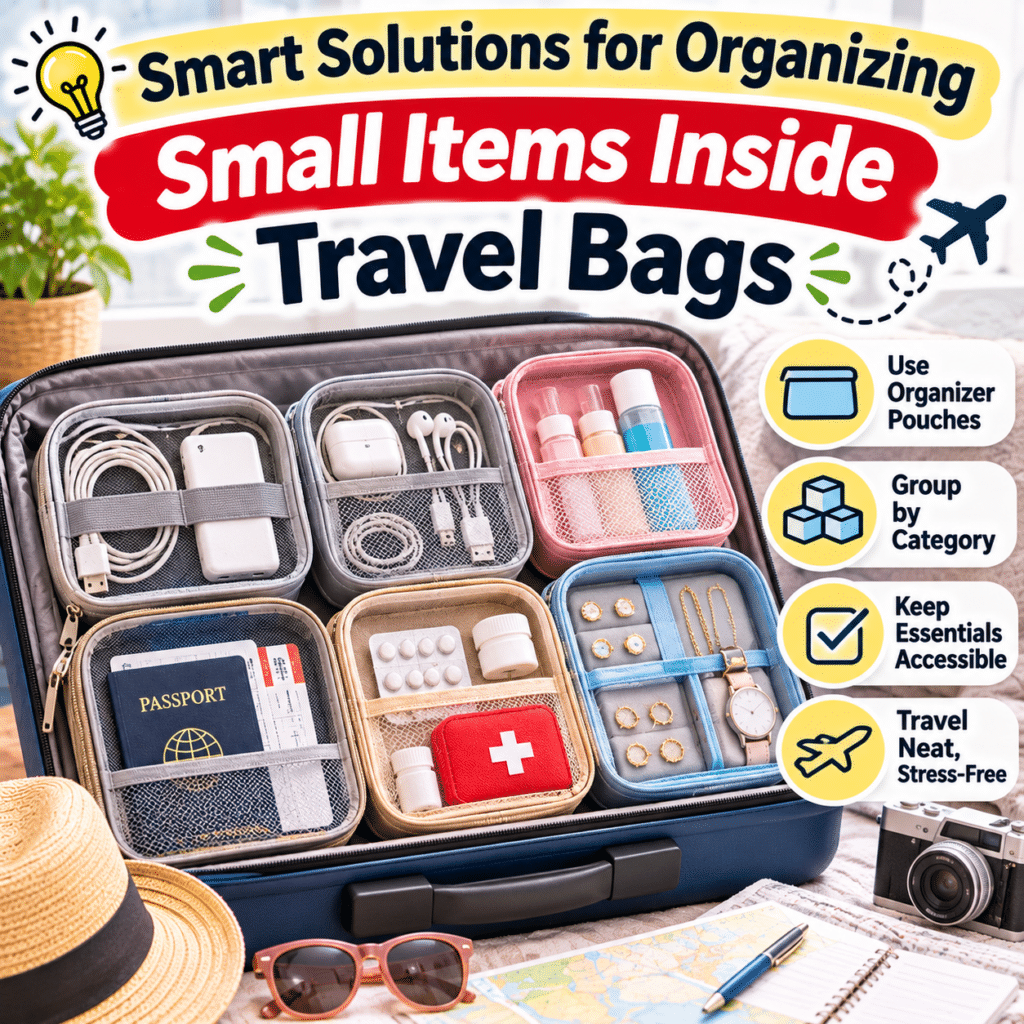
Whether you travel with a suitcase, backpack, carry-on bag, weekend duffel, or compact personal bag, the same basic principles apply: group related items, prevent unnecessary movement, protect delicate belongings, and make frequently used essentials accessible.
This comprehensive guide explores practical ways to organize small travel items efficiently, reduce clutter, and maintain a reliable packing system throughout your journey.
1. Understand Why Small Items Become Disorganized During Travel
Small belongings are often the most difficult items to manage because they can move freely inside luggage.
Small Objects Easily Shift Between Compartments
When bags are carried, lifted, opened, or placed in different positions, loose objects may move into corners or beneath larger belongings.
Common examples include:
- Charging cables.
- Earbuds.
- Travel adapters.
- Keys.
- Pens.
- Lip balm.
- Hair accessories.
- Small toiletries.
- Jewelry.
- Memory cards.
- Luggage locks.
Different Items Are Needed at Different Times
Some belongings are used frequently during transit, while others are needed only after arrival.
Without clear organization, everything may end up mixed together.
Overpacking Makes Searching Harder
A tightly packed bag leaves little room to move items aside.
Even when an object is technically inside the correct compartment, retrieving it may require unpacking several unrelated belongings.
Inconsistent Placement Creates Confusion
If the same item is stored in a different pocket on every trip, finding it becomes less predictable.
The most effective solution is a simple system that gives small belongings consistent, practical locations.
2. Start by Sorting Small Travel Essentials Into Categories
Before packing, gather the small items you expect to bring.
Organizing them by purpose helps determine which items should share a pouch or compartment.
Common Travel Item Categories
| Category | Examples | Suggested Storage |
|---|---|---|
| Electronics | Charging cables, earbuds, adapters | Electronics organizer |
| Personal care | Lip balm, comb, small skincare items | Toiletry pouch |
| Health essentials | Medications, medical accessories | Dedicated health pouch |
| Documents | Identification, tickets, travel cards | Secure document compartment |
| Accessories | Jewelry, hair ties, watches | Small protective case |
| Everyday carry | Keys, wallet, tissues | Accessible personal bag pocket |
| Travel tools | Luggage locks, tags, small approved accessories | Utility pouch |
| Writing supplies | Pens, notebook accessories | Slim stationery pouch |
Keep Categories Broad Enough to Be Useful
Creating too many tiny categories can make packing more complicated.
For most travelers, a few well-defined groups are sufficient.
Separate Items That Could Damage One Another
Avoid placing sharp objects, liquids, delicate electronics, and fragile accessories together without suitable protection.
Review What Is Actually Necessary
Every additional item requires space and organization.
Remove unnecessary duplicates before packing.
3. Choose the Right Small Travel Organizers
Travel organizers are most useful when they solve a specific packing problem.
Zippered Pouches
Small zippered pouches can contain loose accessories and prevent them from spreading throughout a bag.
They work well for:
- Cables.
- Personal care accessories.
- Small travel tools.
- Writing supplies.
- Miscellaneous everyday items.
Mesh Organizers
Mesh pouches allow you to see some of the contents without opening the bag.
They can be useful for dry, non-sensitive items.
However, mesh does not provide reliable protection against liquid spills.
Structured Cases
Rigid or semi-rigid cases can protect delicate belongings from pressure and impact.
Examples include:
- Eyeglasses.
- Small electronics.
- Fragile accessories.
- Certain medical devices.
Transparent Pouches
Clear organizers make it easier to identify contents.
Choose durable materials and avoid exposing sensitive personal information unnecessarily.
Avoid Excessive Organizers
A bag filled with too many separate pouches can become difficult to manage.
Select only the containers that genuinely improve accessibility.
4. Assign Every Small Item a Consistent Location
One of the most effective organization habits is giving frequently used belongings a predictable place.
Create a Personal Storage Map
For example:
- Front pocket: tissues and small everyday accessories.
- Interior zippered pocket: keys.
- Electronics pouch: chargers and earbuds.
- Document compartment: travel identification.
- Toiletry pouch: personal care items.
Use the Same Arrangement Repeatedly
Consistency reduces the need to remember where each item was placed.
Avoid Changing Compartments Unnecessarily
Moving objects between pockets throughout a journey increases the chance of misplacement.
Return Items Immediately After Use
After using a charger, travel card, or accessory, place it back in its designated compartment.
This simple habit can prevent repeated searching.
5. Keep Frequently Used Items Within Easy Reach
Not every item needs the same level of accessibility.
Identify High-Frequency Essentials
During travel, these may include:
- Phone.
- Wallet.
- Identification.
- Boarding information.
- Earbuds.
- Tissues.
- Charging cable.
- Eyeglasses.
- Necessary medications.
Use Accessible Compartments
Store frequently used belongings where they can be retrieved without opening the main luggage compartment.
Balance Accessibility With Security
Important documents and valuables should remain protected against loss or theft.
An easy-to-reach pocket is not always the safest place for sensitive belongings.
Avoid Overcrowding Exterior Pockets
Too many items in a small pocket can make everything harder to retrieve.
Keep only essential objects in high-access compartments.
6. Organize Charging Cables and Electronics Accessories
Electronics accessories are among the most common sources of small-item clutter.
Use a Dedicated Electronics Pouch
Keep related accessories together, including:
- Charging cables.
- Compatible adapters.
- Earbuds.
- Device connectors.
- Small approved power accessories.
Prevent Cable Tangling
Use suitable cable ties, elastic loops, or divided compartments.
Avoid tightly bending cables near connectors.
Separate Fragile Components
Protect small adapters and delicate accessories from pressure.
Check Device Compatibility
Before traveling, confirm that chargers and adapters match the devices you plan to bring.
Follow Transportation Rules
Power banks and spare lithium batteries are subject to airline and aviation safety requirements.
Check current restrictions before departure, including limits on battery capacity and where batteries may be carried.
Inspect Cables Before Packing
Replace damaged cables rather than relying on accessories with exposed wiring or loose connectors.
7. Use Mini Pouches for Everyday Personal Accessories
Small personal belongings are often needed unexpectedly.
A dedicated pouch can make them easier to locate.
Useful Items to Group
Depending on your needs:
- Lip balm.
- Hair ties.
- Small comb.
- Pocket tissues.
- Compact mirror.
- Nail care accessories where permitted.
- Personal hygiene products.
Choose an Appropriate Size
A pouch should hold the necessary items without becoming bulky.
Keep Liquids Protected
Small liquid containers should be properly closed and separated from moisture-sensitive belongings.
Review the Contents Regularly
Remove empty containers, damaged accessories, and unnecessary duplicates.
8. Protect Jewelry and Delicate Accessories
Jewelry can become tangled, scratched, or damaged when stored loosely.
Use a Small Jewelry Organizer
A suitable organizer may include:
- Ring compartments.
- Necklace loops.
- Earring holders.
- Soft protective sections.
Prevent Necklace Tangling
Keep chains separated rather than placing several necklaces in one compartment.
Protect Fragile Pieces
Use appropriate padding for delicate accessories.
Consider Whether Valuables Are Necessary
Traveling with expensive jewelry can create additional security concerns.
Bring only what is appropriate for the journey.
Keep Valuables Secure
Avoid leaving valuable accessories unattended in easily accessible luggage compartments.
9. Organize Medications and Health-Related Essentials Safely
Health-related items require a different approach from ordinary accessories.
Use a Dedicated Health Pouch
A separate pouch can help keep necessary supplies accessible.
Preserve Important Labels
Medications should remain identifiable.
Keep original packaging and prescription documentation when appropriate, especially for international travel.
Avoid Mixing Unidentified Pills
Combining different medications in unmarked containers can create confusion and safety risks.
Consider Storage Conditions
Some medications require protection from heat, moisture, or freezing temperatures.
Follow pharmacist and manufacturer instructions.
Keep Essential Medication Accessible
Important medications should generally be carried where they remain available during transit.
Check Destination Restrictions
Certain medications may be restricted or require documentation in different countries.
Verify official requirements before departure.
10. Use Packing Cubes for Small Clothing Accessories
Packing cubes are not limited to larger garments.
Small cubes can organize compact clothing items.
Group Similar Items
Examples include:
- Socks.
- Underwear.
- Scarves.
- Belts.
- Sleep accessories.
- Small fabric items.
Consider Outfit-Based Packing
For short trips, grouping accessories with complete outfits may simplify dressing.
Avoid Overfilling
Overpacked cubes can become difficult to close and may put unnecessary pressure on contents.
Use Different Sizes
Small cubes are often more practical for accessories than oversized containers.
Keep Clean and Used Items Separate
Use a designated laundry pouch for worn clothing.
11. Take Advantage of Built-In Bag Compartments
Many travel bags already include useful organization features.
Inspect the Bag Before Adding Organizers
Look for:
- Interior zippered pockets.
- Mesh compartments.
- Key clips.
- Document sleeves.
- Padded device sections.
- Small accessory pockets.
Match Compartments to Item Size
Use narrow pockets for slim objects and padded compartments for suitable electronics.
Avoid Forcing Items Into Tight Spaces
Overstuffing can damage zippers, seams, or delicate belongings.
Use Secure Closures
Small items should not be able to fall out when the bag changes orientation.
Keep the Main Compartment Manageable
Built-in pockets are most useful when they reduce clutter rather than create additional hidden storage locations.
12. Use Color Coding to Find Items Faster
Color coding can make travel organization more intuitive.
Assign Colors by Category
For example:
- Blue: electronics.
- Green: personal care.
- Red: health essentials.
- Yellow: miscellaneous accessories.
Choose Distinctive Pouches
Contrasting colors are easier to identify inside dark luggage.
Keep the System Consistent
Using the same colors across trips can reduce confusion.
Avoid Relying on Color Alone
Add simple labels or recognizable pouch shapes when helpful.
Keep It Practical
A complete color-coded system is unnecessary if a few clearly different organizers already work well.
13. Label Small Travel Organizers Clearly
Labels help identify contents without opening every pouch.
Use Short Category Names
Examples include:
- Chargers.
- Toiletries.
- Accessories.
- Travel Tools.
- Health Essentials.
Choose Durable Labels
Labels should withstand normal travel handling.
Avoid Exposing Sensitive Information
Do not place personal identification numbers, medical details, or other sensitive information on externally visible labels.
Consider Internal Labels
Labels placed inside a bag or organizer may provide convenience without unnecessary public exposure.
Keep Labels Updated
Remove outdated labels when the contents change.
14. Organize Small Items in Backpacks
Backpacks are popular for travel because they distribute weight and offer multiple compartments.
However, their vertical design can allow loose items to settle at the bottom.
Use Upper Compartments for Frequent Essentials
Store lightweight, commonly used items in accessible pockets.
Keep Heavy Items Appropriately Positioned
For comfort and stability, heavier belongings are often best positioned close to the back, subject to the backpack’s design.
Use Small Pouches
Separate loose accessories from clothing and larger equipment.
Avoid Overloading Front Pockets
Excess weight in outer compartments may affect balance.
Secure Valuable Items
Use appropriate interior compartments and remain aware of bag security in crowded environments.
15. Organize Small Items in Suitcases
Suitcases provide more space than personal bags, but loose objects can still become difficult to locate.
Use Dedicated Accessory Sections
Place small pouches together in a predictable part of the suitcase.
Keep Heavy and Fragile Items Protected
Avoid placing delicate accessories beneath heavy objects.
Separate Liquids
Use suitable protective storage to reduce the consequences of leaks.
Maintain a Consistent Layout
For example, keep clothing on one side and accessory organizers in a designated section.
Avoid Burying Transit Essentials
Items needed during the journey should remain accessible in appropriate carry-on or personal storage.
16. Keep Small Items Organized in Duffel Bags
Duffel bags often have large open compartments with limited internal organization.
Add a Few Structured Pouches
Use separate organizers for electronics, toiletries, and miscellaneous items.
Choose Pouches That Are Easy to Identify
Distinct colors or shapes can reduce searching.
Place Frequently Used Items Near the Opening
Avoid burying essentials beneath clothing.
Use Side Compartments When Available
Store small accessories in secure pockets.
Avoid Overpacking
A crowded duffel bag can become difficult to search and uncomfortable to carry.
17. Create a Compact Everyday Travel Essentials Kit
A reusable essentials kit can simplify packing for repeated trips.
Include Practical Accessories
Depending on your needs:
- Spare charging cable.
- Travel adapter.
- Compact reusable bag.
- Earplugs.
- Eye mask.
- Small personal care accessories.
- Luggage identification supplies.
Avoid Unnecessary Duplicates
The kit should contain useful items rather than every travel accessory you own.
Check the Kit Before Departure
Confirm that equipment works and supplies remain appropriate.
Keep Sensitive Items Separate
Passports, medications, and valuables may require more secure storage.
Reset the Kit After Travel
Replace used supplies and return reusable accessories to their designated places.
18. Prevent Small Items From Getting Lost During Transit
Travel often involves moving between vehicles, waiting areas, and accommodation.
Each transition creates opportunities for belongings to be misplaced.
Use a Return-to-Pocket Habit
After using an item, return it immediately to its assigned compartment.
Avoid Placing Loose Items on Seats
Small objects may slide into gaps or be forgotten.
Check Compartments Before Leaving
Confirm that important belongings are present before exiting transportation.
Keep Bags Closed
Secure zippers and other closures after retrieving items.
Minimize Unnecessary Repacking
Frequent rearrangement can make items harder to locate.
19. Maintain Organization During Security Checks
Security screening may require certain belongings to be removed from bags.
Requirements vary by airport, equipment, and jurisdiction.
Review Current Screening Rules
Check official airport and aviation security guidance before travel.
Keep Required Items Accessible
Arrange bags so items that may need separate screening can be retrieved without excessive unpacking.
Use Secure Containers
Small accessories should remain contained when possible.
Repack Deliberately
After screening, return belongings to their designated compartments.
Check Before Leaving the Screening Area
Confirm that documents, electronics, and small accessories have been collected.
20. Keep Small Items Organized at Your Destination
A carefully packed bag can become disorganized after arrival if items are scattered around the room.
Designate an Essentials Area
Choose a safe location for frequently used belongings.
Keep Pouches Intact
Rather than emptying every organizer, use the pouches as portable storage.
Create a Charging Station
Keep chargers and devices together in a safe location.
Avoid covering charging devices with bedding or placing them where overheating could occur.
Separate Used and Clean Items
Keep laundry and damp accessories away from clean belongings.
Perform a Daily Reset
Return small items to their designated places before sleeping or leaving the accommodation.
21. Protect Small Travel Items From Moisture and Damage
Small accessories can be vulnerable to spills, humidity, pressure, and impact.
Separate Liquids From Electronics
Use suitable protective containers.
Choose Water-Resistant Storage When Appropriate
Water-resistant pouches may provide some protection from minor splashes.
However, they should not be assumed waterproof unless specifically designed and rated for that purpose.
Avoid Storing Damp Items in Closed Pouches
Moisture can contribute to odors, corrosion, or material deterioration.
Protect Fragile Accessories
Use padded cases for items that could be damaged by pressure.
Inspect Containers Regularly
Replace pouches with broken zippers, damaged seams, or unreliable closures.
22. Common Mistakes When Organizing Small Travel Items
Even useful travel accessories can become ineffective when packing habits are inconsistent.
Mistake 1: Leaving Everything Loose
Small items move around and become difficult to find.
Better approach: Group related belongings into suitable pouches.
Mistake 2: Using Too Many Tiny Containers
Excessive organizers make it harder to remember where things are stored.
Better approach: Use a manageable number of broad categories.
Mistake 3: Mixing Liquids With Electronics
Leaks may damage sensitive devices.
Better approach: Keep liquids in suitable separate storage.
Mistake 4: Changing Item Locations Constantly
Inconsistent placement creates confusion.
Better approach: Assign predictable compartments.
Mistake 5: Overpacking Small Pockets
Crowded compartments make retrieval difficult and may damage closures.
Better approach: Leave enough room to access belongings comfortably.
Mistake 6: Ignoring Bag Security
Convenient exterior pockets may expose valuables to theft or accidental loss.
Better approach: Balance accessibility with secure storage.
Mistake 7: Packing Damaged Accessories
Broken cables, leaking bottles, and damaged cases create unnecessary problems.
Better approach: Inspect equipment before departure.
Mistake 8: Forgetting to Repack After Security Checks
Small belongings may be left behind.
Better approach: Complete a deliberate collection check.
Mistake 9: Failing to Clean Organizers
Dust, residue, and moisture can accumulate.
Better approach: Clean and dry pouches periodically.
Mistake 10: Buying Organizers Without a Clear Purpose
Unnecessary accessories add weight and complexity.
Better approach: Choose storage based on actual packing needs.
23. Troubleshooting Common Small-Item Travel Organization Problems
| Problem | Possible Cause | Practical Solution |
|---|---|---|
| Charging cables become tangled | Loose storage | Use cable ties and an electronics pouch |
| Small items disappear in luggage | No designated compartments | Assign consistent storage locations |
| Too many pouches create confusion | Excessive categorization | Combine related items into fewer groups |
| Toiletries leak onto accessories | Poor container protection | Separate liquids and secure closures |
| Jewelry becomes tangled | Inadequate separation | Use a jewelry organizer |
| Backpack pockets become overcrowded | Too many frequently used items | Prioritize essentials and redistribute belongings |
| Items are difficult to find in dark luggage | Similar-looking organizers | Use contrasting colors or labels |
| Small accessories are forgotten at hotels | Items scattered around the room | Maintain a designated essentials area |
| Electronics become damaged | Pressure or moisture exposure | Use padded, appropriate protective storage |
| Important documents are buried | Poor accessibility planning | Keep documents in a secure, accessible compartment |
| Bag feels unnecessarily heavy | Duplicate or unused accessories | Review contents and remove nonessential items |
| Organizers develop odors | Moisture or residue | Clean and dry pouches thoroughly |
A good troubleshooting process begins by identifying why an item becomes difficult to locate and adjusting the system accordingly.
24. Build a Simple Small-Item Travel Organization Checklist
A reusable checklist can help maintain order before, during, and after travel.
Before Packing
- Gather all small travel essentials.
- Sort items into practical categories.
- Remove unnecessary duplicates.
- Inspect cables, containers, and accessories.
- Choose suitable organizers.
- Confirm transportation restrictions.
- Check medication and documentation requirements.
During Packing
- Place electronics in a dedicated pouch.
- Separate toiletries and liquids.
- Protect fragile accessories.
- Keep medications properly labeled.
- Store documents securely.
- Assign consistent bag compartments.
- Keep frequently used items accessible.
- Avoid overloading pockets and pouches.
During Travel
- Return items to their designated compartments.
- Secure zippers after use.
- Check belongings before leaving transportation.
- Keep valuables protected.
- Maintain organization after security checks.
- Avoid unnecessary rearrangement.
At Your Destination
- Establish a safe essentials area.
- Keep chargers together.
- Store jewelry and valuables securely.
- Separate damp and dry items.
- Return accessories to pouches after use.
- Check the room before departure.
After Returning Home
- Empty all bag compartments.
- Check for forgotten small items.
- Clean and dry organizers.
- Replace damaged accessories.
- Replenish travel supplies.
- Return reusable items to storage.
- Update the packing system when necessary.
25. Frequently Asked Questions About Organizing Small Items in Travel Bags
1. What is the best way to organize small items in a travel bag?
Group related items into a few practical pouches and assign each pouch a consistent location inside the bag.
2. Are travel organizer pouches worth using?
They can be useful for preventing small belongings from becoming scattered, particularly when the bag has limited internal compartments.
3. How many pouches should I use when traveling?
Use only the number needed to separate important categories. Too many pouches can make packing unnecessarily complicated.
4. Should I use clear or opaque travel organizers?
Clear organizers make contents easier to identify, while opaque organizers may offer more privacy. Choose based on the items being stored.
5. How do I keep charging cables from tangling?
Use suitable cable ties, elastic loops, or divided electronics organizers.
6. What is the best way to organize travel adapters?
Keep compatible adapters together in a dedicated electronics pouch and verify destination requirements before traveling.
7. How should I pack earbuds and small headphones?
Use a protective case or secure compartment to reduce tangling, pressure, and accidental damage.
8. How can I organize jewelry in a suitcase?
Use a small jewelry organizer with separate compartments for rings, earrings, and necklaces.
9. Where should I keep my passport in a travel bag?
Store it in a secure, accessible compartment appropriate for the journey. Avoid placing it in luggage that may become inaccessible.
10. Should medications be stored with toiletries?
A dedicated medication pouch is often preferable because it helps preserve identification, accessibility, and appropriate storage conditions.
11. How do I prevent small toiletries from leaking?
Use suitable containers, secure caps, and separate liquids from sensitive belongings.
12. Can packing cubes be used for small accessories?
Yes. Small packing cubes can organize socks, underwear, scarves, and other compact clothing items.
13. How do I organize small items in a backpack?
Use built-in compartments and a few dedicated pouches, keeping frequently needed items accessible and valuables secure.
14. What is the easiest way to organize a duffel bag?
Use a small number of structured pouches to divide the large main compartment into practical categories.
15. How can I find items quickly inside dark luggage?
Choose organizers with contrasting colors, recognizable shapes, or clear labels.
16. Is color coding useful for travel organization?
Yes. Consistent color coding can make categories easier to recognize, although it is not necessary for every traveler.
17. Should every small item have its own pouch?
No. Grouping related items is usually more efficient than using a separate pouch for every object.
18. How do I keep travel bags from becoming overcrowded?
Remove unnecessary duplicates, choose compact accessories, and avoid carrying items without a clear purpose.
19. What should I keep in an everyday travel essentials pouch?
Depending on personal needs, useful items may include tissues, lip balm, small hygiene accessories, and other frequently used belongings.
20. How do I avoid losing items during airport security checks?
Follow screening instructions, keep small accessories contained when possible, and check that all belongings are collected before leaving.
21. Can I keep a travel electronics kit packed between trips?
Yes, provided the accessories are suitable for future journeys and are inspected before departure.
22. How should I protect electronics from moisture?
Separate liquids, use appropriate protective cases, and avoid storing damp belongings near electronic devices.
23. How often should travel organizers be cleaned?
Clean them whenever they become dirty and periodically after travel, especially when they hold toiletries or frequently handled items.
24. What should I do if I keep forgetting where items are stored?
Reduce the number of compartments and use consistent placement across trips. A simple storage map or labels may also help.
25. What is the most important habit for keeping small travel items organized?
Returning each item to its designated compartment immediately after use is one of the most effective ways to maintain order throughout a journey.
26. Create a Long-Term System for Small Travel Essentials
A reliable organization system should remain practical across different travel styles and bag sizes.
Keep Categories Consistent
Use familiar groupings for electronics, toiletries, documents, and accessories.
Choose Versatile Organizers
Select pouches that work with multiple bags rather than purchasing separate sets for every journey.
Prioritize Accessibility
Frequently used items should remain easy to retrieve without unnecessary unpacking.
Protect Sensitive Belongings
Documents, medications, valuables, and delicate electronics require appropriate storage.
Review Your Packing Habits
After each trip, identify which accessories were useful and which created unnecessary clutter.
Reduce Unnecessary Items
Avoid carrying duplicates without a practical reason.
Maintain Equipment
Clean organizers, inspect closures, and replace damaged accessories.
Make the System Easy to Repeat
The best organization method is one you can use consistently without spending excessive time preparing.
Final Thoughts
Small travel essentials may occupy very little space individually, but they can create considerable frustration when they become scattered inside luggage.
The most effective solution is to organize belongings according to how they are used, protect delicate items, and assign consistent storage locations.
Simple tools such as zippered pouches, built-in compartments, packing cubes, and clear labels can make travel bags easier to manage without adding unnecessary complexity.
Just as importantly, everyday habits—returning items after use, keeping frequently needed belongings accessible, and checking compartments before leaving a location—help maintain organization throughout the journey.
A well-organized travel bag does not need to contain countless accessories or perfectly arranged compartments. It simply needs a practical system that makes important belongings easy to locate when they matter most.
With thoughtful preparation and a few consistent habits, you can spend less time searching through your luggage and more time enjoying a smoother, more comfortable travel experience.