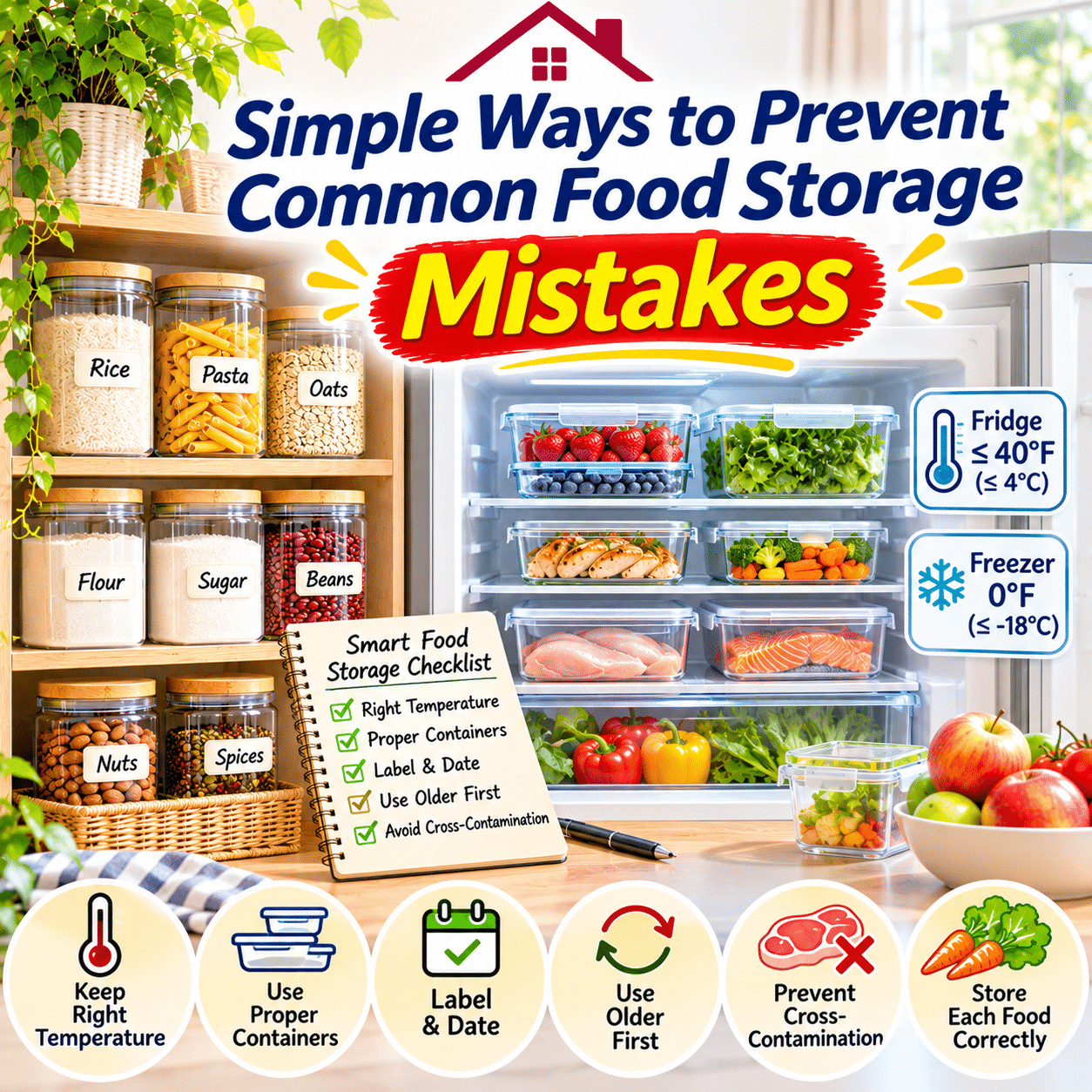
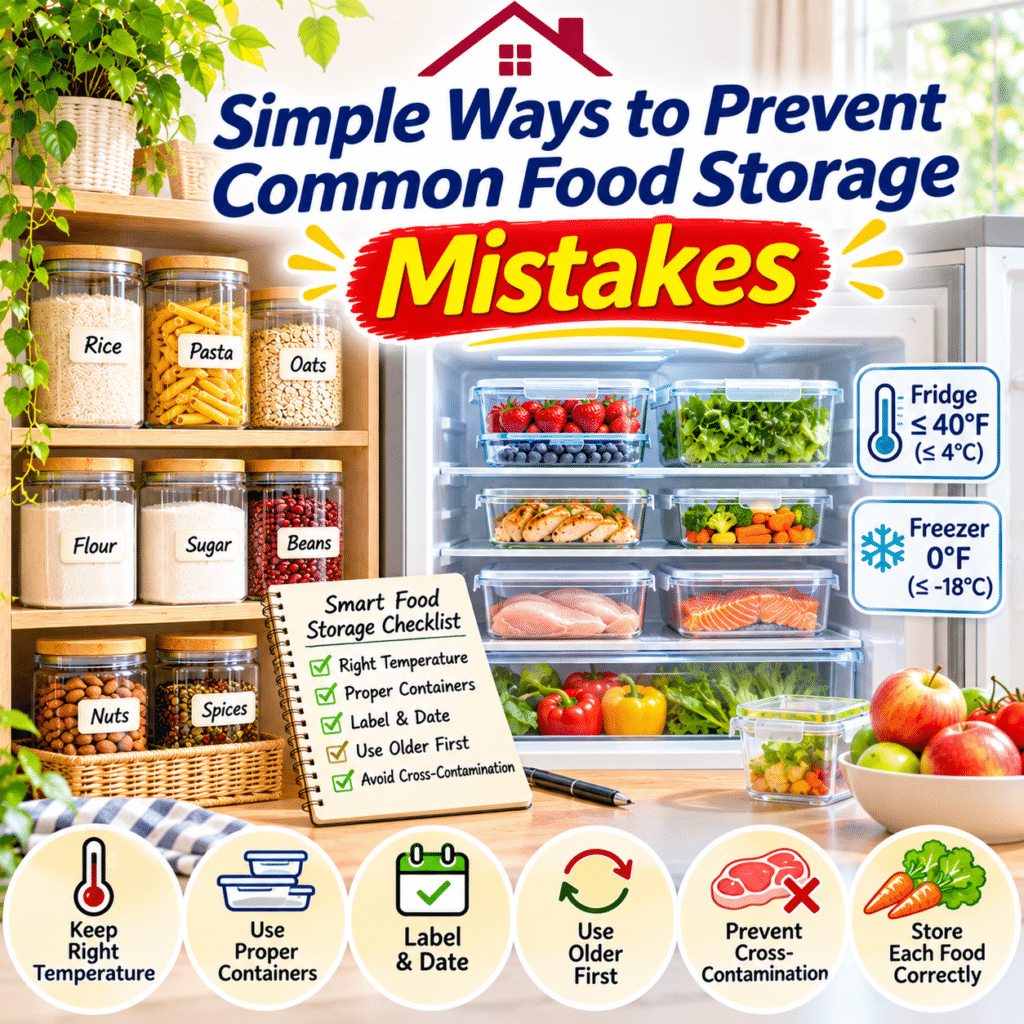
Proper food storage is one of the most important everyday kitchen habits. It helps maintain food quality, reduce unnecessary waste, protect household budgets, and lower the risk of foodborne illness. Yet even well-organized kitchens can develop storage problems when ingredients are placed in unsuitable locations, leftovers are forgotten, or food safety guidelines are misunderstood.
Some mistakes are easy to recognize. Leaving perishable groceries on the countertop for too long, storing opened packages without closing them properly, or overcrowding the refrigerator can affect freshness and safety. Other mistakes are less obvious, such as keeping certain fruits and vegetables together, storing cooking oils near heat, or assuming that frozen food will maintain its original quality indefinitely.
Food storage does not need to be complicated. Most common problems can be prevented by understanding a few basic principles: maintain appropriate temperatures, control moisture, prevent contamination, choose suitable packaging, and use food within recommended timeframes.
Different foods also require different approaches. Fresh vegetables, raw meat, cooked leftovers, pantry staples, dairy products, and frozen ingredients cannot all be handled in exactly the same way. Understanding these differences makes kitchen organization more practical and effective.
The goal is not to create a perfect storage system or purchase an extensive collection of containers. Instead, it is to develop reliable habits that fit everyday cooking routines while keeping food safe, accessible, and enjoyable to use.
This guide explains common food storage mistakes, why they happen, and the simple solutions that can help prevent them. From refrigerator organization and pantry management to freezing, labeling, and handling leftovers, these practical strategies can support a safer, more efficient kitchen over time.
1. Understand the Difference Between Food Safety and Food Quality
One of the most important food storage principles is recognizing that food safety and food quality are not the same thing.
Food quality refers to characteristics such as flavor, texture, appearance, and aroma. Food safety concerns whether food may cause illness when consumed.
A food can lose some quality without necessarily becoming unsafe. Conversely, food may contain harmful microorganisms even when it looks and smells normal.
Food Quality Problems
Common examples include:
- Bread becoming stale.
- Crackers losing crispness.
- Frozen vegetables developing undesirable textures.
- Spices losing aroma.
- Coffee becoming less flavorful.
- Nuts developing rancid odors.
- Fruit becoming excessively soft.
Food Safety Problems
Potential safety concerns include:
- Perishable foods stored at unsafe temperatures.
- Cross-contamination between raw and ready-to-eat foods.
- Improperly cooled cooked meals.
- Damaged or contaminated packaging.
- Unsafe thawing methods.
- Mold growth.
- Food kept beyond applicable safety-related limits.
Why the Distinction Matters
A storage method that preserves appearance does not necessarily guarantee safety.
For example, an airtight container can protect food from moisture and odors, but it cannot make improperly refrigerated leftovers safe.
Similarly, freezing can preserve suitable food for later use, but it does not reliably eliminate harmful microorganisms already present.
The best food storage practices protect both quality and safety.
2. Mistake: Keeping the Refrigerator Too Warm
Refrigerators slow the growth of many microorganisms, but they do not eliminate every food safety risk.
When the refrigerator temperature is too high, perishable foods may deteriorate more quickly and become unsafe.
Recommended Storage Temperatures
| Appliance | Recommended Temperature |
|---|---|
| Refrigerator | 40°F (4°C) or below |
| Freezer | 0°F (-18°C) or below |
These are widely used food safety recommendations.
Why Temperature Problems Happen
Common causes include:
- Incorrect thermostat settings.
- Frequently leaving the refrigerator door open.
- Damaged door seals.
- Overcrowded shelves.
- Blocked internal air vents.
- Appliance malfunctions.
- Placing large quantities of warm food inside without appropriate cooling arrangements.
Practical Solutions
Use an appliance thermometer to verify the actual temperature.
Avoid blocking air circulation.
Check that the refrigerator door closes properly.
Keep the appliance reasonably organized so food can be retrieved without leaving the door open unnecessarily.
If temperatures remain outside the recommended range, investigate the appliance rather than assuming the displayed setting is accurate.
3. Mistake: Overcrowding the Refrigerator
A refrigerator packed tightly with containers, groceries, and leftovers can make food storage less effective.
Overcrowding may restrict airflow and make it difficult to find ingredients.
Common Consequences
- Uneven cooling.
- Forgotten leftovers.
- Hidden produce.
- Difficulty cleaning shelves.
- Unnecessary duplicate purchases.
- Longer door-opening times.
How to Prevent It
Organize foods into practical categories.
Avoid placing containers directly against air vents.
Use appropriately sized storage containers.
Review existing food before shopping.
Remove spoiled or unnecessary items promptly.
Keep enough space for air to circulate according to the refrigerator manufacturer’s instructions.
Avoid the Opposite Extreme
A refrigerator does not need to be nearly empty.
The goal is appropriate airflow, safe temperatures, and convenient access rather than a specific visual appearance.
4. Mistake: Storing Raw Meat Above Ready-to-Eat Foods
Improper placement of raw meat, poultry, and seafood can create cross-contamination risks.
Raw animal products may contain microorganisms that can spread through leaking juices or contact with other foods.
Safer Storage Practices
Keep raw animal products in sealed, leakproof containers or securely wrapped packaging.
Store them below ready-to-eat foods where practical, so leaks cannot drip onto other ingredients.
Keep raw products separate from:
- Washed produce.
- Cooked leftovers.
- Prepared salads.
- Ready-to-eat meals.
- Foods that will not receive further cooking.
Avoid Relying on Packaging Alone
Original packaging may leak.
A suitable tray or secondary container can provide additional protection.
Clean Contaminated Surfaces
If raw meat juices spill, clean and sanitize affected surfaces using appropriate food safety methods.
Wash hands thoroughly after handling raw animal products.
5. Mistake: Leaving Perishable Food at Room Temperature Too Long
Perishable food should not remain at room temperature for extended periods.
Many harmful microorganisms can multiply more quickly when food is held within temperatures favorable to their growth.
General Two-Hour Rule
Perishable foods should generally be refrigerated within two hours.
When the surrounding temperature exceeds 90°F (32°C), the recommended limit is generally one hour.
Foods Requiring Particular Attention
Examples include:
- Raw meat and poultry.
- Seafood.
- Milk and many dairy products.
- Cooked rice.
- Cooked pasta.
- Prepared meals.
- Cut fruit.
- Cut vegetables requiring refrigeration.
- Foods containing perishable ingredients.
Practical Prevention
Put refrigerated groceries away promptly.
Avoid leaving cooked meals on the countertop for several hours.
Refrigerate suitable leftovers in shallow containers.
Use insulated bags or coolers when transporting perishable groceries in warm conditions.
Important Safety Reminder
Food that has been improperly stored should not automatically be considered safe after reheating.
Some hazards may remain even after cooking.
6. Mistake: Waiting for Cooked Food to Cool Completely Before Refrigerating
A common misconception is that cooked food must reach room temperature before it can be refrigerated.
Waiting too long can leave food at unsafe temperatures.
Why This Is a Problem
Large pots of soup, rice, or cooked meals may cool slowly.
Their interiors can remain warm for an extended period.
Better Cooling Practices
Divide large quantities into smaller portions.
Use shallow food-safe containers.
Refrigerate promptly within recommended time limits.
For large quantities, use appropriate rapid-cooling methods when necessary.
Avoid Overloading the Refrigerator With Large Hot Containers
A large, deep pot of very hot food may cool too slowly and can affect nearby refrigerator temperatures.
Dividing food into shallow containers helps it cool more efficiently.
Label Prepared Food
Record the preparation date to make safe storage management easier.
7. Mistake: Keeping Leftovers Without Knowing When They Were Prepared
Leftovers can be convenient, but unlabeled containers often become forgotten.
When preparation dates are unknown, it becomes difficult to determine whether food is still within a recommended storage period.
General Refrigerated Leftover Guidance
Many cooked leftovers can generally be stored for three to four days at 40°F (4°C) or below.
However, some foods require different storage periods, so food-specific recommendations should take priority.
Practical Labeling System
Include:
- Food name.
- Preparation date.
- Optional portion information.
For example:
Vegetable Soup — Prepared Monday
Use Clear Containers
Transparent containers make contents easier to identify.
Keep Leftovers Visible
Place appropriately stored leftovers where they can be seen without searching through the refrigerator.
Freeze Suitable Portions
If leftovers will not be eaten within the recommended refrigerated period, freeze them promptly when appropriate.
8. Mistake: Reheating Leftovers Without Checking Temperature
Reheating food until it feels warm is not always sufficient.
Uneven heating can leave portions of food below recommended temperatures.
General Reheating Guidance
Many leftovers should be reheated to an internal temperature of 165°F (74°C).
Use a Food Thermometer
A thermometer can help verify temperature, especially for thick dishes or large portions.
Stir Food When Appropriate
Soups, sauces, and microwave-heated dishes may benefit from stirring to distribute heat more evenly.
Avoid Repeatedly Reheating Large Quantities
Divide food into portions before storage.
Reheat only the amount needed when practical.
Reheating Does Not Reset Storage Time
The original preparation and storage history still matter.
Do not extend refrigerated storage indefinitely by repeatedly reheating food.
9. Mistake: Thawing Frozen Food on the Countertop
Leaving frozen meat, poultry, seafood, or other perishable food on the countertop to thaw can create food safety risks.
The outer portions may warm to unsafe temperatures while the center remains frozen.
Safer Thawing Methods
| Method | Appropriate Use | Important Consideration |
|---|---|---|
| Refrigerator | Most perishable frozen foods | Allow sufficient thawing time |
| Cold water | Suitable securely packaged foods | Keep water cold and follow recommended handling |
| Microwave | Foods that will be cooked immediately | Cook promptly after thawing |
| Cooking from frozen | Suitable products and recipes | Follow validated cooking instructions |
Avoid Warm-Water Thawing
Warm water can expose outer food surfaces to unsafe temperatures.
Plan Ahead
Move suitable frozen ingredients into the refrigerator in advance.
Large items may require substantial thawing time.
Follow Product Instructions
Some commercially frozen foods are designed to be cooked directly from frozen.
10. Mistake: Assuming Frozen Food Maintains Perfect Quality Forever
Freezing is an effective preservation method, but it does not stop every quality change.
Food stored continuously at 0°F (-18°C) can remain safe for extended periods, but its flavor, texture, and appearance may deteriorate.
Safety also depends on appropriate handling before freezing and after thawing.
Common Freezer Quality Problems
- Freezer burn.
- Dry or tough textures.
- Loss of flavor.
- Ice crystal formation.
- Unpleasant odors.
- Forgotten packages.
Practical Solutions
Use freezer-suitable packaging.
Remove unnecessary air exposure.
Freeze food in realistic portions.
Label contents and freezing dates.
Use older suitable products before newer ones.
Understand Freezer Burn
Freezer burn primarily affects quality rather than automatically making food unsafe.
However, storage history and other signs of deterioration still need consideration.
11. Mistake: Freezing Food in Unsuitable Containers
Not every storage container is designed for freezing.
Some materials may crack, leak, or fail to protect food adequately.
Choose Freezer-Safe Packaging
Suitable options may include:
- Freezer-rated containers.
- Appropriate freezer bags.
- Freezer-safe glass containers.
- Packaging specifically designed for frozen food.
Allow for Expansion
Liquids expand as they freeze.
Leave appropriate headspace when freezing soups, sauces, and other liquid foods.
Avoid Overfilling
Overfilled containers may leak or become damaged.
Use Practical Portions
Small portions can be easier to thaw and reduce unnecessary waste.
Label Clearly
Include the contents and freezing date.
Do not rely on memory to identify frozen food months later.
12. Mistake: Storing All Fruits and Vegetables Together
Fruits and vegetables have different storage requirements.
Some benefit from refrigeration, while others may be stored at room temperature until ripe.
Certain fruits also release ethylene gas, which can influence the ripening and deterioration of nearby produce.
General Produce Storage Guide
| Produce | General Storage Approach |
|---|---|
| Leafy greens | Refrigerate appropriately |
| Berries | Refrigerate promptly |
| Apples | Refrigeration can help maintain quality |
| Bananas | Ripen at room temperature |
| Tomatoes | Storage depends on ripeness and intended use |
| Carrots | Refrigerate appropriately |
| Potatoes | Store in a suitable cool, dark, ventilated location |
| Dry onions | Store in a cool, dry, ventilated area |
| Citrus fruits | Refrigeration can extend storage life |
| Fresh herbs | Use herb-specific storage methods |
These are general principles rather than universal rules.
Separate Ethylene-Sensitive Produce
When practical, keep sensitive vegetables away from fruits that release significant ethylene.
Avoid Excessive Moisture
Some produce deteriorates more quickly when stored wet.
Other vegetables benefit from appropriately controlled humidity.
Check Produce Regularly
Remove spoiled items promptly and adjust storage according to ripeness.
13. Mistake: Washing Produce Too Early Without Drying It Properly
Washing fruits and vegetables before storage can be convenient, but excess moisture may accelerate deterioration in some produce.
Consider the Produce Type
Delicate berries, leafy greens, and other vegetables have different moisture requirements.
Wash Before Preparation When Practical
For many fruits and vegetables, washing shortly before use helps avoid unnecessary moisture during storage.
Dry Produce Appropriately
If produce is washed in advance, remove excess moisture using suitable methods.
Use Clean Storage Containers
Avoid placing freshly washed produce into dirty containers.
Do Not Wash Raw Poultry
Washing raw poultry can spread microorganisms through splashing water.
Proper cooking, rather than washing, is the appropriate method for addressing harmful microorganisms in poultry.
14. Mistake: Storing Potatoes and Onions Without Considering Their Different Needs
Potatoes and dry onions are commonly stored in kitchen cabinets or pantry areas.
Although both benefit from suitable ventilation, their ideal conditions are not identical.
Store Potatoes Appropriately
Choose a cool, dark, ventilated location.
Avoid excessive warmth, moisture, and prolonged light exposure.
Light exposure can encourage greening, which may be associated with increased glycoalkaloid levels.
Discard potatoes that are extensively green, bitter, rotten, or otherwise unsuitable.
Store Dry Onions Appropriately
Whole dry onions generally benefit from cool, dry, well-ventilated storage.
Avoid Damp Containers
Trapped moisture can encourage deterioration.
Separate When Practical
Keeping potatoes and dry onions in separate storage areas can help accommodate their different needs.
Refrigerate Cut Produce
Once cut, potatoes and onions require different handling from intact whole products.
Follow appropriate food safety and storage recommendations.
15. Mistake: Keeping Bread in a Warm, Humid Location
Bread can become stale or moldy depending on storage conditions.
Understand the Difference
Staling primarily involves changes in texture.
Mold growth is a food safety concern.
Choose Storage Based on Consumption
Bread intended for near-term use may be stored according to package instructions and local conditions.
For longer storage, freezing is often useful.
Avoid Moisture Accumulation
Warm, humid environments can encourage mold.
Freeze Extra Portions
Slice or portion bread before freezing when practical.
Discard Moldy Bread
Do not assume removing the visible mold makes the remainder safe.
Bread is porous, and contamination may extend beyond visible growth.
16. Mistake: Keeping Opened Dry Goods in Loose Packaging
Partially opened packages of rice, flour, pasta, cereal, and other dry foods may become exposed to moisture, pests, and spills.
Use Secure Closures
Close packages tightly after each use.
Consider Food-Safe Containers
Suitable containers can improve protection and organization.
Keep Original Information
Preserve product names, dates, allergen information, and preparation instructions.
Avoid Combining Old and New Batches
Mixing products may make inventory rotation and contamination tracing difficult.
Keep Storage Areas Dry
Even well-closed packages may be affected by persistent moisture problems in the surrounding environment.
17. Mistake: Storing Spices Near Heat and Steam
Spices and dried herbs may lose aroma and flavor when exposed to unsuitable storage conditions.
Common Problem Locations
- Directly above the stove.
- Near hot ovens.
- Beside steaming appliances.
- On windowsills exposed to strong sunlight.
- In damp cabinets.
Better Storage
Choose a cool, dry location away from excessive heat and light.
Keep containers closed.
Use clean, dry utensils.
Avoid Shaking Spice Containers Over Steam
Steam can introduce moisture into the container.
Measure spices away from rising steam when practical.
Buy Realistic Quantities
Smaller purchases may preserve flavor quality for ingredients used infrequently.
18. Mistake: Storing Cooking Oils in Direct Sunlight
Cooking oils can deteriorate when exposed to heat, light, and oxygen.
Different oils have different storage characteristics.
Keep Oils Away From Heat
Avoid placing bottles directly beside hot cooking appliances.
Protect From Strong Light
A suitable cabinet may be preferable to a sunny countertop.
Close Bottles Securely
Limit unnecessary air exposure.
Follow Product-Specific Instructions
Some specialty oils may benefit from refrigeration.
Watch for Rancidity
Discard oils showing clear signs of rancidity or other concerning deterioration.
19. Mistake: Treating Nuts and Seeds Like All Other Dry Foods
Nuts and seeds contain natural oils that can become rancid over time.
Their storage requirements may differ from refined grains or sugar.
Use Appropriate Packaging
Limit exposure to air, moisture, and strong odors.
Consider Cooler Storage
Refrigeration or freezing may help maintain quality for longer periods.
Avoid Excessive Bulk Purchases
Buy quantities that match realistic consumption.
Protect Against Allergen Cross-Contact
Clearly identify nuts and seeds.
Use suitable storage and handling practices in households with food allergies.
Discard Deteriorated Products
Rancid or contaminated products should not be consumed.
20. Mistake: Misunderstanding Food Date Labels
Food date labels can be confusing because their meanings vary by product and jurisdiction.
Common Label Types
| Label | General Meaning | Practical Response |
|---|---|---|
| Best Before / Best If Used By | Often indicates expected quality | Consider applicable safety guidance and storage history |
| Use By | May represent a safety-related deadline | Follow the date and product instructions |
| Sell By | Often relates to retail stock management | Do not automatically interpret it as a safety deadline |
| Freeze By | May indicate recommended freezing timing | Follow the manufacturer’s guidance |
Do Not Assume Every Date Means the Same Thing
Regulations differ between countries.
Do Not Rely Only on Appearance
Unsafe food may look normal.
Preserve Labels
When transferring food to containers, retain relevant date and storage information.
Prioritize Safety
If food has been stored improperly or may be unsafe, do not consume it simply because its printed date has not passed.
21. Mistake: Relying on Smell or Taste to Determine Food Safety
Smell and appearance can sometimes reveal spoilage, but they cannot reliably confirm that food is safe.
Certain harmful microorganisms may be present without obvious changes.
Avoid Taste Testing Questionable Food
Do not sample food to determine whether it has become unsafe.
Consider Storage History
Ask whether the food was:
- Refrigerated promptly.
- Kept at appropriate temperatures.
- Protected from contamination.
- Stored within recommended timeframes.
- Handled according to product instructions.
Discard Food When Safety Is Uncertain
Preventing food waste is important, but avoiding foodborne illness takes priority.
Learn From the Situation
If food is frequently discarded because its storage history is unclear, improve labeling and organization rather than taking risks.
22. Mistake: Storing Cleaning Chemicals Near Food
Cleaning products can create contamination risks when stored improperly.
Separate Food and Chemicals
Keep cleaning chemicals away from ingredients, cookware, and food-contact items.
Follow Product Labels
Store products in accordance with manufacturer instructions.
Keep Original Containers
Avoid transferring chemicals into food or beverage containers.
Protect Children and Pets
Store hazardous products securely and out of reach.
Avoid Mixing Cleaning Products
Certain chemical combinations can release dangerous gases or cause other harmful reactions.
23. Mistake: Using Food Storage Containers That Are Difficult to Clean
Containers can support food safety only when they are appropriate for their intended use and maintained properly.
Inspect Containers Regularly
Look for:
- Cracks.
- Damaged lids.
- Worn seals.
- Persistent residues.
- Areas that cannot be cleaned effectively.
Choose Suitable Materials
Use containers intended for food contact.
Follow Temperature Restrictions
Not every container is suitable for microwaving, freezing, or holding hot food.
Clean Thoroughly
Wash containers according to manufacturer instructions.
Replace Damaged Items
Containers that can no longer be cleaned or sealed appropriately should be replaced.
24. Mistake: Using the Same Storage Method for Every Ingredient
Convenience sometimes encourages households to apply one storage system to all foods.
However, storage needs vary significantly.
Different Foods Need Different Conditions
| Food Category | Main Storage Concern |
|---|---|
| Raw meat and poultry | Temperature control and cross-contamination |
| Cooked leftovers | Prompt cooling and storage duration |
| Leafy vegetables | Moisture management and refrigeration |
| Whole potatoes | Light, temperature, and ventilation |
| Dry grains | Moisture and pest protection |
| Flour | Moisture, pests, and product-specific shelf life |
| Nuts and seeds | Oxidation and rancidity |
| Spices | Heat, moisture, and aroma loss |
| Cooking oils | Heat, light, and oxygen |
| Frozen foods | Packaging, temperature, and quality preservation |
| Canned foods | Packaging integrity and storage conditions |
Follow Ingredient-Specific Guidance
Use product labels and reliable food safety recommendations.
Avoid Overcomplicated Systems
Different storage requirements do not mean every ingredient needs a unique organizer.
The goal is appropriate handling rather than excessive categorization.
25. Mistake: Forgetting to Rotate Food Supplies
Older food packages can become hidden behind newer purchases.
This often leads to unnecessary waste.
Use First-In, First-Out
First-in, first-out, or FIFO, means using older suitable products before newer equivalents.
Place New Products Behind Existing Supplies
This can make rotation easier.
Keep Dates Visible
Avoid hiding important labels.
Review Opened Packages
Use existing ingredients before opening duplicates when practical.
Remember Safety Limits
An older product should never be consumed merely because it was purchased first.
26. Mistake: Ignoring Food Storage During Grocery Transportation
Food storage begins before groceries reach the kitchen.
Perishable products may warm during long journeys, particularly in hot weather.
Plan Shopping Order
Purchase refrigerated and frozen foods near the end of the shopping trip when practical.
Use Insulated Bags
Insulated bags or coolers with appropriate cold sources can help maintain safe temperatures.
Avoid Unnecessary Delays
Return home promptly after buying perishable groceries.
Store Groceries Immediately
Refrigerate or freeze suitable items as soon as possible.
Be Extra Careful in Hot Weather
High temperatures can shorten the time perishable foods may safely remain unrefrigerated.
27. Mistake: Failing to Check Refrigerator Door Seals
A refrigerator with damaged or poorly sealing doors may struggle to maintain appropriate temperatures.
Common Warning Signs
- Doors do not close completely.
- Condensation appears around seals.
- Refrigerator temperatures fluctuate.
- Excessive frost develops in certain areas.
- The appliance runs unusually often.
Practical Maintenance
Inspect door seals regularly.
Clean seals according to manufacturer instructions.
Avoid blocking the door with oversized containers.
Seek appropriate repair when necessary.
Verify Temperature
Use a thermometer rather than relying only on whether food feels cold.
28. Mistake: Storing Food Without Considering Household Routines
Even technically appropriate storage arrangements may fail if they are inconvenient.
For example, frequently used ingredients stored behind heavy equipment may remain forgotten.
Keep Everyday Foods Accessible
Place frequently used products in convenient, suitable locations.
Separate Personal and Shared Supplies
In shared households, clear organization can prevent confusion.
Use Transparent Containers When Helpful
Visibility can make ingredients easier to identify.
Create a Use-Soon Area
Keep suitable foods requiring prompt attention visible while maintaining safe separation and temperatures.
Adjust Storage to Actual Habits
A practical system should support how the household shops, cooks, and eats.
29. Mistake: Overbuying Food Without Enough Storage Capacity
Buying large quantities may seem economical, but inadequate storage can lead to spoilage and waste.
Evaluate Available Space
Check refrigerator, freezer, and pantry capacity before purchasing large quantities.
Consider Consumption Rates
Estimate how quickly food will be used.
Avoid Overcrowding Appliances
Do not compromise airflow or safe storage temperatures.
Freeze Suitable Portions
Portion and freeze foods when appropriate.
Purchase Realistic Quantities
A smaller package may provide better value if it prevents waste.
30. Mistake: Ignoring Power Outages and Refrigerator Malfunctions
Unexpected power interruptions can affect refrigerated and frozen foods.
A refrigerator or freezer may also stop cooling properly without immediate notice.
Keep Doors Closed During Outages
An unopened refrigerator generally keeps food cold for about four hours.
A full freezer may maintain an appropriate temperature for approximately 48 hours, while a half-full freezer may last around 24 hours, provided the door remains closed.
These are general estimates, not guarantees.
Use Temperature Information
An appliance thermometer can help evaluate conditions.
Check Food Safety After Power Returns
Follow official food safety guidance when deciding whether to keep or discard affected products.
Do Not Taste Food to Check Safety
Appearance, smell, and taste are not reliable indicators of all foodborne hazards.
Prepare for Recurring Outages
Where outages are common, appropriate coolers and cold packs may help protect perishable foods for limited periods.
31. Common Food Storage Mistakes at a Glance
| Common Mistake | Why It Matters | Better Practice |
|---|---|---|
| Refrigerator too warm | Increases food safety risks | Maintain 40°F (4°C) or below |
| Freezer too warm | Affects frozen storage | Maintain 0°F (-18°C) or below |
| Overcrowded refrigerator | Restricts airflow and visibility | Organize and preserve circulation |
| Raw meat stored above ready-to-eat food | Creates cross-contamination risks | Use leakproof storage below ready-to-eat foods |
| Perishable food left out too long | Allows harmful microbial growth | Refrigerate promptly |
| Large cooked meals cooled slowly | May remain at unsafe temperatures | Divide into shallow containers |
| Unlabeled leftovers | Storage time becomes uncertain | Label contents and dates |
| Unsafe thawing | Outer food surfaces may warm excessively | Thaw using recommended methods |
| Poor freezer packaging | Causes quality deterioration | Use freezer-suitable packaging |
| All produce stored together | May accelerate deterioration | Follow produce-specific guidance |
| Excess moisture on produce | Can encourage spoilage | Manage moisture appropriately |
| Bread stored in humid conditions | Encourages mold | Store suitably or freeze |
| Open pantry packages | Increases moisture and pest exposure | Close securely |
| Spices stored near heat | Reduces flavor quality | Store cool and dry |
| Oils exposed to sunlight | Accelerates deterioration | Protect from heat and light |
| Date labels misunderstood | May cause waste or unsafe decisions | Follow applicable label guidance |
| Smell used as a safety test | Unsafe food may appear normal | Consider storage history and safety rules |
| Chemicals stored near food | Creates contamination risks | Separate and secure chemicals |
| Damaged containers reused | May compromise hygiene | Replace unsuitable containers |
| Food inventory not rotated | Older products are forgotten | Use FIFO appropriately |
| Groceries transported without cooling | Perishables may warm | Use appropriate cold storage |
| Door seals ignored | Appliance may not cool properly | Inspect and maintain seals |
| Excess food purchased | Storage capacity is exceeded | Buy realistic quantities |
| Power outage risks ignored | Stored food may become unsafe | Follow outage food safety guidance |
32. A Step-by-Step Plan to Improve Food Storage at Home
Preventing food storage mistakes becomes easier when changes are introduced systematically.
Step 1: Check Appliance Temperatures
Verify refrigerator and freezer temperatures using suitable thermometers.
Step 2: Review Refrigerator Organization
Separate raw animal products from ready-to-eat foods.
Keep airflow pathways clear.
Step 3: Inspect Existing Food
Check packaging, dates, and storage conditions.
Discard unsafe items.
Step 4: Organize Pantry Staples
Group dry ingredients and protect them from moisture, heat, and pests.
Step 5: Improve Storage Containers
Use suitable food-safe containers where needed.
Replace damaged containers.
Step 6: Introduce Clear Labels
Label leftovers and frozen foods with names and dates.
Step 7: Establish Safe Cooling Habits
Refrigerate perishable cooked foods promptly using appropriate containers.
Step 8: Plan Safe Thawing
Use refrigerator, cold-water, microwave, or suitable cooking-from-frozen methods.
Step 9: Create a Food Rotation Routine
Use older suitable products first.
Step 10: Review Storage Regularly
Check for forgotten foods, temperature problems, moisture, pests, and changing household needs.
33. Frequently Asked Questions
1. What is the most common food storage mistake?
Common mistakes include improper refrigeration, leaving perishable foods out too long, poor packaging, and forgetting leftovers.
2. What temperature should a refrigerator maintain?
A widely recommended food safety target is 40°F (4°C) or below.
3. What temperature should a freezer maintain?
A widely recommended target is 0°F (-18°C) or below.
4. Can I refrigerate food while it is still warm?
Yes. Perishable food should be refrigerated promptly. Divide large quantities into shallow containers to help them cool efficiently.
5. How long can cooked leftovers stay refrigerated?
Many cooked leftovers can generally be refrigerated for three to four days at 40°F (4°C) or below, although some foods have different requirements.
6. Is it safe to thaw meat on the kitchen counter?
No. Thawing perishable foods at room temperature can create food safety risks.
7. Can frozen food become unsafe?
Freezing does not reverse previous unsafe handling, and food may become unsafe if thawed or stored improperly.
8. Does freezer burn mean food is unsafe?
Freezer burn primarily affects quality, but overall safety still depends on proper handling and storage history.
9. Should raw meat be stored on the bottom refrigerator shelf?
Storing raw meat below ready-to-eat foods in leakproof packaging helps prevent dripping and cross-contamination.
10. Should all vegetables be refrigerated?
No. Storage requirements vary by vegetable type, ripeness, and preparation.
11. Can I store potatoes and onions together?
Separate storage is often preferable because their ideal conditions differ.
12. Should berries be washed before refrigeration?
Washing shortly before use is often practical. If washing in advance, manage excess moisture appropriately.
13. Can bread be frozen?
Yes. Freezing suitable bread can help preserve quality and reduce waste.
14. How should flour be stored?
Keep flour dry and protected from pests. Certain whole-grain or specialty flours may benefit from cooler storage.
15. Where should spices be stored?
A cool, dry location away from excessive heat, moisture, and light is generally suitable.
16. Should cooking oils be stored beside the stove?
Excessive heat can accelerate deterioration. Store oils according to product guidance, away from unnecessary heat and light.
17. Do airtight containers make food last forever?
No. They may help protect food quality, but they do not eliminate spoilage, contamination, or storage-time limits.
18. Can I eat food that smells normal?
Normal smell does not guarantee safety. Consider storage conditions, dates, and applicable food safety guidance.
19. What does first-in, first-out mean?
It means using older suitable food before newer equivalent products.
20. Should I remove all food from original packaging?
No. Original packaging often provides protection and important product information.
21. How can I prevent freezer food from being forgotten?
Label packages with contents and freezing dates, and maintain a simple inventory.
22. How can I keep food safe during grocery transportation?
Use insulated bags or coolers when appropriate and refrigerate perishable groceries promptly.
23. How long does food stay cold during a power outage?
An unopened refrigerator generally maintains cold temperatures for about four hours. Freezer estimates vary with fullness and conditions.
24. Should I taste food to determine whether it is spoiled?
No. Tasting questionable food can expose you to harmful microorganisms or toxins.
25. Can reheating make improperly stored food safe?
Not necessarily. Some hazards are not reliably eliminated by reheating.
26. How can I prevent cross-contamination in the refrigerator?
Separate raw animal products from ready-to-eat foods, use leakproof packaging, and clean contaminated surfaces appropriately.
27. How often should I check refrigerator temperatures?
Regular checks are useful, particularly when the appliance is heavily used, temperatures fluctuate, or cooling problems are suspected.
28. Is it better to buy food in bulk?
Bulk purchasing can be practical when storage capacity and consumption rates are appropriate. Otherwise, smaller quantities may reduce waste.
29. How can I make food storage easier in a small kitchen?
Prioritize safe temperatures, use accessible storage zones, limit excess purchases, and keep food clearly labeled.
30. What is the most important principle of safe food storage?
Maintain appropriate temperatures, prevent contamination, follow food-specific storage guidance, and never sacrifice safety to avoid waste.
34. Practical Checklist for Preventing Common Food Storage Mistakes
Use this checklist to establish safer, more reliable food storage habits.
Refrigerator Safety
- Maintain a temperature of 40°F (4°C) or below.
- Use an appliance thermometer when appropriate.
- Keep air vents unobstructed.
- Avoid excessive overcrowding.
- Store raw animal products in leakproof packaging.
- Keep raw foods below ready-to-eat foods.
- Check refrigerator door seals.
- Clean spills promptly.
- Review perishable foods regularly.
Freezer Storage
- Maintain a temperature of 0°F (-18°C) or below.
- Use freezer-suitable containers.
- Leave appropriate space for liquid expansion.
- Freeze realistic portions.
- Label contents and freezing dates.
- Protect foods from excessive air exposure.
- Use older suitable frozen products first.
- Follow safe thawing methods.
Leftover Management
- Refrigerate perishable leftovers promptly.
- Use shallow containers for large quantities.
- Label preparation dates.
- Follow recommended refrigerated storage periods.
- Reheat leftovers appropriately.
- Use a food thermometer when necessary.
- Freeze suitable extra portions.
- Avoid repeated unnecessary warming and cooling.
Produce Storage
- Store fruits and vegetables according to their needs.
- Manage moisture appropriately.
- Separate ethylene-sensitive produce when practical.
- Refrigerate suitable cut produce promptly.
- Check delicate produce regularly.
- Avoid storing produce near excessive heat.
- Discard unsafe or moldy produce.
- Use suitable ripe produce before it deteriorates.
Pantry Storage
- Keep dry goods away from excessive moisture.
- Store spices away from heat and steam.
- Protect cooking oils from excessive light and heat.
- Close opened packages securely.
- Use appropriate food-safe containers.
- Preserve important product labels.
- Check for pantry pests.
- Rotate older suitable ingredients.
- Avoid unnecessary bulk purchases.
Food Safety Habits
- Refrigerate perishable groceries promptly.
- Use appropriate cooling during transportation.
- Avoid thawing perishable food on countertops.
- Prevent cross-contamination.
- Wash hands after handling raw animal products.
- Keep cleaning chemicals away from food.
- Replace damaged storage containers.
- Never taste questionable food to test safety.
- Follow product-specific storage instructions.
- Prioritize safety over avoiding food waste.
Long-Term Kitchen Organization
- Keep frequently used ingredients accessible.
- Label leftovers and frozen meals.
- Review refrigerator contents before shopping.
- Maintain a simple pantry inventory.
- Check appliance temperatures regularly.
- Clean storage areas when needed.
- Adjust storage systems to household routines.
- Review habits when recurring waste occurs.
- Keep organization practical and easy to maintain.
Final Thoughts
Preventing common food storage mistakes is one of the simplest ways to make a kitchen safer, more organized, and less wasteful.
Many storage problems develop through ordinary habits rather than obvious neglect. A refrigerator may be slightly too warm, cooked food may be left out longer than intended, opened pantry packages may not be closed properly, or frozen ingredients may remain forgotten because they were never labeled.
These small issues can gradually affect food quality, increase unnecessary spending, and create avoidable safety risks.
Fortunately, most can be addressed through straightforward improvements.
Maintaining appropriate refrigerator and freezer temperatures, separating raw and ready-to-eat foods, refrigerating leftovers promptly, and thawing perishable ingredients safely provide a strong foundation for food safety.
Proper packaging, moisture control, and ingredient-specific storage methods can help preserve freshness and reduce waste.
Clear labeling and simple inventory rotation make it easier to use existing food before purchasing more.
At the same time, effective storage does not require an elaborate system. A few suitable containers, consistent storage locations, reliable temperature checks, and practical everyday routines can often provide substantial benefits.
The most important consideration is that food safety must always come first. Food that has been stored improperly or may be contaminated should not be consumed merely to avoid throwing it away.
A well-managed kitchen balances freshness, convenience, safety, and realistic household needs.
By understanding common mistakes and replacing them with simple, sustainable habits, households can protect their food, reduce avoidable waste, and make everyday cooking more comfortable and efficient.
Over time, these small improvements can create a kitchen where ingredients are easier to find, meals are simpler to prepare, and food is stored with greater confidence.