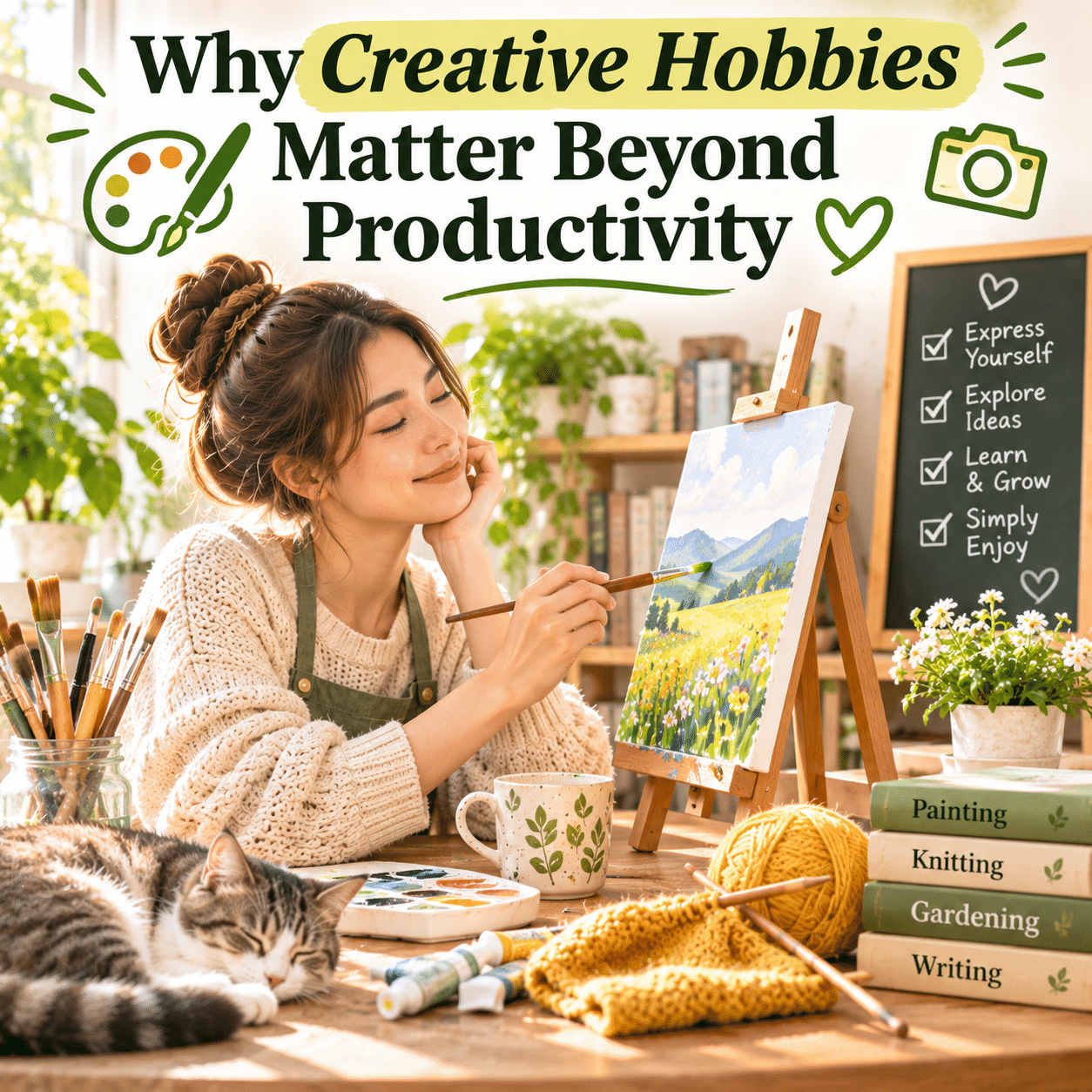
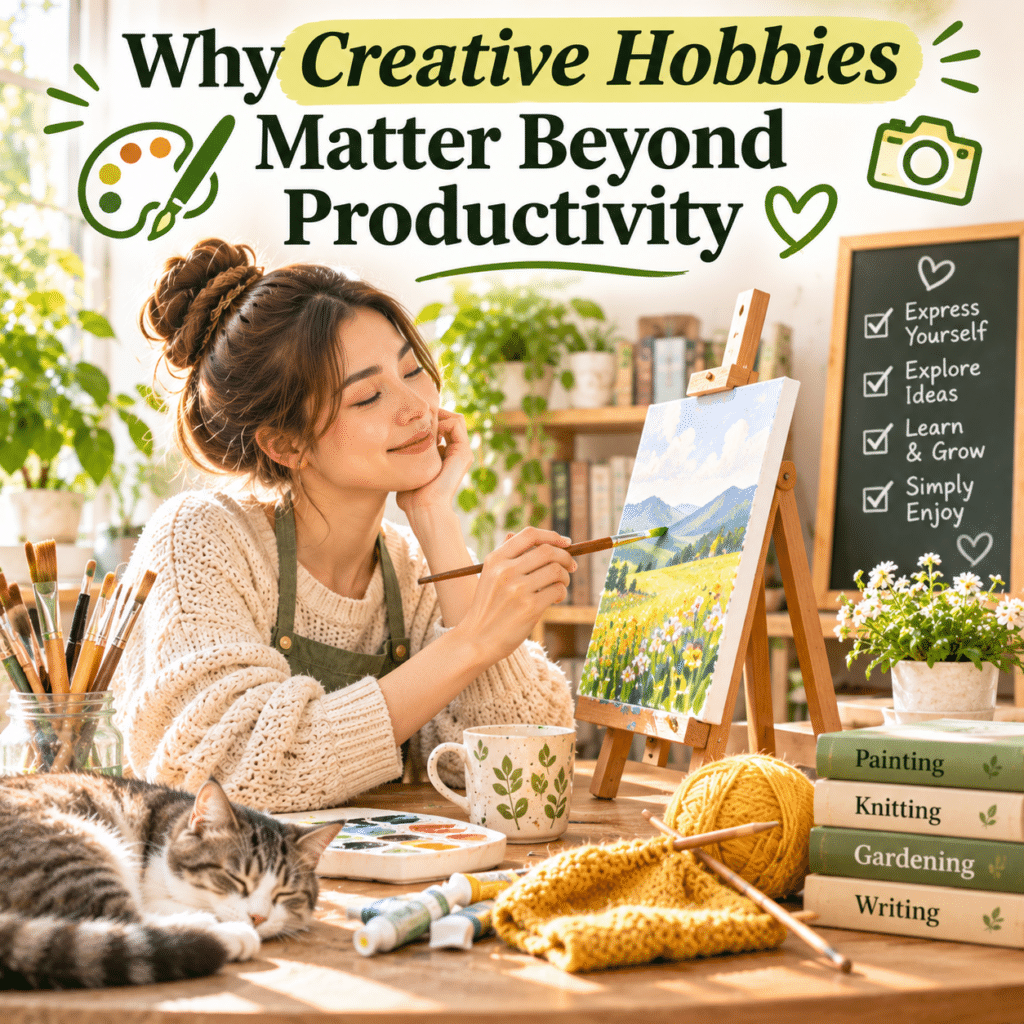
In a world where time is often measured by accomplishments, efficiency, and visible results, creative hobbies can easily become another area of life where people feel pressured to achieve something. A person who enjoys painting may begin wondering whether their artwork is good enough to sell. Someone who loves baking may feel encouraged to turn a favorite pastime into a business. A casual photographer may start evaluating every picture according to how many people might appreciate it online.
These possibilities are not necessarily negative. Creative hobbies can lead to valuable skills, professional opportunities, and personal achievements. However, creativity does not need to become productive in a conventional sense to deserve a place in everyday life.
Drawing, knitting, writing, gardening, crafting, playing music, decorating, pottery, photography, and countless other creative activities can offer meaningful experiences that have little to do with measurable output.
Sometimes the value lies in experimenting with unfamiliar materials. Sometimes it comes from concentrating on a project, exploring an idea, or enjoying the satisfaction of making something with one’s hands.
At other times, creativity simply provides a pleasant way to spend an afternoon.
A handmade object does not need to be perfect. A painting does not need an audience. A personal journal does not need to become a published book. A creative project can remain unfinished without making the time spent on it meaningless.
Creative hobbies allow people to explore interests, develop preferences, express individuality, and experience activities that are not governed entirely by external expectations.
They can also create opportunities for learning, social connection, personal reflection, and enjoyable routines.
Understanding why creative hobbies matter beyond productivity helps people develop a more balanced relationship with leisure, achievement, and personal fulfillment.
Rather than asking only what a hobby produces, it can be equally worthwhile to consider what the experience contributes to everyday life.
1. Understanding the Meaning of Creative Hobbies
A creative hobby is an activity pursued primarily through personal interest that involves imagination, expression, experimentation, or making something.
Creative hobbies can take many forms.
Some involve physical materials, such as painting, sewing, woodworking, or pottery.
Others involve language, sound, movement, or digital tools.
Writing stories, composing original music, arranging flowers, designing digital illustrations, and experimenting with recipes can all involve creativity.
A hobby does not need to result in a finished object.
Someone may enjoy exploring color combinations without completing a painting.
Another person may experiment with musical ideas without recording a song.
The defining feature is often the opportunity to make choices, explore possibilities, and engage with the creative process.
Creative hobbies are personal activities rather than competitions with universal standards of success.
2. Why Productivity Is Not the Only Measure of Value
Productivity usually refers to producing results, completing tasks, or using resources efficiently.
These measures can be useful in professional work and practical responsibilities.
However, they do not capture every meaningful human experience.
A person may spend an hour drawing without creating anything worth displaying.
That hour may still provide enjoyment, curiosity, and opportunities to practice.
Someone may spend an afternoon experimenting with a recipe that does not turn out as expected.
The experience may still be memorable or interesting.
When hobbies are evaluated only by finished results, much of their personal value can be overlooked.
Creative leisure allows people to appreciate experiences that do not need to justify themselves through financial return, recognition, or measurable achievement.
3. The Difference Between Creating and Producing
Creating and producing often overlap, but they emphasize different aspects of an activity.
Producing usually focuses on a completed result.
Creating can place greater attention on exploration, imagination, and the process of making something.
For example, a professional designer may need to complete a project according to specific requirements.
Someone drawing as a hobby may have no fixed deadline, client, or expected outcome.
Both activities involve creativity, but the surrounding expectations differ.
A hobby can provide freedom to change direction, make mistakes, or abandon an idea without serious consequences.
This flexibility is one reason creative leisure can feel different from work.
The process itself can be worthwhile even when no polished result emerges.
4. Why People Feel Pressure to Monetize Their Hobbies
Modern digital platforms make it easier for people to share creative work, build audiences, and explore commercial opportunities.
A person who enjoys making handmade jewelry may discover online marketplaces.
Someone who likes photography may encounter advice about selling images.
A hobby baker may receive suggestions to accept orders.
These opportunities can be rewarding for people who genuinely want them.
However, constant encouragement to monetize hobbies can create the impression that personal interests should eventually become sources of income.
This expectation may change how an activity feels.
A hobby once guided by curiosity may become influenced by customer preferences, deadlines, and financial considerations.
There is nothing inherently wrong with earning money from creativity.
The important distinction is whether commercialization reflects a genuine personal choice.
5. The Freedom to Create Without an Audience
Many creative activities can be enjoyed privately.
A person may write poems that no one else reads.
Someone may sketch in a notebook without posting the drawings online.
Another person may decorate a personal space simply because the arrangement feels pleasing.
Private creativity allows people to explore ideas without needing to explain or defend them.
There is no requirement to attract attention, receive approval, or meet an audience’s expectations.
Sharing creative work can also be enjoyable.
The choice belongs to the creator.
A hobby remains meaningful whether the result is displayed publicly, shared with a few trusted people, or kept entirely personal.
6. How Creative Hobbies Encourage Self-Expression
Creative activities provide opportunities to communicate preferences, ideas, emotions, and personal experiences.
A painting may reflect someone’s interest in nature.
A handmade decoration may express a preference for particular colors and textures.
A short story may explore an imagined situation.
A musical composition may reflect a mood or personal inspiration.
Self-expression does not always require a clear message.
Sometimes choosing materials, experimenting with shapes, or arranging objects is enough.
Creative hobbies allow people to make decisions based on their own interests rather than external instructions.
This freedom can make the activity feel personally meaningful.
7. The Value of Experimentation
Experimentation is an important part of creativity.
It involves trying unfamiliar techniques, combining materials, testing ideas, and observing what happens.
Not every experiment succeeds.
A painting may develop differently than expected.
A knitting pattern may need adjustment.
A recipe may require several attempts.
These outcomes do not necessarily make the experience unsuccessful.
Experimentation allows people to discover preferences and learn through direct experience.
A hobby provides an opportunity to explore without the same consequences that may accompany mistakes in professional work.
The freedom to experiment can make creative activities especially enjoyable.
8. Why Mistakes Can Be Part of the Experience
Mistakes are common in creative work.
Paint colors may blend unexpectedly.
A sewing project may require removing stitches.
A clay object may not hold its intended shape.
A written story may develop in an unplanned direction.
When creativity is treated as leisure, mistakes can become opportunities to adapt rather than reasons for embarrassment.
Some unexpected results may even inspire new ideas.
Of course, not every mistake is enjoyable, and certain activities involve safety considerations.
However, accepting ordinary imperfections can reduce unnecessary pressure.
A hobby does not need to produce flawless work to provide a satisfying experience.
9. Learning Without Formal Expectations
Creative hobbies often involve learning.
Someone may gradually understand how watercolor behaves on different papers.
A beginner gardener may discover which plants suit a particular environment.
A person learning embroidery may become familiar with different stitches.
These discoveries can happen through curiosity rather than formal instruction.
Books, tutorials, classes, and experienced hobbyists may provide useful guidance.
However, learning does not always need to follow a structured curriculum.
People can explore topics at their own pace.
They may repeat familiar techniques or try new ones whenever interest develops.
This flexible approach can make learning feel less demanding.
10. The Satisfaction of Making Something by Hand
Hands-on creative activities can offer a distinctive experience.
Cutting fabric, shaping clay, arranging flowers, folding paper, or assembling a small object involves direct interaction with materials.
The process may require attention to texture, movement, shape, and technique.
For some people, these activities provide a welcome contrast to screen-based work.
The satisfaction may come from watching an idea gradually take physical form.
However, handmade projects do not need to be practical or durable to be worthwhile.
A temporary decoration, experimental sketch, or simple paper craft can still provide enjoyment.
The experience of making something can matter independently of the finished object.
11. Creative Hobbies as a Form of Leisure
Leisure includes activities people choose during time away from essential responsibilities.
Creative hobbies can be one form of leisure because they provide opportunities for enjoyment and personal interest.
Unlike many work-related tasks, leisure activities do not necessarily require external evaluation.
A person may paint because they enjoy colors.
Another may knit because they like the repetitive process.
Someone else may write fictional scenes because imagining characters is entertaining.
The activity does not need to serve a larger purpose.
Enjoyment itself is a legitimate reason to maintain a hobby.
A balanced everyday life can include experiences that are valuable simply because people want to participate in them.
12. Understanding Creative Relaxation
Some people find creative activities relaxing.
Repetitive movements, familiar techniques, and focused attention may make certain hobbies feel comfortable.
Examples include knitting, coloring, simple drawing, pottery, and arranging flowers.
However, creativity is not automatically relaxing.
Complex projects, difficult techniques, or unrealistic expectations can create frustration.
The same activity may feel enjoyable on one day and demanding on another.
People should therefore choose hobbies according to their interests and circumstances rather than assuming every creative activity will produce calm.
Creative leisure is most useful when it remains flexible and personally satisfying.
13. The Role of Focused Attention
Creative hobbies often invite attention to a particular activity.
A person painting may concentrate on brush movements and color combinations.
Someone sewing may focus on fabric placement.
A writer may become absorbed in developing a scene.
This engagement can provide a change from activities involving frequent interruptions.
Some people describe periods of deep involvement as feeling absorbed in the process.
However, focused attention should not become another performance requirement.
Distractions and interruptions are normal.
A hobby can still be enjoyable when practiced in short sessions.
The value lies in having opportunities to engage with something interesting.
14. Why Creative Activities Can Feel Different From Screen Time
Digital technology supports many forms of creativity, including illustration, photography, writing, animation, and music production.
Therefore, creative hobbies do not need to be screen-free.
However, physical crafts can offer experiences that differ from digital activities.
Working with fabric, wood, clay, paint, or paper involves tactile interaction.
These materials respond through weight, texture, resistance, and movement.
Some people appreciate this contrast after spending long hours using computers or phones.
Others prefer digital creative tools because they are convenient, flexible, or accessible.
Neither approach is inherently superior.
The best medium is one that supports the person’s interests and practical needs.
15. The Importance of Personal Choice
Creative hobbies offer opportunities to make decisions without needing to satisfy someone else’s preferences.
A person can choose unusual colors, experiment with unfamiliar techniques, or work on subjects that have little commercial appeal.
These decisions may seem small, but they are part of what makes creative leisure personally meaningful.
Professional work often involves requirements and compromises.
A hobby can provide more freedom.
Someone may change projects midway, repeat the same activity for months, or explore a completely different interest.
Personal choice helps distinguish leisure from obligation.
16. Creative Hobbies and Individual Identity
People often describe themselves through their work, responsibilities, or relationships.
Creative hobbies can provide another way to explore personal identity.
Someone may enjoy being a painter, gardener, writer, photographer, or craft enthusiast even without professional recognition.
These interests can become meaningful parts of how people understand themselves.
A hobby may reflect curiosity, aesthetic preferences, or a long-standing fascination with a particular subject.
However, hobbies do not need to become permanent identity labels.
Interests can change over time.
The value lies in having opportunities to explore different aspects of oneself.
17. Rediscovering Childhood Creativity
Many children naturally experiment with drawing, building, storytelling, and imaginative play.
These activities often emphasize exploration rather than polished results.
As people grow older, responsibilities and expectations may influence how they approach creativity.
Some adults become hesitant to draw or make things because they believe they lack talent.
Returning to simple creative activities can provide opportunities to experiment without professional standards.
A person might begin with colored pencils, paper crafts, or informal writing.
The purpose is not necessarily to recreate childhood experiences.
It is to recognize that creativity remains available throughout adulthood.
18. Why Beginners Deserve to Enjoy the Process
Beginners often compare their early work with the polished creations of experienced artists and makers.
This comparison can create unrealistic expectations.
Every creative skill involves a learning process.
A first painting may look different from the intended image.
A beginner sewing project may contain uneven stitches.
An early photograph may have imperfect composition.
These results are normal parts of developing familiarity with an activity.
People do not need to become highly skilled before they are allowed to enjoy a hobby.
A beginner can appreciate experimenting, learning, and making personal choices from the very first session.
19. Avoiding Unnecessary Comparison
Creative communities can provide inspiration and useful knowledge.
However, viewing highly polished work may sometimes encourage unfavorable comparisons.
Online images often show completed projects rather than the many attempts involved in creating them.
A person may begin questioning whether their own hobby is worthwhile.
A more balanced approach is to treat other people’s work as potential inspiration rather than a universal standard.
Different creators have different resources, experience levels, goals, and preferences.
A personal hobby does not need to resemble professional work.
Its meaning depends on the experience it provides to the individual.
20. The Difference Between Improvement and Perfectionism
Improving a creative skill can be satisfying.
Someone may enjoy learning new painting techniques or becoming more confident with a sewing machine.
However, improvement and perfectionism are not the same.
Improvement involves developing abilities through practice and exploration.
Perfectionism may involve excessively demanding standards that make ordinary mistakes difficult to accept.
A hobby can include ambition without becoming rigid.
People can set goals while allowing room for experimentation.
They can also choose to remain casual participants.
There is no requirement to pursue mastery in every creative interest.
21. Creating Without Deadlines
Deadlines can be useful when coordinating professional work or preparing gifts for particular occasions.
However, personal creative hobbies do not always need fixed completion dates.
A painting may develop over several weekends.
A handmade blanket may take months.
A personal writing project may remain open-ended.
Removing unnecessary deadlines can allow people to work according to available time and interest.
Some individuals prefer structured goals, and that preference is equally valid.
The important distinction is whether a deadline supports enjoyment or creates unwanted pressure.
Creative leisure should allow people to choose an appropriate pace.
22. Why Unfinished Projects Are Not Always Failures
Many hobbyists have unfinished projects.
A sketchbook may contain incomplete drawings.
A craft shelf may hold partially assembled objects.
A story may end after a few chapters.
Sometimes projects remain unfinished because interests change or circumstances become busy.
An unfinished project may still have provided valuable experiences.
The creator may have learned a technique, explored an idea, or enjoyed the process.
Of course, completing projects can also be satisfying.
The point is that completion is not the only possible measure of value.
A hobby does not become meaningless simply because every project is not finished.
23. Creative Hobbies and Everyday Problem-Solving
Creative activities often involve making decisions and adjusting plans.
A person arranging flowers may experiment with balance and color.
Someone building a small wooden object may consider different construction methods.
A photographer may explore lighting and perspective.
These activities provide opportunities to approach problems from different directions.
However, creative hobbies should not be treated only as exercises for improving workplace skills.
Problem-solving can be part of the enjoyment itself.
The satisfaction may come from discovering a solution, adapting an idea, or seeing an unexpected possibility.
24. Exploring Different Creative Materials
Different materials create different experiences.
Watercolor behaves differently from acrylic paint.
Clay offers different possibilities from paper.
Fabric, yarn, wood, and digital tools each have distinctive characteristics.
Experimenting with materials can help people discover what they enjoy.
A person who dislikes drawing may love collage.
Someone who finds knitting difficult may enjoy simple embroidery.
A hobby does not need to follow a predetermined path.
Exploration allows interests to develop naturally.
Safety, accessibility, cost, and available space should guide material choices.
25. The Value of Simple Creative Projects
Creative hobbies do not need complicated equipment or ambitious projects.
A person may begin by decorating a notebook, arranging flowers, sketching a household object, or making a greeting card.
Simple projects can provide opportunities to experiment without extensive preparation.
They may also fit more easily into busy schedules.
A small project can be completed in one sitting or developed gradually.
Its simplicity does not reduce its potential meaning.
Sometimes a modest activity is more enjoyable than an elaborate project that requires significant time, expense, or specialized knowledge.
26. Creative Hobbies on a Limited Budget
Creativity does not always require expensive supplies.
Basic pencils, paper, recycled materials, inexpensive fabric remnants, or familiar kitchen ingredients can support many activities.
Public libraries and community resources may provide additional learning opportunities.
However, low-cost materials still need to be suitable and safe.
Some hobbies require specialized equipment, and not every substitute is appropriate.
A practical approach is to begin with essential supplies and expand gradually if interest continues.
Buying large collections of materials is not necessary to prove commitment to a hobby.
The activity itself matters more than the quantity of equipment owned.
27. Creating a Comfortable Hobby Space at Home
A dedicated creative studio can be convenient, but it is not essential.
Many hobbies can be practiced at a dining table, small desk, or temporary work surface.
The most important considerations are safety, accessibility, lighting, and suitable storage.
Messy activities may require protective coverings.
Tools should be stored appropriately, particularly in households with children or pets.
A portable supply box can make it easier to begin and end a creative session.
A comfortable hobby space should support the activity without requiring a major home renovation.
Practical organization can make creativity more accessible.
28. Making Time for Creativity in a Busy Schedule
Creative hobbies often compete with work, household responsibilities, and other commitments.
However, meaningful participation does not always require long sessions.
Someone may sketch for fifteen minutes.
Another person may work on a craft project during a quiet weekend.
A writer may develop ideas in short periods.
The appropriate schedule depends on the activity and personal circumstances.
Some projects require uninterrupted time, while others can be divided into smaller steps.
Rather than creating unrealistic expectations, people can choose a manageable rhythm.
A hobby should contribute to everyday life without becoming another source of scheduling pressure.
29. Creative Hobbies as Personal Rituals
A recurring creative activity can become a meaningful personal tradition.
Someone may paint on Sunday mornings.
Another may knit while listening to music in the evening.
A person may spend a quiet afternoon arranging plants or working on a scrapbook.
These familiar activities can create something enjoyable to anticipate.
The ritual does not need to happen at exactly the same time every week.
Flexibility helps accommodate changing responsibilities.
A personal creative tradition becomes valuable through familiarity and enjoyment rather than strict repetition.
30. The Social Value of Shared Creativity
Creative hobbies can also provide opportunities for connection.
Friends may attend a pottery class together.
Family members may prepare handmade decorations.
A local craft group may exchange ideas and techniques.
Shared creative activities can encourage conversation, cooperation, and appreciation of different approaches.
However, social participation is optional.
Some people prefer creating privately.
Others enjoy a combination of independent and group activities.
Creative hobbies can support relationships without requiring every project to become a social event.
The most suitable arrangement reflects individual preferences.
31. Learning From Creative Communities
Creative communities can offer inspiration, practical guidance, and opportunities to exchange experiences.
Online forums, local workshops, clubs, and informal groups may help beginners discover techniques.
Experienced hobbyists may share useful advice about materials and common challenges.
However, community participation should remain constructive.
Competitive comparisons, excessive criticism, or pressure to purchase supplies can reduce enjoyment.
People can choose how actively they participate.
Reading occasional advice may be enough.
A creative community should support curiosity rather than determine whether someone’s hobby is successful.
32. The Meaning of Handmade Gifts
Creative hobbies sometimes lead to handmade gifts.
A knitted scarf, painted card, decorated frame, or homemade item may carry personal significance because someone invested time and attention in making it.
However, handmade gifts are not automatically appropriate for every recipient.
Personal preferences, practical usefulness, and the occasion should be considered.
Gift-making can also introduce deadlines and expectations.
Someone who enjoys crafting may not want every project to become a present.
The value of handmade giving comes from thoughtful intention rather than the assumption that creative work must always serve someone else.
33. Preserving Memories Through Creative Activities
Creative hobbies can provide ways to explore and preserve personal experiences.
Scrapbooking, photography, journaling, collage, and memory boxes may help people organize meaningful moments.
A photograph can capture an ordinary family gathering.
A handmade album may preserve travel memories.
A journal may record personal observations.
These activities can be meaningful even when the results remain private.
However, people should respect privacy when including other individuals in photographs or personal stories.
Not every experience needs to be documented.
Creative memory-keeping is most useful when it adds enjoyment rather than pressure to record everything.
34. Creative Hobbies Across Different Life Stages
Creative interests can evolve throughout life.
Children may enjoy exploratory drawing and imaginative projects.
Teenagers may experiment with photography, music, or digital design.
Working adults may appreciate hobbies that provide a change from professional responsibilities.
Older adults may continue familiar crafts or discover entirely new interests.
Age does not determine whether someone can begin a creative hobby.
However, physical abilities, vision, mobility, and other practical needs may influence suitable activities.
Tools and techniques can often be adapted.
The goal is to support meaningful participation at different stages of life.
35. Adapting Creativity to Different Abilities
Creative hobbies should be accessible whenever practical.
People with limited hand mobility may benefit from larger tools or modified grips.
Those with visual limitations may prefer tactile materials or accessible digital features.
Someone who cannot stand for long periods may choose seated activities.
Different hobbies place different demands on movement, coordination, and attention.
Adaptations should reflect individual needs.
The objective is not to force everyone into the same creative method.
It is to provide opportunities for expression and enjoyment through suitable approaches.
36. When a Hobby Starts Feeling Like Work
A creative hobby may become less enjoyable when expectations increase.
Someone may begin accepting too many requests for handmade items.
A photographer may feel obligated to post constantly.
A person selling crafts may find that production deadlines leave little room for experimentation.
These experiences do not mean that creative businesses are inherently undesirable.
They indicate that the relationship between leisure and obligation has changed.
People can review whether their current approach still reflects their goals.
Possible adjustments include reducing commitments, setting boundaries, or keeping some projects entirely personal.
A hobby can evolve into work, but that transition should be intentional.
37. Protecting Creativity From Constant Evaluation
Feedback can help people develop skills, but not every creative activity requires evaluation.
A personal sketch does not need a rating.
A handmade decoration does not need to meet professional standards.
A short story written for enjoyment does not need immediate criticism.
Choosing when to seek feedback can help preserve creative freedom.
Some projects may benefit from guidance.
Others may be more enjoyable when kept private.
People can appreciate constructive advice without making external approval the central purpose of their hobbies.
The right balance depends on individual goals.
38. Knowing When to Change Creative Interests
Creative interests are not always permanent.
Someone who once enjoyed painting may become interested in photography.
A person may move from knitting to embroidery or from pottery to gardening.
These changes do not necessarily indicate a lack of commitment.
Interests can evolve as people discover new materials, techniques, and experiences.
It is reasonable to complete a project before moving on, but it is also reasonable to recognize when an activity no longer feels enjoyable.
The goal is not to maintain every hobby indefinitely.
It is to preserve opportunities for curiosity and meaningful leisure.
39. Balancing Creative Ambition With Enjoyment
Some hobbyists enjoy setting goals.
They may want to complete a quilt, improve their drawing technique, or learn a complex musical piece.
These ambitions can provide motivation and satisfaction.
However, goals should remain compatible with the reasons someone enjoys the activity.
A person can pursue improvement while allowing room for experimentation.
They can also take breaks without treating every pause as a setback.
Creative ambition and relaxed enjoyment are not opposites.
A balanced approach allows achievement to be one possible source of satisfaction rather than the only measure of success.
40. Building a Lasting Relationship With Creativity
A sustainable creative hobby fits naturally into everyday life.
It reflects personal interests, available resources, and changing circumstances.
The activity may involve regular practice or occasional exploration.
It may produce finished objects or remain focused on experimentation.
Some projects may be shared, while others remain private.
A lasting relationship with creativity does not require constant enthusiasm.
Interests may change, and busy periods may interrupt participation.
What matters is preserving the freedom to return to creative activities without unnecessary guilt or pressure.
When creativity is valued beyond productivity, it becomes an open-ended part of life rather than another obligation to complete.
Practical Reference: The Different Values of Creative Hobbies
Creative hobbies can contribute to everyday life in several ways.
| Area of Value | How Creative Hobbies May Contribute | Everyday Examples |
|---|---|---|
| Personal Enjoyment | Provide activities chosen for pleasure | Painting, knitting, photography |
| Self-Expression | Allow exploration of personal ideas and preferences | Journaling, drawing, music |
| Curiosity | Encourage experimentation and discovery | Trying new materials or techniques |
| Learning | Provide opportunities to develop skills | Sewing, pottery, digital illustration |
| Focused Engagement | Encourage attention to an interesting activity | Woodworking, embroidery, writing |
| Social Connection | Create opportunities for shared experiences | Craft groups, family projects |
| Personal Identity | Support interests beyond work and responsibilities | Gardening, creative collecting |
| Memory-Keeping | Offer ways to preserve meaningful experiences | Scrapbooking, photography |
| Practical Creativity | Allow people to make or adapt useful objects | Home decor, clothing repairs |
| Unpressured Leisure | Provide enjoyment without measurable outcomes | Casual sketching, creative play |
These values are possibilities rather than guaranteed outcomes. The experience depends on the individual and the activity.
Creative Hobbies for Different Interests and Preferences
| Creative Hobby | Main Activities | Why Someone Might Enjoy It | Practical Considerations |
|---|---|---|---|
| Drawing | Sketching shapes, objects, and ideas | Simple, flexible personal expression | Paper, pencils, comfortable workspace |
| Painting | Exploring colors and techniques | Visual experimentation | Ventilation and material safety |
| Knitting | Creating fabric through repeated stitches | Tactile, repetitive engagement | Suitable needles and hand comfort |
| Embroidery | Decorating fabric with thread | Detailed, portable projects | Needles and adequate lighting |
| Pottery | Shaping clay into objects | Hands-on exploration of form | Equipment, materials, workspace |
| Photography | Exploring light and composition | Observing familiar surroundings differently | Privacy and equipment choices |
| Creative Writing | Developing stories, poems, or ideas | Imagination and language | Quiet time and preferred writing tools |
| Scrapbooking | Arranging photos and memorabilia | Personal memory-keeping | Storage and privacy |
| Gardening | Designing and caring for plants | Creativity combined with natural processes | Light, water, space, plant suitability |
| Baking | Experimenting with recipes and presentation | Practical and sensory creativity | Food safety and dietary needs |
| Flower Arranging | Combining colors, shapes, and textures | Decorative expression | Plant safety and freshness |
| Digital Illustration | Creating images using software | Flexible visual experimentation | Device accessibility and software costs |
| Woodworking | Designing and making objects | Practical, hands-on construction | Tools, training, protective equipment |
| Paper Crafts | Folding, cutting, and assembling paper | Affordable creative experimentation | Sharp tools and material suitability |
| Music Making | Exploring rhythm, melody, and sound | Personal expression through sound | Noise levels and equipment |
The best hobby is not necessarily the most popular or impressive. It is one that matches the person’s interests and circumstances.
A Step-by-Step Guide to Starting a Creative Hobby Without Productivity Pressure
Step 1: Begin With Curiosity
Think about activities that genuinely interest you.
Consider whether you enjoy colors, textures, storytelling, music, design, or working with your hands.
Choose something because it appeals to you rather than because it might become profitable.
Step 2: Start With a Manageable Project
Avoid beginning with an overly complicated activity.
A simple sketch, small craft, or short writing exercise can provide an accessible introduction.
Step 3: Use Basic Materials
Purchase or gather only the supplies needed to begin.
Explore the activity before investing heavily in specialized equipment.
Step 4: Create a Comfortable Workspace
Choose a safe, practical area with appropriate lighting and storage.
A temporary workspace can be sufficient.
Step 5: Allow Yourself to Be a Beginner
Expect unfamiliar techniques and imperfect results.
Learning is part of the experience.
Step 6: Focus on the Activity Itself
Pay attention to what you enjoy about the process.
Do not judge every session by the quality of the finished result.
Step 7: Experiment Freely
Try different techniques, colors, materials, or approaches.
Allow projects to develop in unexpected directions.
Step 8: Decide Whether to Share Your Work
Sharing is optional.
Keep projects private if that makes the experience more comfortable.
Step 9: Avoid Unnecessary Deadlines
Choose a pace that fits your schedule.
Complete projects when appropriate without turning every activity into an obligation.
Step 10: Revisit Your Interests
Notice which aspects of the hobby remain enjoyable.
Adjust your approach or explore new activities when your interests change.
Creative Hobbies for Different Everyday Lifestyles
| Lifestyle or Situation | Possible Creative Hobbies | Why They May Fit |
|---|---|---|
| Busy Office Worker | Sketching, journaling, small paper crafts | Can be practiced in short sessions |
| Remote Worker | Painting, gardening, photography | Offers variety beyond ordinary work tasks |
| Person Living in a Small Apartment | Embroidery, drawing, digital illustration | Requires relatively limited space |
| Family With Children | Age-appropriate crafts, baking, storytelling | Supports shared creative activities |
| Retired Adult | Gardening, painting, woodworking, writing | Allows flexible exploration of interests |
| Frequent Traveler | Photography, travel journaling, portable sketching | Can accompany changing environments |
| Person With a Limited Budget | Drawing, collage, paper crafts | Can begin with basic supplies |
| Person Who Enjoys Technology | Digital art, animation, creative writing | Uses familiar digital tools |
| Person Who Enjoys Nature | Botanical sketching, flower arranging, gardening | Connects creativity with natural subjects |
| Person Who Prefers Quiet Activities | Reading-inspired writing, knitting, watercolor | Can be enjoyed independently |
These examples are flexible. Interests and accessibility matter more than lifestyle categories.
How to Enjoy a Creative Hobby Without Turning It Into Work
| Common Pressure | More Balanced Approach |
|---|---|
| Every project must be completed | Allow experimentation and occasional unfinished work |
| Every result must look professional | Appreciate beginner work and personal style |
| A hobby should eventually earn money | Treat monetization as an option, not an obligation |
| Creative work must be shared online | Choose whether to share or keep it private |
| Progress must be measured constantly | Notice enjoyment, curiosity, and learning |
| Expensive equipment proves commitment | Begin with suitable basic materials |
| Other people’s work sets the standard | Use examples for inspiration rather than comparison |
| Every session needs a goal | Allow open-ended creative exploration |
| Mistakes indicate failure | Treat ordinary mistakes as part of learning |
| Hobbies must remain permanent | Allow interests to evolve naturally |
A creative hobby can include goals and achievements while still preserving personal freedom.
Simple Creative Activities That Do Not Require Perfect Results
1. Freehand Sketching
Draw familiar objects without worrying about realistic proportions.
Experiment with shapes and lines.
2. Color Exploration
Combine different colors using pencils, paints, or digital tools.
Focus on discovering combinations you enjoy.
3. Personal Journaling
Write observations, memories, or imaginative ideas without preparing them for publication.
4. Simple Paper Collage
Arrange paper shapes, images, and textures into an informal composition.
5. Flower or Plant Arranging
Experiment with natural shapes and visual balance using suitable materials.
6. Creative Photography Walks
Photograph interesting textures, light, or everyday details while respecting privacy.
7. Recipe Experimentation
Adapt a familiar recipe using appropriate ingredients and safe food-handling practices.
8. Handmade Greeting Cards
Create simple cards using paper, drawings, or decorative materials.
9. Decorative Lettering
Experiment with handwriting styles and letter arrangements.
10. Small Fabric Projects
Practice simple stitching or embroidery without expecting professional results.
11. Creative Story Prompts
Write a short fictional scene based on an interesting idea.
12. Nature-Inspired Drawing
Sketch leaves, flowers, or other familiar natural forms.
Each activity can be adapted according to available time, materials, and personal preferences.
Common Mistakes That Can Reduce the Enjoyment of Creative Hobbies
1. Expecting Professional Results Immediately
Beginners need time to become familiar with materials and techniques.
Allow room for learning.
2. Comparing Every Project With Online Examples
Published examples may represent extensive experience and careful selection.
Focus on your own interests and development.
3. Buying Too Many Supplies Before Starting
Large purchases can create unnecessary expense and pressure.
Begin with essential materials.
4. Turning Every Hobby Into a Business Idea
Monetization can be rewarding, but it should remain a personal choice.
Not every interest needs commercial potential.
5. Creating Too Many Rules
Excessive schedules, targets, and restrictions may make a hobby feel like work.
Keep expectations flexible.
6. Treating Unfinished Projects as Wasted Time
An unfinished project may still provide enjoyment and learning.
Completion is not the only source of value.
7. Seeking Constant External Approval
Feedback can be useful, but personal satisfaction also matters.
Choose when and how to share your work.
8. Ignoring Safety and Practical Limitations
Creative activities may involve sharp tools, chemicals, heat, dust, or repetitive movements.
Use appropriate equipment and safe methods.
9. Choosing Hobbies Only Because They Are Popular
A fashionable activity may not match your interests.
Explore what genuinely appeals to you.
10. Refusing to Change Direction
Creative interests naturally evolve.
Allow yourself to try new approaches.
11. Making Every Project a Gift
Creating for others can be meaningful, but personal projects deserve space too.
12. Forgetting to Enjoy the Process
A finished object can be satisfying, but creativity also involves exploration, attention, and personal experience.
Creative Hobby Enjoyment Checklist
Use this checklist to reflect on whether your creative activities remain enjoyable and sustainable.
Choosing a Hobby
- I choose activities that genuinely interest me.
- I consider available time, space, and resources.
- I do not select hobbies solely for their commercial potential.
- I feel comfortable exploring unfamiliar activities.
- I recognize that creativity can take many forms.
Enjoying the Process
- I allow myself to experiment.
- I accept ordinary beginner mistakes.
- I do not require every project to be perfect.
- I can enjoy an activity without completing a finished product.
- I appreciate curiosity and personal expression.
- I allow projects to develop at a comfortable pace.
Managing Expectations
- I distinguish personal goals from external pressure.
- I do not compare every project with professional examples.
- I decide whether to share my work.
- I treat monetization as optional.
- I avoid unnecessary deadlines.
- I allow myself to change interests.
Practical Considerations
- My workspace is suitable for the activity.
- I use appropriate tools and materials.
- I follow relevant safety precautions.
- My hobby expenses fit my budget.
- I store materials responsibly.
- I adapt activities to my physical abilities when necessary.
Long-Term Enjoyment
- Creativity has a comfortable place in my routine.
- I can take breaks without unnecessary guilt.
- I remain open to learning.
- I value the experience as well as the result.
- I recognize that a hobby does not need to become a career.
- I allow creativity to remain a source of personal enjoyment.
The checklist is a flexible reflection tool, not another set of requirements to complete.
Frequently Asked Questions
1. Why are creative hobbies important beyond productivity?
Creative hobbies can provide enjoyment, self-expression, curiosity, learning, and meaningful leisure. Their value does not depend entirely on completed projects, income, or external recognition.
2. Do creative hobbies need to produce something useful?
No. A creative activity can be worthwhile because the process is interesting or enjoyable, even when the result has no practical purpose.
3. Is it okay to have a hobby without trying to improve?
Yes. Some people enjoy developing advanced skills, while others prefer casual participation. Both approaches are valid.
4. Should I turn my creative hobby into a business?
Only if doing so matches your interests, circumstances, and goals. Monetization can create opportunities but may also introduce deadlines and obligations.
5. What are some inexpensive creative hobbies?
Drawing, journaling, paper crafts, collage, simple embroidery, and creative writing can often begin with basic materials.
6. Can adults start creative hobbies without experience?
Yes. Creative hobbies can be explored at any age. Beginners can start with simple projects and learn gradually.
7. What if I am not naturally artistic?
Creative activities do not require professional artistic ability. Experimentation, curiosity, and enjoyment are sufficient reasons to participate.
8. Are unfinished creative projects a waste of time?
Not necessarily. Unfinished projects may still provide enjoyable experiences, learning, and opportunities to explore ideas.
9. Can creative hobbies be relaxing?
Some people find certain creative activities relaxing, particularly when they involve familiar techniques or comfortable repetition. Experiences vary, and not every hobby feels calming to everyone.
10. Is digital art a creative hobby?
Yes. Digital illustration, photography, animation, music production, and other digital activities can involve creativity and personal expression.
11. How much time should I spend on a creative hobby?
There is no universal requirement. The appropriate amount depends on personal interest, available time, responsibilities, and the activity itself.
12. Should I share my creative work online?
Sharing is optional. Some people enjoy community feedback, while others prefer private creativity. Both choices are legitimate.
13. How can I avoid comparing my work with others?
Focus on your own reasons for creating, recognize differences in experience and resources, and use other people’s work as inspiration rather than a fixed standard.
14. What if my hobby starts feeling stressful?
Consider whether the activity has become affected by unrealistic expectations, excessive commitments, difficult projects, or unwanted pressure. Adjusting your approach or taking a break may help.
15. What is the most important principle of enjoying creative hobbies?
Creativity does not need to justify itself through productivity. A hobby can be meaningful simply because it provides opportunities to explore, express, learn, and enjoy the process.
Final Thoughts
Creative hobbies offer something that is easy to overlook in a productivity-focused world: the freedom to participate in an activity without needing to prove its usefulness.
A person can paint without becoming an artist by profession, write without seeking publication, knit without selling handmade products, and take photographs without building an audience.
These activities can still hold genuine personal meaning.
They provide opportunities to experiment, learn, make choices, explore ideas, and experience the satisfaction of creating something.
Sometimes a hobby leads to a finished object that can be displayed, used, or shared.
At other times, the result may be imperfect, temporary, or unfinished.
Neither outcome automatically determines whether the experience was worthwhile.
The process itself can offer enjoyment and opportunities for personal discovery.
Creative hobbies also remind us that not every interest needs to become a responsibility. Not every skill needs to be monetized, and not every enjoyable activity needs a measurable goal.
There is room in everyday life for curiosity without deadlines, experimentation without evaluation, and personal expression without an audience.
The most sustainable creative habits are often those that remain flexible enough to grow with changing interests and circumstances.
People can pursue ambitious projects when they want to, return to simple activities when they need a change, and take breaks without treating creativity as another obligation.
Ultimately, creative hobbies matter because they allow people to experience a different kind of value—one that is not limited to efficiency, achievement, or visible results.
Creativity does not have to produce something extraordinary to be worthwhile. Sometimes the simple joy of making, exploring, and expressing yourself is already enough.