Everyday life becomes unnecessarily complicated when frequently used belongings are difficult to locate. Searching for keys before leaving home, looking for a charging cable during a busy workday, or opening several drawers to find a simple household tool can interrupt routines and create frustration.
These small inconveniences may seem insignificant individually, but repeated searching can consume time, disrupt concentration, and make otherwise manageable tasks feel more demanding.
The solution is not necessarily to buy more storage containers or completely reorganize your home. In many cases, a few thoughtful changes to where items are kept, how they are grouped, and how they are returned after use can make everyday belongings much easier to find.
A practical organization system should reflect the way people actually live. Frequently used items should be accessible, storage locations should be intuitive, and returning belongings to their designated places should require minimal effort.
This comprehensive guide explores smart, realistic ways to organize everyday essentials, reduce unnecessary searching, and create a home where commonly used belongings are easy to locate whenever they are needed.
1. Understand Why Frequently Used Items Are Difficult to Find
Before improving household organization, it helps to identify why certain belongings repeatedly go missing.
Items Move Between Different Locations
Many everyday essentials are used in several rooms.
Examples include:
- Smartphones.
- Charging cables.
- Eyeglasses.
- Keys.
- Pens.
- Remote controls.
- Scissors.
- Reusable shopping bags.
- Personal care accessories.
- Small household tools.
When these belongings are carried from one location to another, they may be left wherever the last activity ended.
Storage Locations Are Not Always Logical
An item may technically have a designated storage location, but that location might be inconvenient.
For example, storing frequently used scissors in a distant utility closet may encourage household members to leave them in more accessible places.
Similar Items Become Mixed Together
Small belongings often accumulate in drawers, baskets, and cabinets without clear categories.
Finding one specific item becomes difficult when it is surrounded by unrelated objects.
Daily Routines Change
A storage arrangement that worked previously may become less useful when work habits, household needs, or living arrangements change.
The most effective organization system should adapt to everyday behavior rather than forcing people to follow inconvenient rules.
2. Identify the Items You Use Most Often
Not every household item requires the same level of accessibility.
The first step is identifying which belongings deserve convenient storage.
Create a Frequently Used Items List
Think about the objects you reach for during a typical day.
Common examples include:
Personal essentials
- Keys.
- Wallet.
- Phone.
- Eyeglasses.
- Watch.
- Personal accessories.
Work and study essentials
- Pens.
- Notebooks.
- Charging cables.
- Headphones.
- Computer accessories.
- Frequently referenced documents.
Kitchen essentials
- Cooking utensils.
- Measuring tools.
- Food storage accessories.
- Reusable containers.
- Cleaning cloths.
Household essentials
- Scissors.
- Flashlights.
- Batteries.
- Basic tools.
- Reusable shopping bags.
- Frequently used cleaning supplies.
Distinguish Daily Items From Occasional Items
A useful approach is to divide belongings into three groups.
| Usage Frequency | Examples | Storage Priority |
|---|---|---|
| Daily | Keys, phone chargers, eyeglasses | Immediate accessibility |
| Several times a week | Scissors, reusable bags, common tools | Convenient nearby storage |
| Occasionally | Seasonal accessories, specialty tools | Organized secondary storage |
Focus on Actual Habits
An item should be considered frequently used based on real behavior, not simply because it seems important.
This distinction helps prevent unnecessary clutter in high-access storage areas.
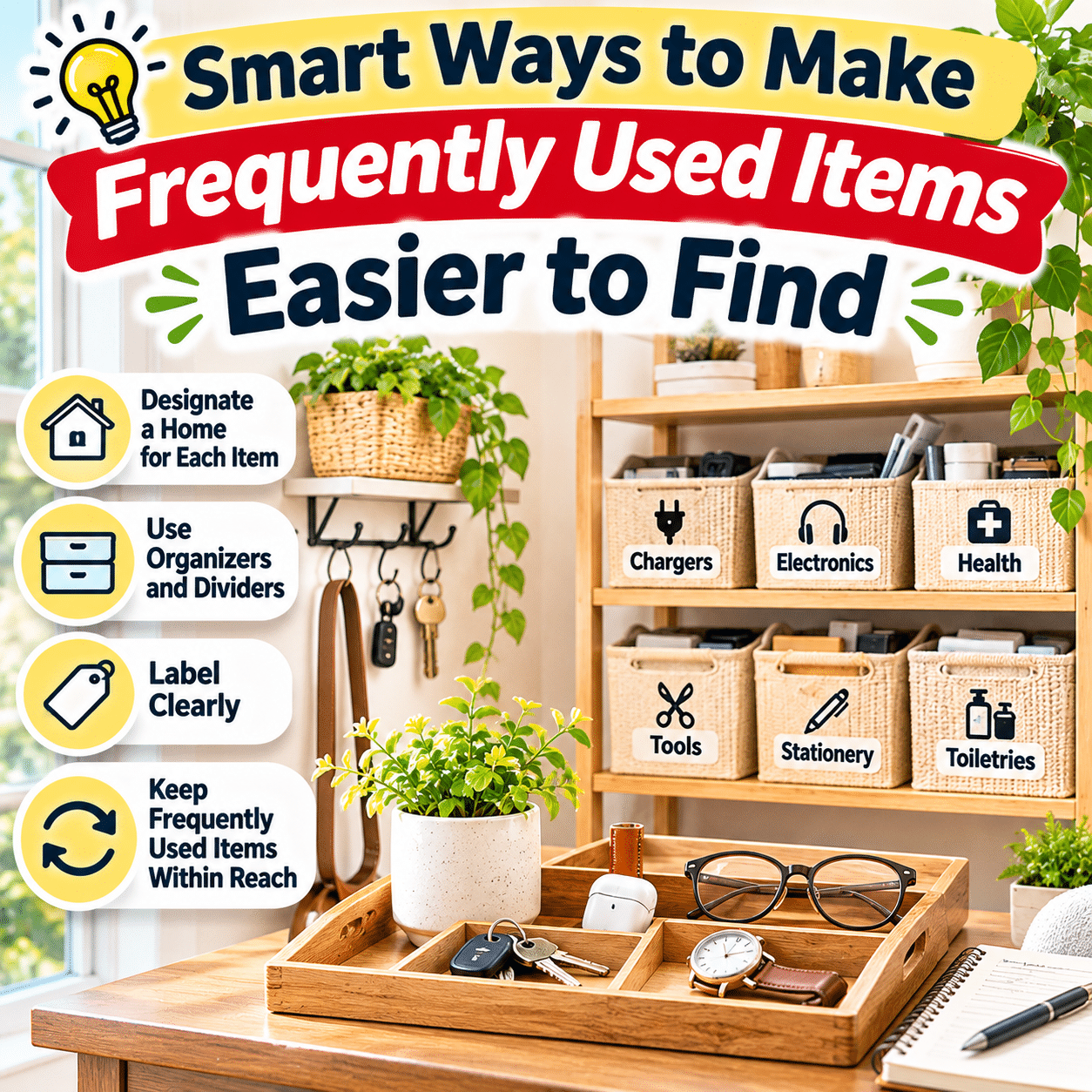
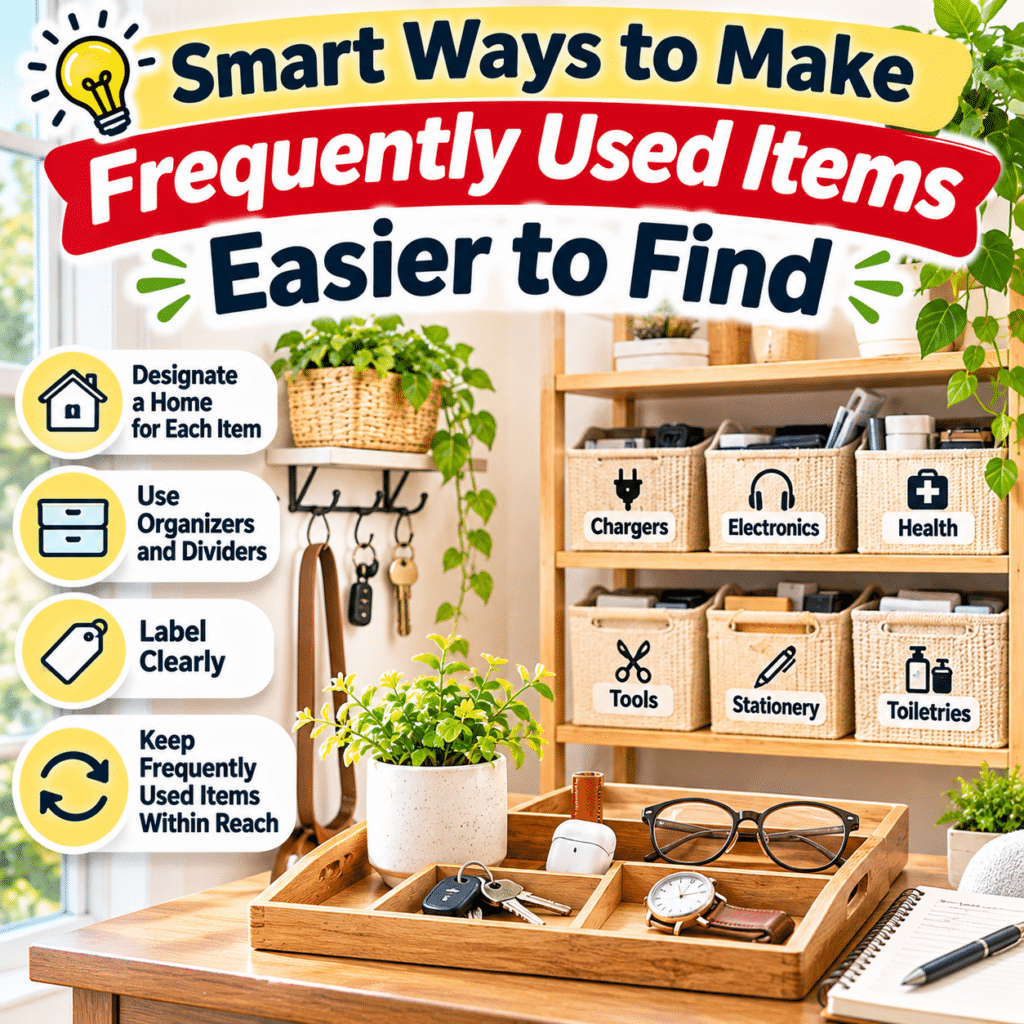
3. Give Every Frequently Used Item a Designated Home
A designated home is a consistent location where an item belongs when it is not being used.
Choose Intuitive Locations
Store belongings near the activities they support.
For example:
- Keys near the main entryway.
- Cooking utensils near food preparation areas.
- Charging accessories near regular charging locations.
- Writing supplies near desks.
- Cleaning cloths near appropriate cleaning stations.
Avoid Complicated Storage Rules
A system that requires opening several cabinets or moving unrelated objects is unlikely to remain convenient.
Make Returning Items Easy
Ideally, putting something away should be just as simple as leaving it on a nearby surface.
Keep Locations Consistent
Changing storage locations repeatedly makes it harder to develop reliable habits.
Review When Necessary
If an item consistently ends up somewhere other than its designated location, consider whether the storage arrangement should change.
4. Organize Items Around Everyday Activities
Activity-based organization often works better than grouping everything strictly by product type.
Create Functional Zones
A functional zone is an area where related belongings are stored close to the activity in which they are used.
Examples include:
- Entryway essentials zone.
- Coffee preparation zone.
- Home office zone.
- Personal care zone.
- Household maintenance zone.
- Travel preparation zone.
Keep Related Items Together
For example, a simple coffee preparation area might contain:
- Coffee-making accessories.
- Measuring tools.
- Filters.
- Frequently used cups.
- Cleaning supplies appropriate for the equipment.
Avoid Unnecessary Duplication
Creating functional zones does not mean every room needs its own complete collection of supplies.
Duplicate items only when they serve a genuine purpose.
Keep Zones Flexible
Some activities overlap.
Choose storage locations that support the most common routine.
5. Create an Entryway Station for Everyday Essentials
The entryway is one of the most useful locations for organizing frequently carried belongings.
Establish a Key Location
Use a suitable tray, hook, or small organizer.
Choose a place that is easy to access when entering or leaving home.
Organize Small Personal Items
Depending on your routine, an entryway station may hold:
- Keys.
- Wallet.
- Sunglasses.
- Reusable shopping bags.
- Small accessories.
- Items needed for the next outing.
Avoid Overcrowding
An entryway organizer should not become a general storage area for unrelated belongings.
Consider Security
Avoid placing valuables or sensitive information where they are visible or accessible to unauthorized visitors.
Build a Return Habit
Place essentials in their designated locations immediately after arriving home.
This can reduce last-minute searching before future departures.
6. Use Small Trays to Contain Frequently Used Objects
Small trays are useful for items that tend to accumulate on countertops, desks, and bedside tables.
Choose Appropriate Locations
Potential places include:
- Entryway consoles.
- Bedside tables.
- Home office desks.
- Dressers.
- Living room side tables.
Group Similar Items
A tray might hold a watch, eyeglasses case, and a few personal accessories.
Avoid Turning Trays Into Clutter Collections
A tray is helpful only when its contents remain manageable.
Choose Easy-to-Clean Materials
Select surfaces suitable for the location and type of belongings.
Keep Important Items Visible
An open tray can make everyday objects easier to recognize without opening drawers.
7. Organize Drawers With Practical Dividers
Drawers can become difficult to use when small items are mixed together.
Start by Emptying the Drawer
Remove everything and group belongings by purpose.
Identify Frequently Used Items
Return the most important objects to the easiest-to-reach sections.
Use Dividers When Helpful
Dividers can separate:
- Writing supplies.
- Charging accessories.
- Small tools.
- Personal accessories.
- Kitchen utensils.
- Household maintenance items.
Avoid Excessive Compartmentalization
Too many tiny sections may make storage less flexible.
Leave Some Open Space
A drawer packed tightly from edge to edge can be difficult to maintain.
Allow enough room to retrieve and replace items comfortably.
8. Use Clear Containers to Improve Visibility
Transparent containers can make stored items easier to identify.
Choose Suitable Items for Clear Storage
Clear containers are often useful for:
- Craft supplies.
- Small household accessories.
- Office supplies.
- Sewing materials.
- Spare cables.
- Frequently used hobby tools.
Avoid Overfilling
Visibility becomes less useful when containers are crowded.
Choose Secure Closures When Necessary
Small components may need lids to prevent spills.
Consider Privacy
Sensitive documents, medications, and personal valuables may be better stored in secure, opaque containers.
Keep Containers Consistent
Using a manageable number of compatible sizes can simplify stacking and storage.
9. Label Storage Locations Clearly
Labels reduce the need to remember where everything belongs.
Use Simple Category Names
Examples include:
- Chargers.
- Batteries.
- Writing Supplies.
- Cleaning Cloths.
- Small Tools.
- Travel Accessories.
- Sewing Supplies.
Keep Labels Specific Enough to Help
A label such as “Miscellaneous” provides little guidance.
A more descriptive label makes contents easier to identify.
Avoid Excessive Detail
Long labels may become difficult to read.
Update Labels When Storage Changes
An outdated label can create confusion.
Combine Labels With Logical Placement
Labels are most effective when the storage location already makes sense.
10. Keep Frequently Used Items at Comfortable Heights
Accessibility is influenced by more than distance.
The height and physical arrangement of storage also matter.
Prioritize Easy-to-Reach Areas
Store frequently used items where they can be retrieved without unnecessary bending, stretching, or climbing.
Reserve Higher Shelves for Less Frequent Items
Lightweight, occasional-use belongings may be suitable for higher storage, provided the shelves are secure.
Avoid Heavy Items Overhead
Heavy objects should not be stored where they could fall or require unsafe lifting.
Consider Household Accessibility Needs
Children, older adults, and people with mobility limitations may require different storage arrangements.
Reduce Physical Obstacles
Avoid placing frequently used items behind stacks of unrelated belongings.
11. Make Kitchen Essentials Easier to Find
Kitchens contain many objects that are used repeatedly throughout the day.
Organize by Cooking Activity
Keep preparation tools near preparation areas.
Examples include:
- Measuring spoons near baking supplies.
- Spatulas near cooking areas.
- Food storage containers near their usual preparation or cleanup locations.
Keep Everyday Utensils Accessible
Frequently used tools should not be buried beneath specialty equipment.
Use Drawer Organizers
Separate utensils by function and size.
Avoid Overcrowding Countertops
Too many visible accessories can make surfaces difficult to clean.
Keep Safety in Mind
Sharp utensils, hot equipment, and cleaning chemicals require appropriate storage.
Convenience should never compromise household safety.
12. Organize Bathroom and Personal Care Essentials
Bathrooms often contain small products that become difficult to locate when storage is crowded.
Group Products by Purpose
Possible categories include:
- Dental care.
- Hair care.
- Skincare.
- Grooming accessories.
- Daily hygiene essentials.
Keep Everyday Products Accessible
Frequently used items can be stored in a suitable drawer, cabinet, or organizer near the sink.
Separate Backup Supplies
Extra products may be stored in secondary locations rather than crowding daily-use areas.
Protect Items From Moisture
Bathrooms can experience high humidity.
Store products according to manufacturer instructions and keep moisture-sensitive items appropriately protected.
Keep Hazardous Products Secure
Medications, sharp grooming tools, and chemicals should be stored safely, particularly in homes with children or pets.
13. Keep Home Office Supplies Within Reach
A functional workspace benefits from predictable storage.
Identify Daily Desk Essentials
These may include:
- Pens.
- Notebook.
- Charging cable.
- Headphones.
- Computer accessories.
- Frequently referenced documents.
Create a Small Desk Essentials Zone
Keep the most-used supplies within comfortable reach.
Store Less Frequent Items Separately
Spare cables, extra stationery, and occasional-use equipment can be placed in drawers or cabinets.
Manage Cables
Use appropriate cable organizers to reduce tangling.
Avoid damaging cables through excessive bending or tight fastening.
Maintain Clear Working Space
Leave enough room for the primary tasks performed at the desk.
14. Create Convenient Charging Stations
Charging accessories frequently go missing because they are moved between rooms.
Identify Regular Charging Locations
Common locations include:
- Bedroom.
- Home office.
- Living room.
- Entryway.
Use Dedicated Charging Accessories
Where practical, keep compatible charging equipment at the locations where it is regularly needed.
Prevent Cable Tangling
Use suitable cable clips or organizers.
Avoid Unsafe Charging Arrangements
Do not cover charging devices with bedding or place them near water.
Use equipment appropriate for the device and follow manufacturer instructions.
Inspect Accessories Regularly
Replace damaged chargers and cables.
A charging station should be both convenient and safe.
15. Keep Remote Controls and Small Electronics Organized
Remote controls and compact electronics often move between seating areas.
Choose a Consistent Storage Location
A small tray or organizer near the primary seating area can help.
Avoid Storing Remotes Beneath Cushions
Objects may become difficult to locate or accidentally damaged.
Group Related Accessories
Keep remote controls, suitable charging accessories, and related devices in one predictable area.
Check Battery Compartments
Inspect devices periodically for damage or battery leakage.
Avoid Unnecessary Clutter
Remove obsolete accessories that are no longer used.
16. Organize Small Household Tools
Basic household tools are useful only when they can be located quickly.
Create a Dedicated Tool Area
Store commonly used items such as:
- Screwdrivers.
- Measuring tape.
- Flashlight.
- Appropriate scissors.
- Small repair accessories.
Separate Sharp Tools
Use protective storage where necessary.
Keep Components Together
Store related bits, fasteners, and accessories in suitable containers.
Avoid Mixing Tools With Unrelated Objects
A general-purpose drawer may become difficult to search when tools are mixed with stationery and household clutter.
Prioritize Safety
Keep sharp tools, batteries, and hazardous accessories away from children and pets.
17. Use Portable Organizers for Items Used in Multiple Rooms
Some belongings are regularly needed in different parts of the home.
Identify Mobile Essentials
Examples may include:
- Craft supplies.
- Cleaning accessories.
- Personal care tools.
- Hobby materials.
- Small household maintenance items.
Use a Portable Caddy
A suitable caddy can keep related items together while allowing them to move between rooms.
Choose a Stable Design
Containers should be easy to carry and appropriate for their contents.
Return the Caddy After Use
Portable organization works best when the entire container has a designated storage location.
Keep Hazardous Items Secure
Cleaning chemicals and sharp tools should not be left unattended in accessible portable containers.
18. Reduce Duplicate Items That Create Confusion
Keeping several copies of an item can sometimes improve convenience, but excessive duplication may create clutter.
Identify Useful Duplicates
For example, a charging cable in both the bedroom and home office may be practical.
Identify Unnecessary Duplicates
Multiple unused adapters, pens, or household tools may make storage harder to manage.
Keep Backup Supplies Separate
Store spare items in a clearly identified location.
Review Before Purchasing More
Check existing supplies before buying replacements.
Focus on Function
The goal is not to eliminate every duplicate but to keep a manageable number that supports everyday routines.
19. Use Visibility to Reduce Searching
Objects are easier to locate when their storage makes them recognizable.
Avoid Deep, Overfilled Containers
Items at the bottom can become hidden.
Use Shallow Storage When Appropriate
Shallow trays and drawers make contents easier to scan.
Arrange Items Upright
Some belongings, such as files or notebooks, may be easier to identify when stored vertically.
Use Contrasting Containers
A light-colored organizer may make dark accessories more visible, while a darker container may help distinguish pale objects.
Keep Labels Facing Forward
Consistent orientation reduces searching.
20. Make Storage Systems Work in Small Homes
Limited space requires careful prioritization.
Use Existing Storage Efficiently
Before adding furniture, evaluate drawers, cabinets, and shelves already available.
Choose Compact Organizers
Small trays, dividers, and suitable containers may improve organization without consuming additional floor space.
Use Vertical Storage Carefully
Wall-mounted shelves and hooks can free up surfaces when properly installed.
Avoid Blocking Walkways
Convenient storage should not create tripping hazards.
Prioritize Frequently Used Items
The most accessible spaces should be reserved for belongings used regularly.
Keep the System Simple
A small home benefits from clear categories and minimal unnecessary storage equipment.
21. Build a Consistent Return-to-Place Habit
Even an excellent storage system becomes ineffective when items are not returned after use.
Make Returning Items Convenient
Choose storage locations that require little effort.
Connect the Habit to Existing Routines
For example:
- Put keys away immediately after entering.
- Return remote controls after watching television.
- Place pens back after finishing work.
- Return tools after completing a repair.
Avoid Waiting for Major Cleanup Sessions
Small, immediate actions can prevent clutter from accumulating.
Adjust Systems That Are Frequently Ignored
If an item repeatedly ends up somewhere else, reconsider the designated storage location.
Encourage Shared Consistency
In households with multiple people, use simple systems everyone can understand.
22. Common Mistakes That Make Everyday Items Harder to Find
Mistake 1: Storing Frequently Used Items Too Far Away
Inconvenient storage encourages items to be left elsewhere.
Better approach: Keep essentials near their usual point of use.
Mistake 2: Using Too Many Storage Containers
Excessive containers can create confusion.
Better approach: Choose a manageable number of practical organizers.
Mistake 3: Mixing Unrelated Items
Searching becomes difficult when categories are unclear.
Better approach: Group belongings by purpose or activity.
Mistake 4: Overfilling Drawers
Crowded drawers make items difficult to retrieve.
Better approach: Remove unnecessary objects and leave usable space.
Mistake 5: Constantly Changing Storage Locations
Inconsistent placement makes habits difficult to establish.
Better approach: Maintain predictable storage locations.
Mistake 6: Using Vague Labels
Labels such as “Stuff” or “Other” provide limited guidance.
Better approach: Use clear, descriptive categories.
Mistake 7: Keeping Too Many Duplicates
Excess items can overwhelm convenient storage areas.
Better approach: Retain duplicates only when they serve a practical purpose.
Mistake 8: Ignoring Safety
Convenient storage may expose children or pets to hazardous objects.
Better approach: Balance accessibility with secure storage.
Mistake 9: Creating Complicated Organization Rules
Systems that require too many steps are difficult to maintain.
Better approach: Make storage intuitive and easy to use.
Mistake 10: Failing to Review Changing Needs
Storage arrangements may become outdated.
Better approach: Reassess frequently used items and their locations periodically.
23. Troubleshooting Common Household Item Organization Problems
| Problem | Possible Cause | Practical Solution |
|---|---|---|
| Keys frequently go missing | No consistent entryway location | Use a designated key tray or hook |
| Charging cables are difficult to find | Cables move between rooms | Establish charging stations or a cable organizer |
| Drawers are difficult to search | Mixed categories and overcrowding | Use dividers and remove unnecessary items |
| Remote controls disappear | No designated seating-area storage | Use a small remote organizer |
| Kitchen utensils are hard to locate | Poor activity-based organization | Store tools near their usual point of use |
| Small tools are scattered | No dedicated tool storage | Create a compact tool station |
| Bathroom products become mixed together | Unclear categories | Group products by daily routine |
| Desk accessories cover the workspace | Insufficient nearby storage | Use a small desk essentials zone |
| Storage containers overflow | Excess belongings or poor sizing | Review contents and adjust capacity |
| Items are not returned after use | Storage is inconvenient | Move storage closer to the activity |
| Family members cannot find supplies | Inconsistent organization | Use simple labels and shared locations |
| Small belongings disappear in deep cabinets | Poor visibility | Use shallow organizers or accessible containers |
The most effective troubleshooting approach is to identify why an item repeatedly becomes difficult to locate and change the underlying storage arrangement.
24. Create a Practical Everyday Organization Checklist
A simple checklist can help maintain a reliable system.
Initial Setup
- Identify frequently used household items.
- Group belongings by activity or purpose.
- Choose logical storage locations.
- Remove unnecessary duplicates.
- Select suitable organizers.
- Label storage areas when helpful.
- Keep hazardous items securely stored.
- Confirm that essentials are easy to retrieve.
Daily Tasks
- Return keys to their designated location.
- Put charging accessories away after use.
- Return remote controls to their storage area.
- Place writing supplies back after work.
- Return household tools after use.
- Keep frequently used surfaces manageable.
- Check that walkways remain clear.
Weekly Tasks
- Review frequently used drawers.
- Return misplaced items.
- Remove unnecessary clutter.
- Wipe trays and organizers.
- Check commonly used accessories for damage.
- Reorganize areas that have become difficult to use.
Periodic Tasks
- Review changes in daily routines.
- Reassess storage locations.
- Identify unnecessary duplicates.
- Update labels.
- Evaluate organizer capacity.
- Adjust accessibility for household needs.
- Replace damaged storage accessories.
The goal is not constant cleaning or perfect arrangement. It is maintaining a practical system that remains easy to use.
25. Frequently Asked Questions About Finding Everyday Items
1. What is the easiest way to keep frequently used items organized?
Give each item a consistent storage location near where it is normally used, and return it there after use.
2. How can I stop losing my keys at home?
Create a designated key location near the entryway and make returning keys part of your arrival routine.
3. Why do I keep misplacing everyday objects?
Common reasons include inconsistent storage locations, cluttered surfaces, frequent movement between rooms, and inconvenient organization systems.
4. Should frequently used items be stored in plain sight?
Visible storage can improve accessibility, but it should be balanced with safety, privacy, and the need to maintain clear surfaces.
5. Are drawer organizers worth using?
Drawer organizers can make small items easier to separate and locate when they are appropriately sized and not overfilled.
6. What is the best way to organize small household items?
Group them by function, use suitable containers, and assign clear storage locations.
7. How do I organize frequently used items in a small apartment?
Prioritize accessible storage, use compact organizers, and avoid keeping unnecessary duplicates.
8. Should I label every storage container?
No. Labels are most useful when contents are not immediately visible or when several people share the same storage system.
9. How can I make kitchen utensils easier to find?
Store frequently used utensils near their primary cooking or preparation areas and separate them from occasional-use tools.
10. What is the best way to organize charging cables?
Use dedicated charging locations, suitable cable organizers, and clearly separated storage for spare accessories.
11. How can I keep remote controls from disappearing?
Use a small tray or remote organizer near the primary seating area.
12. Should I keep duplicate items in different rooms?
Duplicates can be practical when they reduce unnecessary movement, but excessive copies may create clutter.
13. How do I organize a drawer full of miscellaneous items?
Empty the drawer, sort belongings by purpose, remove unnecessary items, and use simple dividers or small containers.
14. Are clear containers better than opaque containers?
Clear containers improve visibility, while opaque containers may be preferable for privacy or visual simplicity. Both can work.
15. How can I keep my desk essentials organized?
Create a small workspace zone for frequently used supplies and store backups separately.
16. Where should I store frequently used household tools?
Choose a secure, accessible location near common maintenance activities while keeping sharp or hazardous items protected.
17. How can I organize bathroom essentials without clutter?
Group daily products by routine, use suitable drawer organizers, and store backup supplies separately.
18. What should I do when items keep ending up in the wrong place?
Observe where they naturally accumulate and consider moving their designated storage location closer to that area.
19. How can I make storage easier for older adults?
Prioritize comfortable reach heights, clear visibility, stable containers, and storage arrangements that minimize bending or stretching.
20. How do I keep frequently used items organized with children?
Use age-appropriate storage, simple categories, and clear labels while securing hazardous objects.
21. Is open storage better for everyday essentials?
Open storage can improve accessibility, but closed storage may offer better protection from dust, moisture, pets, or unauthorized access.
22. How often should I reorganize frequently used items?
Review storage when routines change or when the current system becomes inconvenient. Constant reorganization is usually unnecessary.
23. Can organizing everyday items save time?
A consistent organization system can reduce unnecessary searching and make routine tasks more efficient.
24. How can I prevent storage trays from becoming cluttered?
Limit each tray to a clear purpose and remove unrelated items regularly.
25. What is the most important habit for keeping items easy to find?
Returning belongings to consistent, designated locations immediately after use is one of the most effective habits.
26. Build a Long-Term System That Keeps Everyday Items Accessible
A successful organization system should remain useful without requiring constant attention.
Prioritize Real-Life Convenience
Store belongings according to how they are actually used.
Keep Categories Simple
Avoid excessive sorting rules that make storage harder to maintain.
Make Returning Items Effortless
Choose locations that are easy to reach and remember.
Maintain Clear Visibility
Use suitable containers, labels, and drawer layouts.
Balance Accessibility With Safety
Hazardous items, sensitive documents, and valuables may require secure storage even when used regularly.
Review Storage Periodically
Adjust arrangements when routines, household members, or accessibility needs change.
Avoid Unnecessary Purchases
Improve existing storage before adding more containers or furniture.
Focus on Consistency Rather Than Perfection
A practical system does not require every object to look perfectly arranged.
It simply needs to help people find what they need without unnecessary searching.
Final Thoughts
Making frequently used items easier to find is one of the most practical ways to simplify everyday life.
Keys, chargers, kitchen utensils, personal accessories, and household tools may be small, but searching for them repeatedly can interrupt routines and create avoidable frustration.
The most effective solutions are often surprisingly simple: give belongings consistent homes, store them near where they are used, organize related items together, and make returning them easy.
Small trays, drawer dividers, clear containers, labels, and activity-based storage zones can improve accessibility without requiring a major home makeover.
Just as importantly, organization should adapt to the people using the space. A system that works naturally with daily habits is more likely to remain useful than one built around complicated rules or perfect appearances.
By creating thoughtful storage locations and maintaining a few consistent habits, you can spend less time searching for everyday essentials and more time focusing on the activities that matter.
A well-organized home is not necessarily one where everything is hidden away. It is one where the things you use most often are easy to find, comfortable to access, and simple to put back.